Showing posts with label Festival. Show all posts

Friday, 7 August 2026

Malaysian real book

I haven't attended a George Town Festival programme in years. When was the last time? I can't remember, but it was definitely before Covid-19. Funny how we've started classifying events as "pre-Covid" and "post-Covid", almost as though history has been split into two distinct eras. Anyway, I remember my last George Town Festival outing. It was to the old Soonstead mansion in Northam Road for 2 Houses, a play that required the audience to move between two neighbouring buildings. The houses themselves became part of the performance, blurring the line between theatre and reality.

This year, it wasn't a play that brought me back. Instead, it was a concert called The Malaysian Real Book II: Past to Present, part of this year's George Town Festival. To be honest, I had never even heard of The Malaysian Real Book. Apparently, the inaugural concert had been staged last year and was successful enough to earn an encore. It had completely passed me by.

My invitation came from an unexpected source. See Ming, a dear ex-JobStreet colleague from Kuala Lumpur, had planned to meet me on the fourth of August while she was in Penang. Unfortunately, I already had another engagement. Rather than abandon the idea altogether, she surprised me by buying a ticket for the following evening's performance before flying off on her own travels. It was one of those small acts of kindness that catches you by surprise.

So on the fifth, I found myself stepping into the Majestic Theatre in Khoo Sian Ewe Road, a venue I had not stepped into since 2019. Instinctively, I looked for a strategic position. The front rows were all occupied by the well-connected, but the back row suited me perfectly. Only three seats made up my row, mine and those of an elderly Caucasian couple sitting beside me. Little did I know they would become part of my evening's entertainment.

The concert itself was unlike the jazz performances most people would probably expect. There were no familiar American standards, no Gershwin, no Duke Ellington, no Fly Me to the Moon. Instead, this was unapologetically Malaysian.

The three featured vocalists, Janet Lee, Ida Mariana and Yon Lynn, explored a repertoire that drew on the country's multicultural musical traditions. Some songs were well known, others completely unknown to me, but all had been lovingly reimagined through the language of jazz. Backing them was the WVC Jazz Quintet under the direction of Tay Cher Siang, whose musicians seemed equally at home accompanying a gentle ballad, a lively Hokkien number or an energetic jazz improvisation. Keeping the evening flowing were Gareth Richards and Melina, who introduced the songs with warmth and humour without ever overstaying their welcome. 

As I listened, I occasionally glanced sideways at my Caucasian neighbours. Their expressions became increasingly difficult to read. It wasn't that the music lacked quality. Far from it. The problem, I suspect, was that the concert demanded a familiarity with Malaysian culture that overseas visitors simply could not be expected to possess.

When the singers launched into Malay classics, Penang Hokkien songs and Mandarin compositions, much of the audience responded with smiles of recognition. Heads nodded. Feet tapped. Some quietly sang along. The couple beside me sat politely through it all. And after about an hour, they quietly stood up and left. They never came back. I almost felt sorry for them because they had missed the second half, which I thought was even more enjoyable than the first.

The programme wandered effortlessly across Malaysia's musical landscape. There were songs by P Ramlee, instrumental compositions by contemporary Malaysian jazz musicians, a charming Penang Hokkien bossa number, Chinese melodies with unmistakable Nanyang flavours and, towards the end, Francisca Peter's Setia, which had much of the audience singing along. This was jazz wearing a Malaysian passport. The melodies, languages and stories belonged unmistakably to us.

Too often, when we speak about preserving our heritage, we think only of old buildings, temples, clan houses or food. Rarely do we include music in that conversation. Yet Malaysian music is every bit as much a part of our cultural identity. Projects like The Malaysian Real Book remind us that our musical heritage deserves to be documented, celebrated and performed, not simply archived away as memories of another generation.

When the concert finally ended after the encore, the audience were already on their feet in enthusiastic applause. Many had spent the evening clapping along. A few even danced. It was obvious this wasn't merely another jazz concert. It was a celebration of who we are.

As I walked out into the warm Penang night, I couldn't help looking back at the brightly lit Majestic Theatre. I found myself thinking that perhaps See Ming had done me a favour without even realising it. Had she not bought that ticket, I would probably have stayed home and remained blissfully unaware that such a remarkable project existed.

Sometimes all it takes is one thoughtful friend to nudge us out of our routines and remind us that there is still plenty happening around us. And perhaps that's the greatest gift George Town Festival continues to offer after all these years: the chance to discover, in our own backyard, something I never knew I was missing.


Tuesday, 7 April 2026

A time of remembrance

Cheng Beng (清明) is over for us this year. We finished it last week, spread over two visits. The first was on Monday at Sungai Lembu on the mainland, the second on Friday on the island. The mainland trip was for my father-in-law, who died four years ago. That Nirvana site, I must say, is very well kept. Clean, orderly, almost too neat in a way. There were attendants arranging tables, making sure everything was in place. Very convenient.

A few days later we went to the older graves, my two sets of grandparents at Batu Lanchang and Wat Pimbang On. These are out in the open, exposed to sun and rain, so timing mattered a lot. There was a time we used to leave at six in the morning, reaching Batu Lanchang around 6.45am, the cemetery cloaked in darkness but other people were already out and about to perform their own Cheng Beng obligations. In the past decade we eased that a bit, leaving at 6.30am and arriving around 7.15am, just as the sun nudged above the trees. This year we went even later. Left the house at seven, got there about 7.45am. The morning helped us out: a bit overcast, so the heat didn’t come down too hard.

From Batu Lanchang we crossed over to Wat Pimbang On, a Siamese cemetery that looked more chaotic and less organised. Somehow, I felt that many people have already abandoned the place. Untidy and unkempt with overgrown grass, vegetation all around. Even under the canopy of trees, we could feel the day catching up with us. The sun's rays were cutting through the humidity. After that, our final stop was the Triple Wisdom Temple, where we paid respects to the memorial tablets of my parents and aunt. A quieter ending, it was indoors but no less meaningful.

I remember as a child in the late 1950s or early 1960s, when we were still living at Seang Tek Road, Cheng Beng meant booking a trishaw pedlar from down the road to take my grandmother, my mother and me to the Batu Gantong cemetery. At six o’clock sharp, the trishaw would arrive and wait for us. Then came the slow, unhurried ride through York Road and Batu Gantong Road. Along the way we passed huge angsana trees, their small yellow flowers falling constantly around us and carpeting the road. After all these years, I can still remember the cool morning breeze and that feeling of calm and serenity.

Every year going through this Cheng Beng process, I find myself thinking about the alternate name people like to use, Tomb-Sweeping Day. It’s not wrong, but it never quite right either. Yes, we clear the lallang, clean the headstones and tidy up the place. That part is visible and easy to describe. But there's more to Cheng Beng because the sweeping is only incidental. It’s just something that needs to be done before anything else can happen. To call the whole day by that one act feels like missing the point. It turns something that has taken shape over centuries into a simple task, almost like a chore to be checked off.

Cheng Beng itself means “clear and bright”. It began as a marker in the yearly Chinese lunisolar cycle. As far back as the Zhōu Dynasty 周朝 (1046–256 BC), people were already observing the seasons through solar terms, paying attention to the small changes in light, air, growth and renewal. Cheng Beng marked the time when the sky cleared, the air sharpened and the earth began to stir again after the stillness of winter. It wasn’t a festival in the beginning, just a moment in nature.

But alongside that, there was always this deep-rooted practice of remembering those who came before. In the Zhōu world, burial grounds were under official care. Remembering wasn’t optional, it was part of maintaining continuity. By the Warring States period 戰國時代 (475–221 BC), these practices had been adopted by ordinary families. People began visiting graves, bringing offerings, acknowledging that their lives were part of something longer, something that didn’t begin or end with them. By the time of the Táng Dynasty 唐朝 (618–907 AD), with Confucian values firmly in place, filial piety became something the state actively encouraged. Cheng Beng became the natural time for these acts of remembrance.

So when we reduce it to “tomb sweeping”, something feels out of place. The clearing of grass and the washing of stone are just preparations. What's more important are the quieter moments that come after. The offer of food and fruits, the lighting of the joss sticks, calling the names of the forefathers, standing there for a while without saying much but having a quiet conversation with them in the mind, then the burning of paper offerings before leaving. Every time, it feels like we are continuing a process that has always been there.

There’s no festivity in it, and I don’t think there is meant to be. Just a kind of stillness, even when the sun is already up and the day is getting warm. Families gathering, not out of obligation alone but because something in the rhythm of the year brings them back. And in that space, between the living and the remembered, the connection doesn’t feel distant at all.


Thursday, 2 April 2026

Panguni Uthiram festival

On my way to a hospital appointment yesterday morning, I was caught in a heavy traffic congestion that stretched almost a mile long. At first, I thought that there was an accident up ahead but when I rounded a corner, I realised it wasn't. It was an Indian religious festival taking place, every year around this time in Bukit Mertajam. 

Along the road to the hospital, cars were moving bumper-to-bumper, going past temporary stalls and altars. Eventually, I passed by the Shri Maha Mangalanayagi Amman Devasthanam, crowded with devotees mainly wearing yellow. My curiosity was piqued. What an opportunity it would be to visit. But that would have to wait until my appointment was over. 

Leaving the hospital at about 11.15am, I crossed the road only to be stopped in my tracks by the temple chariot being pushed and pulled to the main road. What luck, the procession was about to begin. Only then did I begin to appreciate what I had just stumbled into.

This temple goes way back to 1893. More than a hundred years old, it started off tucked inside a Tamil school, the old Ramanathan Tamil School. In those days, the deity was known as Sungurumbai Mariamman. Over time, as the school moved out, the community grew and the temple grew with it, eventually becoming what it is today, a full-fledged devasthanam. This was quite typical of how early Indian settlers in Malaya did things. They started small, built what they could and slowly over the years, those little shrines became proper temples.

Today, the temple stands along Jalan Kulim, not far from the hospital, with its towering gopuram and all the usual South Indian architectural features. And of course, that chariot I spoke of. Big, imposing, intricately carved, and I was standing just feet away. People say it is one of the largest in this part of the region and seeing it up close, I have no reason to doubt that.

The festival itself, which I had unknowingly walked into, was the Panguni Uthiram, the main event of the year for this temple. Everything had built up to this day. Early in the morning, special prayers would have been conducted. The goddess, Mangalanayagi Amman, would have been dressed in silk sarees, adorned with gold jewellery and fresh flower garlands. By the time I arrived, all that had already been done and the focus had shifted outside.

The chariot was brought out slowly to the road. The deity placed within, and then the long pull began. Devotees took hold of the ropes, inched the whole structure forward along a fixed route through town. Wasn't a fast affair, the procession could take the whole day accompanied by the steady beat of drums and the wail of the nadaswaram.

Along the route, people lined both sides of the road. Makeshift stalls were everywhere, a bit like a moving carnival except that underneath it all, there was a deep sense of devotion. I could see it in the faces of those carrying milk pots on their heads, fulfilling their vows. Others carried the kavadi, walking barefoot under the hot sun. These are personal acts of devotion, fulfilling promises made and now being honoured.

What struck me most was how the whole town seemed to adjust itself around the procession. Traffic slowed to a crawl, people waited patiently, nobody really complaining. Everyone knew what was happening. This wasn’t an interruption. It was part of life here.

The first thing I noticed on entering the temple was the dwajasthambam standing tall in front of the main sanctum that housed the Goddess Mangalanayagi Amman. But since the statue had been taken out for the procession, only the priests remained. Devotees continued lining up to pray before the sanctum, and the priests kept passing containers of cow’s milk inside. At the side of the sanctum, the emptied milk flowed out through an opening in the wall. 

In the multi-purpose hall next to the temple, free food was being served. I was curious to see what was on offer and suddenly, an empty plate was thrust into my hand. A holy man urged me to join the queue, and I came away with a plate of Indian vegetarian rice that never tasted more delicious.

All these sights, sounds, smells and tastes at the temple. To think that I had almost dismissed them as just another traffic jam.


Friday, 16 January 2026

The sun

On one hand, there is Pongal. On the other, there is Lì Chūn (立春), or Jip Chūn as we Penang Hokkien folk call it. Two festivals from different cultures, thousands of miles apart, yet bound by the same denominator: the Sun. Let me elaborate.

Every year without fail, the Sun traces the same invisible journey across the sky. It never rushes, never hesitates. It advances by roughly one degree a day, completing its 360-degree journey in a little over 365 days. Long before calendars, clocks or even written history, farmers in India and China learned independently to read this slow walk of light. Out of that observation were born Pongal and Li Chun.

In the Tamil world, the crucial moment for Pongal comes when the Sun reaches a particular point in its yearly path, one that later Indian astronomy would call Makara Saṅkrānti, coinciding with the Sun’s entry into the zodiac segment known as Capricorn. It almost always falls on the 14th of January, though in 2026 it occurs on the 15th. That is why Pongal is so steady on the calendar while most other Indian festivals drift with the Moon. Pongal does not wait for a lunar phase. It looks straight at the Sun.

For people whose lives were shaped by the soil, this marked the turning point of winter. The Sun, which had been sinking lower in the sky since June, reached its lowest point at the December solstice. By Makara Saṅkrānti, it had already gathered enough strength to begin its northward climb. The days would lengthen. The earth would stir. And so the milk was boiled, the rice sweetened and the Sun thanked for returning.

China mapped the same solar journey, but instead of zodiac signs it divided the circle into 24 equal segments, each fifteen degrees wide, known as the solar terms. They are not festivals in the modern sense but seasonal markers with names such as Lesser Cold, Greater Cold, Coming of Spring, Rain Water, Awakening of Worms and et cetera.

When Pongal arrives in mid-January, the Chinese calendar is passing from the Lesser Cold (小寒) solar term to the Greater Cold (大寒). The deepest chill of winter usually comes around the 20th of January. While the Tamil farmer senses the Sun turning homeward, the Chinese farmer feels winter tightening its grip. They are reading the same sky, only from different angles.

Forty-five solar degrees later, the Sun reaches 315 degrees. The Chinese name for this moment is Li Chun, the Coming of Spring. It usually falls around the fourth of February, when frost may still linger in northern China. Yet in Chinese metaphysics, this is the true start of the new year. A child born before Li Chun belongs to the old zodiac animal even if Chinese New Year has already been celebrated. The Moon may start the festivities, but it is the Sun that shifts destiny.

Seen together, the story becomes seamless. After the solstice, the Sun begins its slow return northward. Around the 14th of January, Tamil homes boil rice in new pots and cry out “Pongal, Pongal!” Around the 20th, Chinese almanacs mark the depth of winter. And around the fourth of February, it's Li Chun. Spring has begun, not in temperature, but in truth.

Pongal does not correspond to Chinese New Year. It corresponds to the Sun itself, just as Li Chun does. They are not parallel festivals but points along the same solar year, fixed by the geometry of the heavens. What appears to be cultural difference is really perspective: the Tamils give thanks for the Sun’s return while the Chinese declare that spring has begun.

Every January and February, unnoticed by most of us, the Sun retells this story of celestial degrees — 270°, 300° and 315° — and two civilisations, thousands of miles apart, continue to mark its passage in their own way.


Thursday, 15 January 2026

Commemorating Pongal

Today's Pongal, which is a Tamil harvest festival rooted in gratitude, renewal and the intimate relationship between human life and nature. Celebrated each year in mid-January, it marks the end of the agricultural cycle and gives thanks to the Sun, the land, cattle and the labour that sustains daily life. While it has long been observed within Tamil communities, its presence and visibility in Penang have grown steadily over the past two decades, becoming part of the island’s wider cultural landscape.

Historically, Pongal is no recent invention. References to the festival appear in Chola-period inscriptions, including a land grant recorded during the reign of Kulottunga I in the 11th century, as well as in devotional Tamil literature such as Tiruvempavai. Even the dish itself of rice cooked with milk and sweetened with jaggery until it boils over has evolved across centuries, appearing in temple offerings and royal kitchens long before it became a household ritual. The word “pongal” means “to boil over”, a symbolic gesture of abundance and prosperity.

The festival unfolds over four days. Bhogi marks the discarding of the old, both literally and symbolically, with homes cleaned and unwanted items burned to welcome renewal. The second day, Thai Pongal or Surya Pongal, is the heart of the celebration. Freshly harvested rice is cooked in a clay pot at sunrise, often outdoors, until it spills over. The offering is first made to the Sun God, acknowledging his role in sustaining life. Mattu Pongal follows, honouring cattle for their role in agriculture, and the festival concludes with Kanum Pongal, a day of visits, picnics and communal gatherings.

In Penang, Pongal was once largely observed within temples and family compounds. My own first encounter with a public Pongal celebration was in Glugor, about a year after George Town received UNESCO World Heritage recognition. At the time, it felt modest and local, rooted firmly in the neighbourhood. Since then, the festival’s profile has grown noticeably. Over the past 20 years, public Pongal events have become more visible, supported by temples, community groups and state bodies. Kolam designs now spill onto pavements, ceremonial cooking takes place in open spaces and celebrations increasingly draw curious onlookers from outside the Tamil community.

This growing awareness mirrors Penang’s broader embrace of cultural heritage. Just as Chinese clan houses and Malay traditions are publicly celebrated, Pongal has found space to be seen, explained and appreciated. It remains, at its core, a festival of thanksgiving and humility, but in Penang today it also stands as a reminder that shared rituals, when allowed to be visible, enrich the life of the city as a whole.


Sunday, 10 August 2025

Totsu-totsu

I first came across the totsu-totsu dance several years ago quite by chance when I attended a workshop organised by Dr Cecilia Chan at the Bagan Specialist Centre in Butterworth. I remember being intrigued not just by the gentle rhythm of the movements but also by the man leading it. He was a genial Japanese gentleman named Osamu Jareo, whose warmth seemed to fill the room.

The totsu-totsu dance isn’t a performance in the theatrical sense; it’s more like a quiet conversation between body and mind. The movements slow and deliberate, feet tapping, simple arm gestures that sweep through the air like you’re brushing away clouds, using simple props like stools. There’s a natural sway from side to side, a subtle rocking forward and back, each step paired with steady breathing. No rush, no strain, just an unhurried, slow-motion flow that feels almost like moving through water.


Originating in Japan, the totsu-totsu dance was created as a community-building exercise for seniors, particularly those living with memory decline. Its name, “totsu-totsu,” echoes a Japanese onomatopoeia that suggests a slow, rhythmic tapping much like the heartbeat of the dance itself. In Japan, it’s often taught in eldercare centres and community halls, not only for physical activity but as a way to bring people together in a calm, non-competitive setting.

That day in Butterworth, I didn’t think too much about it beyond the pleasant novelty of seeing an unfamiliar form of movement therapy. But the memory stayed with me.

Fast forward to this year’s George Town Festival 2025, Saw See and I were wandering around the Hin Depot after dinner with See Ming, a friend visiting from Kuala Lumpur, when we stumbled upon a small group in rehearsal. There was that same unhurried rhythm, the same gentle swaying, and it brought back memories of the dance we’d seen in Butterworth. And yes, there was Osamu again, still radiating that same patient energy. We noticed Cecilia practicing her introductory spiel and went up to say hello.

Seeing it again, I realised how well suited the totsu-totsu dance is for dementia therapy. Its repetitive, predictable patterns help stimulate memory recall and give participants a sense of mastery. The slow tempo reduces the risk of falls while still engaging balance and coordination. For caregivers, joining in becomes a shared experience. A rare moment where both can move together without the pressure of achievement, just the comfort of presence. There’s something grounding about it, as though the steady rhythm quiets the mind and makes space for connection.

Perhaps that’s the real gift of the totsu-totsu dance: it’s less about the steps themselves, and more about creating a gentle rhythm that people can immerse themselves into, together.


Sunday, 27 July 2025

The art of endurance

Image from The Star online portal

Huge crowds turned up last night for the annual Novena and Feast at St Anne’s Church, now formally recognised as a Minor Basilica following its elevation some years back. I didn’t join the throng but I had gone a few days earlier when the place was less packed and one could walk around without bumping into anyone.

The celebration spans nine days, culminating on the night of the 26th of July, when thousands of Catholics—and quite possibly not a few non-Catholics too—descend on the church from all over the peninsula. We've heard of road accidents before, but thankfully, none for quite a while already. The aftermath of these few thousand people usually means that the roads, the main road especially, will be filled with garbage from the pilgrims and street vendors alike. 

The open spaces and roadsides would be chock-full of cars. Buses, especially, are a common sight, lined up neatly along the roads. Although the church is only about a kilometre from where I live, luckily my area is mostly spared the traffic jams. Still, the usual disruptions occur: the Traffic Police had cordoned off some roads around the church and rerouted vehicles into the neighbourhood, which caused some minor chaos. But we Malaysians are used to these seasonal disruptions. Every community has its festivals, and we’ve learned to live with them. Grumble a bit about the traffic maybe, but we endure. 

What’s harder to endure, though, is the usual display of Traffic Police incompetence. They had simply blocked off the main road at the traffic lights but didn’t bother to redirect traffic or even show up. They simply left it as is, seemingly adopting a couldn’t-care-less attitude. So for long stretches of time, cars were stopped at a completely empty junction, obeying traffic signals that no longer made sense. The least they could’ve done was to wave cars through the red lights. But no. Nothing of the sort. Just another reminder that in Malaysia, even routine traffic control can be too much to ask.


Monday, 12 May 2025

Wesak Day activities

I did head back to Nandaka Vihara yesterday around nine in the morning with my daughter, thinking we'd spend just about an hour there. But the weather had other plans. The rain came, and we couldn’t get home. So we ended up staying until after the lunch dana. There wasn’t much to photograph yesterday, unfortunately, as we had missed the parrita chanting and pindapata. Everything else was pretty subdued.

I returned again to the meditation centre this morning – the actual Wesak Day public holiday. I had expected the place to be more packed than the day before, but to my surprise, the crowd was a lot thinner than I imagined. It seems that with so many Buddhist centres holding their own Wesak celebrations this year, the crowds have naturally spread themselves out. As a result, Nandaka wasn’t all that busy.

The day’s observances began a little past eight with paritta chanting in the new meditation hall, followed immediately by the pindapata ceremony – largely ceremonial in nature. Devotees formed a line that led from the hall out onto the road, then looped back through the main gate and into the old meditation hall. I managed to capture the procession on video – the YouTube clip at the end of this story gives a good sense of the morning’s atmosphere and activities.


Coincidentally, Khoo Chean Jin and the Penang Urban Sketchers had chosen the Nandaka Vihara as the venue of their latest painting activity on this Wesak Day


Sunday, 11 May 2025

Wesak 2025

It’s an extended Wesak celebration at Nandaka Vihara in Bukit Mertajam this year! The Burmese community is observing Wesak today, even though the actual Wesak Day falls tomorrow. As a happy compromise, the Nandaka Vihara committee decided to stretch the celebrations over two days – today and tomorrow! These photos were taken early this morning, around 6.45am, when I popped in for a quick visit. I’ll be heading back later. Even as preparations for the day’s activities were getting underway, my thoughts drifted to Bhante Neluwe Aranagavesi and the two other Sri Lankan monks who were with us last year for an extended stay but aren’t here this time around. Wherever they are, I send them my warmest wishes for a Happy Wesak. May they be well and happy...


Wednesday, 2 April 2025

Guardian spirits of the land

The story two days ago about our Datuk Kong experience at the Nandaka Vihara got me thinking—how did the Datuk Kong tradition even get started in this part of the world? These Datuk Kong shrines are almost everywhere in Malaysia, from small towns to bustling cities. Possibly in Singapore, Indonesia and southern Thailand too. But where did this guardian spirit come from?

Before I go any further, I should mention that this peculiar local guardian spirit is sometimes called Natok Kong, or even Latok Kong. Why? Because in the old days, Chinese settlers had trouble pronouncing certain Malay words, and Natok Kong or Latok Kong just stuck.

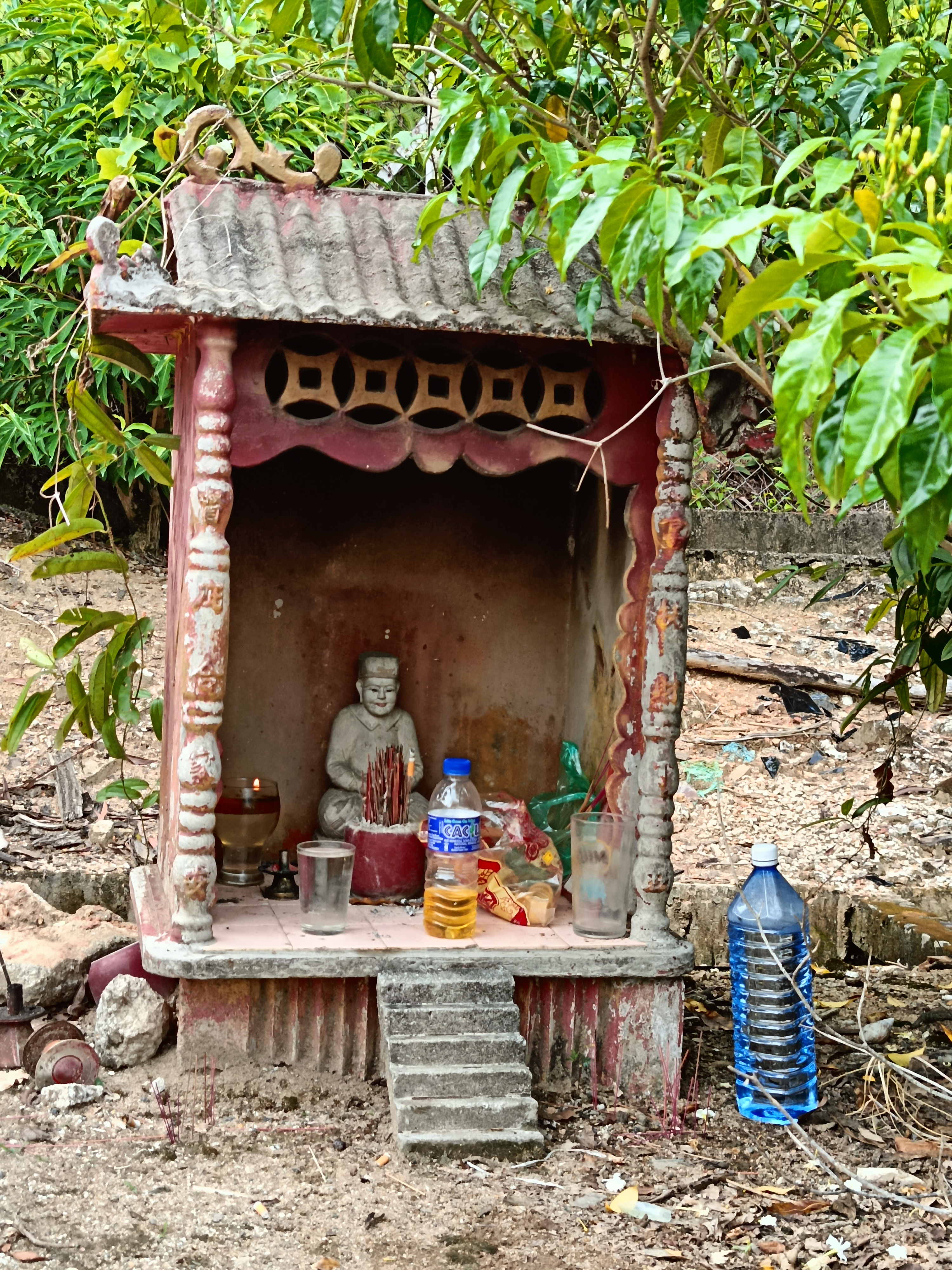
These shrines aren’t grand temples like the ones dedicated to well-known Chinese deities. They’re usually small, tucked into corners, by the roadside, nestled beneath trees or standing quietly outside homes and businesses, some private and some public—especially in areas with large Chinese communities. But even with their modest appearances, they hold immense significance for those who worship there.

The Datuk Kong isn’t just one deity; it’s a general term for guardian spirits believed to watch over specific places. Some say each Datuk Kong was once a real person—an early settler, a respected village elder or a local leader who shaped the land’s history. Others believe these spirits are tied to nature, acting as protectors of the land, trees and hills. Whatever the origins, one thing’s clear: their presence is deeply woven into the lives of the people who revere them.

What makes the worship of Datuk Kong fascinating is how it blends Chinese folk traditions with Malay spiritual beliefs. The name itself—Datuk, a Malay honorific—already hints at this fusion. As Chinese immigrants settled in the Nanyang, they encountered local traditions and incorporated certain elements into their own practices. And so, the Datuk Kong became a figure straddling different worlds and cultures, and embodying Taoism and indigenous animistic beliefs all at once.

No two Datuk Kong shrines are exactly alike. Some are just humble altars with a single Datuk Kong statue or figurine and incense burners, while others are more elaborate, featuring multiple and different Datuk Kong statues together, red lanterns, banners and plaques inscribed with prayers or auspicious words. Occasionally, there's no statue at all. Instead, I've seen earth mounds, termite mounds, boulders draped in yellow cloth. even red wooden plaques with gold-painted Chinese characters, to represent the deity—emblems of the Datuk Kong’s presence in nature. Offerings vary too—flowers, fruits, tea and even traditional Malay delicacies like sireh and pulut (glutinous rice) are common. But one rule is almost always observed: no pork. Since many Datuk Kong spirits are believed to have Islamic roots, worshippers take great care to keep offerings halal. If anything, this small but significant detail reflects the harmonious blending of cultures that defines Malaysia’s spiritual landscape.

Sometimes, though, the Datuk Kong doesn’t even have a physical shrine, but they are there all the same. When we step into parks, forests or mountains, we just know the spirits are there. It’s an unspoken understanding—we respect their presence, and in return, we hope they don’t disturb us. Some people even carry joss sticks, ready to offer a quiet prayer to appease them and ask for forgiveness for any unintentional transgressions, just in case. And I say this from personal observation—I’ve seen friends bring joss sticks to Kedah Peak when we visited in the 1970s, long before it was developed into the Jerai Hill Resort like it is today.

For those who pray at these shrines, Datuk Kong isn’t just a guardian of the land—he’s a protector, a giver of wisdom, someone to turn to in times of need. A shopkeeper might light incense and ask for prosperity in business. A traveller might pause to seek safe passage. A family might offer prayers for good health and peace at home. Whether these requests are granted is, of course, a matter of faith. But ask any believer, and they’ll tell you—Datuk Kong watches over them, in quiet but steadfast presence.

And despite the ever-changing world around them—where old villages give way to skyscrapers and traditions constantly evolve—these small shrines remain. They’re a silent but enduring reminder of the past, a testament to a community that continues to find comfort in its spiritual roots. It’s an unspoken understanding, one that bridges cultures, connects generations and, in its own quiet way, keeps the spirit of Datuk Kong alive.

Note: I wrote about unintentional transgressions above. But what about the intentional ones—the kind that affect innocent parties? Just last month, I heard a story about someone—an artist, apparently—who thought it’d be cool to paste a picture of a well-known local art celebrity over the face of a Datuk Kong statue. He brushed it off as nothing more than artistic expression, just a bit of creative flair. No harm intended.

But whether he meant any harm or not, something strange happened soon after. The person whose face was used in this so-called "art piece" started experiencing some unexplained health issues. Nothing life-threatening, but troubling enough that it couldn’t be ignored. It got to the point where his family felt compelled to seek forgiveness. And once they did, the health problems reportedly eased.

Sceptics might scoff and call it pure coincidence. And maybe it was. But if there’s one takeaway from stories like this, it’s that local spiritual cultures—whether you personally believe in them or not—are not to be taken lightly. Some things, some traditions, have a way of demanding attention and respect. Best not to tempt fate.

Note: These pictures of roadside Datuk Kong shrines were taken during my walks around the neighbourhood. Maybe I should revisit these shrines to get updated pictures of these statues.


Monday, 31 March 2025

Nandaka's natuk kong

For the third year running on the eve of Hari Raya, we’ve been attending a buka puasa worship—Chinese-style—for the resident Natuk Kong shrine at the Nandaka Vihara, joining friends, monastery devotees, and workers. Yellow candles and plenty of joss sticks. Though the Nandaka Vihara is strictly a Theravādin Buddhist monastery, certain local beliefs still persist, including the spiritual presence of Natuk Kong, the guardian of the land on which the monastery stands.

Since Natuk Kong is believed to be of the Islamic faith, special care is taken in preparing halal food. No pork is ever offered to the deity. Last night, we had briyani rice with both chicken and mutton curries—plenty to go around for the occasion. The worship began at around 7.40 pm, just minutes after the official buka puasa time for Penang.

About 50 metres away, a dhamma talk was underway, attended by some 80 people—mostly temporary monks, sayalays and eight preceptors—all absorbed in their practice and completely unaware of our buka puasa activities taking place on the Nandaka grounds.


Tuesday, 2 July 2024

Rainforest world music festival 2024

About six weeks ago when I mentioned to my wife that Kitaro would be performing at this year's Rainforest World Music Festival (RWMF) in Sarawak, she did not register much interest. I let that slide because I had expected June to be a pretty much busy month for us. We were expected to head to Kuala Lumpur to help our daughter move into her own new condo. As it turned out, yes, we were needed in Kuala Lumpur from the 29th of June until the first of July. 

But life has its twists. On the 10th of the month, we bumped into an acquaintance who mentioned he would be attending the RWMF where Kitaro was the main draw. He wasn't sure which night Kitaro would perform, though. Could be on the opening night or the other two nights. That bit of information got my heart really racing and once I reached home, I checked the festival's website and, jackpot, Kitaro was scheduled for the first night!

Once my wife was briefed on this discovery, the wheels were set into motion. We were on our way to Kuching! Quickly, our tickets to the festival were purchased, as also our hotel room in Kuching for two nights and the air tickets, the out-bound Penang-to-Kuching flight on 27 June and in-bound Kuching-to-Kuala Lumpur flight on 29 June to meet our daughter. 

Everything fitted in very well into our plans, except that we had a small Buddha statue to gift our daughter. This Buddha statue, measuring some 10 inches tall, had been purchased from Sri Lanka, and brought into Penang by a Sri Lanka monk in November last year. All this while, we had placed it for safekeeping at the Nandaka Vihara but now it has to make the trip to Kuala Lumpur. A most roundabout trip as it was turning out now since we had to detour to Kuching first before ending up in my daughter's condo in Kuala Lumpur. 

And that’s how we ended up in Kuching, or more specifically, in Santubong at the Sarawak Cultural Village. It’s not an actual village but a "living museum" that showcases the heritage of Sarawak’s various indigenous groups. The place features traditional houses, daily life activities, and cultural performances from ethnic groups like the Iban, Bidayuh, Orang Ulu, Chinese, Malay, Melanau and Penan. Since the RWMF is held there, and unless you have your own transport, the free bus ride from Kuching is your best bet. It's about an hour each way, and traffic gets pretty snarled up the closer you get to the venue​. 

The opening day's programme began with a traditional Miring ceremony that holds significant cultural and spiritual importance. It is primarily a ritual to appease spirits and ancestors for blessings and protection for the community of RWMF organisers and attendees over the next three days. I edged closer to the stage to see four representatives of Sarawak's indigenous groups performing various rituals that ended with them bringing out a live cockerel. It would've been pretty gross if they had slaughtered the animal in front of everyone but thankfully, the leader did not do that. Nevertheless, they still did their best to injure the chicken. What unnerved me was seeing them cut off part of the cockerel's comb and then plucked two or three feathers from each wing! Don't tell me there was no pain for the bird. It may mean nothing to these indigenous people but animal rights proponents would be up in arms if they had seen this. As for me who had been carrying a Buddha statue from Bukit Mertajam to Kuching, watching this ritual struck me as very unsettling.

That over, the festival continued with a drum circle. The rhythmic beats drummed on and on, which bored me after a while and I went searching for food. Thankfully the drum circle ended soon enough and the first real performance started with the Ensemble Melayu Nusantara. The members hailed from diverse backgrounds, but they were united in their passion for Malay traditional music and performance. Their blend of traditional and contemporary sounds was refreshing, and it drew me back to the stage. 

Next up was The Borneo Collective, made up of well known local Sarawakian performers. This debut collaboration included veteran musicians such as Jerry Kamit, Johari Morshidi, Mathew Ngau Jau, Ezra Tekola Semuel and Rining Peter Paris. Rining is a traditional musician of the Lun Bawang ethnic group known for playing the tapi'. Their individual and collective talents converged to give us 40 minutes of thoroughly enjoyable music. 

After The Borneo Collective finished their set, the festival brought us an innovative joint effort between Rhythm Rebels and Selonding Bali Aga. For 40 minutes, they delivered a unique performance that combined traditional Balinese gamelan music with modern rhythms. This fusion of ancient and contemporary sounds was captivating, pushing the boundaries of what you might expect at a world music festival.

Rhythm Rebels, powered by Reza Achman on drums and Rizal Hadi on the bamboo didgeridoo, are based in Ubud, Bali. The duo combined musical forces to conceptualise their unique blend of energetic roots music. Their rhythms were powerful and raw, combining different sounds from instruments such as drum kits, didgeridoo for bass and synthesiser sound, and many more. On the other hand, Selonding Bali Aga consisted of four performers on the traditional Balinese gamelan musical instrument. They are the last generation that still played and nurtured this gamelan. The idea behind this collaboration was to blend these two different styles of music, modern and traditional, to create a unique new sound while preserving the traditional music, and the result was an unforgettable fusion that brought the past and present together in perfect harmony.

By then it was about 9.15pm. Kitaro finally appeared onstage with his accompanying musicians. The crowd erupted in a thunderous welcome and incredible reception. The whole ground was jampacked with people, something I had never witnessed before in the three occasions I had attended the festival previously. All these people had come, I suspect, to watch Kitaro perform amidst the backdrop of the rainforest. Even the Sultan of Selangor and the Chief Minister of Sarawak were present but of course, they were in their own privileged section well insulated from the rest of the festival goers. 

What can I say about the Kitaro segment of the music festival? Well, it was an aural experience like no other. The music was necessarily loud, swirling through the grounds, coming at us from all directions. The minimalist visual experience added to the mystique, with the stage darkened and ever-changing subdued multicoloured strobe lights and spotlights trained on Kitaro and his ensemble. On one or two key occasions, a performer in traditional Japanese garb appeared onstage and danced to Kitaro's music, adding a visual element that complemented the auditory feast. Kitaro's closing number was a heartfelt rendition of John Lennon's Imagine. Before playing, he shared a personal anecdote, mentioning how during the COVID-19 pandemic, he had many friends passing away one after another. Fearing the virus himself, he secluded himself and found solace in his music, spending his days playing and composing. This performance was not just a tribute to Lennon but also a poignant reflection of Kitaro's own experiences during those challenging times.

In short, it was an unforgettable night, blending the mystique of the rainforest with the mesmerising sounds of Kitaro. Despite the hectic travel and unexpected detours, it was all worth it to witness such a magical performance.

However, we were brought back to reality soon afterwards. We didn't stick around for the last act by Belle Sisoski, a local DJ and multi-instrumentalist. Fearing the mass exodus after Kitaro's performance, we headed to the bus area to get back to Kuching. But we weren't fast enough. A few hundred people were already in line, waiting patiently to enter the holding area. To everyone's credit though, we formed ourselves into rough lines, but latecomers ignored them and started jumping the queues. "This whole place is a disaster," I muttered. No security personnel were in sight to manage the crowd, but eventually two arrived to assess the situation. Our complaints got through to them and they went off to control the queue jumpers. I couldn't see what happened next because we finally got into the holding zone. But as I mentioned, it was a disaster. You'd think that after 26 earlier years of organising the RWMF, they'd have learned from experience and gotten this last part right. 

#RainforestWorldMusicFestival #RWMF2024 #SarawakCulturalVillage #WorldMusicFestival #Kuching #SarawakCulture #MusicFestival2024 #Kitaro #KitaroLive #TravelSarawak