Showing posts with label Thailand. Show all posts

Saturday, 3 May 2025

Home-cooked authenticity

While in Bangkok last month, my fellow travellers and I sampled food from upscale Thai fare at the elegant Baan Khanitha on Sukhumvit 23 to the street stalls outside Platinum Fashion Mall. Some dishes were delicious, others decidedly lacklustre and no amount of chilli or spices could disguise their blandness. But the one place where we truly tasted authentic Thai cooking was at the Ruean Jaisai in Nakhon Ratchasima. This is a Buddhist meditation retreat roughly 200 kilometres from central Bangkok. Tourists don't normally visit there unless they go with a purpose. It’s nearly a four-hour journey to get there and another four to get back, but utterly worth the effort.

Because monks live at the retreat, each morning and midday devotees arrive to make dāna offerings of home-cooked food. By tradition, the monks eat only until lunchtime (at some temples it’s a bit later but never after 1 pm) and consume nothing substantial thereafter except permitted liquids and even then, there are rules to follow. So everything that is laid out will have been prepared fresh in people’s own kitchens. How much more authentic can the food get? When we visited Ruean Jaisai on 21 April 2025, we joined the lunch dāna and experienced the ultimate Thai-food moment. Simple yet sublime, every dish spoke of generosity, tradition and genuine home cooking. For that alone, I’m truly glad I was there.


Thursday, 1 May 2025

Bangkok, Day Four (21st April)

"Today, we shall continue where we left off yesterday," my travel companions declared after breakfast in Bangkok. What they meant was that on this fourth day of our visit, having already completed our main objective of finding a foundry to cast bronze Buddha statues for Nandaka Vihara, we finally had time on our hands to go shopping.

The night before, we had arrived at the Platinum Fashion Mall with barely an hour left before closing time at 10 pm. We didn’t even have time to browse, let alone shop, as all of us were famished after the long drive back from the foundry’s showroom in Ang Thong province. Food took priority. So, today was our real opportunity to explore the mall properly.

But first, we had another commitment: to accompany Bhante Dhammasubho to visit Ruean Jaisai Ban Soi Dao (เรือนใจใสบ้านสอยดาว), a relatively new and lesser-known meditation retreat located in Nakhon Ratchasima province, in northeastern Thailand. To get there meant a road journey of about 3¼ hours. We made two pitstops along the way and eventually arrived just after 11 o’clock.

At the Buddha Pavilion (ศาลาโพธิโรจน์), we were greeted warmly by Bhante Roj Bodhiyan (ด่พระรุจ โพธิญาณ), the Chief Abbot with the most pleasant disposition, who had been a schoolteacher before his ordination. We arrived in time for the lunch dāna. While Bhante Dhammasubho was seated at the main table in the Thammamon Pavilion (ศาลาธรรมวิมล), a structure newly built in 2023, together with Bhante Roj and three other monks, the rest of us joined the lay devotees’ section of the building along with Thusin and William.

After lunch, we rejoined the monks for chanting and light conversation. Ruean Jaisai Ban Soi Dao is definitely off the radar for most international tourists, but the grounds are neatly maintained, the well-watered lawns lush and green despite the hot weather. A Bodhi tree grows sturdily near the pavilion, and in the distance, I could see rolling mountain ranges stretching across the horizon. It was a beautiful, peaceful setting. My story continues after the pictures below.


With that visit concluded, we made our way southward again, back to the Platinum Fashion Mall in Bangkok. This time, we had more time to wander the shops after grabbing an early dinner outside the mall. Unfortunately, I must admit we fell into a typical tourist trap. The street food stalls looked lively and inviting, but the food was mediocre at best and absurdly overpriced. In hindsight, we should have known better, or at least asked someone first. The mall’s sixth-floor food court offered similar dishes, probably at a fraction of the price.

Our final stop that evening was at the Thao Maha Brahma (ศาลท้าวมหาพรหมเอราวัณ), otherwise known as the Erawan Shrine, on the way back to the hotel. This popular landmark, located at the busy intersection of Ratchadamri Road and Ploenchit Road in the heart of Bangkok’s shopping district, is dedicated to the Four-Faced Buddha, an incarnation of the Hindu god Brahma. The shrine draws countless devotees, both locals and tourists, seeking blessings, protection or the fulfilment of personal wishes.

If their prayers are answered, it’s customary for devotees to return and make an offering, often in the form of flowers, incense or even commissioning traditional Thai dancers to perform in gratitude. We watched such a performance that night—graceful and rhythmic, accompanied by the steady beat of Thai percussion in the background.

The shrine itself has an interesting and turbulent history. It was originally built in 1956 after a string of misfortunes plagued the construction of the nearby Erawan Hotel. A Brahmin priest advised that a shrine should be erected to counter the negative energy. Since then, the Erawan Shrine has become one of Bangkok’s most iconic spiritual landmarks. In August 2015, it was damaged in a deadly bombing that shocked the nation. But the shrine was quickly rebuilt and restored. Today, it continues to stand strong, a place of hope, devotion and resilience.

With this, I conclude my narrative on our visit to Bangkok. I won't be writing separately about our Day Five, since all we did were to check out of the hotel after breakfast and make our way to the Suvarnabhumi international airport. How eventful can that be?


#RueanJaisai #เรือนใจใสบ้านสอยดาว #ศาลท้าวมหาพรหมเอราวัณ #ErawanShrine 

Wednesday, 30 April 2025

Bangkok, Day Three (20th April)

Warning: A very long story, this!

On the third day of our stay in Bangkok, we were informed at breakfast that we’d be visiting the showroom of the second bronze casting foundry that we’d missed out on the day before. Apparently, the owner had been tracked down the previous evening and had agreed to meet us that afternoon. Since the place was supposed to be "quite nearby", we were told there was plenty of time, and we could spend the morning visiting two Buddhist temples first.

So off we went to the Wat Bowonniwetwiharn Ratchaworawiharn (วัดบวรนิเวศวิหาร ราชวรวิหาร), which happened to be the temple where Nandaka Vihara’s Chief Abbot, Bhante Dhammasubho, was ordained back in 1989. As he walked down the temple’s passageways steeped in Thai Buddhist history and tradition, I was sure memories came flooding back. He paused outside a stately building once occupied by the American monk who had shaved his head and helped him enter the sangha. But of course, that was more than 30 years ago, and the monk could no longer be there.

In the heart of the temple stands the main pagoda, gleaming in its unmistakable golden hue. Beyond its striking appearance, it enshrines relics of the Buddha, making it a focal point of reverence for visitors. But there’s more. I’ve heard the pagoda also holds the ashes of Thai royalty. From a distance, it rises from an elevated base, and a closer look reveals Chinese-style pavilions and depictions of celestial and earth-bound beings from Chinese mythology on the lower terrace. On the upper terrace stands a statue of the Buddha known as Phra Pairi Pinat. Many visitors, I suspect, are so captivated by the pagoda that they miss the four small golden sculptures tucked into each corner—figures of an elephant, lion, eagle and horse, said to represent the centre of the universe, with Siam (Thailand) at its heart.

Elsewhere in the temple complex lies the Ubosot, or ordination hall, which houses two Buddha images: Phra Phuttha Suwannakhet and Phra Phuttha Chinasi. These statues are not only revered for their artistic and spiritual beauty but also for their connection to Thailand’s royal legacy. The ashes of both Rama VI and Bhumibol Adulyadej—both of whom had been ordained at this very temple—are kept within the Ubosot.

There was a third building we attempted to enter—possibly the Phra Satsada temple—but it was undergoing heavy renovations. Bhante Dhammasubho and William ventured in, picking their way through the metal scaffolding, with me trailing behind. But we kept hitting dead ends, so we eventually turned back. My story continues after the pictures below.


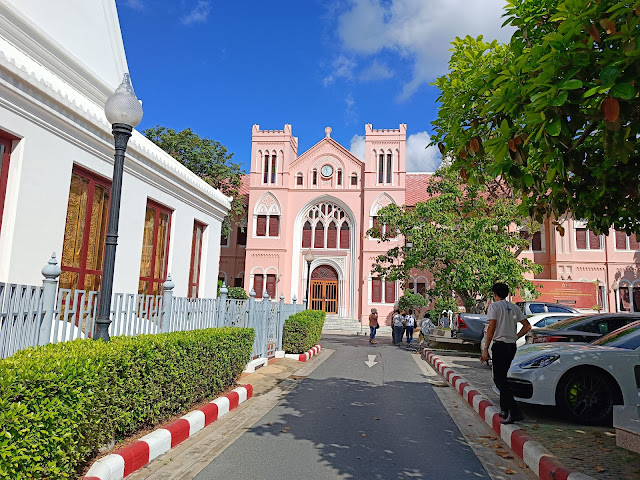
This building resembles a European gothic church but it is actually a Buddhist museum and library  

Our next stop was the Wat Paknam Phasi Charoen (วัดปากน้ำภาษีเจริญ), a sprawling 32,000-square-metre temple complex. With limited time on our hands and the temple’s massive outdoor Buddha statue hidden under scaffolding for repairs, we focused our visit on the pagoda. But first, we had to walk through a long covered passageway that led us past a small pavilion honouring one of the temple’s former abbots who passed away in 1959. 

That’s something uniquely Thai. They have no hesitation about venerating monks after death. Lifelike statues are made in their image, often becoming objects of veneration. If there's a reason for this, I haven't understood it yet. Anyway, that kind of practice wouldn't be seen among Malaysian Buddhists. In this case, Luang Pu Sodh, a highly respected former abbot, was honoured with not one but two seated statues. One of them was covered in layers of gold leaf foil. A gold leaf-foiled elephant statue nearby added to the eclectic scene.

From the pavilion, we continued to the temple’s impressive Maharatchamongkhon Pagoda (มหารัชมงคล), an 80-metre-high structure completed in 2012 after eight years of construction. The pagoda houses five floors, accessible by both stairs and lift. At the top was an eight-metre glass stupa surrounded by a luminous domed ceiling adorned with neon-hued artwork. A floor below, we found relics, Buddha images and portraits of esteemed monks. 
My story continues after more pictures below.


Lunch followed at the Kathi Baan Thai Food and Desserts (กะทิบ้านอาหารไทยและขนม) restaurant, not too far from the Wat Paknam. The food was decent—nothing spectacular—but the restaurant’s surroundings were quite a treat. There was a walkway lined with a koi pond teeming with colourful Japanese carp. The place had been designed to simulate a shaded forest setting, complete with leafy paths, a flowing stream and a small artificial waterfall.

With lunch done, it was time for the main item on our Day Three itinerary—a meeting with the boss of the second foundry. Since we’d been told earlier that the showroom was “quite nearby,” we settled into our seats expecting a short hop across Bangkok. But no, it turned into another long 90-minute drive back to Ang Thong province. Some landmarks along the way looked familiar as we’d passed them before. 
My story continues after even more pictures below.


Eventually, we arrived at their Independence Square (ลานอิสรภาพ ๑๐๙), home to three gigantic statues, including one of Naresuan, one of Thailand’s most revered historical figures. He’s remembered for freeing Ayutthaya from Burmese rule and waging multiple campaigns against the Taungoo Empire. His massive statue here, standing 109 metres tall, shows him pouring water onto the ground, symbolising the declaration of independence from Burma. Naresuan’s legend looms large in Thai history and pop culture, with statues, memorial parks and countless retellings on television.

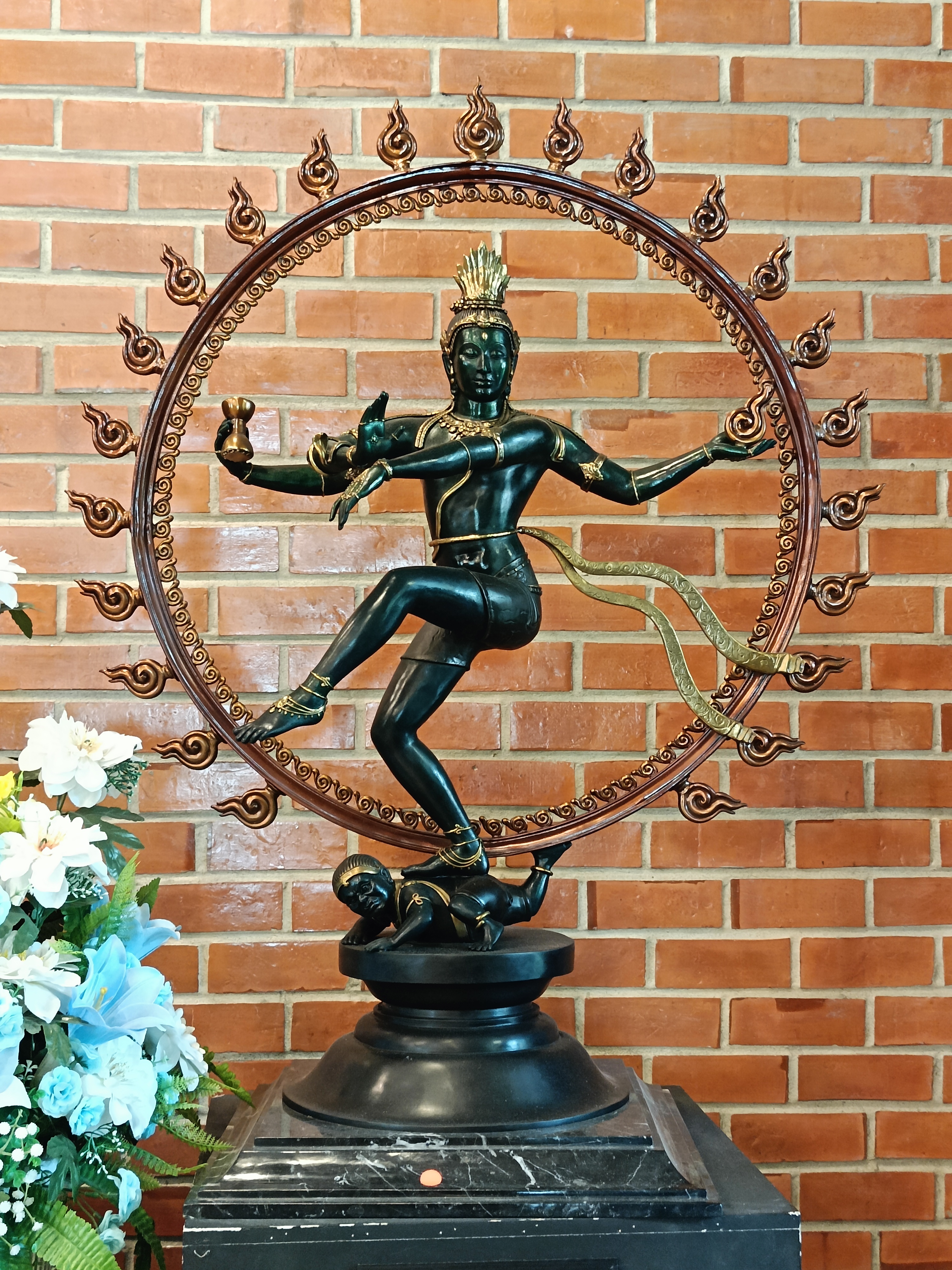
At the edge of this square stood the Asia Fine Art Foundry’s showroom. While we waited for the owner to arrive, we took the chance to wander about and admire the foundry’s creations: not only statues of the Buddha and famous Thai figures, but also Hindu deities like Ganesha and Vishnu.

When the owner finally arrived, he respectfully prostrated himself before Bhante Dhammasubho. Discussions followed—out of my earshot—but eventually, a deal was struck for the production of five bronze Buddha statues for the Nandaka Vihara.

With that done, we were finally on our way back to Bangkok. Another hour and a half on the road, but before heading back to the hotel, we were dropped off at Mixt Chatuchak Mall and later at Platinum Fashion Mall for a bit of shopping and quick dinner to round off a long and, I suppose, fulfilling day.


#WatBowonniwetwiharn #วัดบวรนิเวศวิหารราชวรวิหาร #
WatPaknam #วัดปากน้ำภาษีเจริญ #IndependenceSquare #ลานอิสรภาพ๑๐๙ #Naresuan