Showing posts with label books. Show all posts

Sunday, 15 November 2026

Chinese wedding customs

Having made all arrangements for my son's wedding a fortnight ago, I became curious about how much Chinese wedding customs have changed over the years, and how some of the arrangements differed even from those at my own wedding. We had to take into account and reconcile the advice of both the matrimony matron (送嫁庵)  and the date-selection master. My son's wedding was very much a modern affair, but even so, there were still quite a number of traditional rituals and customs to observe. Some were familiar, while others were followed more out of respect for family traditions than anything else.

Then Chinese Creeds and Customs emerged from my cupboard. What did Burkhardt have to say about Chinese betrothal and wedding customs in his account of life in China and Hong Kong? His descriptions turned out to be quite fascinating, although they belonged to a very different era. Much of what he wrote was based on practices of the 1950s and, in some instances, customs that had been around for generations before that.

There is quite a contrast between the weddings we attend today and the elaborate arrangements he described. I thought it would be interesting to revisit some of his observations and share them here. Burkhardt wrote mainly about the Cantonese customs in Hong Kong and southern China. Marriage in those days was very much a family affair, with a go-between, usually an older woman, arranging the match. She obtained the birth details of the prospective bride and bridegroom and submitted them to a fortune-teller to check whether their horoscopes were compatible. Only when everything was considered favourable would the negotiations proceed.

The betrothal involved an exchange of gifts. The bridegroom's family sent presents of gold, pork, chickens, wine and coconuts, together with Dragon and Phoenix cakes symbolising a happy married life. These cakes were distributed among relatives and friends to announce the forthcoming wedding, rather like the invitation e-cards we receive today.

The bride's family also returned gifts, including steamed rice cakes, lotus roots and cloth for a pair of trousers. Interestingly, the bride was expected to demonstrate her sewing skills by making the garment and embroidering shoes for her future husband's female relatives. One can imagine her future mother-in-law keeping a close eye on her handiwork!

In the days leading up to the wedding, the bride was attended by her unmarried girlfriends, who acted as bridesmaids. She was expected to show sadness at leaving her parents' home, sometimes weeping when relatives came to inspect the wedding presents. Whether all that crying was genuine or merely part of the performance is another matter!

On the eve of the wedding, her furniture and belongings were transported to her new home in a procession. Even the traditional chamber pot had its place of honour, leading the procession. Since no household article was supposed to be sent empty, it was filled with eggs or pomegranates.

On the wedding morning, the bride took a ceremonial bath using water infused with pomelo leaves, before having her hair dressed in the style of a married woman. She then paid her respects to the ancestral tablets and her parents before leaving home, traditionally in a red bridal sedan chair. Motor cars, however, had already begun to replace these in Hong Kong.

There was still some bargaining to be done before the bridegroom could take his bride away. The bridesmaids demanded lucky money before allowing him to approach the sedan chair. Apparently, a little negotiation was customary, and the bridegroom had to pay up before he could proceed! The bride's parents did not accompany her to the wedding. The go-between went along in their place, together with the bridesmaids, while the parents remained at home and entertained their own relatives and friends.

Among the Cantonese, the bride returned to visit her parents on the third day after the wedding. She arrived dressed in her red skirt and black jacket, with all her jewellery on display. The bridegroom's family sent food offerings, including two roast pigs, portions of which were distributed to relatives and friends who had given wedding presents. The custom of reciprocating gifts was important, as even a small present called for some form of acknowledgement.

Burkhardt also described differences among other Chinese communities. Swatow brides, for instance, travelled in a larger sedan chair and, on reaching their husband's home, had to step over a fire of dry grass to rid themselves of evil influences. Unlike the Cantonese, they did not return to their parents' home until four months after the wedding. The Hakkas had their own variations, including the use of the red bridal chair and the inclusion of a lion dance in the celebrations.

Some of the customs Burkhardt described were considerably more unusual. In the Shun Tak district of Kwangtung, a live cock could stand in for an absent bridegroom since many of their men there had emigrated overseas. The bride went through the usual wedding arrangements and was received into her husband's family, even though he might be thousands of miles away and might never actually meet her. Burkhardt called this the "Chicken's Bride". He even recounted a court case involving one such marriage, where the validity of the union became important in determining the widow's inheritance rights.

There were also marriages between deceased persons. When a young man died before marrying, his family could arrange a marriage with a girl who had also died unmarried. The customary betrothal and wedding ceremonies were performed, with ancestral tablets representing the deceased couple. The girl's remains might subsequently be reburied beside those of the young man in his clan's cemetery. Such arrangements reflected the importance attached to family continuity and ancestral worship.

Another aspect of Burkhardt's account was the position of women in traditional Chinese society. The birth of a son was generally welcomed because he would carry on the family name and perform the ancestral rites. A daughter, on the other hand, was expected eventually to leave her parents' household upon marriage and become part of her husband's family.

A young bride could therefore find herself in a rather difficult position. She was expected to obey her mother-in-law, adapt to an unfamiliar household and fulfil her responsibilities as a wife. Producing a male heir was particularly important, and a woman who failed to do so could find her position in the family considerably weakened. Burkhardt also described the Golden Orchid Society, whose members pledged themselves to remain unmarried rather than submit to arranged marriages. Some even refused to return to their husbands after being forced into marriage.

Burkhardt's account reveals a glimpse of just how elaborate and sometimes demanding traditional Chinese marriage customs could be. Many of these practices have since disappeared or changed considerably, particularly with the spread of education and greater freedom for young people to choose their partners.

Some traditions, of course, have survived in one form or another. The exchange of wedding cakes, the giving of angpow, the selection of auspicious dates and the importance attached to family blessings are still familiar to many Chinese families today. But the days when a bride had to leave her parents' home in a red sedan chair, with a chamber pot leading the procession, are certainly a different story altogether!

Saturday, 14 November 2026

Chinese creeds and customs

Sometime in the late 1970s or early 1980s, I picked up a rather worn copy of the first volume of Chinese Creeds and Customs by VR Burkhardt from a second-hand bookstore in Penang. Even at that time, I was already quite interested in Chinese customs and found the book useful as a reference whenever I wanted to look up something about traditional Chinese beliefs and religious practices. Unfortunately, despite looking around, I couldn't find the second and third volumes anywhere in Penang. After a while, I simply left it at that and made do with Volume One.

Then, during one of my trips to Hong Kong in the 1980s, I came across something quite unexpected. I was there to play in one of the Asian Cities Chess Championships which the Hong Kong Chess Federation used to hold rather regularly in those days. While browsing the bookshelves in a bookstore, I spotted an attractive hardback book with the title Chinese Creeds and Customs and the author's name, VR Burkhardt, prominently displayed on its red cover. But this was not just another copy of Volume One or Volume Two or Volume Three. The subtitle on the cover read, "A compilation of the best-selling trilogy". It was the complete work, bringing all three volumes together in a single book!

Immediately, I bought it. No hesitation. One doesn't hesitate when a gem is discovered. The book was published in 1982 by the South China Morning Post Ltd in Hong Kong, with printing done by Yee Tin Printing Press Ltd, also in Hong Kong. It was a substantial hardback, with red cloth binding and gold lettering on the front cover and spine.

And there it has remained in my book cupboard all these years. More than four decades later when I brought it out, both the original red dust jacket and the hardcover book are still in excellent condition, almost as good as new. The dust jacket has survived particularly well, which is something I am quite pleased about.

I suppose this is one of those occasions when a chance find during a trip abroad turns out to be more rewarding than expected. I had started out with a worn copy of the first volume, unable to locate the other two in Penang and then quite unexpectedly, I found the complete trilogy in one book in Hong Kong. And unlike many other books that have come and gone from my shelves over the years, this one has stayed with me.

I don't know how many times I have actually taken it down from the cupboard to refer to its contents, but I have certainly been glad to have it around me. Some books are worth keeping, not necessarily because they are valuable, but because of the story behind how they came into our possession. This is one of them. 

Now about the book itself. What makes Chinese Creeds and Customs particularly interesting to me is that although Burkhardt wrote mainly about the Chinese in Hong Kong, much of what he describes is also recognisable to someone who grew up in a traditional Hokkien family with Baba-Nyonya roots in Penang. After all, many of the customs and religious beliefs practised by the Chinese communities in Hong Kong and Penang have their roots in southern China, particularly Hokkien province, from where many of our ancestors came. Over the generations, however, these traditions developed along somewhat different paths, influenced by the local environment and the communities in which they took root.

Take the Chinese festivals, for instance. Burkhardt devotes considerable attention to the lunar calendar and the various celebrations throughout the year. There is Chinese New Year, the God of Wealth, the Beginning of Spring, the Dragon Boat Festival, the Hungry Ghost Festival, the Mid-Autumn Festival and the Double Ninth, among others. For a Penang Hokkien, many of these are familiar territory. We know Cheng Beng, when families visit ancestral graves to pay their respects; and the seventh lunar month, when Phor Thor committees organise prayers, food offerings and traditional performances for the wandering spirits. Then there is the ninth day of Chinese New Year, when Hokkiens celebrate the birthday of Thnee Kong, the Jade Emperor. This is an especially important occasion among Penang Hokkiens, with elaborate offerings and prayers at midnight. And towards the end of the year, there is the Tang Chek Festival, marking the Winter Solstice.

There are also the subjects of marriage, betrothal, funerals, ancestor worship, fortune-telling, Fengshui, charms and talismans. These are not merely descriptions of old Chinese practices. Many of them would have been part and parcel of family life in Penang, particularly among the older generations. Some of us would remember how our parents and grandparents consulted the Chinese almanac before choosing an auspicious date for a wedding, moving house or undertaking an important activity, and we still do it today! Even the mourning rituals were governed by traditions passed down through the generations.

Of course, not everything described by Burkhardt would be familiar to us. His accounts of certain Hong Kong religious practices, the customs of the Boat People and some local beliefs reflect the particular communities he studied. Penang, too, has developed its own distinctive Hokkien customs, with influences from the Malay environment and the local Baba-Nyonya culture. The way we celebrate certain festivals, prepare food offerings and conduct religious ceremonies may therefore differ from what Burkhardt recorded in Hong Kong.

So in this book, we can look back at a period when traditional Chinese beliefs and customs still played a much greater part in everyday life. Some practices have changed or disappeared, while others continue to be observed quite faithfully in Penang. Flipping through Burkhardt today, I recognise certain things from my own cultural background, while discovering others that I might never have come across. And that is perhaps the attraction of this three-volume compilation. It is not just a collection of descriptions about Chinese customs in Hong Kong. Rather, a useful point of reference for understanding the cultural heritage that many of us in Penang have inherited from our forefathers.


Sunday, 13 July 2025

Ah, an author at last!

On the third day of the Standard Chess competition at the 23rd ASEAN+ age-group chess championships, I received a message from a friend—obviously not a chess-playing one—telling me that someone from Kelantan had posted a picture of my old chess book on Facebook.

“Buku catur pertama yang ambo baca 29 tahun lepas ditulis oleh Mr Quah Seng Sun,” he’d written. And right there, beside a photo of me playing chess at the Berjaya Penang Hotel, was the book itself: CATUR. “Buku Bahasa Melayu pertama ni,” someone commented. “Legend,” wrote another. Aiyah, I’m so embarrassed to be called a legend.

There’s actually a story behind this book that I’ve never told anyone before—at least not until a few days ago when that same picture started circulating on WhatsApp too, and other people began noticing it. So finally, here’s the inside story of how CATUR came about.

It was way back in 1990 when two old friends, former classmates from our Penang Free School days, came to visit me at home. After some catching up, one of them raised the idea of me writing a chess book in Bahasa Malaysia. As far as we knew, nothing like it existed yet. Since I was already writing chess columns for The Star newspaper, they told me I’d be the most logical person to write such a book. By then, my columns had already been running for about 10 years. I’d also been the editor of a local chess magazine in English—also called CATUR—so they felt a book was a natural continuation.

But I protested: my command of Bahasa Malaysia wasn’t that great, and besides, I didn’t know any publisher. “No problem,” one of them said. He knew someone who wrote textbooks and workbooks for schools—and he was a chess player too. I asked who, and it turned out to be Saw Boo Pheng, whom I knew very well since 1972 when we both played for our respective schools (he was from Technical Institute) in the first-ever Penang Schools Sports Council (MSSPP) chess team competition.

The idea was that I’d write the manuscript in English, and Boo Pheng would translate it into BM. Once he agreed and the publisher came on board, we were on our way!

I spent weeks piecing the book together manually. This was pre-Internet, pre-chess software. Fortunately, desktop computers had already appeared, and I worked on an Intel x286 machine using an early version of Microsoft Word. I’d write one chapter at a time, print it, deliver it to Boo Pheng for translation, then retype the BM version into the computer. It was painstaking work.

The second challenge was creating the chess diagrams manually. I managed to get ready-made diagram stickers from a friend in Singapore. I’d sit with a tweezer in hand, peeling off the miniscule chess pieces and placing them on a blank board. Everything had to be labelled precisely so the publisher could match diagrams with the correct text.

Once the manuscript was done, I sent it to the publisher to be retyped into their system, which was another headache. What if the type-setters made mistakes? What if the mistakes were not spotted by the proof-readers? And sure enough, all that happened. I had to go through draft after draft—first, second, third—making corrections everywhere. Eventually, we cleaned up all the obvious mistakes. If there were any left, well, not intentional lah. We really did try our best.

When CATUR finally went to print, I was thrilled to see it on bookstore shelves despite having some trepidation about the cover design. I had not known at all that the publisher had planned to use a picture of Jimmy Liew who was at that time Malaysia's foremost chess player. Did they contact Jimmy for permission? I don’t remember how well it sold, but for the next three or four years, Boo Pheng and I received our modest royalty cheques. It didn't make us rich though. Lim Eng Siang was also credited as a third contributor, though in truth, his only role was to propose the idea in the first place! But I couldn't leave him out. For old times sake, I couldn't do that.

Then in 1994, the publisher came back and asked for an English version of CATUR. But alamak, I no longer had my original English manuscript! Back then, we stored everything on floppy diskettes and mine had gotten corrupted. So what to do? I had to retranslate the BM version back into English. The irony of it. Of course, the job was so much easier and Boo Pheng didn’t need to be involved at all. This was also a chance for me to correct mistakes spotted after the Bahasa Malaysia version had come out.

I finished the retranslation and emailed everything to the publisher. Since the manuscript was now fully digital, production became much easier. The English version, Taking Up Chess, came out in 1995 with all three of us still credited as authors.

Looking back now, I never imagined that CATUR would still be remembered after all these years, let alone spoken of fondly by people I’ve never met. It was just something I did with a couple of old friends, cobbled together with stickers, printouts and a lot of patience. A labour of love, we didn’t have grand ambitions....just the hope that it might be useful to someone starting out in chess, especially Malay-speaking students in schools.

That it turned out to be the first local chess book in Bahasa Malaysia was, in some ways, secondary to the experience of making it. But now, to hear that someone in Kelantan picked up the game from this book nearly three decades ago, and still remembers it, is both humbling and gratifying. We never know which of our efforts will last or leave an impression. Sometimes, we just do what needs to be done at the moment. If it happens to light a spark in someone else’s journey, that’s a bonus.

So yes, CATUR might’ve started small, but it seems to have travelled far in its own quiet way. I’m thankful for that.

ADDENDUM: As can be read from the glossary in the book (glosari in BM), the translations of the chess terms from English to Bahasa Malaysia were fairly straightforward except for one term. What should we call the Bishop in BM? To us, Gajah (elephant) didn’t feel quite right, despite its historical origins. The modern-day chess piece clearly depicts a bishop’s hat, not an elephant. Even chess diagrams use the bishop’s mitre to represent the piece. So we decided to go with Biskop instead. We felt it would cause less confusion for the readers. And after all these years, I still wonder whether we made the right call.

Wednesday, 16 April 2025

A demised friend's room

When one of my closest friends passed away last January, I knew he had left behind a treasure trove in his room. Among many things, he was a man of books and thought, someone who always found comfort in pages and print. Still, I had no inkling of the extent—or the sheer richness—of what he had kept close to him all those years.

His sister was in the process of clearing out the room and had kindly invited a few of his friends over, suggesting we take anything that held meaning to us, anything we might want to keep as a memento. What I saw when I stepped inside truly astounded me.

One side of his room was lined with bookshelves, every inch occupied. Two full rows were dedicated to computer books—outdated, of course, as technology marches on relentlessly and renders manuals obsolete within years. But beyond that were the real gems: another two rows filled with classic literature and dictionaries. These were books with weight—not just physical, but intellectual and emotional. Titles that spanned centuries, works that had shaped civilisations.

He had been a passionate reader, especially of ancient history. His shelves were filled with Penguin Classics and scholarly translations of the great writers and thinkers of the past—Caesar, Homer, Livy, Plato, Tacitus, Plutarch, Thucydides. It made me pause, because in that moment, I recognised a kindred spirit. When I was in my twenties, I too had spent many hours with Homer, Aeschylus, Sophocles and the like. Oddly enough, we had never discussed our shared reading interests at all, but there it was—evidence that we had been walking rather parallel paths in our separate, private ways.

And then there were the dictionaries. At least three sets of English-language dictionaries, not counting the Bahasa versions. Pride of place went to the Oxford English Reference Dictionary, and beside it, the magnificent two-volume set of the Shorter Oxford English Dictionary (Sixth Edition). They looked almost regal on the shelf, like sentinels watching over him while he read.

His sister had said, “Take whatever you like. Once everyone’s had a look, I’ll be calling the recycling people to clear out the rest.” My heart sank a little at that. These books—these precious written treasures—meant something. They represented a lifetime of curiosity, of quiet evenings, of reflection and learning. To think they might end up in a second-hand shop, or worse, in a landfill, was too much to bear.

So I made a decision. I took what I could—some of the classic titles, these two dictionaries, anything I felt carried a spirit of him—and left the tech manuals behind, naturally. My plan is to donate them to a library, perhaps one that still values the printed word, where students or lovers of history might browse them and feel, as he once must have, a sense of wonder at the past.

It’s a small way to honour him, but one I hope he would have appreciated. Books, after all, aren’t just objects. They’re memories, ideas, voices—and sometimes, they’re the closest we get to holding onto the soul of someone who’s gone. I shall miss you, my old friend, for the conversations we had and the conversations we never had.


Monday, 24 March 2025

Roget's thesaurus


I'm not unfamiliar with a dictionary or a thesaurus. In fact, as a kid in primary school, I used to flick through my father's copy of Chambers' 20th Century Dictionary. It got so well-worn that the pages were slowly coming apart. I've still got it somewhere in the house, though I'd need to search hard for it—I've got newer dictionaries now, like the Oxford, Collins and BBC ones. 

Heck, at one point in the 1980s, on a trip to the Merdeka team chess tournament in Kuala Lumpur with my chess friends, I even bought a ridiculously voluminous—and heavy—dictionary from the Popular Bookstore there. Mainly because it was cheap. Also mainly because one of my chess friends and I were urging each other to buy such a thick book. We struggled to carry our copies on the bus back home to Penang. That dictionary’s long gone, by the way. Took up too much space in the house, and though I loathed to part with it, I had little choice.

The thesaurus, on the other hand, was a different story. I only discovered its existence when I was in college. The moment I saw a copy of Roget's Pocket Thesaurus in a bookstore, I was smitten. Finally, a book that could provide me with synonyms and antonyms, expanding my vocabulary beyond my limited scope. I used it so much that the pages became well-leaved. And then, a little while later, I came across Roget's Thesaurus in Dictionary Form. No hesitation—I got myself a copy. I was used to the original format of the thesaurus, but I quickly realised that the dictionary form was even easier to use. No more flicking through the index and then jumping to the relevant category at the front of the book.

As time passed, Roget's Pocket Thesaurus was forgotten—misplaced, lost. I relied solely on the dictionary version to get by. But even that eventually fell into disuse. When the Internet came around in the '90s, online thesauruses became my go-to resource, and my physical copy was relegated to the cupboard.

Only two or three weeks ago, I finally brought it out from storage—all because someone passed me a copy of her Roget's Pocket Thesaurus! Putting the two copies side by side brought back such wonderful memories of using them. Those were the good old days...

Thursday, 27 February 2025

Every night, Josephine!


It’s quite puzzling why this catchy, bubblegumish song, released in 1964, has remained under the radar all these decades. Even today, a video of Every Night, Josephine is still nowhere to be found online. A quick Internet search turns up little nothing, so I had no choice but to make my own video of this seven-inch 45rpm record spinning on the turntable. The record label tells me the song was sung by someone named Ronnie Jackson—but like the song itself, next to nothing is known about the singer, and I’ve had to leave it at that.

However, the songwriting credits caught my attention. Although one name, Vic Thomas, didn’t ring any bells, the other did. Jacqueline Susann. The only Jacqueline Susann I’ve ever heard of was the one who wrote Valley of the Dolls, that scandalous novel that was all the rage among secondary school students back in the 1960s and 1970s. The book followed three young women navigating the highs and lows of fame, fortune and relationships in the American entertainment industry—complete with a heavy dose of pill-popping culture. But before Valley of the Dolls made her famous, Susann had actually written an earlier book called Every Night, Josephine! The exact same title as this song.

Her book, published in 1963, wasn’t about Hollywood starlets or scandalous affairs. It was a lighthearted, affectionate memoir about her beloved poodle, Josephine. A collection of amusing stories about life with her pampered pet. Which brings me to the big question: why would Susann’s name show up as a co-writer of this song? Why should the song’s title be exactly the same as her book? And to top it all off, the lyrics of the song reveal—right at the very end—that Every Night, Josephine was all about a poodle.

It can’t just be a coincidence, right? One possibility is that the song (released in 1964) was some sort of promotional tie-in for the book (published in 1963). Back then, it wasn’t unheard of for books, films and even brands to have an accompanying song, either as a marketing gimmick or just a fun add-on. Maybe Susann or her publisher wanted a song to help push the book. Or maybe the songwriters were inspired by it. As for Susann’s songwriting credit, could she have actually contributed something? Lyrics, ideas, or just the title? Or was her name added purely as part of a promotional deal? And here’s one more giveaway—every song has a publisher, and in this case, it was Poodle Music Inc. Now, if that isn’t a clue, I don’t know what is!

And then there’s the biggest mystery of all—Ronnie Jackson. Who was he? A session singer hired for the job? A pseudonym? A one-hit wonder who never even had a hit? The fact that Every Night, Josephine faded into obscurity along with its singer only deepens the mystery.

Whatever the real story is, one thing’s for sure: this is one of those strange, forgotten little pieces of music history that seems to have slipped through the cracks. And unless someone, somewhere, has more answers, I guess we’ll just have to leave it at that.

Lyrics: 
I told Susie I could not go out with her
Not go out with her
No no no, not go out with her
She got mad at me and made an awful scene
But I got no time to run around
Got no time to paint the town
Only got time with Josephine

Every night Josephine
She waits for my return and I must be true to her
If I fail to take her out
Josephine will puff and pout
Josephine is so demanding of me
Josephine Josephine

Folks all laugh at me and say that I'm a fool
They say that I'm a fool
Oh yes, they say that I'm a fool
Other guys have lots of women at their feet
But I got no time to run around
Got no time to paint the town
Only got time for Josephine

Every night Josephine
I'm afraid to come home late Josephine might misbehave
Guess I've got a dirty deal
She won't even cook the meals
Josephine is so demanding of me
Josephine Josephine

She takes everything I've got
While my love life goes goodbye
Every night I stay at home
Guess my soul is not my own
It belongs to a high strung
Temperamental blue blood poodle named Josephine
Jo Josephine


Friday, 11 October 2024

SRI LANKA: Travelling through Buddhist eyes

When my wife and I went to Sri Lanka in January this year, all that I thought of doing once back in Penang was only to chronicle our travel on this blog. But my writing soon got the better of me and before long, I discovered that I had quite a decent narrative, one which I believe could benefit friends who were into Buddhism or at the very least, interested to know about life in Sri Lanka. 

After procrastinating for quite a while, I have now my first Kindle e-book, SRI LANKA: Travelling through Buddhist eyes, published at the beginning of this month and selling for USD8.99 on https://www.amazon.com/SRI-LANKA-Travelling-through-Buddhist-ebook/dp/B0DJFD9WCB/ref=litb_stb_nodl?nodl_android=1

A very modest, unassuming experiment, if I may say so myself. Almost a hundred pages thick and filled with lots of pictures seen through my camera lenses. Book was divided into seven chapters, and it includes an epilogue with two Sri Lanka-related stories. Do show some support and encouragement by purchasing the e-book from the amazon.com website.

Saturday, 21 September 2024

On making a difference

Tan Boon Lin is part of a very rare breed of educationist. When it comes to Penang Free School, I know that he’s one of only two people to have gone from being a pupil at the school to returning as a teacher, and eventually becoming the headmaster. But in Headmaster Boon Lin’s case, he didn’t stop there – he went on to even greater heights in Malaysia's education system.

I still call him Headmaster, out of respect, even though others might refer to him as Master or even Dato’ Tan, after he received the Darjah Setia Pangkuan Negeri (DSPN) award from the Penang Governor in the 2018 Penang state awards. To me, though, he’ll always be my headmaster, even though more than 50 years have passed since his footsteps echoed through Pinhorn Hall at Penang Free School during the Monday morning assemblies.

The last time I saw him was at his home in Petaling Jaya on the 24th of March this year. He was frail, but still in good physical and mental health for someone who's now 97. For a long time, Headmaster Boon Lin had been thinking about publishing his autobiography but held back for reasons of his own. Back when I was writing Fidelis for The Old Frees' Association in 2011, I had a chance to look at an extract from it, which covered his experiences during the war years. He was still a pupil at Penang Free School then, and wrote about the chaos and carnage when Japanese planes bombed George Town in December 1941.

Earlier this year, I found out that Headmaster Boon Lin was finally ready to release his autobiography. After the usual search for a publisher, his family chose Areca Books. At the family's request, I stopped by the publisher’s office about ten days ago to help review the proofs before they went to print. I was lucky enough to see the nearly finished book – 320 pages and it’s packed with photos, showing his long journey through life and his career in education. I’d say about a third to half of the book focuses on his years as a pupil, teacher and headmaster of Penang Free School. So, any Old Free, especially those who were at the school during his time as headmaster from 1963 to 1969, would definitely want a copy. At RM80 a copy, it’s very reasonable!


Monday, 2 September 2024

Early minutes

Something intriguing happened recently. On the 29th of July, Stephen Yeap Leong Huat, grandson of the once-richest and most notable Penangite, Towkay Yeap Chor Ee,  presented his grandfather's private papers to the National University of Singapore (NUS). While I admired his decision, this choice puzzled me. Why donate them to an institution in Singapore and not Malaysia, where Yeap Chor Ee had built his business empire? Born in Fukien, China, in 1868, he emigrated to the nanyang in 1885. The Chop Ban Hin Lee that he set up in 1890 was the beginning of his empire, and the Ban Hin Lee (萬興利) nomenclature, meaning Ten Thousand Prosperities, carried him through the rest of his life. With Penang as his main base, he dealt in sugar initially. By the time he died in Penang in 1952, he was known chiefly as a banker. Not many individuals could claim to have owned a bank successfully, but he did. There is, therefore, no dispute that Yeap Chor Ee lived his life as a Malayan. So why are the Yeap Chor Ee private papers now in Singapore hands? Aren't Malaysian institutions committed to preserving our own history? Big question mark, indeed. 

On reflection, it was a clever and astute move by Stephen Yeap. Singaporean institutions have a stellar reputation for preserving and valuing historical documents. Unlike in Malaysia, where such treasures might not receive the same attention, Singapore ensures these records are meticulously cared for and made widely accessible to researchers and the general public. For instance, the National Library of Singapore has done an exemplary job of digitising old newspapers from the region, making them readily available online. So, it was likely that NUS would treat the Yeap Chor Ee private papers with the same level of dedication. Stephen Yeap’s decision, in hindsight, thus seemed perfectly sound. 

What was even more astonishing for me was the speed of subsequent developments. Just three weeks later, I learnt that NUS had already digitised the collection, making the entire set of Yeap Chor Ee private papers available online. This is impressive, considering the usual slow pace of such processes.

During the research for my book, Ten Thousand Prosperities, which documented the history of Ban Hin Lee Bank (萬興利銀行), I was given physical access to several boxes of old files and documents. I found a register recording Board meeting minutes from the late 1960s onwards but never came across anything from the earlier years. I suspected an early register once existed, but with no one then able to confirm its whereabouts, I had to let it go. So, I’m thrilled now that these early minutes have resurfaced and are now digitised for all to see. My only regret is that I was unable to see the early Board minutes sooner.

With these documents now online, I’ve been able to compare the actual minutes with the information I gathered elsewhere about the bank's early years. I’m pleased to say that about 95 to 98 percent of what I wrote was accurate enough. It’s a relief to know that my research efforts stood up so well. 

The book, Ten Thousand Prosperities, can be purchased online from this link. click here.

Note: As far as I know, the term towkay (pronounced as thhau-keh) is of Penang Hokkien origin, meaning "big boss" or "proprietor." It signified not only the person's wealth and success but also their status and influence in the community. A towkay was often seen as a leader or benefactor who provided employment, supported social causes and contributed to the overall development of the local Chinese community. Yeap Chor Ee certainly qualified as such.

#YeapChorEe #SingaporeArchives #PenangHistory #NUS #10000Prosperities #TenThousandProsperities #BanHinLeeBank

Saturday, 31 August 2024

Dr Ong Chong Keng

This 31st of August marks the 67th anniversary of the birth of our nation—well, technically, half the nation, as only the peninsula achieved its independence from the British in 1957. Full independence for Malaysia would come slightly over six years later. Nevertheless, the 31st of August will mark the 67th anniversary of the formation of the Federation of Malaya. I’d like to regress a further 10 years to 31 August 1948, exactly 10 years before Malaya’s Independence, when a most dastardly act of terrorism erupted on Penang Island.

In my 2016 book on Penang Free School, Let the Aisles Proclaim, I dedicated about three pages to discuss this event. Similarly, in my 2023 book on The Old Frees’ Association, Centenary, I repeated much of the same information to a slightly different audience. I wish to share the story again, not in print, but here on my blog, to reach a wider audience who may not have access to my books. In my writings, I described the event as "a murder most foul," and indeed it was.

The most shocking news to emerge in 1948 was the cold-blooded murder of Dr Ong Chong Keng at the hands of an unknown assailant on the night of 31st August. The news rocked the Federation and was carried on the front pages of the newspapers: 

Dr. Ong Chong Keng, a Federal Executive and Legislative Councillor, was murdered by an unknown gunman in a squatter area three miles from the centre of Penang. Police offered a reward of $5,000 for information leading to the arrest of the murderer. A Chinese youth was detained. 

Dr. Ong had long been opposed to Communism and had not hesitated to state his views in the Federal Council. He was found dead with bullet wounds in his head at 7am in a lane in a squatter area at Trusan Road, a turning off Perak Road. He had been called out to a case and left his house on a motorcycle. Police were not prepared to state whether the call was real or a fake to get Dr Ong away from his house. He apparently left his motorcycle at Trusan Road and took one of the many footpaths in the kampong. He was found sprawled face downwards with his medical bag close by. 

An official police statement said that at 9pm a young Chinese youth, aged about 22, went to Dr Ong’s dispensary and told the manager that there was a sick man in Jelutong. The manager contacted Dr Ong, who went on his motorcycle to Jelutong with the young Chinese on the pillion. When Dr Ong had not returned by 11.30pm, the manager went out to look for him but could find no trace of him. He reported the matter to the police, who instructed patrols to make a search for him. Early the next morning, a Chinese man on his way to work saw a crowd of children gathered around a body. A police party identified the body as that of Dr Ong Chong Keng. 

At the time of his death, Dr Ong was also the President of The Old Frees’ Association. The Free School paid tribute to his memory by flying its flag at half-mast and was well represented by the Scouts at the funeral several days later. In an immediate Government response to the murder, the Commissioner-General, Malcolm MacDonald, said in appreciation, “Dr Ong Chong Keng was a man of rare distinction. He was more than a leader of the Chinese community. He was a leader of the peoples of Malaya. To the service of this country, he dedicated a brilliant array of gifts. He had the courageous heart of a soldier, the cultured mind of a scholar and the noble vision of a statesman. He was a memorable Malayan Patriot.” In a remarkable gesture, MacDonald himself attended Ong’s funeral. 

A public appreciation was also offered by Harold Cheeseman: “Ong Chong Keng, known to me always as OCK, first came under my notice as a precocious child in Standard II. I watched and indeed stimulated his progress through the school until I had him as a pupil for some years in the top classes. He was not a hard worker. There was no need for him to work hard, for he had exceptional ability. He took a full part, however, in the various school activities and societies. He was a keen scout, later a keen cadet officer, and in after years an enthusiastic volunteer officer. He made his first excursions into debate in the school debating society, and his articles, becoming more and more polished as the years passed, were a feature of the school magazine for many years. From early youth, he was an omnivorous reader, and in recent years there was nothing in which he had greater pride than his library. 

"Some pupils pass from the master’s ken after school days are over. Not so with Ong Chong Keng. He maintained regular contact with me throughout his career at the University of Hong Kong and in later years. After the liberation, he never visited Kuala Lumpur without calling on me or writing to express regret if he had been unable to do so. I think, therefore, that I may claim to have known him well. He was an able and forceful speaker. He was ambitious, but it was not merely personal ambition; it was also ambition to be a leader of his people and to work for them. He was proud of being Chinese, but as he used to say to me again and again, he was proud most of all of being a Malayan Chinese. 

"His service was not confined to his community. It was to the country. This was exemplified in many ways. He was a past president of the Penang Rotary Club, and he was an official in, and often the driving force of, many organisations that exist to render service. This true and able son of Malaya has been foully and prematurely cut down in the fullness of his powers, just when life seemed to be opening out for him in great promise. His life was not lived in vain. His service must be an inspiration to all who seek to work for the good of this country.” 

Police investigations later disclosed that Dr Ong was believed murdered as the result of a conspiracy between the Malayan Communist Party and the Ang Bin Hoay secret society. However, the man that pulled the trigger was never captured. At the inquest in November, an automatic pistol found on the dead body of a Kedah bandit was believed to have been the weapon that killed Dr Ong. A police witness testified that he found the pistol on a hilltop, attached to the body of the bandit, who was believed killed in an engagement with the police and military. One of the five bullets in the pistol’s magazine was sent for testing, and the Senior Chemist concluded he was strongly of the opinion that the bullet matched the one which killed the former Federal Councillor. 

In December, the Coroner returned a verdict of “murder by a person or persons unknown” but added that there was good reason to believe that the perpetrator of the crime had outlived his victim for a few weeks and “expired miserably in a place remote from civilisation at the hands of his fellow murderers, his body lying there to rot as would the body of a dead beast of prey.” 

The body of Dr Ong was brought to the Toi Shan Convalescent Home on Hutton Lane, where it remained until the fifth of September. After the traditional Chinese funeral rites were completed, a procession of 5,000 relatives and friends followed the hearse on its hour-long journey around George Town. Leading the procession was an armed police escort, accompanied by the Municipal Band, its drums draped in black cloth, playing funeral selections. Following a parade of scrolls and Chinese musical troupes was the hearse, carried by Ong clansmen and escorted by police armed with rifles and Sten guns. Mourners walked beside and behind the hearse, with a contingent of Boy Scouts from local schools bringing up the rear, followed by several thousand friends and relatives. Curious crowds estimated at 50,000 lined the streets, while armed police patrolled the town. Special constables on motorcycles and in loudspeaker vans directed the traffic. The procession dispersed at Macalister Road, after which the hearse proceeded to Mount Erskine for the burial.


Tuesday, 30 January 2024

Four books

I had long admired the late Prof Dr Ghulam Sarwar for all his accomplishments. Very few people are aware of how devastated I felt when I learnt of his demise in 2022. He died in November that year, a month before the Penang Chess Association could formally invite him to attend the 50th anniversary celebrations. He was so excited when I had mentioned to him that I would like him to be present. Anyhow, these are four books that he authored. There are many more...

Update: I've added Ghulam Sarwar's social commentary about our politicians, the Yang Berhormats in our midst, who usually only appear in their constituencies just before any general elections. It is taken from his book, Mirror of a Hundred Hues, published in 2001.


Thursday, 14 September 2023

A book called Centenary

At long last, this book is ready and set to be launched at The Old Frees' Association annual dinner on 21 October 2023. 


Tuesday, 23 May 2023

Prefaces

A few days ago, I had written about how forewords should be crafted. Today, I want to continue with something in the same vein by commenting on prefaces. Whereas a foreword is written by someone other than the author of a book, serving as an introduction or endorsement of the book and helping to establish credibility, a preface is written by the author and provides additional context, motivations or insights into the book's creation. It should not be far removed from the book's content since it helps to enhance the reader's understanding of the work.

Thus, writing a preface has its own guidelines, such as:

  1. Understanding the purpose: A preface is written by the author and serves as an introduction to the work. It allows the author to provide context, explain his motivations and share additional information with the readers. 
  2. Determining the content: Decide what you want to convey in the preface, consider discussing the book's background, your personal journey in writing it, any challenges or inspirations faced or any relevant information that enhances the reader's understanding. 
  3. Starting with a warm greeting: Address the readers and express gratitude for their interest in the book. Acknowledge specific individuals or groups who supported you during the writing process. 
  4. Providing context: Explain the reasons behind writing the book and any relevant background information. Discuss the book's purpose, the problem it aims to address or the knowledge it seeks to impart. Connect the book's content to its significance in the field or genre. 
  5. Sharing your journey: Describe your personal experience in writing the book. Discuss the research, discoveries or insights that influenced your work. Can also mention any challenges, breakthroughs or notable experiences that shaped the book's development. 
  6. Acknowledging influences: If appropriate, acknowledge individuals, mentors or previous works that influenced your writing. This could include thanking people who provided guidance, inspiration or feedback during the writing process. 
  7. Discussing the structure or organisation: Provide an overview of how the book is structured, highlighting any unique features or organisation methods. Explain how readers can navigate through the content and what they can expect in each section. 
  8. Clarifying terminology or assumptions: If the book relies on specific terms, concepts or assumptions, use the preface to define or explain them. This helps readers understand your intended meaning and approach. 
  9. Addressing potential readers: Consider mentioning the intended audience for your book. Explain how different groups can benefit from reading it, whether they are experts in the field or individuals seeking introductory knowledge. 
  10. Conclude with a personal note: Summarise your feelings about completing the book or express your hopes for how readers will engage with it. Can also express gratitude to those who supported you throughout the writing process. 
  11. Revising and editing: Review the preface for clarity, coherence and grammar. Ensure it aligns with the tone and style of the book. Consider seeking feedback from trusted individuals or beta readers. 
  12. Finalising: Once satisfied with the preface, incorporate it into the book's manuscript. Typically, the preface appears before the main content, often after the table of contents.

My own preface from Let the Aisles Proclaim in 2016


Friday, 19 May 2023

Forewords


Long ago in 2011 when Ten Thousand Prosperities finally
appeared in print.


Anwar Fazal is remarkable. A font of various ideas and wisdom. Other than indulging in so many worthwhile causes, he has the time to write forewords for books. 

When I wrote Ten Thousand Prosperities two years ago, I had asked him to contribute a foreword to my book, which he readily did. The bonus was that he even gave me a copy of his own book with the aptly named title of Moving Forewords. Inside was a collection of 30 forewords of his. Old forewords of his but all still relevant in terms of the subject matters.

Writing a foreword can be fun if the foreword writer is given free rein to let his thoughts wander. While the writer can also write things that are totally irrelevant to the book's content, it is more prudent to follow traditional guidelines, such as these below. But of course, they can be totally ignored too:

  1. Understand the purpose: A foreword introduces the book and its author to readers. It's typically written by someone other than the author, such as an expert or a well-known individual in the field. 
  2. Read the book. If not possible, maybe an excerpt or even a chapter: Familiarise yourself with the content, themes and style, taking note of the author's main ideas and unique perspectives. 
  3. Start with a warm greeting: Address the readers and express your enthusiasm for writing the foreword. You can also mention your relationship with the author if it's relevant. 
  4. Share your perspective: Discuss why you believe the book is important and how it contributes to the field or genre. Highlight the author's qualifications, expertise or notable achievements. 
  5. Personalise it: Connect with the readers by sharing your personal experiences or anecdotes related to the book's topic or the author. Explain how the book impacted you or influenced your own work. 
  6. Summarise the book: Provide a concise summary of the book's main ideas and themes. Avoid giving away all the details or spoilers, as the foreword should intrigue readers to explore the content themselves. 
  7. Emphasise the value: Discuss the potential benefits or insights readers can gain from reading the book. Highlight any unique features, research or perspectives that set it apart. 
  8. Conclude with a positive note: Encourage readers to dive into the book and express your confidence that they will find it valuable. You can also mention your admiration for the author's work or express gratitude for being involved. 
  9. Revise and edit: Review your foreword for clarity, coherence and grammar. Ensure it flows smoothly and engages the readers. Consider seeking feedback from the author or other trusted individuals. 
  10. Finalise and submit: Once you are satisfied with the foreword, submit it to the publisher or the book's editor for inclusion in the final publication.

Remember, a foreword should be concise and captivating, providing readers with an intriguing preview of the book and establishing your credibility as the writer of the foreword.


Saturday, 15 January 2022

An autobiography titled "𝑳𝒐𝒈"

I never got to ask David Hwang Hong Shi why he named his pictorial autobiography as Log but I was offered an answer by his wife, Molly Ooi. 

In his younger days, David had been a very active Scouter and he was a King's Scout from his schooldays at St George's Institution in Taiping. His interest in Scouting had continued throughout his working life, first as a Scout Master at Westlands (Primary) School in the 1950s and which carried through to Penang Free School in the 1960s and early 1970s, later at Westlands Secondary School until his retirement from government service, and finally at the International School of Uplands. The Scout movement will remember that they had to keep a log book of their activities and this was the reason why David's autobiography was simply called Log. 

The book chronicled his life's work from his schooldays till his final retirement as General Manager of Penang Club and then the founding of the Taman Sri Nibong Residents' Association. Log is privately produced and there is not more than 50 copies in print. I consider myself lucky to have received a copy. 

Actually, I visited the couple yesterday afternoon to collect it and we spent time reminiscing on the past: not that our careers crossed paths but he was already a school master at Penang Free School when I entered Form One in 1966. True to his outdoorsy lifestyle, he was a Physical Exercise teacher at the school. Fast forward later to 2012 when Molly and I were co-editors of FIDELIS, the coffee table book of The Old Frees' Association, David was always in the background to give advice on certain matters when required. That was when I got to know him well.

Wednesday, 5 January 2022

Water, wigs and wisdom

One of my latest acquisitions: the third volume of Marcus Langdon's research into Penang's history when the island was elevated as the fourth Presidency of British India from 1805 till 1830, with Malacca and Singapore considered as its dependencies.

The third volume comprises six chapters which the author had termed as books with each dealing with different aspects of the island's past. 

Book One covers the aqueduct system which delivered water from the dams and reservoirs to the town. Book Two researches the public jetty which provided the early transportation of goods and people from the island to the trading vessels and the mainland. Book Three deals with the history of the early newspapers. Book Four talks about the the first hospital in Penang. Book Five describes how the present legal system of the country had started from Penang. And Book Six touches on how the Penang jail was established.


Thursday, 30 December 2021

Eating an orange

Thich Nhat Hanh is a Zen Buddhist monk from Vietnam. This story is taken from his book, A Pebble for Your Pocket (ISBN 1-888375-05-1), published 20 years ago. 

Since 2014 there have been some concerns about his health but no latest word is available. If he is still around, he should be in his 90s.

Here is one of several meaningful gems from his book. Be in the present. The past is gone; the future is yet to come.

When you look deeply at an orange, you realise that an orange - or any fruit - is nothing less than a miracle. Try it. Take an orange and hold it in your palm. Breathe in and out slowly, and look at it as if you were seeing it for the first time. 

When you look at it deeply, you will be able to see many wonderful things - the sun shining and the rain falling on the orange tree, the orange blossoms, the tiny fruit appearing on the branch, the colour of the fruit changing from green to yellow, and then the full-grown orange. Now slowly begin to peel it. Smell the wonderful scent of the orange peel. Break off a section of the orange and put it into your mouth. Taste its wonderful juice.

The orange tree has taken three, four or six months to make such an orange for you. It is a miracle. Now the orange is ready and it says, "I am here for you." But if you are not present, you will not hear it. When you are not looking at the orange in the present moment, then the orange is not present either.

Being fully present while eating an orange, an ice cream cone, or any other food is a delightful experience.

Tuesday, 14 December 2021

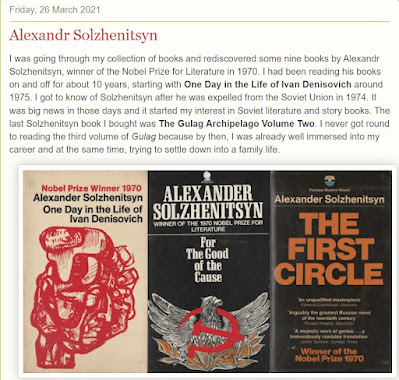
Alexandr Solzhenitsyn (2)

In March this year, I wrote a story here about my prized collection of books by the Nobel Prize for Literature winner, Alexandr Solzhenitsyn, books which I have since donated to the library of The Old Frees' Association. I felt that it is far better to share these books with my fellow members than to keep them unread at home. 

Today, I read from facebook an item on Solzhenitsyn which was posted in A Daily Dose of History. It's quite interesting and I feel that by reproducing it here, I can ensure that I can retrieve the story easier from my own blog than to search for a story that's buried beneath millions of facebook posts. So here it is:

While serving in the Soviet army in the closing days of World War II, Aleksandr Solzhenitsyn wrote a letter to a friend, in which he was critical of Josef Stalin and Stalin’s conduct of the war. The letter was discovered by Soviet intelligence authorities and Solzhenitsyn was sentenced to eight years in a work camp. When his term ended, Solzhenitsyn was sent to internal exile in rural Kazakhstan. While there he would experience a philosophical and religious transformation that informed the rest of his life’s work.

In 1956 Solzhenitsyn was released from exile and permitted to return to Moscow, where he taught high school and secretly began writing his novel One Day in the Life of Ivan Denisovich, describing life in a Stalinist work camp. In 1960 Solzhenitsyn risked showing the manuscript to a Soviet editor. Because Khrushchev was attempting to purge the Soviet Union of Stalinism, he personally approved the book’s publication, and it became a smash hit. But Solzhenitsyn didn’t remain long in favor. Subsequent works were prohibited as being “anti-Soviet” and after Khrushchev was removed from power, Solzhenitsyn was deemed a “non-person” and the KGB raided his home and seized his manuscripts.

During this time, Solzhenitsyn was secretly writing his Gulag Archipelago, a three-volume examination of life in Soviet labor camps, hiding portions of the manuscript at the homes of various friends. In 1973, after the KGB had located and seized one of the three copies of the manuscript, Solzhenitsyn had a microfilmed copy smuggled out of the country and in December it was published in Paris.

The Soviet authorities felt somewhat constrained in what they could do to Solzhenitsyn, who had been awarded the Nobel Prize for Literature in 1970 and was an international celebrity. The Politburo considered sentencing him to life in prison, but instead deported him to West Germany. Solzhenitsyn made his way to the United States where he lived and worked for almost 20 years. While he praised and admired Western liberty and democratic values, Solzhenitsyn criticized the West for underappreciating, devaluing, and misusing them. He also criticized the West’s cultural weakness and its loss of religious and spiritual grounding. 

After the fall of the Soviet Union, Solzhenitsyn returned to Russia, where he was received as a hero. He died in August 2008, at age 89.

Aleksandr Isayevich Solzhenitsyn was born on December 11, 1918, one hundred three years ago today.

“(T)he line separating good and evil passes not through states, nor between classes, nor between political parties either -- but right through every human heart -- and through all human hearts. This line shifts. Inside us, it oscillates with the years…. If only there were evil people somewhere insidiously committing evil deeds, and it were necessary only to separate them from the rest of us and destroy them. But the line dividing good and evil cuts through the heart of every human being.”