Tuesday, 26 May 2015

Private dinner at OFA Restaurant


Quite an enjoyable and interesting experience I had last night when I was invited to join a private dinner with friends and acquaintances at the OFA Restaurant in Penang. Dinner was hosted by Anwar Fazal whom I know personally in several capacities such as he being the president of the Dr Wu Lien-Teh Society and the chairman of Think City Sdn Bhd.

His main guests at dinner were Mary Hughes and her husband. Both had been in Malaysia for about four weeks already, and they had been travelling around the peninsula on sort of a homecoming trip. Mary is the daughter of JMB Hughes who was the last British headmaster of the Penang Free School and had lived in the old Headmaster's Bungalow on the school grounds from 1957 until 1963. In fact, she was born in Kota Bharu when Hughes worked there prior to his transfer back to Penang. "I came home," was how she described her trip to Malaysia.

JC Rajarao arrived from Kuala Lumpur yesterday. Rao was another Old Boy of the school and he was also a teacher in his Alma Mater. Lately, I have been corresponding with him as I wanted to tap his memory for information about the Indian National Army (INA). I had known that during the period of the Japanese Occupation from 1941 to 1945, he had a brief stint in the youth section of the INA. Certainly, he had a very colourful past.

Nik Rahiman was another guest at dinner. He is an architect by profession and presently, his firm is undertaking some restoration work for the Penang State Museum in Farquhar Street. That building used to be the former premises of the Penang Free School and later, the Hutchings School. At the tail-end of the Japanese Occupation, half of the original building was destroyed by Allied bombing.

He was telling us that the Chief Minister, Lim Guan Eng, was informed that it could cost about RM7 million if the state government wanted to rebuild the bombed half of the school. The story goes that the CM shelved the idea when he heard of the cost involved.

Nik Rahiman isn't an Old Free but his partner in the architect firm is. A by-product of their state museum restoration work is that they have documented the architectural features of the present school building in Green Lane too. They have more or less finished with that task and they plan to publish the results anytime.

Finally, we had Khoo Salma and her husband, Abdur-razak Lubis. Khoo Salma needs no introduction at all as she is the president of the Penang Heritage Trust. I've known her for a very long time partly because she is cousin to Eric Cheah, a long-time chess friend in Penang. Moreover, her ties with the Free School comes from her father being both an Old Boy and teacher at the school.

And so at dinner, it was a foregone conclusion that the topics of discussion would revolve around the Penang Free School and heritage issues in Penang. Personally, I found the discussions quite informative but it is not appropriate for me to say anything here.


Saturday, 23 May 2015

Bullock cart express, part 2


In June 2013, I had written something about the bullock cart express. Yes, that's right, I'm was referring to the Malaysian postal services. Nothing has changed in the intervening two years. We still get the same bullock cart treatment from the same service provider, namely, Pos Malaysia.

Only this time, my experience is with posting out a letter to Singapore, not receiving one. Here is what happened.

When I returned from Singapore earlier this month, I had to send back to my old school pal there something that belonged to him. So I went to the post office in Bukit Mertajam on the morning of 12th May with my letter. The lady at the counter issued me with the stamp and even gummed an airmail sticker to the envelope without me asking for it. Destination: Singapore. By airmail. How slow could it take to arrive at its destination?

I just found out. My pal in Singapore received my letter yesterday. That's the 22nd of May. Eleven whole days for a letter to travel from Bukit Mertajam to Singapore by airmail. Wow, talk about efficiency from the Malaysian postal service!

Just to place matters in its proper perspective, let me add that the letter was dropped into the post box inside the Bukit Mertajam post office before noon on 12th May -- that's well before their daily cut-off time of 1p.m. -- and the letter bore a Butterworth post mark dated 14th May. Imagine, it already took the postal services TWO DAYS for the letter to travel from Bukit Mertajam to Butterworth. I guess the poor postman must have walked the 11 kilometers from one post office to the other.

And then there are the remaining nine days for the letter to move from the Butterworth post office to my friend. Who is at fault: Singapore Post or Pos Malaysia? How long does Singapore Post take to deliver mail within their borders? And how long does it take Pos Malaysia to ensure that an airmailed letter would travel from Penang to Singapore?

Eleven whole days for delivery. Excuse me, there are scores of flights everyday between Malaysia and Singapore. Did my letter actually travel by air from Penang to Kuala Lumpur and from Kuala Lumpur to Singapore? Or did it travel by air directly from Penang to Singapore? Or, did the postal services simply ignore their own airmail sticker and send my letter over surface mail, meaning, overland? I dread to think that if it had taken so long for an airmail delivery, how much longer it would take if their counter staff had not affixed that sticker on the envelope.

Do Singapore Post and Pos Malaysia have a KPI for their delivery processes? Definitely, I am owed an explanation. There are just too many occurrences of inefficiencies in the delivery system.


Friday, 22 May 2015

Remembering William B Kelley


I first got to know William B Kelley more than 20 years ago when he came to visit Penang with his close companion, Chen Ooi, who happens to be my god-uncle.

You see, we Chinese have this time-honoured tradition where good family friends like to accept one another as close relations. So it was in the mid-1950s that my paternal grandparents took care of the son of one of their family friends and eventually, accepted him as their god-son, which made me a god-nephew to this fellow. He was just two years older than I, and we got along quite well. We played together whenever we got the chance. After Form Five, he suddenly decided to seek his fortune in the United States where he settled down later in Chicago with William Kelley whom he got to know over there.

I think it was in the mid-1990s when my family was still living in Seberang Jaya that my god-uncle and William Kelley - whom my son and daughter would call Uncle Bill - came to visit Penang. It was the first time that I had ever met Bill, a distinguished man about 10 years older than Chen Ooi.

Their second trip to Penang was more sober. Chen Ooi's mother had passed away and they came for the funeral. And their third trip was several years later when my god-uncle wanted to visit the columbarium and temple, and pay his respects to his mom. I would take them on a tour of the island, visiting places like the Kek Lok Si temple, the Ayer Itam dam, the Khoo Kongsi, Butterfly Farm, etc. These three visits of theirs and our numerous email exchanges brought me to understand Bill and his work better. Definitely, knowing Bill helped to broaden my outlook of life.

For you see, Bill was a human rights activist in the United States. But he was not just any common human rights activist; Bill was more special. He was an LGBT rights activist. Almost throughout his whole adult life, he breathed and worked to promote LGBT rights. Unfortunately, my friend Bill passed away in his sleep at home in Chicago on Sunday, 17 May 2015, and today is his funeral.

Bill was born in Missouri but he moved to attend the University of Chicago in 1959. By 1965, he was a member of the Chicago branch of the Mattachine Society, an early gay organization, founded in 1950.

In 1966, he helped organise the North American Conference of Homophile Organizations and helped found the Chicago Gay Crusader newspaper.

In 1967, along with some of the great names in American LGBT history, he picketed Independence Hall in defense of equality of rights before the law for gay people.

In 1977, Bill was one of the representatives of the LGBT community to have met with President Carter at the White House.

In the last few years, he had witnessed many landmark decisions to overturn anti-gay legislation in the United States. When Bill first moved to Illinois, it was illegal to be gay in all of America's 50 states. By his death it was legal for gay couples to marry, and Bill was instrumental in this battle.

My memories of Bill would include him visiting my home for the very first time and calling my aunt (and Chen Ooi's god-sister) Busu-chi or Sister Busu. Also, in February 2013, I had arranged a Skype hook-up with Chen Ooi and Bill in Chicago so that they could talk with my aunt who was already in great pain and in the last few months of her life.

Also, I remember Bill as a very well-read man who was very proud of his family lineage. While I could trace my own ancestors in Malaysia back to my great-great-grandfather, Bill could count on ancestors that fought in the American Civil War.

Healthwise, I knew that Bill had suffered from a heart attack maybe about eight years or so ago. Thankfully, he had recovered sufficiently to carry on with his life's work for the LGBT community in the United States. But anyone with a similar health history as him would certainly realise that every new day would be a bonus. Bill knew that of course, because he told me:
"I'm recovering well from my heart attack, though I occasionally still get a little short of breath. Apparently the heart damage, though considerable, wasn't as much as the cardiologist thought at first. I never took care of my health before, except that I ate fairly well, and have been fortunate in usually having good health. There's not too much I can do now that the damage is done, except try harder to eat well and (ugh!) exercise, take my medicines (now down to a few more than half a dozen a day), try not to waste time, and consider it a signal that I probably won't live many more years, given my cardiac heredity and the fact that I've already had an attack."
Apart from his activist work, it may be unnecessary for me to add that Bill loved music and concerts, good food and travelling. In addition, I could sense that he loved nature deeply. In the last month of his life, I had noticed that he was more appreciative of the natural beauty that surrounded their house in Chicago.

Rest in peace, Bill, rest in peace. Your work is done.


Friday, 15 May 2015

Strained shoulder muscle


I think it was during one of those fist-pumping, arms-waving activities at the Anthony Robbins seminar in Singapore recently that I injured my shoulder muscles. I don't remember any other occasion that would have caused me so much pain in subsequent days of my stay there.

On the second day of the seminar, I was already feeling uncomfortable while moving my right arm. I had to move the arm gingerly as any sudden movement resulted in a searing pain running down from the shoulder to the elbow.

I found that only with some effort, I could touch my  left shoulder with the right hand. And I could no longer position my right arm behind my back. The pain did seem to subside a little during the afternoon but I must have aggravated it again whilst turning my body because later, the nagging pain just simply would not go away. I can tell you that it was a cause of concern both to me and my wife.

When we went for dinner with my old school mates, I found that I was required to reach for the food in the centre of the table with chopsticks. At first, I didn't find this a problem but as the night wore on, it became difficult for me to stretch my arm out. Further, I discovered that I could not even touch my left shoulder now, no matter how much I tried to bear with the pain.

Friends and relatives all urged me to seek immediate treatment and in fact, I wanted to. But there was also the traditional medicated plaster that I thought I should try first. Yes, luckily they did provide me with some comfort.

Upon my return to Penang on Sunday, I rushed to my physiotherapist at the Carl Corrynton Hospital in Green Lane on the following day. The physiotherapist confirmed that it wasn't a ligament problem; just a strained shoulder muscle. He's a young chap, just 25 or 26 years old, but he is good. Just two treatments on Monday and Thursday and the pain is almost gone. I've recovered maybe 95 percent of the use of my right arm. There is still a slight pain when I move the arm in a certain direction but he assured me that it should disappear with time and the proper exercises. Here's hoping that he's correct!


Thursday, 14 May 2015

Expensive reunion in Singapore


Another small gathering with my old school mates and their families while I was in Singapore last week. Great to see all of you guys!

Seated, left to right: Mrs Kok Chuan, Kok Chuan's daughter, Kok Chuan, Kheng Hock, myself, Saw See; standing, left to right: Mrs Kah Keat, Kah Keat, Nai Kwang, Evelyn

We were at the Imperial Court Restaurant on the first floor of the Grassroots Club in Ang Mo Kio. The restaurant had some sort of promotion going on during that weekend, it being Mother's Day. Still, the bill came up to SGD698++ (plus 10% and 5%, if I understand correctly) which meant that that night's dinner amounted to a staggering RM2,176 after doing my exchange rate conversions! Thank you, fellas, we'll stick to bak chor mee in Upper Thomson Road next time okay?


Monday, 11 May 2015

Our Tony Robbins experience


My wife, son and I were in Singapore last week to attend the Anthony Robbins TOTAL SUCCESS seminar. While it had been promoted as a three-day event, Robbins appeared for only two days.

The last day was filled with various other speakers who tried so hard to hard-sell their own seminar programmes to us. While they were entertaining enough on their own and they did provide quite a lot of useful information,

I found their hard-selling tactics to be a great turn-off. Nevertheless, we tried to stay till the very end of the third day and left only because a more pressing engagement awaited us that night.

It would be rather difficult to describe everything that went on during the two days of the Tony Robbins seminar and I think it would be better for me to provide some pictures and try to explain the circumstances behind them.

We were outside Hall #1 of the Singapore Expo grounds, where the Anthony Robbins seminar took place. Just before we entered the hall itself. We managed to buy the Silver tickets which cost RM1,217 a piece, but the organisers had offered three tickets to us for the price of two which meant that our tickets effectively cost about RM800 each. Not a bad deal, actually.

 I had wandered to the far back of the hall in order to see how large the crowd was. According to the organisers, there were more than 6,000 people here. Impossible for us to gauge correctly, of course.

Tony Robbins first appearance onstage which caused the crowd to erupt deliriously. During the two days, Robbins whipped the crowd up into a frenzy several times. He is truly a master in motivating his audience.

 One of several occasions when Robbins left the stage to walk along the corridors and get up close with the audience. This close-up interaction probably did a lot to reinforce his popularity.

 Unfortunately, this is about as close and I could get to take a photograph with Antony Robbins.

Robbins had a few one-on-one sessions with a few select people from the floor. Here, he was walking round and collecting handbags from a few ladies. The crux of this example was, he asked them why they had bought their own particular handbag and then he analysed their decision.

It was almost impossible to get up close with Tony Robbins. Unless he approached you, no-one could approach him. Reason? The three burly minders that you see above. They were always around him: walking ahead of him, trailing behind him or checking out the routes beside him. As if the audience would suddenly become uncontrollable and pounce on him. Or maybe they would?

Taking part in a role-playing session. Jeremy's new-found friend trying to pumped a message into his sub-conscious mind.

It's almost the end of the road now. One for the road. I do hope my son has learnt a few things from this seminar. It is not often that a person of Tony Robbins' calibre passes through this region. The last time he was here was six years ago. He had also come to Kuala Lumpur but I was told that he had an unpleasant experience with Immigration or Customs and was held up for several hours at the airport. He vowed never to step foot into Malaysia again.

Thailand's big contingent to the Tony Robbins seminar. Indonesia and Vietnam had equally large contingents too but they are not in the picture. Those who were not fluent in English were provided with translation headsets, available for a fee. But I was told that the translators could not keep up with Robbins' presentation and many were left disappointed. Also, reception was rather erratic in the hall and there were many blind spots where there was no reception at all. I could see people rushing from one area to another in order to pick up the translations.


Tuesday, 5 May 2015

Short holiday in Singapore


I'm heading down to Singapore today with my wife and son. Haven't been there for about two years already, no thanks to the exchange rate for the Singapore Dollar, but I've to make this trip because my wife has signed up the three of us for an Anthony Robbins seminar there.

So whether I like it or not, I shall have to bear with the unprecedented SGD1 = MYR2.70 exchange rate for the next six days. Luckily, we are able to stay at my brother-in-law's apartment in the Ghim Moh area of Singapore. That's our accommodation well taken care of, thankfully, and we only have to worry about our transportation and food.

But transportation in Singapore is a no-brainer with their super-efficient MRT service. Between the Singapore Expo and the Buena Vista stations, it is just a single MRT line - the East-West line - although there is a need to change trains at Tanah Merah. Plus, it is so easy to connect to everywhere else. And a wide variety of interesting food is available in all corners of Singapore. I shouldn't be complaining about this too, and I won't.

And finally, while in Singapore, I am also looking forward to meeting up with some of my old school mates again. We shall have dinner for sure, to catch up on the good old times.


Saturday, 2 May 2015

Musical echoes from Penang's past


So there I was, having just removed this accompanying compact disc from the back of the book, Just For The Love Of It, which chronicles the growth and development of popular music in Penang from the 1930s till the 1960s, and fed it into my CD player. Pretty soon, the most awesome local music from the past years began filling my living room.

Not only was the next 75 minutes a trip down memory lane, it was also a discovery of much of the local music that I wasn't even aware of.

It sure made me feel a bit embarrassed. Some friends do look up to me as a somewhat knowledgeable source of information on the foreign pop and rock music scene of the late 1960s and early 1970s, but sadly what happened in my own backyard had certainly passed me by.

But that aside, I must say again that I enjoyed the music on this compact disc immensely, from the very first track, Tanah Pusaka, composed by Ahmad Merican and performed in 1964 by the Ger van Leeuwen Orchestra in the Netherlands right until the final song, Please Don't Talk About Me, which included a short ukulele solo from Clive Scott.

In between these two opening and closing tracks, there are 22 other songs composed or performed by notable Penangites such as Ahmad Nawab, Ahmad Daud, P Ramlee, Zainal Alam, David Ng, Jimmy Boyle, Rubia Lubis, Frankie Cheah, Colleen Reed, Ooi Eow Jin and Bryan Jeremiah.

Let me list down the songs on this compact disc (and while my personal favourites are highlighted in red, it doesn't mean that I don't like the rest of the selection - I do like them too):

  • Tanah Pusaka
  • Keindahan Bintang Malam - composed by Ahmad Nawab and sung by Zaharah Agus
  • Kasakazan Do Bambazon - composed and performed by Peter Pragas, which became the signature tune for Radio Malaysia Sabah's Kadazan service
  • Senandong Malaysia - a bilingual kerongchong song performed by Ahmad Daud
  • Getaran Jiwa - composed and performed by P Ramlee for the film Antara Dua Darjat
  • Rose, Rose I Love You - performed by the inimitable Zainal Alam in four languages
  • Slamat Malam - composed by David Ng and performed by David Ng's The 4 Saints
  • Bengawan Solo - a popular Indonesian folk song played in a Country and Western style by Clive Scott
  • Chendering - composed and performed by Jimmy Boyle
  • Royal Hawaiian Hula - performed by Edwin Rajamoney and the Island Rhythmics
  • She Was Happy Till She Met You - performed by Rudy Baum 
  • Sungai Pahang - composed by Jimmy Boyle and sung by Rubia Lubis
  • Putera Puteri - Jimmy Boyle's most recognisable tune which was sung by Frankie Cheah
  • Just One Of Those Things - performed by Colleeen Reed and the Inn Jazz Quartet
  • Who Can I Turn To - performed by Fred Cheah
  • S'wonderful - performed by Ruby Rozells and the Jazzocrats
  • Am I Ready - played by Vince Chu and the Tyros
  • It's Impossible - sung by Raja Din Wan Mat and backed by the Ooi Eow Jin combo
  • Ping Quah - a Chinese song performed in English by Syed Agil and the Flamingoes
  • Siapa Bilang Aku Tak Sayang - performed by Teruna Ria
  • Thunderbolt Twist - played by the Thunderbolts
  • Dendang Pontianak - sung by Ahmad Daud and backed by the Swallows, from the movie Pusaka Pontianak
  • There's A Love Knot In My Lariat - sung by Bryan Jeremiah at the first Bakat TV finals
  • Please Don't Talk About Me

And so, my final words about this compact disc: if you are curious about Penang's - and indeed, Malaysia's - rich musical heritage, this compact disc just about covers a lot of ground already. This collection of popular local music is a gem not to be missed and it is only available if the book, Just For The Love Of It, is purchased. The CD is not available anywhere else, certainly not in the music stores. Go grab it now and you won't regret it.


Sunday, 26 April 2015

Remembering JARING


I felt quite dumbfounded last night when I surfed to The Malaysian Insider news portal and found sad news of Jaring, which was the country's first Internet service provider, facing liquidation.

When I subscribed to Jaring as a user in the early 90s, my subscriber number was 3xxx which made me one of the earliest persons to be tuned into the Internet.

I remember that there was a long form to fill in and I needed someone in my old office to approve it. And I remember that I did have a somewhat tough time convincing my immediate supervisor to sign on the dotted line because nobody in the bank had heard of Jaring, let alone the services it offered.

But I did manage to get the form signed eventually. I submitted it to Jaring a few weeks later when I was on a chess holiday to Kuala Lumpur and soon later, I received instructions on setting up my desktop computer and dialling into Jaring's server.

In those days, computers did not come with any networking capabilities and initially, I had to borrow an external modem to plug behind the computer. My borrowed modem - I think it was a Hayes-compatible model - was a rudimentary piece of plastic box measuring about two inches by one inch by five inches, which was popular among a very small community of bulletin board users here to connect to services like Compuserv or AOL. But with this tiny modem running at 300 bits per second, I had made my first Internet contact with the outside world. Later, I managed to buy a 14.4kbps internal modem, which was a quantum leap in speed, before upgrading to an internal 28.8kbps card.

Not only that, my Internet connection was by dial-up. The modem made all sorts of screeching noises and it connected with the Jaring server. And I could stay connected for long hours on one dial-up at a cost of a mere 10 sen. At that time, Telekom hadn't charged users on a "per minute" basis yet. Of course, staying on-line then meant that my house telephone line was tied up for a very long time and nobody could call out or anyone call in.

My very first email address, supplied by Jaring, was ssquah@schach.pc.my. With this email address and UUCP protocol, my vista opened up as I was soon connected with friends studying in foreign universities. I joined USENET and was soon receiving messages from newsgroups. Essentially, it helped me in writing my chess columns.

Compared with today, the Internet was chugging along at a very slow pace. But it proved sufficient for protocols like Gopher, FTP and Telnet which allowed users to log into foreign servers and get access into the public areas of their computer network.

The World Wide Web was in its infancy then and Netscape was just about coming out. If I'm not mistaken, the first version of Netscape I used was not even version 1.0 - it was only a beta version - but it was just about usable on my old desktop running on an Intel 286 chip. The first HTML pages were exclusively text on a grey background, not like the present-day white background which everyone takes for granted.

Later, I joined instant messaging chatrooms such as IRC. Instant messaging gave way to connecting to chess servers like FICS. I even had an account with ICS, the commercial Internet Chess Server, which allowed me to play chess online with other chessplayers around the globe.

I did all this with my Jaring account. At Jaring, the name of Mohamed Awang Lah  was synonymous with the Internet service provider. He would come into the Jaring newsgroup and provide helpful advice to any problem faced by the Jaring subscribers. His people were equally helpful. I remember once when I had some technical problems with logging in, he asked one of his technicians to come round to my house in Seberang Jaya and troubleshoot it.

But he being in Kuala Lumpur and I being in Penang. we never had the chance to meet until sometime in the mid-2000s when I was already at JobStreet.com. Mohamed Awang Lah came visiting our Penang office at the Hotel Equatorial and that was I finally got to meet him face-to-face.


Tuesday, 21 April 2015

Just For The Love Of It


If there is one thing in my life that I regret not learning, it must be the playing of a musical instrument. Any musical instrument, be it the guitar, piano or violin. I missed all those opportunities in my youth.

But one good thing was that I had a radiogram in the house. Throughout my primary and secondary school years, this radiogram was my constant companion in the afternoons and evenings when I was back from school. So I'm not unfamiliar with music. My love for music has followed me through the years and it has remained unabated.

Therefore, when I learnt last week that there was going to be a launch of a book detailing a bit of history of the music of Penang, I was very much intrigued. I must get my hands on this book, I told myself. And got it I did, and I must declare that everyone with any musical interest will love this book.

Just For The Love Of It is termed as Penang's very own music book and there are very good reasons why this is so. From cover to cover, through all 22 pages of it, this book is a huge gold mine of information. Flipping through the pages of this book certainly brought to light the musical heritage of Penang from the 1930s till the mid-1960s. And of course, the musical journey doesn't stop here. It will continue. That's how rich Penang's contribution to the local music scene.

The book begins with a whole list of acknowledgements spreading over two pages and one can't help but start getting excited over the names that are mentioned here. People like Ahmad Nawab, Ooi Eow Jin, Richard Hoon, Alfred Ho, Bryan Jeremiah, Colleen Read, James Boyle, and many others. A veritable list of music personalities that can claim to have Penang as their past or still present home.

It is difficult to give a proper review of this book seeing that every page holds a wealth of interesting information but let me just go through the Contents page.

The book starts with a chapter on Penang's diversity of people and traditions; it tells the story of the Penang Wireless Society; the book continues by describing the development of Penang's popular music during the Second World War and that was perhaps the only bleak piece of news in this book.

After the war, musical development continued afresh with all sorts of dance clubs established in big name hotels and other venues like the amusement parks. Then there was the coming of Radio Malaya and Rediffusion, music in the cinemas, the growing popularity of vinyl records, the launch of RAAF radio in Butterworth, introduction of cheap transister radios in the 1960s and the coming of television.

Interspersed among all these information are write-ups on Penang's music personalities and bands of the 1950s and 1960s. Familiar names (to me, anyway) like P Ramlee, Jimmy Boyle, Ahmad Merican, Joe Rozells, David Ng, Albert Yeoh, Zainal Alam, Ahmad Nawab, Ooi Eow Jin Ahmad Daud and the Rajamoneys. More familiar names like The Mysterians, Richard Hoon Trio, Alfred Ho, Basir Ahmad, Bryan Jeremiah, Kathleen Rodrigues and Rubia Lubis.

Plus, at the very end of it all, a free compact disc in the book with more than 70 minutes of pure music treasure by Penang's music talents. Here is the list of the tracks on this CD: Tanah Pusaka, Keindahan Bintang Malam, Kasakazan Do Bambazon, Senandung Malaysia, Getaran Jiwa, Rose Rose I Love You, Slamat Malam, Bengawan Solo, Chendering, Royal Hawaiian Hula, She Was Happy Till She Met You, Sungai Pahang, Putera Puteri, Just One Of Those Things, Who Can I Turn To, Swonderful, Am I Ready, It's Impossible, Ping Quah, Siapa Bilang Aku Tak Sayang, Thunderbolt Twist, Dendang Pontianak, There's A Love Knot In My Lariat, Please Don't Talk About Me.

More about the music on this CD later.


Sunday, 19 April 2015

The Karpal Singh Forum 2015


There are certain people that you admire and there are certain people that makes you want to treat them with utter disdain. 

The late Karpal Singh was certainly one of those people that I group together in the first category.

He was a fine lawyer but he was a finer politician and law maker. One year ago, he met with an unfortunate road accident which claimed his life.

One year later when the Penang Institute decided to hold this forum on the country's Sedition Act 1948, it became appropriate that the forum would be known as the Karpal Singh Forum, in honour of the man who campaigned ceaselessly against this law and who was himself charged twice under it.

The timing for this Forum just couldn't have been more appropriate. Days earlier, the federal government had bulldozed through Parliament various amendments to the Sedition Act which made this despicable Act even more draconian.

Steven Thiru, the present president of the Malaysian Bar, gave a very explicit explanation of everything that are wrong with the Act in its newly amended form. Ambiga Sreenevasan, a former president of the Malaysian Bar, asked for pending charges against those who criticised the federal government to be dropped. Mahadev Shankar, a former Court of Appeals Judge, said the courts were the last hope against unjust laws. More here and here.


Thursday, 16 April 2015

Train travel


When we travelled to Kuala Lumpur a few days ago, we had decided to travel by day train from Bukit Mertajam instead of driving down. After all, I was already eligible for a half-fare travel on account of reaching the age when the government terms me as a Senior Citizen, and I intended to make use of this privilege on the public transport systems as much as possible.

In the meantime, we also weren't averse to train travel because nowadays, the journey had become quite smooth on the new electrified double tracks between Butterworth and Kuala Lumpur. Even though the much anticipated ETS service had yet to be implemented, travel time had now been cut down to almost six hours. Six hours is only slightly longer than five hours by car point-to-point and besides which, we were completely relaxed and felt stress-free.

So there we were, at the new Bukit Mertajam railway station at eight o'clock in the morning on the day of travel. The Express Rakyat train arrived promptly at 8.20a.m. and we settled ourselves into the Second Class seats. Comfortable enough, and for once, our seats were facing the right direction in the coach. No incidents along the way and the train pulled into KL Sentral at 2.17p.m.

For our return journey, we had decided to travel by First Class. The train was, however, delayed for one reason or another and we only departed from KL Sentral at 4.57p.m. instead of the originally scheduled 4.05p.m.

Fortunately, the double tracking allowed the train to catch up slightly on the lost time and we arrived at the Bukit Mertajam station at 10.29p.m., a half-hour behind schedule. Despite the delay, we didn't feel at all flustered and settled down into the coach as station after station whizzed by us.

I wrote earlier about the much anticipated ETS service that's going to be introduced later this year. Right now, the service connects Ipoh with KL Sentral and travel time on this sector on the ETS trains takes only two-and-a-half hours at the most.

Recent news reports suggest that the ETS service will be extended to Butterworth and further north to Padang Besar by August or September. I must say that I am really looking forward to this new train service.

If the news reports are correct, the rail journey from Padang Besar to KL Sentral will take four hours and 15 minutes to complete. Presumably from Butterworth or Bukit Mertajam, I would anticipate the journey to Kuala Lumpur may be reduced to a mere three or three-and-a-half hours. Even faster than driving.

As details are still very scanty and there's no official information at all on the Keretapi Tanah Melayu KTM website, we shall have to wait for tiny bits of information to be leaked out until the service is launched.

In the meantime, we are due to go down to Kuala Lumpur again in June. Maybe this time, we'll opt for the Second Class night berths going down and coming back.

P.S. I should add here that while we were in Kuala Lumpur, I decided to go on a little adventure with my wife and we travelled a great deal by the LRT and monorail services.

From KL Sentral, we decided to take the LRT to the Masjid Jamek interchange and then connect to the Chan Sow Lin station as we were staying at the Ibis Styles Hotel, Fraser Business Park. We decided to go to the Pavillion for dinner and so, we took the LRT from Chan Sow Lin station to Hang Tuah station and then changed to the monorail to take us to the Bukit Bintang station. During the two days that we attend the Qi Men Dun Jia seminar at The Gardens in MidValley, we took the LRT from Chan Sow Lin station to KL Sentral and from there, took the KTM Komuter service to the Midvalley station. Every step of the way, I exercised my right to half-fare as a Senior Citizen, and I must say that despite the risks of walking in a near deserted Fraser Business Park at night, we spent only a minimal sum on public transport.


Tuesday, 14 April 2015

The REAL hawker food of Kuala Lumpur


For far too long whenever I'm in Kuala Lumpur, my meals would be rather predictable. I would either eat alone at MidValley or through the good grace of my friends, be taken to such popular places such as Yut Kee or Suzy's Corner.

But my wife and I were blessed with some good luck last weekend when we went to Kuala Lumpur and stayed at the Ibis Styles Hotel at the Fraser Business Park. As it was a short distance away from Pudu, Imbi, Bukit Bintang, whatever, our daughter decided to take us to the new Bukit Bintang market in Jalan Kampong.


I must say that this was the REAL Kuala Lumpur. Visiting the hawker centre at this market was exactly what I've been looking for in Kuala Lumpur and yet been unable to describe. The real Kuala Lumpur where the people come to market and where the people come to eat.

Although we did not get to go inside the market, we sat among the local residents who had come for their breakfast. All around us, the tables were full of people and we had to wait a bit before someone left and we plonked ourselves into the empty seats. The table tops were still full of empty cups and bowls of food, and we waited patiently for them to be cleared away.

My daughter ordered toast bread, half-boiled eggs and two cups of milk tea. The bread was unbelievably well toasted and the filling of butter and jam simply melted away in our mouths. Sooner, my wife's wanthan mee arrived. Around us, we saw people eating many other types of popular hawker food but I had already chosen what I wanted: a plate of fried koay kak. All that I can say about my choice was, it was a very good choice.

The Bukit Bintang market's hawker centre....that's where I hope to go again the next time I'm in KL. Here are some photos. I bet it would make anyone's mouth water!


Monday, 13 April 2015

Dabbling with Qi Men Dun Jia (奇門遁甲)


We've just returned from Kuala Lumpur where we had spent two days attending a Joey Yap seminar on Chinese metaphysics. While the event was interesting enough, I wouldn't say that I am completely sold on the subject.

Yap had called his seminar "Getting Whatever You Want From Whatever You've Got." I know, it was quite a mouthful just to repeat it, but it attracted about 250 participants from around the peninsula, and there was even two ladies who had turned up from Hong Kong and the United States.

Since about 10 years ago, Yap had seen his popularity soar at the expense of other fengshui practitioners. His mantra of "location and direction" has become a common household saying among his legion of fengshui followers, my wife being one of them.

But as I said, I'm not completely sold on the subject. I do admit that there may be some truth to Chinese metaphysics studies but it is not something that I would wholeheartedly embrace. There is just something that leaves me sceptical. What is it? I don't know. It quite unexplanable.

During our two days at this Joey Yap seminar, the man explained quite a lot about Qi Men Dun Jia (奇門遁甲) which in a nutshell can best be explained as taking your own destiny into your own hands. He presented many techniques that can be applied and claimed that many of the people he had taught had already benefited from it.

In itself, Qi Men Dun Jia is nothing new, of course. The Chinese people centuries ago were familiar with it and had utilised the principles of this practice in their daily lives. Warriors and soldiers had adopted Qi Men Dun Jia in times of warfare and indeed, Sun Tzu's famed "The Art of War" could have been based on this metaphysical studies.

In Qi Men Dun Jia, Yap claimed that everyone has a personal guardian angel based on their date and time of birth, and this guardian angel can bestow help and favours on the person. There are also other guardian angels that can be called upon to assist when necessary. He even suggested a method to calm down a person, which then opens his mind to communicate with his guardian angels. Once your mind is still and open, he said, you can ask whatever you want from the guardian angel.

Personally, I haven't been able to count down slowly and unwaveringly from 64 to one successfully as my mind would race somewhere during the countdown process and I have to start all over again. Thus, it would mean that I haven't connected with my guardian angel yet. But my wife who is a bigger believer of Qi Men and fengshui than I haven't had the success either. She would tend to fall asleep as she counted down.

So what does this mean? If I can't even connect with our own guardian angels, how much can I rely on Qi Men Dun Jia to get whatever I want from whatever I've got? Is it a question of persistent practice to make it perfect? I really, really don't know at all....


Monday, 6 April 2015

Cheng Beng, paying homage to my ancestors


So this year's Cheng Beng has come and gone. In a whiff, Cheng Beng is over. As usually the case, this year's Cheng Beng was observed on the fifth of April.

In practical terms, Cheng Beng fell only 30 days after this year's Chap Goh Meh, which was the 15th day of Chinese New Year. That hardly gave my wife and I enough time to finish folding the incense paper for the two graves and a columbarium that we would be visiting.

This problem arose because we were unsure whether we could start the incense paper folding process even before Chinese New Year ended. It would have been fine if we were only folding the gold-stamped incense papers which was normal when offering to the deities but here, we were folding the silver-stamped incense papers which were offered only to the ancestors. In terms of custom, praying to the ancestors is one notch lower than praying to the gods and deities.

So to be on the safe side - and with nobody to refer this "sensitive' question to - we had decided to start the incense paper-folding process after Chap Goh Meh, and that would be the sixth of March. Thus, it was a frenzy getting enough of the incense papers folded in time for Cheng Beng. A race with time, so to speak, but like all races to meet deadlines, we managed to complete this task with a day or two to spare.

The problem with Cheng Beng last year and this year is that we have to pay homage to my aunt's memory on the actual day of Cheng Beng itself. According to Chinese custom, this has to be done for the first three year's of a person's death. With my aunt passing away in May 2013, we had no choice but to follow this custom for the second year in succession. Next year too, we have to do this.

Therefore, we had arrived early at the Batu Gantong columbarium yesterday to pray before the urns of my deceased parents and aunt. We expected a lot of people going to the cemetery and columbarium on the day of Cheng Beng itself but surprisingly, we found the crowd rather manageable. Still, we had to park the car quite a distance away and walk the rest of the way.

At the Batu Gantong cemetery grounds itself, there are several columbarium buildings. The newer ones were full of people because these contained newer urns. By comparision, the two older buildings had less crowd because the niches ans urns were quite old, and people had already come to perform their Cheng Beng obligations days earlier. Nevertheless, we had to pick our way slowly through the crowd because we had to pass by the newer columbarium buildings before we could get to the older ones.

And that's one of the features of Cheng Beng. Our Chinese custom allows us to observe Cheng Beng anytime within a 20-day period centering on the fifth of April. Thus, Cheng Beng would begin ten days earlier on the 26th of March and end ten day later on the 14th of April. Anytime during this period would be fine for Cheng Beng.

For my family, our practice would be to go for Cheng Beng earlier rather than later. Ever since I became aware of the significance of Cheng Beng during my youth, I can't ever remember any occasion when my family had done their Cheng Beng after the fifth of April.

When I was a small boy, I would follow my maternal grandmother and my mother to the same Batu Gantong cemetery to pray at the grave of my great-grandparents. We didn't own a car in those days and our normal mode of transport then was by trishaw. My grandma would ask me to remind a trishawman that stayed down the road from where we used to live in Seang Tek Road, that we would require his services.

In the late 50s and early 60s of the last century, trishaws were the accepted mode of moving around to areas not covered by the bus routes. Trishaws were respectable modes of transportation in the past, unlike today when trishaws are mainly tourist attractions.

So come the arranged dated, Uncle Sek Lim, as I used to call him, would wait at our doorstep at five o'clock in the morning to take my grandmother and mother. I would squeeze in between them, and with foodstuff and folded incense paper on the floor of the trishaw before us, the trishawman would peddle ever so slowly to the cemetery.

I remember he'd go along Dato Kramat Road and then turn into York Road before entering Batu Gantong Road itself. I also remember that the most memorable part of the journey would especially be along York Road. The road would be strewn yellow with the fallen flowers of the Angsana trees. As the trishaw slowly trundled along, small yellow flowers would continue falling down upon us in the open trishaw and we would arrive at Batu Gantong with a thin carpet of yellow on us.

But there are people who do perform their Cheng Beng obligations during the second half of this 20-day period. For instance, I've just heard from a cousin in the Klang Valley that she will be going to her grandparents' grave in Shah Alam only this weekend, on the 12th of the month.

Yes, but for us, we would prefer to get it done within the first half of the Cheng Beng period. For us, the earlier we get this ancestral homage completed, the better it would be. It would be one more year of Cheng Beng behind us as we look ahead.

I should perhaps also mention here that my annual Cheng Beng route normally takes us to the Batu Lanchang cemetery where my maternal grandparents' grave is, and the Wat Pinbang Onn Siamese cemetery in Green Lane where my paternal grandparents were buried.

After our visits to these two cemeteries, we would then proceed to the Triple Wisdom temple in Pangkor Road to pray before my parents's memorial tablets. But because we needed to visit the Batu Gantong columbarium for three successive years, we have dropped the Triple Wisdom temple from our itinerary for the time being. Of course, this will resume in 2017 when we no longer have to do Cheng Beng at the columbarium.


Tuesday, 31 March 2015

Seremban2 to honour chess masters


In mid-January this year while on a trip to Seremban and Malacca, I had stopped by the Seremban2 city park to take in the view. In recent years, this park with its main feature being a magnificent lake has become a premier oasis for the people of Seremban, supplanting the popularity of the Seremban lake gardens which for many decades had been a principal feature of the town.

Anyway, the city park in Seremban covers a sprawling area of about 15 acres. My wife and I took a slow walk around the perimeter of the lake and observed the many activities going on there: individuals walking, jogging or participating in vigorous mass zumba exercises; families strolling and relaxing with their young children in tow. Feeding the fishes in the lake also seemed to be one of the favourite past-times of the people and mind you, there are probably thousands of fish, especially catfish.


I had noticed a particular junction along the perimeter where three pathways joined up. A small, relatively flat space that overlooked the lake. I was told that there were plans by the developer of the sprawling Seremban2 township, IJMLand, to make something out of this land very shortly, possibly to complete before the Chinese New Year. It would be one of their CSR projects.

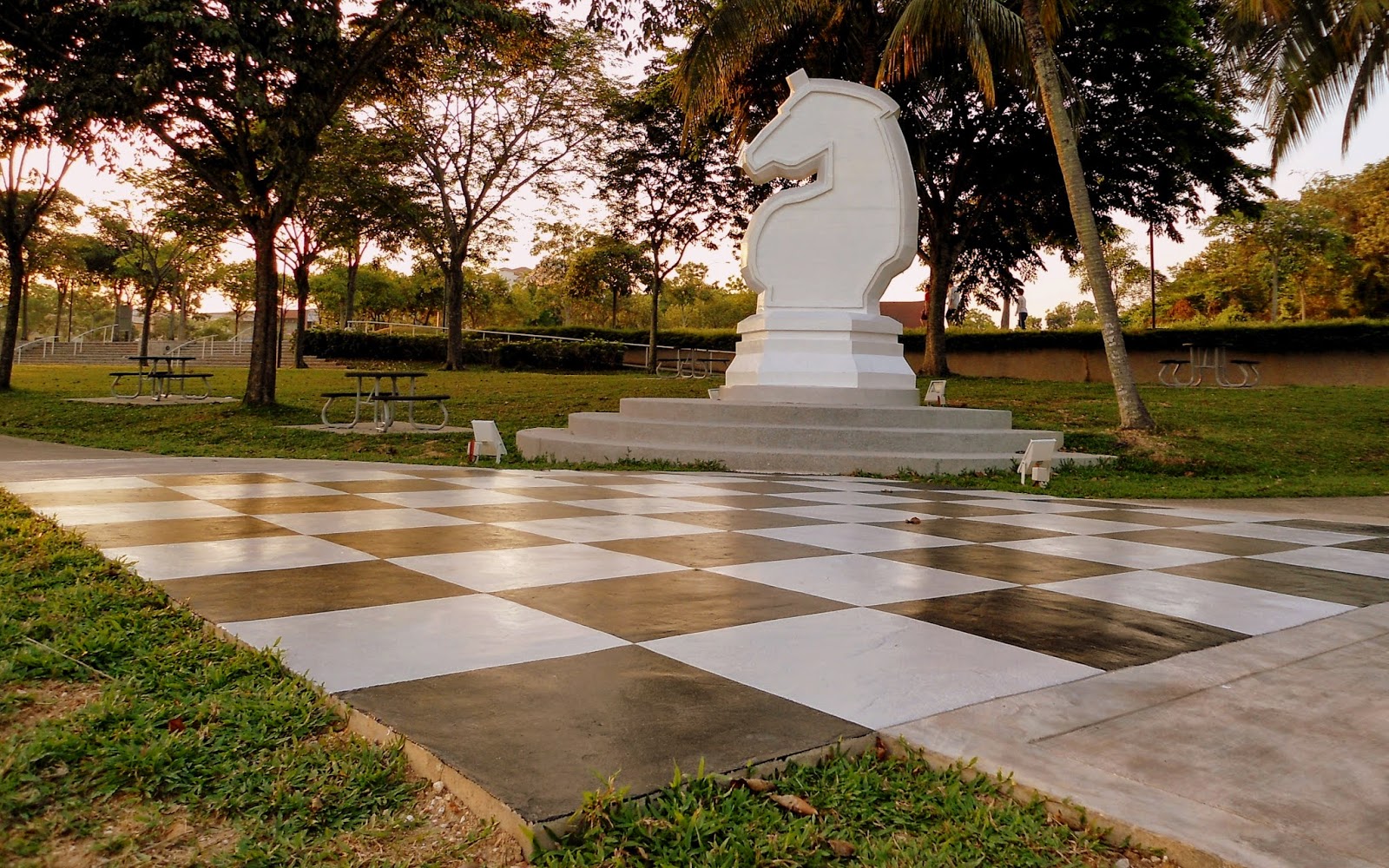
In the weeks that followed my visit to Seremban2, many curious people would have wondered why this 15-foot statue of a chess knight was being erected in that vacant space. But following its completion with no inkling of news on why the statue was there at all, curiosity has made way for quiet acceptance of its presence.

But of course, there is a purpose to this project. Very soon, I am told, possibly come the middle of May, there will be an official ceremony to dedicate this statue and the area around it to chess.

Chess may not be one of the more visible games in this country but I can assure you that the game has a sizable following. If we consider that:
  1. Chess is not exactly a spectator sport for the masses, 
  2. There are chess tournaments all year round ranging from higher-end internationally-rated tournaments for the more serious-minded players to the frequent much more popular lower-end rapid-chess tournaments that attracts 100 players on an average per tournament, 
  3. On the assumption that the chess population in the country consists of 10 percent hardcore chess players who have been playing the game all their lives, 25 percent of chess players who have been at the game for more than 10 years, 35 percent of chess players who have been playing the game for more than five years and the remaining being chess players who have competed in local chess tournaments (including at school level), and 
  4. There are unknown players who only play socially among themselves without ever participating in tournaments, plus an unknown number of people who read chess news off the Internet, 
  5. A growing chess coaching industry throughout the country ensures that more children, getting younger all the time, and their parents and guardians are getting exposed to the game,

Taking all the points above, I would venture to guess that the chess enthusiasts in the country would conservatively number around 100,000. A sizable following for a game that is not often in the public eye, and indeed, does not attract as much support from the Olympics Council of Malaysia as I feel it should.

But for all its grassroots popularity, chess does not have a local hero that the chess players can look up to. Considering that the Philippines have their Eugene Torre, India have their Viswanathan Anand and China have their Hou Yifan - and I'm quoting only three countries - Malaysia have none save for our five international masters. We have not grown beyond five because our culture does not permit state support or even provide ample recognition for our chess talents. Is it any wonder then, that our IMs do sometimes question whether it was really worth their while to have spent so much time in chasing their chess dreams and in return, benefit little or at the very least, see scant recognition for their efforts?


For the unheralded chess players in this country, there is now an attempt to give credit to these five international masters. If we need to grow our chess level, these five IMs should be the core of our development efforts. The country shall need to engage them in order for the game to progress further. By right, this should be the responsibility of the Malaysian Chess Federation but even after more than 40 years there is a perception that something is holding the federation back. By this perceived reluctance to fulfil their role and engage our titled players, private individuals and interested companies must instead step into the void created by the Federation.


Thus, I am glad that IJMLand is now prepared to step into this void. As starters, the public-listed company has erected this statue on their property, the Seremban2 city park. Come this May at the dedication ceremony, the company will unveil five park benches around the statue which shall honour our five international masters. Each of these benches will bear a caricature of a player and beside a chess board etched into the bench, will feature the player's most important game. To make this move meaningful, our five players have already agreed to lend their support to this project.

But while these will be the initial set of five park benches, it should not stop here. I am confident that IJMLand will be prepared to commit more of their benches around the statue to honour new international masters should more of our local players attain this title.

But what will happen if someone should go further and obtain the grandmaster title? I don't see this happening soon enough but when it happens, I would dare say that IJMLand may have other plans in mind to honour them. Who knows, perhaps naming their pavillions at their hill park that overlook Seremban2 after Malaysia's future chess grandmasters? When the time comes, that will be a fine gesture indeed.


Tuesday, 24 March 2015

My (close) brush with Lee Kuan Yew

This is my copy of The Singapore Story, the memoirs of Lee Kuan Yew who died yesterday.

I had bought it a long time ago, and possibly more than a decade has passed by already. This particular book of mine has a very remarkable story of its own. And I'm only willing to tell it only because this is a tribute to Singapore's founding father.

It started in June 2009, you see, about a year after the General Elections of 2008 which saw Penang and Perak falling into the hands of the Pakatan Rakyat. Lee Kuan Yew or LKY, the Minister Mentor of Singapore and who was already 85 years old, decided to embark on a tour of Perak, Penang, Kelantan and Pahang.

I was intrigued when I heard the news. Here was a great man whom I'd like to meet, if I can. But I couldn't. It wasn't in LKY's itinerary to meet people publicly. He only wanted to meet the people in government and talk with them. (Personally, I had thought that he wanted to come to Penang to gauge and assess the new state government for himself, and see whether Singapore could work with Penang on mutual projects. To me, it was a fact-finding mission. And I believe that I wasn't too far off the mark in my assessment.)

Undeterred, I asked a friend in the state government whether it could be possible for LKY to autograph my copy of his memoirs. I knew it was going to be a long shot because I had heard that very seldom he would sign his books and if he did, a sizable donation would have to be made to some charity of his choice. Anyhow, my friend said that he would try but gave no promises.

As it turned out, LKY could not autograph the book then and there as he would be leaving soon for Kelantan. But never mind, someone in his entourage told my friend to just leave the book with them and if they can catch LKY in a freer mood, maybe, just maybe....

So apparently, my book left Penang and went to Kota Bharu and from there, it travelled with the Singapore entourage to Kuantan before they arrived back in Singapore. A week passed. What had happened to my book? I didn't want to ask my friend about it because frankly, he wouldn't know either.

More weeks went by without a word. I waited and waited, until one fine day he asked me to collect the book from him. The book had come back from Singapore after all. It had travelled in a big triangle from Penang to the east coast of the peninsula and then down south to Singapore before returning to Penang. It had finished a remarkable trip.

I flipped open the book and there it was, Lee Kuan Yew's signature. Definitely, this will be a book for me to cherish. A precious book for me, and a book for my family. It wasn't easy to get his signature, and it is impossible now to get it again. Rest in peace, Lee Kuan Yew, you did well for Singapore.


Sunday, 22 March 2015

Solar eclipse 2015


There was a total eclipse of the sun on Saturday afternoon - starting from 3.41p.m. and lasting for about four hours - but it was not visible in my part of the world, South-East Asia. It was, however, seen from across the northern part of Europe especially above the Arctic Circle. Not having seen solar eclipses before, I had to scour the international news sites to experience this occasion. I wasn't disappointed because someone had decided to film the eclipse from an aeroplane. Wow, awesome!


Sunday, 15 March 2015

50 shades of pink


Today's post is all about the Tecoma flowers which have been blooming all over the place in my neighbourhood and in particular, along the road where I live. For about a week, I've seen the buds open into a glorious bloom of pink and I've seen the flowers wither and fall to carpet both the roadside, kerb and inside my porch.

I've been noticing that many people had chosen to walk along the road just to admire the trees in various shades of red, pink and white.

But while the flowers are beautiful indeed, sweeping away the fallen flowers have been a most tiring effort. The paper thin petals stick to the ground and while singularly the flowers are very light, they are quite heavy when swept together.

And I've been doing this both inside and outside the porch. I've bags full of wet and dry flowers to show as evidence, all waiting for the Municipal Council's garbage collectors to come and dispose off.

Earlier last week, I made a complaint through the Better Penang website that the Council sweepers have not been seen in my neighbourhood for a very long time.

More than a year ago, the Province Wellesley Municipal Council (MPSP) had terminated the services of their contractor. The MPSP had recognised that their appointed contractor hadn't been doing a good job and taken back the service of sweeping the roads and clearing the drains.

I hailed that decision because I had believed that the MPSP was serious enough about keeping their standards high to meet ratepayers' expectations.

Initially, I noticed sweepers coming round to my road on Wednesday mornings. But for several months already, the sweepers have been absent. I haven't been seeing them doing to rounds. Luckily, ours is a relatively responsible neighbourhood and our roads remain clear of falling leaves and other debris.

However with the Tecoma season upon us, I was concerned that clearing off the fallen flowers would become tedious. So I wrote to the Better Penang website.

Two days later, my wife noticed a group of men coming round to collect the heap of fallen flowers on the roadside. So she asked the supervisor why they hadn't been doing their jobs for so long and the answer she got was that there was shortage of manpower at the Council.

Shocking indeed! It's gross inefficiency for us ratepayers to suffer the manpower shortage at the MPSP with the Council taking little visible effort to address the issue. At least, that's my perception of the problem.

Thankfully today, eight days after the first flowers had bloomed, almost all of them have fallen off the branches, leaving behind a tree bereft of flowers and leaves. It is as if autumn had arrived in my neighbourhood except that the Chinese New Year weather remains hot, humid and stuffy.