Saturday, 27 March 2021

Canggih chess

I had forgotten all about this picture, which I had posted to facebook 10 years ago, until it was shared again recently by Mok Tze Meng. Quite rightly, it has stirred up a lot of old memories within the Penang chess circle. Among a small group of chess friends, they have been asking when this picture was taken and what was the occasion. 

Those in the picture were, from left, Wong Zi Jing, Ronnie Lim Chuin Hoong, Mok the winner, Dr Toh Kin Woon who was partially hidden behind Mok, an unusually very smartly dressed Agus Salim and a lady known as Rohani bt Ismail, representing one of the sponsors. 

Zi Jing now works in Texas A&M University while Mok coaches chess full-time to kids. Ronnie is a radiologist in Penang Hospital. Dr Toh is a retired Penang state executive councillor and was once the President of the Penang Chess Association. Agus Salim was once the scourge of chess players in the Klang Valley. He is now deceased.

But finally, it has been confirmed that this was the Canggih international open chess championship that was held in 1997 to celebrate the 25th anniversary of the Penang Chess Association. I remember this event well because I was the one negotiating for the venue from Wah Seong Trading (M) Sdn Bhd and sponsorship from KUB Tekstil Sdn Bhd which still manufactures school uniforms under the Canggih brand today.

Anyway, I did make a brief report about this tournament in my then fortnightly column in The Star on 02 January 1998. Just managed to dig it out from my online archives and I'd like to repeat it here, with some minor alterations, of course!

Mok Tze Meng outpaced a field of 71 players to win the first prize of RM3,000 at the PCA Canggih international open chess championship in Penang last week on 28 Dec 1997. He shrugged off an early second-round loss to score 7.5 points from nine games. In second place was Agus Salim who obtained seven points and won RM2,000.

Five players finished the tournament with 6.5 points each: Lim Chuin Hoong winning RM1,000, Wong Ji Zing RM800, international master Jimmy Liew RM600, Mak Weng Yee RM400 and Ismail Ahmad RM300. The eighth prize of RM200 went to Julian Navaratnam who was the best scorer among a group of players with six points.

The prizes for the five best Penang players went to Tan Eng Seong, Wong Chee Chung, Chuah Heng Meng, Khor Shihong and Khor Bean Hwa. Woman Fide master Angela Khegay of Uzbekistan and Lim Jean Nie won the prizes for the two best woman players, while the under-18 prizes went to Lim Yee Weng and Ng Tze Han. Teng Wei Khoon and Deon Moh won the under-15 prizes.

Among the 71 participants were three players from Indonesia, two from Brunei, and one each from Uzbekistan, the Netherlands, India and the Philippines.

The prizes were given away by Penang state executive councillor Dr Toh Kin Woon who is also the president of the Penang Chess Association, Dr Choong Sim Poey who is a former president of the association and Puan Rohani Ismail, the business manager of sponsor KUB Tekstils Sdn Bhd.

KUB Tekstils, manufacturer of the Canggih brand of garment wear that includes tracksuits and a complete range of school uniforms and accessories, had sponsored RM20,000 towards the running of the four-day event which was held at the MarVista Resort in Batu Ferringhi, Penang from Dec 25 to 28.

The other sponsors of the event were DMV Sdn Bhd, WWT Communications Sdn Bhd and Star Publications (M) Bhd. 

Friday, 26 March 2021

Alexandr Solzhenitsyn

I was going through my collection of books and rediscovered some nine books by Alexandr Solzhenitsyn, winner of the Nobel Prize for Literature in 1970. I had been reading his books on and off for about 10 years, starting with One Day in the Life of Ivan Denisovich around 1975. I got to know of Solzhenitsyn after he was expelled from the Soviet Union in 1974. It was big news in those days and it started my interest in Soviet literature and story books. The last Solzhenitsyn book I bought was The Gulag Archipelago Volume Two. I never got round to reading the third volume of Gulag because by then, I was already well immersed into my career and at the same time, trying to settle down into a family life.

One Day in the Life of Ivan Denisovich This crisp, shattering glimpse of the fate of millions of Russians under Stalin shook Russia and shocked the world when it first appeared. Krushchev himself, during the Russian thaw, is said to have authorised the publication of this spare, stark description of life in a Siberian labour camp. (Summary on back cover)

For the Good of the Cause Set in a new provincial school, this is a scathing indictment of the victimisation of ordinary, decent people by Soviet careerist bureaucrats. Solzhenitsyn presents the conflicts between right and wrong, between the freedom of the individual and the harshness of the system with absolute sincerity and conviction. (Summary on back cover)

The First Circle It is the tome of this huge book that is so marvellously new. It has no villians in it - which many people may think shows incredible tolerance. It shows something else, really - that when the world is reduced to guiltless criminals, freaks, narks, nuts and placemen, a loud laugh is more crushing than a howl of agony. (Nigel Dennis, Sunday Telegraph)


Cancer Ward Solzhenitsyn, like Oleg Kostoglotov, the central character of this novel, went in the mid-1950s from concentration camp to cancer ward and later recovered. The British publication of Cancer Ward in 1968 confirmed him as Russia's greatest living novelist although it has never been openly published in the Soviet Union. (Summary on back cover)

The Love Girl and the Innocent Drawing on his personal experience, the Nobel Prize-winning author sets this play in a Stalinist slave camp in 1945. His vivid dramatisation creates a terrifying picture of the despair and degradation suffered under a merciless camp regime. (Summary on back cover)

August 1914 Solzhenitsyn's August 1914 is what it promised to be - a classic of contemporary world literature... We can only marvel at the sweep and power of this epic work written in isolation by a man of unbreakable spirit (John Barkham, New York Post)

We Never Make Mistakes brings together Solzhenitsyn's two most famous novellas, Incident at Krechetovka Station and Matryona's House, both of which were first published in the prestigious Russian literary magazine, Novy Mir, in 1963. Both stories form part of the larger canvas in which Solzhenitsyn describes the havoc brought on human dignity by Stalin's bureaucratic and secret police. The title of the book is taken from the concluding remark of a NKVD investigator in this story. (Summary on back cover)

The Gulag Archipelago is a key work unparalleled in Russian or any other national literature. Solzhenitsyn has created it from his own experience of imprisonment and forced labour, and from that of numerous victims of Stalin's Terror and of Soviet prisons and labour camps. The result is a unique and startling national epic that presents the suppressed history of a vicious epoch and clearly documents the system that deformed or destroyed the lives of millions. (Summary on back cover)

The Gulag Archipelago Volume 2 With this publication, Solzhenitsyn's staggering achievement becomes more apparent: he has created an enduring and brilliant literary monument to the victims of one of the most monstrous crimes against humanity ever committed and the most complete account of the history, function and scope of the concentration camp system yet written. (Summary on back cover)


Sunday, 21 March 2021

No Cheng Beng again

One of the trustees of the Swee Cheok Tong Quah Kongsi also sits on the board of the United Hokkien Cemeteries in Penang. This United Hokkien Cemeteries is just one of 18 associations that owns vast areas of cemetery land strewn around the mainland and island, but they are possibly the biggest in Penang. 

When word went around last week that the Federal Government had relaxed the Movement Control Order regulations for four weeks to enable the Chinese community to carry out their Cheng Beng obligations - with certain strict procedures to be observed - I had some doubts about its practicality. How would this news affect people like me who are fearful of too many people around us ?  

Thankfully, I don't have to visit the columbarium at Batu Gantong where my parents' urns are located. Whenever I step inside the building, I feel so stifled. Maybe I'm claustrophobic. But I still have my grandparents' graves in Batu Lanchang and the Wat Pimbang On in Green Lane, which I don't mind going at all. However, I wouldn't want to visit these cemeteries if the crowd control was lax or non-existent. And I don't see how the United Hokkien Cemeteries and the Siamese temple committee could effectively control the people visiting their respective cemeteries.

My fellow trustee told me that the United Chinese Charitable Cemeteries Board, the umbrella body of the 18 associations, would be meeting to discuss the best way forward in this matter. True enough, this Board met yesterday and they made a quite unprecedented announcement that for the second year running, the cemeteries under their care would remain closed for the full duration of the Cheng Beng period. Read the report in The Star newspaper here.

Traditionally this would mean from 26 March until 13 April this year as the actual Cheng Beng day fall on 4 April, but I suppose the period even the cemeteries will remain closed will be from 21 March till 17 April as relaxed by the government.

For me, this shall be the second time then that I shall have to carry out my Cheng Beng worship at home. There won't even be an opportunity to spruce up the graves: clearing them of the over-grown weeds although I've already commissioned two persons to clean them up for me. For this year, just pray at home again.

Meanwhile, I suppose people can still go to the temples or clan associations to pay their respects at the memorial tablets of their ancestors. But it is best to check up with the respective temples or clan associations, such as the Than Hsiang Temple in Bayan Baru which will allow prayers by proxy. But many others will not share the same opinion and they may still not want to open their doors to visitors, especially during this Cheng Beng period.


Thursday, 18 March 2021

Old George Town

A few days ago, this image of old George Town in the 1920s or 1930s popped up on my facebook feed. The main thoroughfare in the image was that of Downing Street. The domed building belonged to the Hongkong and Shanghai Bank before it was demolished after the Second World War. Indeed, both the buildings on the left have been demolished too to make way for the Bangunan Tuanku Syed Putra which opened in 1962. On the right, the single-storey building and the building in the foreground have disappeared too and an open-space carpark occupies the space. But the building in the background on Beach Street still stands today. It used to be occupied by The Chartered Bank but no more, the bank (now Standard Chartered Bank) having moved further up Beach Street to new premises. 


The picture rather intrigued me and made me scour the Internet for some old images of London and came upon this one of Piccadilly Circus looking down into Regent Street in the 1920s. It's amazing how much parts of old George Town had looked like London in the past, what with similar vintage cars moving on the streets.


Finally, I's like to compare the first image with a picture of today's George Town. This picture below was taken from Google Streetview, practically from the same viewpoint but a little elevated. The building on the left is the Bangunan Tuanku Syed Putra.


Wednesday, 17 March 2021

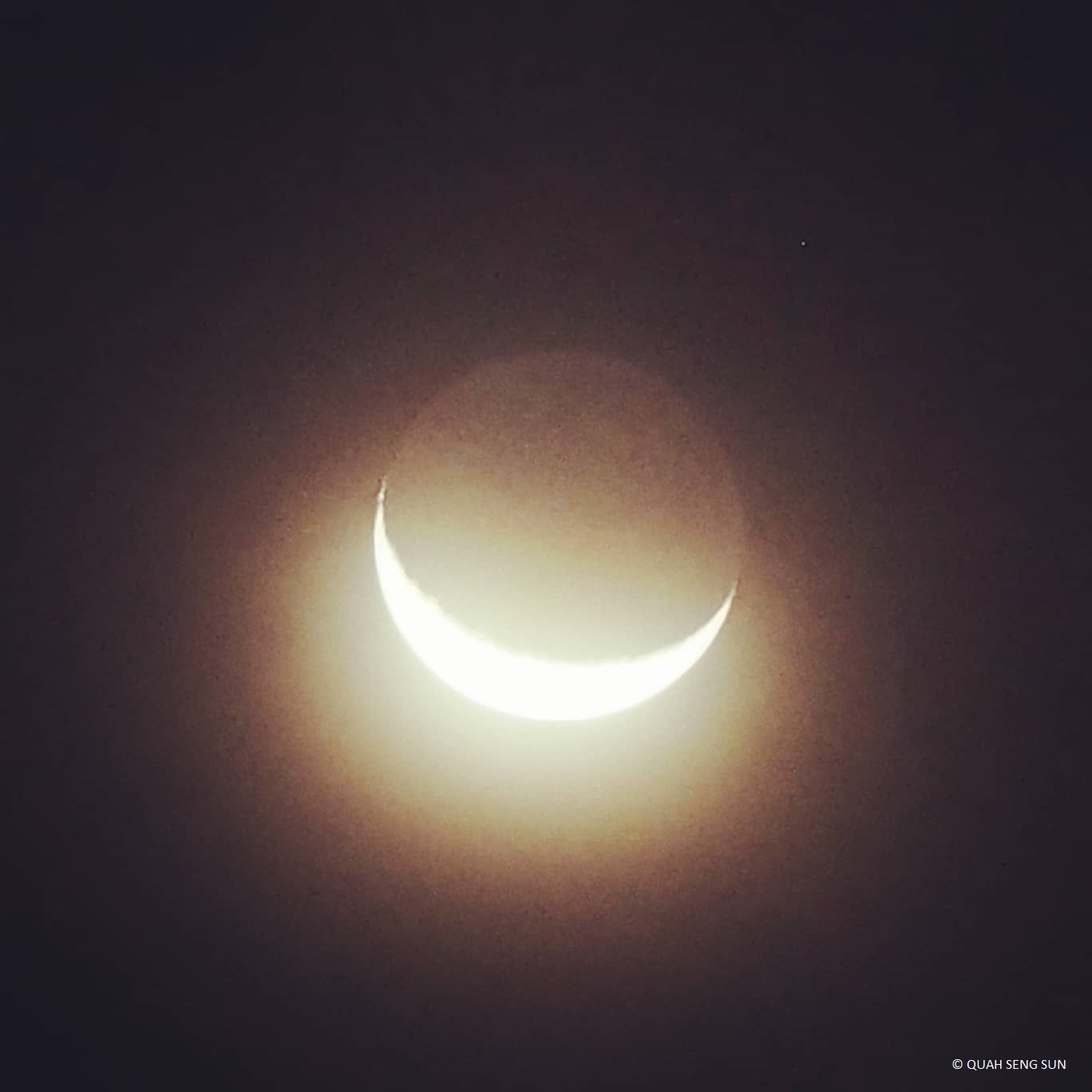
Crescent moon

Tonight is already the fifth day of the second Chinese lunar month. The moon is still a thin-enough crescent, about 15 percent illuminated, but it is slowly but surely waxing.

(Note: Just because 85 percent of the moon is not illuminated does not mean that it is not there!)


Getting an award

It's been a week since I was at the Penang Institute grounds to celebrate the 142nd anniversary of the birthday of Dr Wu Lien-Teh on 10 March 2021. But that date had a bigger significance for me; a greater reason to celebrate, and all thanks to the good doctor and the society which was formed in January 2013 to honour him, the Dr Wu Lien-Teh Society.

Early last year, the secretary-general of the Society had submitted my name - together with Clement Liang who is the Society's treasurer - to the state government for a Governor's annual award. For a long time, no news was received from the government, partly also due to the coronavirus pandemic that can forced the country into various stages of a lockdown. The Society had also submitted the name of the president, Anwar Fazal, to receive a Dato' Seri title from the state government but for that sort of high-level award, a recommendation from someone who was already a Dato' Seri was also required. 

Then in November last year, I received an official notification that I would be awarded a Pingat Kelakuan Terpuji (PKT) and was asked to collect the medal on the 19th of January this year. But no, I won't be receiving it directly from the Governor. Because of the pandemic, he won't be there to pin the medal on me or any of the recipients. 

Anyway, about 10 day before this date, someone called from the state government to inform me that the ceremony was postponed and would be held on the ninth of February. The new date was fine with me although it was clearly too close to Chinese New Year.

Penang was then badly affected by a second surge of coronavirus infections and was placed under another lockdown. And so, I was informed again by the state government of yet another postponement. Finally after weeks of delay after delay, another official notification came in early March to say that the award ceremony would now be held on the 10th of March. I breathed deeply on seeing this date. Significantly, of course, there was never a more appropriate date than this to receive an award that had been recommended by the Dr Wu Lien-Teh Society itself. So I've to thank the Society again for the nomination.

Incidentally, this PKT award comes 25 years since I was given a Pingat Jasa Kebaktian (PJK) award by the state government in 1995 for my contributions to chess in Penang. That recommendation had come from the Penang Chess Association when Dr Choong Sim Poey was still the president. As I had not expected to receive another award since then, this PKT comes with a lot of personal satisfaction indeed. Perhaps I shall have to wait another 25 years before a third award can come my way. 😁

Tuesday, 16 March 2021

Ten Thousand Prosperities (萬興利) - Part 3


Since my last update on this book project more than a month ago, many things have been going on in the background. Comparing the laid-out text against my edited draft has been one of them and I have subjected this to two full rounds of checking. It has been a tedious and most exhausting task. No doubt, there'll surely be one or two mistakes that are bound to be detected before the book goes out to the printers. Together with the checking, there have also been some minor edits made. 

My publisher and editor are also going through the book with a fine toothcomb. My editor, especially, has the unenviable task of preparing the Index section of the book. I had thought this would be easy but it isn't. Firstly, you have to extract all the possible words for the Index and then decide whether each one would be relevant for inclusion. After that, fill in the page numbers where the word appears in the book. Again, this is another meticulous task. 

But certainly, we are marching right towards the end of the tunnel. We shall get there soon. Final piece of the jigsaw: awaiting the design of the book cover from New York and hopefully, by the end of the week, the layout artist will be able to piece everything together.


Sunday, 14 March 2021

Two giants of science

Interestingly, the 14th of March marks the anniversaries of both the birth of Albert Einstein in 1879 and the death of Stephen Hawking in 2018. Today is also recognised as Pi Day in honour of π, that irrational number with no end and no permanent repeatable sequence, which during schooldays was always approximated to the fraction 22/7.


Thursday, 11 March 2021

Wu Lien-Teh birthday anniversary activities

On the tenth of March every year, the Dr Wu Lien Teh Society would organise some activity or function to mark the anniversary of this renown gentleman's birthday. For 2021, the 142nd anniversary of his birth, we decided a few weeks ago to have a tea gathering on the grounds of the Penang Institute where there is a bust of Wu Lien-Teh. 

We were planning a soft launch of the second reprint of his auto-biography, Plague Fighter, which is now out-of-stock in the bookshops. In the first reprint several years ago, 1,000 copies were printed but we had not anticipated the immense interest shown in this book. Obviously, the Covid-19 pandemic had added to the demand because of the N95 face mask. There were also plans to video-tape the committee members reading short excerpts from this book which would then be uploaded to the website. My contribution was to read from a newspaper report on his death in 1960.

Then on Tuesday, the Society's president, Anwar Fazal, informed us that Salma Khoo would be offering us a herbal plant to remember Wu Lien-Teh's work on traditional medicine. This would be planted near the bust at Penang Institute. With these going on, these were already quite a lot of activities lined up for the gathering.

We awoke on the 10th morning to a lot of excitement. People who had logged into the Google homepage were intrigued to see a doodle of Wu Lien-Teh on the Google search page. Google's explanation of this doodle

Today's Doodle celebrates the 142nd birthday of Chinese-Malaysian epidemiologist Dr Wu Lien-teh, who invented a surgical face covering that is widely considered the precursor to the N95 mask.

Born into a family of Chinese immigrants in Penang, Malaya (modern-day Malaysia) on this day in 1879, Wu went on to become the first student of Chinese descent to earn his MD from Cambridge University. Following his doctoral studies, he accepted a position as the vice director for China's Imperial Army Medical College in 1908. When an unknown epidemic afflicted north-western China in 1910, the Chinese government appointed Wu to investigate the disease, which he identified as the highly contagious pneumonic plague that spread from human to human through respiratory transmission. 

To combat the disease, Wu designed and produced a special surgical mask with cotton and gauze, adding several layers of cloth to filter inhalations. He advised people to wear his newly invented mask and worked with government officials to establish quarantine stations and hospitals, restrict travel, and apply progressive sterilization techniques; his leadership contributed greatly to the end of the pandemic (known as the Manchurian plague) by April 1911—within four months of being tasked with controlling its spread.

In 1915, Wu founded the Chinese Medical Association, the country’s largest and oldest non-governmental medical organization. In 1935, he was the first Malaysian—and the first person of Chinese descent–nominated for the Nobel Prize in Physiology or Medicine for his work to control the pneumonic plague. A devoted advocate and practitioner of medical advancement, Wu’s efforts not only changed public health in China but that of the entire world. 

Happy birthday to the man behind the mask, Dr. Wu Lien-teh! 

By mid-morning, the doodle had created a lot of buzz in the country. Suddenly, people wanted to know more about Wu Lien-Teh. We were getting a bit flustered by the attention created by this doodle, not that we minded. But something else was happening in Penang that we were unaware of. 

According to the grapevine, several news media began contacting the Chief Minister's Office to ask what the state government was doing to commemorate Wu Lien-Teh's birthday. I heard that the Chief Minister, Chow Kon Yeow, was caught by surprise. He had little idea of the significance of this date and was unprepared for it. In a half-panic, his Office contacted the Penang Institute to find out more and was told, "We have the solution. Please come to the tea gathering at the Penang Institute this afternoon at 4.30pm to find out more. And that was why when my wife and I turned up at the Penang Institute at about 4.45pm yesterday, we were bemused to see the Chief Minister there together with lots of media people covering the event.

Among them was a television crew from Astro Awani. Meanwhile, the Astro AEC channel also wanted to conduct an interview with the Society through Zoom. So suddenly, they had a stroke of luck as the Chief Minister himself could be interviewed on the very same topic of Wu Lien-Teh and at the same time, witness him doing the soft launch for the book's reprint. 

I shall now take the liberty to share a summary report by the Secretary-General of the Dr Wu Lien-Teh Society, Dr Hor Chee Peng, regarding the activities held yesterday at the Penang Institute.

Today marks a special day for us to celebrate the iconic legend, Dr Wu Lien-Teh, the internationally acclaimed plague fighter in China and a visionary public health physician standing up for social justice and community development. His life story and heroic achievements have remained as an inspiration and set the standard for generations of doctors to come.

It has been more than a year since the Covid-19 outbreak started in Wuhan and became the pandemic affecting every one of us in unprecedented scale. Dr Wu left a legacy in his initiative approach in containing the plague epidemic from strict isolation policy, movement control practices and orders, disinfection, and the historic mass cremation in the history of China, through his tough fights with authority for the community. 

We are celebrating his birthday, reflecting from his life journey and learning from his legacy, not only as a visionary, courageous public health physician, but a highly intellectual and wise person which has much to offer to the society ranging from anti-racism, anti-opium to advocating primary education for girls back then.

There were series of activities the Society has conducted today:

(a) A small tea party at the Dr Wu Lien-Teh Garden in Penang Institute with his bust donated from University of Harbin, China. A few of us were present physically, of course, all masked up with good physical distancing. We were honoured with a surprise visit from our honourable Chief Minister of Penang, Mr Chow Kon Yeow. His presence acknowledged the recognition of the Penang State Government for Dr Wu's extraordinary contributions to the world and his legacy. Besides, we also had Ms Alison Chong, Vice-President of the Society and Great Grandniece of Dr Wu, joining us virtually from Singapore to celebrate this special day.

(b) Planting a herbal plant (Senna alata, or known as the ringworms shrub) in the Dr Wu Lien-Teh Garden to commemorate his passion and works for the traditional and complementary medicine. Dr Wu Lien-Teh co-authored the History of Chinese Medicine with Dr Chimin Wong. The plant was donated by Mdm Salma Khoo, one of the founders of the Society, and our beloved President, Dato’ Seri (Dr.) Anwar Fazal. We planted it with love and look forwards to seeing it being nurtured to blossom in years to come! 

(c) Soft launching of the second reprinting of Dr Wu’s autobiography, Plague Fighter: The Autobiography of a Modern Chinese Physician in 2021 conjunction with his 142nd birthday anniversary in midst of a global fight for the Covid-19 pandemic. The current copy is out of stock. A thousand copies of reprint is in progress!

(d) Launching the book reading session from the autobiography to share the stories and reflections from Dr Wu's life journey. There were several book reading sessions of variable lengths recorded by various committee members of the Society and they will be uploaded from time to time!

Last but not least, the blast of the day was Dr Wu being featured in Google Doodle! Many of our friends and colleagues texted us with words of motivation and filled with joy! It was great to learn that the great-grand-daughters of Dr Wu, namely Dr Shan Woo- Liu and Dr Ling Woo-Liu, worked in partnership with Google for this project. Dr Shan Woo-Liu is also our life member of the Society and an Associate Professor of Emergency Medicine from Harvard Medical School.

In a single day, Dr Wu received such an enormous attention throughout the world from various media platform locally and internationally - such a long overdue recognition!

These were the activities for today. Stay tuned for more! Do follow our facebook page, https://www.facebook.com/wulientehpg , and website, www.wulientehsociety.org , for more updates!


Finally, here is a link to a video which had been uploaded by Astro AEC to their youtube channel. It's in Mandarin but the message should be clear to everybody watching.


Wednesday, 10 March 2021

142nd birthday

I shall be celebrating Dr Wu Lien-Teh's 142nd birthday this afternoon on the grounds of the Penang Institute in Brown Road, George Town, where a bust of this real Malaysian hero stands.


And for good measure, Wu Lien-Teh is featured today on Google Doodle. Anyone visiting the Google homepage will be greeted with this image:


In celebration of his birthday, The Star newspaper wrote this about Wu Lien-Teh:

PETALING JAYA: Google on Wednesday (March 10) paid tribute to Chinese-Malaysian epidemiologist Dr Wu Lien-Teh, who created a surgical face covering widely believed to be the precursor of today's N95 mask. To celebrate his achievements, Google dedicated its Doodle to Dr Wu on the doctor's 142nd birthday.

 More of this story can be read here.


Tuesday, 9 March 2021

All in one frame

I woke up a bit later than intended this morning and had no time to go hunting for a better place to do some dawn planet gazing than right in front of my house. Hence, the unfortunate electrical pole in the picture. I did walk to the road junction about 50 metres away but the street lights were too glaring. Only the crescent of the waning moon was prominent enough. So back to the front of my house. Stood in the shadow of a tree to adjust myself and there they were: pinpricks of light, lining up roughly in a straight line leading from the moon, namely in order, a dim Saturn, then a bright Jupiter, and followed by an equally dim Mercury. All in the same picture frame. 

The image has been digitally manipulated, of course, to increase the contrast so as to reveal the three planets better but the process has also shown up a lens flare because my aperture size was held fully wide to capture as much of the dim light as possible.


Sunday, 7 March 2021

Real news

Back in the old days, the mainstream news media do actually report on real news once in a while (as one of my chess friends would say tongue in cheek). This was the front page of The Star newspaper on 19 October 1978 although for the most part, the news media generally ignored news items on chess. 

In 1978, I was already working in Ban Hin Lee Bank and had left behind my friends from National Echo (previously known as Straits Echo Press). Nevertheless at the end of each day, during the course of the match between Anatoly Karpov and Viktor Korchnoi, I would drop by the newspaper firm to see the guys in the teleprinter room and pick up the unwanted chess stories from the waste basket. "You can have them," they told me because the sub-editors did not consider the day-by-day chess reports from the news wires (AFP and others) newsworthy enough for print. Not even when Karpov won the match. So I had amassed a big collection of the stories from this match. Only The Star thought it significant enough to report the end of the match on their front page (see below).


Saturday, 6 March 2021

Another conjunction


I had set my alarm for 6.15am this morning. By 6.30am, I was already out of the house, driving to the nearby market where I could see - and wanted to see - a wide open sky. My only hope was that the sky would be clear and without clouds. I was lucky: the sky was clear and high above me was the waning moon.

But it wasn't the moon that I wanted to see. Rather, it would be two pinpricks of light in the east which would be bright enough to pick out. It took me several seconds to get my bearings right and to have my eyes accustomed to the dark sky. But eventually, I saw them hovering ahead of me, due east.

Yes, those would be the conjunction of two planets: the dimmer Mercury and the brighter Jupiter. Only the second time that I had managed to catch a sight of Mercury at dawn or dusk but this time, it was easy because of the nearby Jupiter in the sky. Not that Jupiter is actually close to Mercury. Far, far from it. But because their apparent positions in the sky were so close together, a conjunction of the planets, it was easy to pick the smaller planet out.

So there they were: Mercury and Jupiter. The even dimmer Saturn was also lurking nearby but my camera simply could not detect it at all. Well, I shall have to be contented with what I saw. After the great Jupiter-Saturn conjunction last 21 December, being able to observe this lesser-publicised Mercury-Jupiter conjunction coming just 2½ months later was definitely a big bonus.

An update: The above picture was taken at 6.45am. By the time I arrived home, I could no longer see the planets or even the moon. Thick clouds had rolled in....

Another update: I have to utter an oops here because I had cropped the above image too much and had taken out Saturn. Below is another image where I've now included all three planets within the frame. 


Sunday, 28 February 2021

An inspirational poem

INVICTUS
William Ernest Henley

Out of the night that covers me
Black as the pit from pole to pole,
I thank whatever gods may be
For my unconquerable soul.

In the fell clutch of circumstance,
I have not winced nor cried aloud.
Under the bludgeonings of chance
My head is bloody, but unbowed.

Beyond this place of wrath and tears
Looms but the Horror of the shade,
And yet the menace of the years
Finds, and shall find, me unafraid.

It matters not how strait the gate,
How charged with punishments the scroll,
I am the master of my fate:
I am the captain of my soul.

Friday, 26 February 2021

Have a Pengat today

Pengat, that sweet dessert that's the hallmark of a Penang Straits-born or Nyonya family, is normally cooked once a year to mark Chap Goh Meh which is the fifteenth day of Chinese New Year. This year, my family decided to share our Pengat with the Buddhist monks of the Nandaka Vihara meditation society in Bukit Mertajam.

In the video below, one of my ex-colleagues from the Ban Hin Lee Bank days, Jack Ong, shares his agak-agak method of cooking pengat. I must say that his method largely mirrors the style of my own family, which goes back at least four generations. My mother cooked it this way too, same as her mother and her mother's mother. Like Jack Ong and many other Straits-born families, we use only white sugar and not gula Melaka in our recipe. But I must try his style next time by putting in the purple tuber last.

Note: Because of the second wave of the Covid-19 pandemic that has been raging in Malaysia since last September, my Kongsi has not been able to celebrate Chap Goh Meh with the usual worship session. Everything has been very low-key and scaled down, including the amount of food and fruits offered to the deities and ancestors, and this year's worship was attended by only me and my Vice-President.


Saturday, 20 February 2021

The sports houses of Penang Free School

Last Monday (15 Feb), I was contacted by Reena Sekaran, a journalist with Free Malaysia Today, who wanted to do a story on the sport houses of Penang Free School. Of course, I obliged her. Nothing less that I can do when it comes to The Old Lady herself. 

We spoke for about 10 minutes, during which time I fed her with all the information she needed for her story. By the way, she has also done a lot of homework herself too and she told me that as an Old Girl from St George's Girls' School, with a brother that had also studied at Penang Free School, she was quite familiar with Penang. So it was quite a pleasant conversation and I promised to send her some pictures to accompany her piece.

Today, I discovered that her story on the sports houses of Penang Free School was already published in the Leisure section of Free Malaysia Today. Here is the link to the story, but I shall want to reproduce it here too.


Legacy of Penang Free School’s sports houses lives on

Reena Sekaran @ FMT Lifestyle -February 20, 2021 7:30 AM

Penang Free School, the oldest English-medium school in Southeast Asia. (Quah Seng Sun pic)


PETALING JAYA: If you grew up in Penang, you’d have heard of the constant rivalry that existed between the schools on the island. Parents, teachers, students – all joined in.

“My son studies in Penang Free School,” mothers would proclaim, noses up in the air, eyes ablaze.

Established in 1816, this 205-year-old school has produced many a notable figure including Malaysia’s first prime minister Tunku Abdul Rahman, legendary artist P Ramlee and world-renowned physician Wu Lien Teh.

The school also has the honour of being the oldest English-medium school in all of Southeast Asia.

However, up till 1928, sports houses were non-existent.

According to Quah Seng Sun, author of Let the Aisles Proclaim, a biography that commemorates the once-in-a-lifetime Bicentenary celebrations of Penang Free School, students were originally grouped by age.

The school has eight sports houses, named after headmasters, teachers and students. (Quah Seng Sun pic)

Quah tells FMT that it was headmaster D R Swaine who made the move to introduce the house system in 1928. There were five in total – Hargreaves (Brown), Pinhorn (Blue), Hamilton (Yellow), Cheeseman (Red) and Wu Lien Teh (Green).

Interestingly, the first three sports houses were named after Swaine’s predecessors.

William Hargreaves was the first academically qualified headmaster for Penang Free School in 1891 and ended his career as a headmaster in 1904.

He was replaced by Ralph Henry Pinhorn, who took charge of the school till 1925. When Pinhorn retired owing to ill health in 1925, William Hamilton became headmaster till 1926.

The next time you find yourself in Penang, look up Pinhorn Road, Hargreaves Road and Hamilton Road, all named after these three well-respected and much-loved headmasters.

Penang Free School. Quah Seng Sun pic)

The fourth sports house, Cheeseman, was named after a teacher who taught in the school itself – Harold Ambrose Robinson Cheeseman.

He joined the teaching staff in 1907 and remained at the school for 15 years. While here, he produced the school’s first ever school magazine.

By the time he retired from the Malayan civil service in 1948, he had risen in rank to Director-General of Education, Malaya.

If you’re familiar with the roads in Penang, there is a road named after him, Cheeseman Road.

A bust of Dr Wu on the grounds of the Penang Institute. (Quah Seng Sun pic)

The Covid-19 pandemic definitely brought to light the many accomplishments of Penang-born legendary plague fighter Dr Wu Lien Teh, who designed a face mask that eventually became the N95 mask.

In 1935, he was nominated for the Nobel prize for his fight against the 1910 Manchurian plague and for identifying the role of tarbagan marmots in the transmission of the disease.

And yes, this brilliant scientist was a scholar at Penang Free School, receiving his primary and secondary education here.

However, he never forgot his roots and would make numerous visits back to his alma mater to deliver talks and lectures to students.

A road near the school has been named after him – Wu Lien Teh Garden.

The sixth house, Tunku Putra (Orange) only came about in 1967 after the school celebrated its 150th anniversary.

The library was the brainchild of the nation’s first prime minister, Tunku Abdul Rahman. (Quah Seng Sun pic)

Tan Boon Lin, who was the headmaster then, announced the formation of this new house in conjunction with the nation’s first prime minister Tunku Abdul Rahman, who was also the guest of honour at the celebration.

Tunku who is an old Free himself contributed to the construction of Kutub Khanah Tunku, Penang Free School’s first ever library. This was in 1969.

Fastforward to 2009 and two final sports houses were introduced by headmaster Haji Ramli Din. These were Tuanku Syed Sirajuddin (Purple) after the Raja of Perlis Tuanku Syed Sirajuddin Syed Putra Jamalullail and P Ramlee (Grey).

Interestingly, both Tuanku Syed Sirajuddin and P Ramli, Malaysia’s silver screen legend, studied together here.

Penang Free School has a rather interesting phrase, ‘Once a Free, Always a Free’. It’s not hard to see why.

Thursday, 18 February 2021

Seventh day of Chinese New Year

Traditionally, the seventh day of Chinese New Year refers to the birthday of mankind which the Chinese in Penang, typically the Nyonya community, celebrate with a yellow rice noodle dish called Lam Mee, comprising ingredients including bean sprouts, shredded omelette, sliced pork belly, prawns and sometimes fish ball. The broth is made from boiling pork bones, meat and prawn shell. My wife and I served this dish to the Theravadin monks at the Nandaka Vihara meditation centre in Bukit Mertajam for their lunch today.


Wednesday, 17 February 2021

My Chinese New Year tradition

One of my Chinese New Year traditions - I don't know whether any other household practices it or not - is to give the image of Kuan Imm on the altar an annual symbolic cleansing. About two or three days before the New Year, I would place the stone image in a pool of fragrant water and slowly pour cupsful of the scented water over it. But don't ask why I do it. This has been practiced in my family for a very long time...since the days of my grandmother. I don't question it as it's actually quite therapeutic for me. For a reason, I find myself relaxed after completing this ritual. 


Sunday, 14 February 2021

An exceptional Chinese New Year

Well, this has been a pretty much exceptional Chinese New Year in the midst of a pandemic that seems to be abating world-wide but not here in Malaysia. Infections are raging in the community and until the vaccination programme kicks off in March or April, I do not see the numbers decreasing until then. My age-group puts me squarely in the second stage of the programme which should begin from May this year but my wife will not be able to get hers until much later as she will be in the third stage when the rest of the population will get their chance.

So how more exceptional is this Chinese New Year? For one, there's this silly sohai Minister who had set the rules for this year's family gatherings and reunions. Only members of the same family staying in the same household can hold their Chinese New Year Eve reunion dinners. What crap. That's no difference from a normal lunch with all your family members on a normal day. That's gross stupidity for you, courtesy of an idiot who doesn't understand the culture of the rest of the people in the country, the product of a skewed education.

Anyway, I'm thankful that my son can still be with us at the reunion dinner even though my daughter cannot. I do miss her physical presence terribly, same with my wife, and we're hoping for the day when the movement control order is relaxed enough for her to come home for a visit. She's working in the Klang Valley and had to celebrate her Chinese New Year with friends instead.

But although it is a quieter and more sombre Chinese New Year, we still needed a reunion dinner with at least the son. Therefore, the cooking and the preparations. We tried to cut down on the amount of food, seeing there were only three of us at the dinner table, but it seemed almost impossible to do that. We still had to buy the ingredients for a reasonable dinner, meaning, we had to have the too tor soup, jiu hoo char, roast chicken and stir-fried prawns. Our son brought back some roast pork from the island and we also bought some lobak from the market here. All our must-have Chinese New Year food which would see us through the first few days of the festival until the wet market opens again.

The eve was also quieter because there weren't many houses in the neighbourhood letting off their firecrackers or fireworks. Usually around midnight, we'd be hearing lots of firecrackers being let off and seeing fireworks in the sky. Not this Chinese New Year though. What a damper, indeed! Perhaps there'll be more such activities come this 19th night -- the eighth day of Chinese New Year -- when the community shall pray to the Tnee Kong or God of Heaven.

Since the movement control order has also forced us to limit our movements within a 10-kilometre radius of the house, we also do not expect many visits from the relatives and friends, if at all. On our part, we can't even visit my in-laws in Bandar Tasek Mutiara because the place is in Province Wellesley South, a different district from ours, which the movement control order prohibits us from crossing. So it was through whatsapp video connections that we have been exchanging New Year greetings. 

Don't expect angpows to be greatly reduced. They have all been prepared before hand. What have to be given will be given, if not now then later. There's no escaping that. Some relatives, I hear, have resorted to crediting the angpow money into the recipients' bank accounts online but this is not something that I contemplate doing. Angpows should be given in person to make it meaningful, even though we have to wait until we meet up eventually. Still a traditionalist in many ways.

Together with the anticipated reduction in visits, we had decided to cut down on buying the festival cookies. This year, we only bought a bottle of kueh kapit folded with meat floss to supplement our annual frying of dried buah binjeh slices. We even cut down on the preparation of buah binjeh because we anticipated not being able to distribute them to our usual friends and relatives. To our surprise though, we have been receiving more New Year cookies than ever before. Our daughter asked us to collect some cookies from her friend on the mainland and then, some other friends decided to send us more cookies and dried foodstuff through courier delivery. So now, our table is filled with cookie bottles, a few still unopened but many already part consumed by the family. 

Happy Chinese New Year, everyone! May you keep safe and healthy this 2021, and hope that next year's festival will be better!


Wednesday, 3 February 2021

Ten Thousand Prosperities (萬興利) - Part 2

I received some good news by email yesterday. The graphic designer of my book, Ten Thousand Prosperities: the Story of Ban Hin Lee Bank, sent over the layout with the chapters completed and all the images inserted. Of course, I still need to go over the PDF file and correct whatever omissions I can find. That'll keep me occupied until Chinese New Year, I'm sure! But I'd like to give a peek here of the first page of every chapter in the book, plus the one picture of the man who made it possible for the book to be even written in the first place. That man? None other than Yeap Chor Ee. 

Chapter I: The Founding covered the pre-war years in the Straits Settlements, touching on Yeap Chor Ee's arrival in Penang and the growth of his business empire. In Chapter II: Surviving the War Years, I covered the period from the Japanese Occupation until the 1950s. 

Chapter III: Forging a New Image talked about the struggles that the bank faced in navigating its way through the difficult years of the 1960s and 1970s while Chapter IV: The Busy Eighties detailed the busy years after the bank had successfully reinvented and rejunevated itself for the future.

After the successful public listing exercise in 1991, the progress of the bank knew no bounds, as described in Chapter V: Roaring into the Nineties. Then in Chapter VI: Merger, I covered those crucial two years or so when the banking industry was pressured into mergers.

In Chapter VII: Across the Causeway, I delved into researching the history of the bank in Singapore and was delighted to find gems of information that were previously unknown. Chapter VIII: The Pursuit of Technology covered the bank's progress from a different point of view: firstly through mechanisation and then the computerisation of its banking services from the early 1980s until the merger in 2000. 

The bank was probably one of the pioneers that looked into incorporating financial services into its everyday banking business, which I covered in Chapter IX: The Financial Services. Finally, Chapter X: The Quest for Control touched on the changing board of directors and how in the 1980s, it accepted the inevitability of bumiputra equity participation, plus in the 1990s after the public listing, the pressures of takeover attempts.

There are also six appendices in the book of which the most interesting ones should be Appendix Five which touched on the bank's two logos and Appendix Six which was a reminiscence by an old staff of the bank before his retirement in 1980. In Appendix Seven, I attempted to reconstruct a list of the bank staff from 1935 till 2000. I have to admit that despite having more than 3,000 names here, I have missed out on many, many others because of incomplete records. It's regrettable, of course, but regardless of whether or not a name appeared here, this book is dedicated to them, all of them who had contributed to the success of Ban Hin Lee Bank.