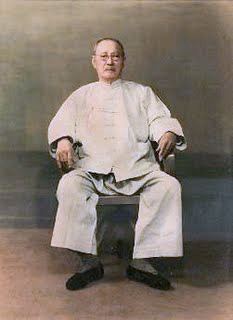
Oh boy...this must rank as the most mind-blowing story that I've read online today. I don't know whether to classify it under "Humour" or "Food" or anything else. Probably none of them. To unravel the wonder of the full story, click here.
Thursday, 10 June 2010
Wednesday, 9 June 2010
Chess in bed
It was a serious chess tournament going on at the Dato Arthur Tan Chess Centre in the Wilayah Complex, Kuala Lumpur and what do I see? A double-decker bed in the tournament hall. I suppose if any player needs a rest between games, he can just catch his 40 winks on it.
Tuesday, 8 June 2010
Please say NO to the Penang Botanic Garden arches
I've written a few times already about the desecration of the Penang Botanic Garden by the Federal Government and the way that the Ministry of Tourism rides roughshod over the state of Penang, disregarding the environmental impact. But maybe for once, we have a chance to get them to listen to the people.
Today, I've just visited the website of the Ministry of Tourism. On the right side of their home page, the Ministry is running a survey to determine whether the two arches at the Penang Botanic Garden should be retained or removed. I hear that they are going to use the survey results as the reason to keep or bring down the arches.
I would like to urge my fellow Malaysians - whether or not you are a Penangite, whether you are living in Penang or outside Penang, whether you are living in Malaysia or anywhere else in the world - to participate in the survey and vote with your heart and conscience on the two arches.
You know exactly how I feel about them. You can either disagree with me and vote to keep the arches, or you can agree with me and say NO to the concrete arches. Either way, your vote counts. Please consider the positives and negatives of the project and above all, consider how your voice can contribute to environmental change in this country we call home.
Remember, please participate in the survey here. All I'm asking is that if you agree with my point of view, please choose the NO button in the Ministry of Tourism survey.
Thank you.
Penang's tale of two parks
I greatly suspect that it's hardly coincidental that the improvement works at the Ceruk To'kun Forest Park at the foothills of the Bukit Mertajam hill are going on at the same time as the expansion works at the Penang Botanical Gardens.
Both are being carried out with funds from the federal government, not the state government as I had assumed initially, and presumably both projects were approved at the same time. But there's a lot of unhappiness about how the federal government has bulldozed it's way through with scant disregard for the wishes of the stakeholders, especially the people of Penang.
While the works at the Penang Botanic Gardens have come in for a lot of criticism and protests from environmentalists who claim - rightly, as I would like to believe and wholeheartedly support - that the very soul of the Gardens is being destroyed, the on-going works at the Ceruk To'kun Forest Park has hardly garnered any adverse comment.
I suppose it's because there's none of the monstrosity that's affecting the Penang Botanic Gardens permanently. The federal government had approved the plans to build two huge concrete arches near the entrance to the Gardens and allocated RM7 million of tax payers' money to it. In the process, a lot of the vegetation has been cleared and destroyed. Many hawkers who used to operate near the entrance has also been displaced. What's left currently is an eye sore: a vacant clearing with the two arches and tarred road surfaces all around it. With the clearing of the vegetation, the silence of the Gardens is broken by the jarring sound of guns firing from the nearby Penang Rifle Club. All these have not been considered by the federal government and indeed, the writer of this blog said that the architect couldn't even give any justification for his plans. Sad, indeed.
By contrast, I'm relatively happy that the RM500,000 works at the Ceruk To'kun Forest Park on the mainland is being carried out with almost no public complaints.
I suppose it's because there's no destruction of the environment here. Work started late last year with the cementing of the banks of the stream that flows through the Park. Today, hordes of people come in the afternoon to take in the cool fresh air and the local boys (and the occasional monkeys) use the pools for a dip.
At the entrance to the Park, all that's seen is a modest archway but what the authorities can improve on is to redraw the parking lots. More thought should be put into this as there is a dearth of parking lots during peak hours.
The old nursery is currently being rebuilt as well as the nearby surau there.
But if there is anything to object about all the work here, it has to be the building that's coming up on what was once a small field that campers use in the Park grounds. I haven't been able to figure out yet what's this building for. By the time I do, it will most probably be too late. I only hope this project can only improve the Park and not destroy it.
Sunday, 6 June 2010
George Town Festival
Even though there's still no official word from the Penang government on the holiday status of Penang Heritage Day on 7 July 2010, I see that plans are at least in place to celebrate George Town's status as a UNESCO world cultural heritage city.
It's been disclosed today that the second anniversary of our city attaining this status will see various activities during the whole month of July.
Dubbed as the George Town Festival 2010, there will be more than 30 programmes to promote arts and heritage in the state by the Penang government, Penang Island Municipal Council, George Town World Heritage Incorporated and Penang Global Tourism.
The George Town Festival will include theatre, music, dance, film, arts, food, fashion, photography, talks and visual spectacle, all taking place within the heritage core zone.
In particular, the streets of the city will come alive on 7 July 2010 with a heritage trishaw treasure hunt in the morning, day-long free entrance to normally restricted heritage buildings like the City Hall and the Town Hall, a guided heritage shophouse trail in the morning, and a street cultural celebration in the late afternoon.
Crocked player
This is a haunting image. The pain in his eyes, the despair in his look, the realisation in his mind. I really felt for him when I heard the news.
There is no other worse image than that of England captain Rio Ferdinand moments after realising that his damaged knee ligament injury during the team's first training session on Friday, suffered even before the first ball is kicked, has now dashed his hopes of playing in the World Cup in South Africa.
The injury is serious enough. It could even mean that he will miss the start of next season's Premier League in August. Yes, maybe he's jinxed from the start.
As the seriousness of the injury sank in, the rest of the England team stood around shocked. Apart from realising the loss of their captain, they were also sensing that their prospects of landing top honours in the competition have dimmed some.
Meanwhile, for a bit of comic relief to take the spotlight off the injury list in South Africa - Didier Drogba and Arjen Robben being crocked too - my friend, Colin, got the wax image of this neither-coach-nor-player by the golden balls recently at Madame Toussaud's in London. P.S. Don't tell me that it's distasteful to put up this irrelevant picture in the same blog post as English football's latest national crisis because I know that it is. But what the heck...
Saturday, 5 June 2010
Flag Counter statistics
Although this blog goes back to February 2007, I've only had Flag Counter included here in October last year. I've also ClustrMaps, Sitemeter and FeedJit installed. Don't ask me why I'm such a stickler for traffic statistics.
Day after day, I've been fascinated by the number of people who actually visits. Naturally, the bulk of my visits are from people here in Malaysia but there seems to be a sizeable percentage from elsewhere too.
Last night at about 10.06pm, the Flag Counter counter for Australia reached a landmark 1,000th visit. FeedJit told me that it came from someone in Sydney, Australia. Now, I have been waiting for this to happen for quite a while, and I'm glad that it has happened at last.
Flag Counter says that people from 140 countries have seen my blog since last October. Interested to add Flag Counter to your website or weblog? Just register here.
Friday, 4 June 2010
In defence of our Chinese dialects
The Chinese Malaysians are really a diverse lot. In the last six hundred years or so since our ancestors arrived on these shores from various parts of China, we have the Hokkiens, the Cantonese, the Foochows, the Hakkas, the Teochews, the Hainanese and others, all actively interacting socially with one another and the other races.
As a race in today's modern society, we still observe a lot of the old Chinese cultural practices. Religions may differ but cultural practices are largely retained. Including the dialects. Typically, people of my generation converse a lot in our local dialects with large smatterings of English, Mandarin and Bahasa Melayu thrown into the conversation.
But I fear that this may not last. Slowly but surely, unless we Chinese in Malaysia are serious enough to arrest the situation, we stand to lose this sub-culture which we call our dialects. This aspect of our heritage may be gone within the next two or three generations.
Although I say this now, it is nothing new to me. In fact, I have been observing this unwelcome trend for quite a while now. Take this morning, for example, which only reinforced my observations.
At the food court, I was sitting near a middle-aged couple who had brought their grandson along for breakfast. The boy was probably not more than three years ago. While the couple was talking to one another in Hokkien, to their grandson it was totally in Mandarin. I asked them whether they speak to the child in Hokkien? They said no, and his parents don't too.
Why on earth, I wondered to myself, couldn't they talk to the boy in their own dialect? Okay, I accept that in today's world it is important for the Chinese here (and elsewhere too) to master Mandarin and it is never too early to start off on this language.
But modern parents in their haste to give their children this linguistic head start in life are also depriving their children from recognising and using their own rich, local dialects. This, I find to be very disconcerting.
Mandarin may be the unifying tongue for the Chinese people in China and of course, it is important too that the Chinese Malaysians know the unifying language of their ancestors but for heaven's sake, learning this language should not be made at the expense of our own heritage here in Malaysia.
Our forefathers came to Malaya to make better lives for themselves. They toiled hard and while they assimilated well into this land, they never forgot or shed their own local dialects. Like I said earlier, the dialects are our sub-cultural heritage. In the past, they were strong focal points of socialisation, unification and loyalty, but of course today, these features have become less significant.
Nevertheless, I still believe in this concept of the dialects as focal points in our Malaysian society. The dialects still have an important part in play in our Chinese Malaysian culture and is an integral part of our heritage. That's what makes it so rich and fascinating. That's what makes it so unique here too, a melting pot of dialects within such a small country. We should be proud of our ability to understand the dialects and never give them up.
So to the modern parents, I urge them to please help to pass down this sub-culture which I call your dialect to your children. Make them appreciate their heritage and make them be proud to know and use their dialects.
Thursday, 3 June 2010
Hard of hearing
An elderly gentleman has had serious hearing problems for a good number of years now. Finally, he went to the doctor and the doctor fitted the man with a set of hearing aid that allowed him to hear as well as before.
After a month, the elderly gentleman visited the doctor for a follow-up. The doctor checked him and said with a beam: "Your hearing is perfect. Your family must be really pleased that you can hear again."
The gentleman replied casually: "Oh, I haven't told any of my family yet."
"And why not," enquired the doctor.
"I prefer to just sit around and listen to the conversations around me," the old gentleman said with a wry smile. "You know, I've changed my Will three times already!"
Wednesday, 2 June 2010
Once bitten, twice shy
It was about three o'clock in the afternoon yesterday. The sky was getting gloomy again. Then the skies opened up. Not too heavy but yet, a steady downpour. In the distance, just a hint of rolling thunder. I ignored the sound and continued doing some work on the Internet.
Soon, the unmistakable sign of the intensifying rainstorm appeared. The thunder getting louder. That meant lightning couldn't be too far away now. With a sigh, I went to unplug the telephone line from my modem. Better be safe than sorry. Once bitten, twice shy. Having already experienced a meltdown of the Internet connectivity in my house just about two weeks ago because of a thunderstorm, I was being cautious - nay, even ultra cautious despite having a surge protector near my equipment - and alert every day to avoid further modem malfunction. Too much hassle and time wastage if the modem dies again. I haven't even gone yet to the Kedai Telekom to exchange my old spoilt modem for a new one. My existing package is a lifetime warranty which means Telekom will have to let me have a new modem should the old one gets spoilt. Presently, I'm still using a spare D-Link modem.
So I unplugged the telephone cable from the modem and went back to my work. My house wireless network now being useless, I switched to a free wireless signal in my neighbourhood and continued surfing. Good, the signal was strong. Three bars out of four.
But I couldn't ignore the lightning and accompanying sound of thunder. They were getting more frequent. And suddenly .... there was a tremendously bright flash outside the window and an immediate thunderclap. Immensely loud. Almost jolted me out of my skin. Phew, I thought to myself. Lucky that I had yanked out the telephone cable. If not, for sure, my equipment would have been fried again. I prided myself for that.
However, I didn't reckon with the storm affecting the other telecommunication equipment in the neighbourhood. The first inkling of problem came when I couldn't surf through the free wireless signal anymore. The signal was still strong but all attempts to reach a website proved useless. Oh, great, there goes the rest of my afternoon, I thought. Time to curl up and go to sleep. That's what this weather was meant for, in the first place.
After about an hour, the storm had abated and I tried to use the Internet again. I replugged the telephone cable into the modem and waited for the lights to appear. A minute passed. Another minute passed. Strange, there wasn't a DSL signal. Can't be happening again, can it? Not after I had taken exra precaution. An inner voice asked me to lift the telephone handset. I did. No dialling tone. Only silence. Darn it. Now, the telephone service itself was down. Even when I connected the telephone directly to the wall cable, there was no dialling tone at all.
I phoned my wife in the office, asking her to make a report to Telekom that our telephone line was down. They asked all sorts of questions. "Is the modem working properly?" "What are the lights showing on the modem?" Heck, she was just reporting that the telephone service itself was affected and there they went to ask about the Internet connectivity. Anyway, she did manage to get the message through to them eventually.
In the meantime, I was playing Sherlock Holmes at home. Got a bright idea to phone my immediate neighbours. Were their telephone service affected too? With my mobile, I phoned the neighbour two doors from me. Their phone rang but no one picked it up. Then I made a call to another neighbour and this time I made extra effort to listen carefully over the ledge. Nope, no telephone ringing in their house either. So now I knew. The whole bloody neighbour has been affected by the thunderclap. It wasn't me alone.
For the rest of the night, there wasn't more that I could do except to watch television. And to watch my wife doing her work on the desktop. She didn't need to go into the Internet for that. Eleven o'clock and telephone line was still down. What a bummer of a day. Might as well retire for the night now, I told my wife.
This morning at about 7.45am, I was curious. Would the line problem persist for another day? I lifted the handset. Glory be, the dialling tone's back. Telekom has fixed the problem. I replugged the cable into the modem, waited until the DSL light woke up and here I am, reconnected to the rest of the village. Please welcome me back!
Monday, 31 May 2010
History: Yeap Chor Ee's secret
My fascination with the Yeap Chor Ee story continues here. About a week ago, I reproduced an old newspaper story that reported on the death of this Penang multi-millionaire who founded the Ban Hin Lee Bank. Sadly, I can't find any news about his funeral itself but I managed to dig up a follow-up story on this old Towkay that appeared on the day of his big, ceremonious send-off. There are two brief comments of mine in the story, which I've marked in red. The year in question, by the way, is still 1952.
Towkay Chor Ee's secret yielded him $100 mil.
(wrote Gunn Chit Thye in The Straits Times on 31 May 1952)
PENANG, Saturday: When the Penang banker, Mr. Yeap Chor Ee, goes to his final rest at his Bukit Gambier Estate tomorrow, it will mark the passing of a one-man dynasty in Penang. (This would be on 1 Jun 1952, seven days after his passing.)
For this towkay, with the touch of Midas, who came to Malaya without a cent at the age of 17, has now departed the richer, it is estimated, by more than $100,000,000.
Towkay Chor Ee called his firm Ban Hin Lee - the "business of a thousand successes." (When I was still with the bank, I've also heard the term translated as "ten thousand prosperities" which I think is closer to the original meaning as the word "ban" means "ten thousand".)
And so it has proved to be. From the humblest of beginnings, Ban Hin Lee has expanded so with the years that, in course of time, it became, inevitably, a bank.
What was the secret of this man of success?
Did it lie in his supreme confidence, his dogged and persevering spirit, his faith in this country? Or was it sheer luck?
Whatever Towkay Chor Ee's secret was, one thing is certain. And no-one will deny his credit for it: Throughout the 70 years he toiled in Malaya, he had never been known to take a holiday.
"We will never see the like of him again," one Chinese leader said.
"We simply haven't got men of this type any more. Times have changed and the present generation is too pleasure loving to be able to get up that early and work late into the night, day after day, without a rest."
Towkay Yeap Chor Ee was orphaned when he was only three months. When he came to Penang at 17, he was like most Chinese immigrants - penniless, having used all his money for his passage.
PROVERBIAL FORESIGHT
But he worked hard and, within six years of his landing, was able to open his own firm of Ban Hin Lee in Prangin Road.
With his foresight, which had by now become proverbial, Towkay Chor Ee dealt in the sugar trade and when the big rubber boom came early in the century, he was quick to realise the potentialities of the industry and, with characteristic enterprise, staked on it. It paid and young Mr. Yeap was soon a millionaire.
He next turned to rice, tapioca and other commodities. Everything he touched turned to gold.
With all his wealth, Towkay Chor Ee hardly ever relaxed. He was up early in the morning when younger men were still rubbing their eyes in bed.
Regularity in habits and at work simplicity in life, moderation in food and self-denial in everything -- these were his creed, his life.
Although in recent years his health had been failing him, Towkay Chor Ee still went to his bank every day. He made his last call on the Friday two days before he died at the age of 85.
There was nothing pretentious about the millionaire with the Midas touch. One would have expected a veritable merchant prince to be cold, haughty and calculating, but Towkay Chor Ee was pleasantly the reverse -- a humble, genial self-made man, unspoilt by success.
Other Ban Hin Lee Bank stories here.
Saturday, 29 May 2010
Is George Town Heritage Day still on?
I remember that way back in July last year and again in January this year, I was writing about the Penang government wanting to turn 7 July into a public holiday every year in commemoration of George Town's Heritage Day.I wonder what has happened to it. The intention is good but there's been hardly anything mentioned in the newspapers since then. Is the Heritage Day public holiday still on? Or is it already off? The Penang government must clarify their position and time is fast running out on them. If 7 July is indeed a new public holiday in the state, I'd like to know whether it has been gazetted yet. And if it is gazetted, why aren't we told about it?
Although the holiday does not affect me one way or another, I'm saying all these because communication is important and I know that everyone would need to be told about it in advance.
In addition, is the government serious enough to instil the proper appreciation of our heritage? I feel that as we progress further in this modern world, we mustn't lose touch with the past and our heritage. The history we learn in school today is already so inadequate. Observance of the George Town Heritage Day on a large, state-wide level - not just limited to government departments and schools - will be a very good starting point to touch base with our rich local history again.
Therefore, the government should give everyone, including the important business community in Penang, an advance and proper notice so that plans can be made if they want to accommodate the additional holiday. If the holiday is sprung on them with little notice, I can safely say that very few people will be observing Heritage Day when the day comes around. Let not the government's effort go to waste.
Friday, 28 May 2010
A lotus on Wesak Day 2010
The lotus flower is a very powerful symbol of Buddhism. It represents purity, the purest of the pure. How very apt it was for me to find this one blooming in its full spendour at the Buddhist Hermitage Lunas on Wesak Day today:
Thursday, 27 May 2010
Tennis sure is fun....
I know that interest in this year's French tennis open championship has been bumped up a notch with the participation of the Williams sisters. There is talk of Astro Supersports editing out Venus Williams' outfit if she continues to wear this further. How Astro is going to do it, well, I don't know....
"The outfit is about illusion, and that's been a lot of my motif this year, illusion. The design has nothing to do with my rear – it just so happens that I have a very well-developed one. These days I just have a lot of fun with my designs and designing and doing different things," explained the 30-year-old tennis queen.
Wednesday, 26 May 2010
Pacman
Some call it a time waster. Others say it is a game to develop your reflexes. It doesn't really matter. If I fancy a spot of the good old-fashioned game of PACMan, here's where I can go to play this game online. You can, too. Just insert a virtual coin and off you go:
History: Yeap Chor Ee's death
A bit of history in today's post. Towkay Yeap Chor Ee, the founder of the Ban Hin Lee Bank in George Town, Penang, died on this day 58 years ago. I've just managed to extract this news item on his death which was carried on the front page of The Straits Times newspaper on 27 May 1952. Here it is:
Other Ban Hin Lee Bank stories here.
The G.O.M. of Penang is dead
PENANG, Mon.
MILLIONAIRE banker Mr. Yeap Chor Ee, "grand old man" of local commerce, died today in his palatial home in Northam Road, Penang. He was 85.
Mr. Yeap had been in failing health, but went to his bank, the Ban Hin Lee Bank, as usual last Friday.
He died in the presence of his family.
Born in Nam Aun, Fukien Province, Mr. Yeap was orphaned when three months old and was brought up by his grandmother, who died when he was seven.
At 17 he came to Penang. By hard work and astute foresight, he worked his way up, until within six years he was able to open his own firm of Ban Hin Lee in Prangin Road, near the market in 1890.
SUGAR, RUBBER
Mr Yeap at first confined his activities to the sugar trade. When rubber engaged the attention of business interests at the beginning of the century, Mr Yeap, with characteristic enterprise, staked on it and was fully rewarded.
He next turned his attention to the rice industry and again he was successful. It was the same with tapioca and other Malayan produce.
He invested in them with courage and foresight with the result that he reaped substantial profits.
Typical of his courage and judgment in business was his investment in tin ingots during the slump in the early thirties.
He continued to buy on a falling market, confident that the demand would reassert itself. At one time he held stocks of several thousand tons.
When recovery came, he was in a position to control the world market, and London and New York had to take notice of this unpretentious business man in Penang.
When he found his business enlarging, Mr. Yeap established his own bank, the Ban Hin Lee Bank, in 1918. The bank was made a limited company in 1935, with Mr. Yeap as chairman of directors.
A philanthropist, Mr. Yeap last year gave $250,000 to the University of Malaya Endowment Fund for the establishment of a Chinese library.
He also gave land for a new building for the Chung Shan Chinese School in Bayan Lepas.
Mr. Yeap leaves a widow, Madam Lee Cheng Kin, four sons, Lean Seng, Kim Hoe, Hock Hoe and Hock Hin, two daughters and numerous grandchildren and great-grandchildren.
Arrangements for his funeral are still being made but it is understood that it will not be this week.
Other Ban Hin Lee Bank stories here.
Tuesday, 25 May 2010
Nine treasures
My family attended an eight-course Chinese dinner function at the Stone Bay Restaurant on the island recently. Although we enjoyed the food, I can't say that it was really very good. The Starview Restaurant at the New World Park is better. Anyway, the piece de resistance at the dinner was this very first course - a double-boiled soup course - containing delicacies that only we Chinese can really appreciate, such as scallops, fish maw, abalone and many others. I think it's called Nine Treasures. I overheard a passing comment that this soup dish alone cost RM300. Wow....
Monday, 24 May 2010
Mrs Yeap Chor Ee
Towkay Yeap Chor Ee, the founder of Ban Hin Lee Bank, may have died in 1952 but there is still a lot of unknown, untold or forgotten information about him and his family. For instance, I've just dug up an interesting photograph from a newspaper dated 14 Oct 1948 which showed Mrs Yeap Chor Ee nee Madam Lee Cheng Kin presenting the Malayan Chinese Football Association Cup (MCFA Cup) to Yeang Kar Chong, captain of the Penang Chinese team that defeated the Negri Sembilan Chinese Recreation Club 6-2 in the final played at Penang on 10 Oct 1948. Standing beside her was Yeap Hock Hoe. It's just a shame that the whole picture's watermarked over.
Other Ban Hin Lee Bank stories here.
Sunday, 23 May 2010
Do-it-yourself vinyl record cleaner
Do it yourself! This is the short video clip that I uploaded to YouTube a few hours ago of me cleaning one of my vinyl records.
The rotating base comprises a few pieces of non-slip rubber mats, a lazy susan, a round chopping board and a piece of car rubber mat cut into size. The solution for cleaning the record is made up of one part iso-propyl alcohol and three parts distilled water, with several drops of dishwasher detergent. I use a brush to dig up the dirt loosened from the grooves and non-woven cotton swab to clean the record surface.
A very manual way of cleaning the records but it works, and that's the most important result!
View from the top
I went up the Bukit Mertajam hill two days ago. It wasn't preplanned but I made a resolve to reach the peak which is about 1,760 feet above sea level. Once in a while, you have to make such a resolve. There's always a mountain to climb any time in our lives. You may have climbed a mountain once successfully but there is always another climb somewhere else, even if it is the same one. If nothing more, it's to prove that you still have the same determination and you relish the challenge. So, don't shy away from the mountains in your life.
Going up the hill track by way of the dam at the foothill, I reached the transmission towers after a slow climb of one hour and eight minutes. By the way, this wasn't a very popular route, especially on a Friday afternoon. Along the way, I met only three people. By contrast, I saw so many more people on the tarmac road as I was coming down, it being the busiest towards the end of the walk. My slow descent was also at a very steady pace and I made it to my car after an hour and 13 minutes.
This was the nicest view from my climb: a breath-taking vista of the Mengkuang Dam to the north of the BM hill. I don't get to see this view often. Indeed, I wonder how many other people appreciate the quiet beauty of this place.
Subscribe to:
Posts (Atom)