Tuesday, 27 July 2021

Penang in Cheng Ho's sights

A flashback to what I wrote in Let the Aisles Proclaim some five years ago. At the beginning of the second chapter where I was touching briefly on Penang's early history, I wrote:

Long before Captain Francis Light established Penang as a trading post and settlement for the East India Company, the island was already known to seafarers from the East and West who had sailed through the Straits of Malacca. 

The first geographical reference to the island of Penang was made by China’s most celebrated explorer, Admiral Cheng Ho, who had documented his various expeditions between 1405 and 1433 from China to Africa during the reign of the Yong-Lo and Hsuan-Te Emperors of the Ming Dynasty. Cheng Ho’s surviving documents were later compiled into the 17th Century historical nautical map, The Nautical Charts of Cheng Ho.

During the research for the book, I had come across a portion of this nautical chart and was deciding whether or not to include it in the book. At the last moment, I felt that historical though the chart might be, it was only very remotely connected to the history of Penang Free School. So I left the chart out entirely although I still did make reference to it.

What's interesting about this chart is that Penang island is shown as a prominent landmark. It is that L-shaped island that is marked with the characters 梹榔嶼 or pin lang yu, meaning "palm island." In my opinion, there is uncertainty whether or not Cheng Ho had physically stepped onto the island but a local legend has it that his left footprint - actually, a large impression in the rock that looks like a giant footprint but that's what legends are made of - appears on a rock at the Sam Poh Tong, a seaside temple in Batu Maung village on the south-eastern part of Penang island. During my schooldays, there was also talk of a corresponding right footprint of his somewhere in Sumatra but I find no mention of this on the Internet. 

There were several named islands on the chart but I shall leave it to others to interpret their names. Not for me to do so. 

Regarding the footprint at the Sam Poh Tong, here is an image and a comment from the TripAdvisor website, but do note that they were written in November 2017 and not that quite recent:

This old Chinese Temple was built after a giant-sized footprint was found on a rock at Batu Maung, Penang. In my younger days I remembered the footprint was on a rock by the sea at this fishing village but with so much development around this area, the fishing village had disappeared and taken over by condominiums and houses. Besides the mushrooming accommodation in its place, there is also the newly constructed flyover and traffic is a real mess after Friday prayers at the mosque nearby.

In the old days devotees offered their prayers at a makeshift altar using joss sticks and a simple urn on the rock but in its place a shrine with a deity of Cheng Ho has been erected and this is where the footprint is displayed now. There was also a seafood restaurant on stilts in the middle of the bay and the hot seller was their famous satay grilled with peanut sauce. I was told by the caretaker at the temple that this eatery had been relocated to Teluk Kumbar several years ago.

Now the refurbished Temple has a pretty landscaped garden but still has the charm of the scenic view of the blue sea, horizon and fishing boats. The new addition is the second bridge which enhances it and makes it more picturesque. The sad thing is that the quaint fishing village has been taken over by various fish wholesale dealers on a plot adjacent to the temple grounds. They appear to dominate the place with sorting of fish and the grounds are stacked up with unsightly huge cooler boxes to contain their catch.


Saturday, 24 July 2021

The lotus moon

Photo taken on 24 July 2021 at 10.07pm from my vantage point in Bukit Mertajam. Moon was at 99.4 percent illumination but beginning to wane. The night sky being so much clearer tonight, the moon can be seen in greater definition. It's no imagination but very faint tinges of red and blue can be ascertained on the moon's surface if observed carefully.

Lotus moon: that's another name to describe the full moon seen on the 15th day of the Chinese lunar calendar. It is associated with the day that the Lord Buddha gave his first discourse after achieving enlightenment.

It is said that about 2,610 years ago on the full moon day of May, Gautam, the Sakyan prince turned ascetic, became enlightened as the omniscient Lord Buddha under the Bodhi tree in Bodhigaya, India, after six years of striving in the thick forest of northern India. After spending 49 days at Bodhigaya in bliss and contemplation of his discovery of the path to Enlightenment, he set foot on the 50th day on his journey to start his teaching. 

From Bodhigaya, the Lord Buddha walked barefooted for about 250km to meet his five fellow ascetics - Kondañña, Assaji, Bhaddiya, Vappa, and Mahānāma - who once attended to him when he was on self-mortification. However, they had abandoned him after he gave up that austere practice. The five ascetics were at Samath, Isipatana, the Deer sanctuary of Benares, which is the present-day Veranasi in India. 

It was on the full moon day of July when the Lord Buddha arrived there several days later. The sun was about to set and the full moon just emerged from the horizon. Here on Earth, only five humans were present at that moment to listen to his first discourse but innumerable numbers of higher beings - brahmas and devas - were also present, unseen to human eyes, all awaiting earnestly to hear him expound the great Dharma

To commemorate the occasion of the first discourse, setting in motion the Turning of the Dharma Wheel, today marks the day when monks and lay devotees celebrate the auspicious day. Since that first teaching, Theravadin monks (see note below) have fixed this full moon day as the day to enter their annual Vassa (rains retreat) for a three-month period, spending the time meditating in the monastery without any long-distance travel.

(The above story was adapted from a whatsapp posting received today.)

[Note: In case people disputes me, a Theravadin is a follower of Theravada Buddhism.]

Friday, 23 July 2021

The buck moon


We are inching towards the 15th day of the Chinese sixth lunar month tomorrow. But tonight, the moon is already at 99.4 percent illumination. The above picture was taken at 10.01pm. It's an almost perfectly round orb in the sky. Plus, an added bonus of seeing some very subtle red and blue tinges on the surface because, contrary to popular belief, the moon is not in various shades of grey. Actually, there are tinges of blue and red in the shadowy areas. Look closely and be amazed! They are there!

Bolide over Penang?

Two days ago, a friend and former colleague at JobStreet.com posted a message to our whatsapp chatgroup saying that at about 5.15am, he heard a loud boom from his condominium on the island which rattled his windows. But there wasn't any lightning at all. 

A few hours later, I received a short note from another whatsapp chatgroup which said that the morning's loud bang heard over Penang could have been caused by a bolide (large meteor) that entered and exploded in the atmosphere. Others speculated that it could be rubbish jettisoned from the passing International Space Station. The Astronomical Society of Penang was attempting to gather more information from various sources about the loud explosion. 

I don't have any extra information about this interesting matter - and there's nothing reported in the mainstream media so far - but my friend did mention to us later than his surveilance camera in his condominium unit had captured both the flash of light at 4.59:48am as the bolide exploded and subsequently at 5.02:13am, the sonic boom that shook him awake. That there was a 145-second interval between the flash of light and the sonic boom, he estimated the incident to have occurred about 50.2 kilometers from his home in Tanjong Bungah.

(This video clip was provided by Ted Targosz)

Thursday, 22 July 2021

Ten Thousand Prosperities (萬興利) - Part 7

Compare the original (left) with the reprint (right) and see the difference. Note: I've intentionally blurred out part
of the right image but I assure you that they are as clear as the first two paragraphs. I hope to show the whole back
cover in detail sometime in the future.

I returned from a trip to the Phoenix Press printing plant a few hours ago. Had to make a special trip there at the Prai industrial zone to pick up my 10 copies of the reprinted book jacket for Ten Thousand Prosperities, the story of Ban Hin Lee Bank. 

The reason, you see, was that the printer had mucked up the first print of the jacket. Although the same shown to us followed the specifications laid down by the designer, the final product came out wrong: the size of the bank logo was wrong, the logo itself was skewed towards the left and white was used as the colour of the narration on the back of the jacket. Against a light grey background, the narration was too light to be read properly, if at all.

So we made representations to the printer's owner. How could the finished product turn out so different from the sample? At first, the plant manager denied that the specifications were not followed but his denials were over-ruled by the owner. 

Whether or not he liked it, he had to print the book jackets for us again. And it was completed a few days ago. It could have been done sooner if not for the imposition of the second Movement Control Order last month.

Now starts the rather difficult task deciding how to exchange the original book jackets with the reprint. The problem is that the book had been factory sealed. To replace the jackets will mean having to remove the plastic seal for almost 1,000 copies. I doubt we would want to do this ourselves. Anyway, a decision will have to be taken soon before the publisher releases it for sale in the bookstores. In the meantime, the next milestone will be the launch.

Wednesday, 21 July 2021

The Classical Collection

Back in the mid-1990s, I collected the monthly issues of The Classical Collection from the bookstands but stopped at the 45th issue as there was no indication when the series would end. The magazines were very informative as each issue dealt with the life histories of the classical music composers. Accompanying each issue would be a compact disc that showcased the composer's music, played by lesser known second or third-tier orchestras which were good enough, actually. 

One doesn't need listening to world-renowned orchestras to appreciate classical music. Many second and third-tier orchestras also do an exemplary job if one gives them a listening ear. Thus, if they are the National Symphony Orchestra (from Canada) or the Radio Symphony Orchestra Ljubjlana or Slovak Philharmonic playing well on these compact discs, never mind the point that they are not a first-tier orchestra like the Berlin Philharmonic or the London Symphony Orchestra. Just sit back and enjoy their music output. 

The image below shows all my 45 copies, including an extra Christmas issue. All came with corresponding compact discs. I learnt later that eventually, 108 issues were produced. Almost all the composers were featured multiple times. A list of the compact discs appears here


Tuesday, 20 July 2021

Rurouni Kenshin

I never thought that I could be so taken in by Japanese movies but I've been spending the last few days viewing the series of Rurouni Kenshin films at home. 

Netflix has made the first and fourth Rurouni Kenshin films -- Origins and The Final -- available for home viewing but I've also learnt that there are two more floating out there in cyberspace going by the names of Kyoto Inferno and The Legend Ends

And as a bonus, there'll be a fifth instalment, The Beginning, due for release at the end of this month. Looking forward to it. [LATEST: Netflix has started streaming The Beginning from today, 30 July 2021.]

Origins was released in 2012 and was followed by Kyoto Inferno and The Legend Ends in 2014. Both The Final and The Beginning are released in 2021, although their filming was completed two years ago. The Rurouni Kenshin films are adapted from a best-selling Japanese manga series of the same title by Nobuhiro Watsuki.   

Thursday, 15 July 2021

Talking with Tan

I'm still rearranging my personal chess archives, otherwise known as my storeroom. Happened to come across this November 1995 issue of Chess Life, published by the United States Chess Federation, which featured Tan Chin Nam on its cover. Probably a first for a Malaysian chess player, amateur or otherwise, to frontpage a foreign chess publication but then, with former Chess Life editor Larry Parr behind the story it was bound to happen one day, and this was it.

The magazine commented that while most of Tan's largesse was evidenced on the Pacific Rim, he "played a large part in securing sponsorship for the US Amateur Team playoff at the Harbor View Marina and Yacht Club in Baltimore in 1993."

A transcript of the interview that Parr had conducted follows below. By then, he had moved his residency to the SuCasa Hotel Apartments in Kuala Lumpur where he was employed to ghost write Dato' Tan's autobiography.

TALKING WITH TAN, by Larry Parr

IF DATO' TAN CHIN NAM is not the world's wealthiest businessman, he is probably its wealthiest chessman. An enthusiastic and dangerous amateur player, this 70-year-old mega-developer keeps a chessboard and men at the ready in his private office in Kuala Lumpur, Malaysia. Visitors are expected to play on the set with the man whom business newspapers dub the "property grandmaster" and chess journalists the "Maecenas of Malaysian chess."

But life was not always so prosperous.

Dropping out of school at age 13 and working as a street hawker and clerk, this financial giant avers that he "was once a poor man myself." Among his earlier business efforts was the famous Ipoh Gardens housing project which earned him the nickname of "Mr. Low Cost."

Although officially retired from Tan & Tan and IGB Corporation, the two major components of the Tan Group of companies, Dato' Tan is still, in the view of many business reporters, the man who calls the major shots. For example, this vigorous old Lion King divided power among his children between Tan & Tan and IGB, and then quoted the Chinese proverb, "You can't have two tigers on one hill."

As far as chess is concerned, Dato' Tan started out by playing the Chinese variant at a good club level, first becoming involved in Western chess about 1973 when a previous Malaysian federation got deregistered by the government. He proved important in establishing the current Malaysian Chess Federation.

But let Dato' Tan speak for himself about why he became enmeshed in Caissa's coils and about what he regards as his most important contributions:

Larry Parr: What attracts you to chess?

Dato' Tan Chin Nam: I'm fascinated by the game. I eat, talk and dream chess – though the dreams are sometimes nightmares. For example, how many FIDE officials will stand and watch a game for four hours with corns on their feet? I do.

Chess can be rewarding. I now think that I can become a better player. Chess teaches you never to say, "l should have won the game." That's like saying you shouldn't three putt. I'm stupid to make a mistake or not to anticipate a move by the opponent. There are no "should-haves" in chess. The failures are the result only of one's stupidity.

For youngsters, chess teaches discipline, patience, systematic analytical thinking, and the humility that only comes from getting beaten. In fact, I like to lose. If I win, then there is no more competition for me; any player that I beat is out of my book. To remain in my "club," you must beat me.

Parr: Speaking of "nightmares," what do you find most aggravating about being involved in chess?

Dato' Tan: That's easy to answer. Like doctors, chess players never say thank you and never say sorry. When I started organizing chess events, some of the local players rated at 2200 wanted appearance fees! ln a way the sheer nerve of these people made me feel happy even when it was also annoying.

Parr:  Malaysia has held a number of high profile international competitions, including the 1990 Karpov-Timman candidates' final. What about sponsoring the Kamsky-Karpov match for the FIDE "world championship?"

Dato' Tan: No. It would be hard for the Malaysian Chess Federation to do this when local players would be raging against any potential sponsor. Before we can host grand tournaments and matches, we need a home-grown grandmaster and some more IMs. The point behind the 12-tournament rating series is to create a large new pool of Malaysian players, several of whom might then become grandmasters.

Our best prospect right now is Mas Hafizulhilmi Agus Rahman, a 15-year-old Malay schoolboy who has just scored 50 percent in the qualifying Zonal for our region. It was a tremendous result for him and for our country. Eduard Gufeld thinks very highly of the boy.

Parr: By one estimate, you have donated about $2 million to chess. Why?

Dato' Tan: Some people are born stupid. Just think how I could have invested those funds! But I already answered this question earlier. It is because I like chess and wish to be involved, and I'm proud of some of the things that I've done.

Parr: What are your outstanding contributions to chess?

Dato' Tan: Chess people best know me for helping to finance and find a venue for the 1984 USSR vs. the World Match, but I've done other things that have had a greater long-term value.

What Kerry Packer did for cricket, I have tried to do for chess. Around 1986 I fought very hard to rate rapid chess, which has contributed significantly to chess development and media interest in Asia. I also initiated the Asian Presidents' Conference which is held every two years at Olympiads. Campomanes has made it a regular feature in order to keep up communications among all of the Asian federations. Another innovation was my starting the Asian Team Championship in 1974 and the Asian Cities Championship in 1979. Both of these competitions have helped the Asian federations to come together in cooperation.

Parr: One last question. Do you take authentic pleasure from playing a lovely game of chess from start to finish?

Dato' Tan: I think I would. But I have yet to play such a game and can't tell you for sure.

Note: I would have liked to change all the American English spellings into proper international English but then decided to leave them alone to reflect the original idiosyncratic flavour of the American culture.

Sunday, 11 July 2021

My old chess columns

After about a month of going through the old The Star newspapers in my storeroom, I have unearthed more than enough issues to compile my chess stories into a YouTube video. I tried to fit all 640 videos within the 9:53 minutes of music but it's impossible. The visuals spilled over for about 50 seconds with no accompanying sound. These old newspaper pages spread over a period of 20 years from January 1992 till March 2012. Unfortunately, those old clippings prior to 1992 are no longer with me: totally misplaced, I believe. 


Saturday, 10 July 2021

The other plague expert


There is an excellent news item in The Star newspaper today on Dr Ng Cheong Yew who was a nephew of plague fighter Dr Wu Lien-Teh. As Dr Wu's protege in China, Dr Ng was also deeply involved in the fight against the plague as chief assistant to his uncle. According to this news story, Dr Ng held some leading roles with the Chinese Government. By 1937, he was already considered an expert on plague. At the outbreak of the Sino-Japanese conflict that year, he was appointed director of the China Red Cross in Hong Kong. He was also director of China's transport and supplies department. There's not much reference to Ng Cheong Yew in Plague Fighter, where he was indexed as Wu Chang-Yao, but Dr Wu acknowledged that Ng was his "gifted nephew."

It was also mentioned in the story that Dr Ng studied at Penang Free School without mentioning much details. In reality, Ng Cheong Yew was the Head Prefect in 1916 and was instrumental in convincing the headmaster, Ralph Henry Pinhorn, that the School's Centenary that year must be celebrated. It was an occasion that almost did not take place as Europe was in the midst of World War One. As the editor of the Penang Free School Magazine, he coordinated the publication of the historical Centenary issue. 

The news story in The Star appears at the bottom of Page 5. Here is the transcript in case it proves difficult to read from the image above:

Author researching lesser known Malayan plague expert (by Ivan Loh)

IPOH: When we talk about plague, Penang born epidemiologist Dr Wu Lien-Teh's name always comes to mind.

However, there is yet another expert on the plague from these shores who has been forgotten over the years: Dr Ng Cheong Yew. 

Dr Ng, also known as Dr Ng Chong Yew or Dr CY Wu, was a nephew of Dr Wu's, who like the latter, had also travelled extensively across continents on the League of Nations' Travelling Fellowship.

Chan Sue Meng, founder and chief executive officer of Sue Meng Heritage Sdn Bhd, said Dr Ng also had as high and illustrious a profile as Dr Wu, going around the world on work with the latter.

"He had earlier spent time in China, initially as Dr Wu's protégé.

"He had visited all key ports and health centres and also engaged in discussions with Chinese ministers in various cities," she said.

Chan said Dr Ng also held some leading roles with the Chinese Government, and by 1937, was described as an expert on plague.

"At the outbreak of the Sino-Japanese conflict, he was appointed director of the China Red Cross in Hong Kong and was also director of China's transport and supplies department then.

"He was a prominent and influential figure and was followed and frequently quoted by the media," she added.

Chari said she became interested to learn more about Dr Ng after chancing upon an old newspaper announcement of his engagement to Wong Siong Bing, the daughter of Dr Wong I Ek.

She has been gathering information on Dr Wong, a core supporter of Chinese revolutionist Dr Sun Yat Sen in Perak, for her second book on Dr Sun's journey here and found Dr Ng's name.

"Born in Penang in 1899, Dr Ng is the son of Dr Wu's third brother, Ng Lean Fatt. He also went to Penang Free School," she said, adding that Dr Ng also practiced as a doctor here (note: Wu and Ng refers to the same Chinese surname).

"He went to a medical school in Hong Kong University, before furthering his studies in England and the United States.

"He was a prolific writer, editor, actor (Shakespearean plays), sportsman, researcher into anthropology and authored a book about China through the lens of a Malayan.

Like Dr Wu, Dr Ng was regarded as a 'credit to Malaya'," she said.

She said Dr Ng was also described by the media as a leading member of the Perak Chinese community. 

"He had contributed to many social causes in Perak, served in various committees and philanthropic bodies, including the Kinta Sanitary Board, Town Planning Committee and Tanjung Rambutan Central Mental Hospital," she said.

Chan said she sourced much of the information on Dr Ng from old newspapers.

"I have also reached out to the descendants of Dr Wong but not many have information about Dr Ng.

"It is an ongoing research. I’ve been researching Dr Ng periodically for about 12 months as he goes by several monikers," she said.

"I’m still sorting out my findings about his contributions outside Malaya and in China," said Chan, who is the author of Road to Revolution: Dr Sun Yat Sen and His Comrades in Ipoh.


Thursday, 8 July 2021

Not levelling off

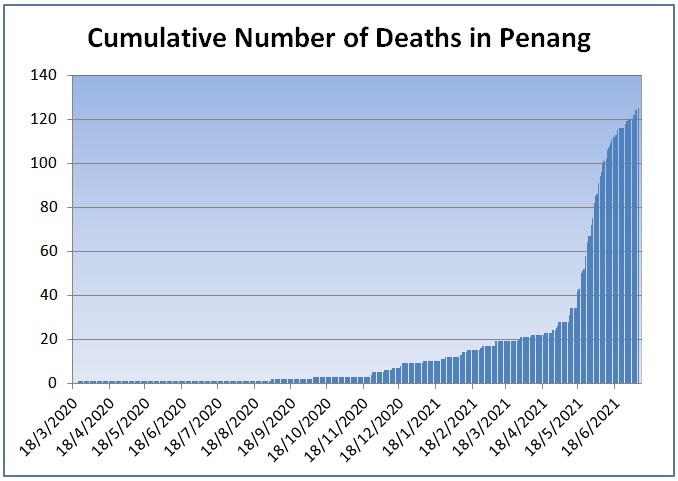
On the 13th anniversary of George Town being recognised as a UNESCO world heritage site, this is the updated chart of Penang's Covid-19 deaths. One month of the movement control order in the country does not seem to be making any difference in bringing down the numbers, not least in Selangor, Kuala Lumpur and Negri Sembilan. In Penang, the numbers of infection look like holding steady and yesterday, the federal government said the state could go into Phase 2 of the movement control order, which means that more types of business activities can resume, such as hair salons (but no big deal for me presently because my hair is still short enough). However, it is the mortality rate of the Covid-19 patients that continue to concern me because they keep rising. It stands now at 125 cumulative deaths as at 07 July 2021.


Friday, 2 July 2021

Penang-born who fought plague

Another material from my personal archives. This is one of those rare non-chess newspaper clippings that I had kept over the years. This time, the subject matter was Dr Wu Lien-Teh who in 1911 had fought and eradicated the dreaded plague in northern China. The writer, Foong Thim Leng, had well-covered much of the known areas of Wu's life in China and Malaya. I'm sure the Dr Wu Lien-Teh Society would be much interested in this story which came out 10 years before the society was founded. 

Penang-born who fought plague by Foong Thim Leng (The Star, March 29, 2002) 

IPOH: Dr Wu Lien-teh was a distinguished scientist and Cambridge-trained Chinese physician who fought the pneumonic plague in Manchuria in 1910-11 which claimed 60,000 deaths and threatened China.

 "The successful ending o[ this major plague epidemic covering a distance of 3,200km from the north-western border of Siberia to Peking, within a short period of four months, brought him international fame and marked the beginning of almost 30 years of devoted humanitarian service to China," says his eldest daughter, Dr Wu Yu-lin.

 Yu-lin, who resides in Singapore, is the author of the book Memories of Dr Wu Lien-teh - Plague Fighter.

 Wu Lien-the, whose father was a successful goldsmith in Penang, was born on the island in 1879 and studied at the Penang Free School.

He won the only Queen's Scholarship of 1896 and was the first Chinese admitted to Cambridge University for medical studies.

After obtaining First Class Honours in Natural Sciences, he proceeded to St Mary's Hospital, London, and won virtually all the available scholarships and prizes.

He did post-graduate studies under eminent scientists in Europe – research in malaria at the Liverpool School of Tropical Medicine under Ronald Ross, and in bacteriology, in Halle, Germany, under Karl Fraenkel and at the Institute Pasteur in Paris under Ellie Metchnikoff.

At 24, he completed his M.D. degree requirements two years ahead of time.

On his return to the Straits Settlement in 1903, there were no posts in the Colonial Medical Service for non-British specialists so he joined the newly established Institute of Medical Research in Kuala Lumpur for one year, researching into beri-beri, then a killer disease.

He went into private practice in Penang from 1904 to 1907 and also became actively involved in campaigns against opium addiction.

He founded and became the president and Physician-in-Chief of the Penang Anti-Opium Association and organised the first ever Anti-Opium Conference of the Straits Settlements and the Federated Malay States, in Ipoh.

"His anti-opium campaign aroused considerable agitation amongst the powerful forces involved in the highly lucrative opium trade," says Yu-lin.

"When warnings from these quarters went unheeded and promises of bounteous 'compensation' were spurned, a search warrant was issued on Dr Wu's dispensary in Penang in 1907, followed by his prosecution for illegal possession of a 'deleterious drug' – one ounce of tincture of opium that he had purchased from a British lady practitioner three years earlier, in case he needed it to treat opium patients."

The Director of Public Prosecution claimed that it was a "test case", as Dr Wu technically required a licence to possess the one ounce of opium, which he did not have.

Dr Wu was duly convicted and ordered to pay a fine of one hundred dollars. The case attracted wide publicity abroad.

His appeal to the Supreme Court of Malaya was rejected.

Shortly after, he received two unexpected letters, one from London inviting him to attend an Anti-Opium Conference at the Queen's Hall that same year, and the other from the then Grand Councillor Yuan Shih-kai of the Chinese Government in Peking, offering him the post of Vice Director of the Imperial Army Medical College in Tientsin. He accepted both invitations.

On Dec 19, 1910, Dr Wu was directed by the Foreign Office, Peking, to travel to Harbin to investigate a mysterious disease that was killing victims by the hundreds.

Little did he realise that his mission would assume such proportions as the eradication of a terrifying continental pneumonic plague epidemic extending from the far west and north of Manchuria, through the capital itself to the provinces of Chihli and Shantung, and finally reaching as far south as Nanking and Shanghai.

"Dr Wu acted virtually as Commander-in-Chief of the huge anti-plague organisation and gave orders to doctors, police, military and civil officials alike,” said Yu-lin.

The most dramatic action taken was when he boldly asked for imperial sanction to cremate more than 3,000 corpses that had been lying unburied on the frozen ground. It proved to be the turning point of the epidemic.

In 1912, the Manchuria Plague Prevention Service was established with headquarters in Harbin, and it was on this foundation that Dr Wu began to modernise China's medical services and medical education.

He was instrumental in founding the Chinese Medical Association (1915), establishing the Central Epidemic Bureau in Peking (1919), and organising the National Quarantine Service.

He represented the Chinese Government at various international conferences held in and outside China.

In 1930 he was appointed Chief Technical Expert of the Ministry of Health to advise the government on important health matters.

He also embarked on work for the League of Nations and became a world authority of plague.

In 1937, Japan overran much of China after occupying Manchuria in 1931. With the retreat of the nationalists, Dr Wu decided to return to Penang. He was then 58.

That year he set up medical practice in Ipoh and quickly adjusted to living a new life in relative obscurity after a 30-year illustrious career.

After the Second World War, he declined invitations to participate in politics.

To encourage the young to share his love for reading, Dr Wu tirelessly collected donations to start the Perak Library (now The Tun Razak Library) in Ipoh, a free lending public library.

In his own medical practice at 12 Brewster Road (now Jalan Sultan Idris Shah), long queues were a common sight, and he was known as the doctor who gave free consultation and treatment to the poor.

He practised medicine until the age of 80, when he bought a new house in Penang for his retirement.

He died on Jan 21, 1960, aged 81, barely one week after moving into his new home.

The Times of London on Jan 27, 1960, wrote that "by his death, the world of medicine has lost a heroic and almost legendary figure".

A road named after Dr Wu can be found in Ipoh Garden South, a middle-class residential area in

Ipoh located between Hock l.ee Park and Ipoh Garden East. Along the road are two rows of double-storey terrace and semi-detached houses. The Kinta City Shopping Centre is located nearby.

Spelt by the City Council as Jalan Wu Lean Teh, it is one of the roads motorists would pass while taking a detour to their homes, the restaurants or the entertainment outlets in Ipoh Garden East and other residential areas in the vicinity in order to avoid the traffic jam at Jalan Tasek.

In Penang, a private road named Taman Wu Lien Teh is located near the Penang Free School. Dr Wu's romanised name, Gnoh Lean Tuck, appears third on the Penang Free School's plaque in honour of Queen's Scholars.


Thursday, 1 July 2021

Kenneth Rogoff

Here's a story that I found in my archives: an article from the Starbizweek section of The Star newspaper of 01 August 2009. The subject of the story was Kenneth Rogoff. The first moment I saw this page in the newspaper, I recognised the name immediately. Any chess player of my era would. Rogoff was an American chess grandmaster in the 1970s who would later become an economist known around the world. Thean Lee Cheng did a very good job writing this story.

Kenneth Rogoff: Harvard economics professor 

“We’re just not going to see mid-sized banks go under in the next few months. We’re going to see a whopper, we’re going to see a big one, one of the big investment banks or big banks.”

-        Prof Kenneth Rogoff, Financial Times, Aug 20, 2008

LESS than one month after he made the above remark in a Singapore conference organised by RAM Holdings Bhd, investment bank Lehman Brothers collapsed on Sept 15 and Fannie Mae and Freddie Mac were nationalised on Sept 10. And Harvard economics professor Kenneth Rogoff who predicted the fallout in the financial sector, went into hiding for two weeks.

Britain's Financial Times calls him a crisis nerd. He calls himself "a conservative economist."

Rogoff did not realise the impact his views had around the world until he was mid-flight to Sweden via London. He happened to glance at the headlines of The Guardian a fellow passenger was reading.

"I was shocked and nervous when I saw the headlines. I kept replaying the statements I made in Singapore. Could the press have misquoted me? It seemed so extreme when you see yourself on the newspapers. I asked myself, what is going on? Did I say something I did not mean to say?

"l was not trying to make headlines although I know how to do it. It was just a straight discussion."

His remark generated “400 emails from political leaders, famous investors and crazy religious people all over the world."

"l was scared. I hid. I didn't want to be hounded and I didn't want to go on TV and be asked which bank I mean."

That was one year ago. Last week on July 20, during the first year anniversary of his remarks, Rogoff was in Kuala Lumpur for the first time, in another seminar organised by RAM.

The fear is replaced by a glint of mischief in his eye, mixed with amusement. He laughs and jokes about that incident which sent him into hiding for two weeks.

"I research financial crisis. I don't predict, or cause a crisis."

Rogoff enjoys his work tremendously today, not because of how things have turned out in the global financial landscape. But 15 years ago, when he was doing theoretical work, he would not have said that, he says.

"There are different aspects of economics. In my most basic research, you can go for months as a time filling in the details. Every two to three years, you have the Eureka! moments which you live for, and a model crystalises. That is one element."

Today, he writes, teaches, speak publicly and is consulted all over the world.

"l enjoy people and I enjoy teaching policies. I learn so much from policy makers because they understand their problems so deeply."

Rogoff is in the midst of co-writing a book about the economy This Time Is Different with Carmen M. Reinhart.

Rogoff comes across as consistently controversial. He dropped out of high school at 16 to play chess, which he had earlier found difficult to grasp. His father, a radiology professor had given him a chess set at six but it was a game he did not take to until he was in his teens.

When he finally learned the game, he mastered it to eventually become "the most promising young

American since (Bobby) Fischer roamed the Manhattan Chess Club in sneakers."

When he quit school to make a living out of chess, his parents were dubious. "l did not do it for the adventure. My parents, being true liberals, insisted on living in the city where their children could have a genuine American inner city high school experience. It was a good place to learn how to deal with all kinds of people but I was not learning anything else. But that was not the reason I dropped out. I was already a top chess player and rising very fast. I really enjoyed the game," he says.

At a time when he was touted to be the top player in the United States, living off his prize money, he quit chess to go back to college. He dropped out of graduate school because he lacked direction in life only to later become among the top student in the field.

Today, Rogoff is one of several economists with a large following around the world. He writes, speaks publicly and is consulted for his views.

Ironically, Rogoff did not embrace economics easily until he started his first job with the Federal Reserve.

The choice of studying economics was itself not a conscious decision. While playing chess in Greece, he had, at 17, befriended John Geanakoplos (now Yale economics professor). But the real evangelist was Jeremy Bulow (now Stanford economics professor) who had a huge influence on his decision. The three were to become roommates in Massachusetts Institute of Technology (MIT) graduate school.

But Rogoff continued to be torn between being a professional chess player and research economist. He repeated his high school experience when he dropped out of MIT after one semester. One year later, he returned to MIT and was glad they took him back. He also counts himself very fortunate that Yale accepted him when he decided to return to college despite dropping out at 16.

"It was only during my first job at the Federal Reserve that I embraced economics and took a professional view of the whole thing.

"I'm not someone who instantly picks up on everything, but I am patient and persistent. It takes me a long time to get a grasp of things. Maybe that's why I am able to explain things clearly because I need a lot of time to really understand something myself.

"Most of my classmates went to universities to join the academia. If you are a top student, you don't go into the International Monetary Fund (like I did). But my research was different. My first academic paper was Why countries should have an independent central bank."

Until today, his ties with chess continue to feature. Rogoff still gets letters from some of the top 30 players seeking advice on how to quit chess. "l cannot play chess now because if I play, I become an addict. I'm always asked why I quit and how I quit.

"l quit because I wanted to do something more with my life. I feel now I have done that. It was not easy for me to say that 15 years ago when I was doing theoretical work.

"The second reason I quit was because I was unhappy with my social life. I like girls and chess tournaments are rather male-oriented. The third reason was I did not want to travel so much.

"But when I went into theoretical work, there were not many women in that field and I travelled all the time. I then realised it was me, and not chess."

Rogoff wants his life to be inspiring, to count for something. On what motivates him, he says it is important to do things which he finds interesting and enjoyable.

“To be creative and successful, you have to enjoy what you are doing. If you do not find the work you do interesting it is difficult to make it interesting for someone else.

"There are all sorts of duties which are not interesting, but which have to be done. There will be false starts and I'll be depressed for months, but if I were to flee from one thing to another, I will not find anything. So I try to be responsible. I try to think of ideas or define ideas which are helpful."

Because he spends so much time working and travelling, he says he needs to exercise and meditate for relaxation. "l learned this when I was playing chess. You have to have stamina for so many days and hours. You have to train and until today, although I don’t play chess anymore, I continue to train.”


Sunday, 27 June 2021

Artificial intelligence

How often does chess make the front page of our local newspapers? Probably not more than two or three times within living memory. It is even rarer to find chess hitting the front pages of a local Chinese language newspaper but this actually happened in 1997 when the Guang Ming Daily reported on the match between Gary Kasparov and the IBM computer known as Deep Blue. 

The Guang Ming Daily or Kong Ming Yit Poh (光明日報) was formed from the closure of the Sin Pin Jit Poh (星檳日報) newspaper which was founded by the Singapore Tiger Balm king, Aw Boon Haw in 1939. Ten years earlier, Aw had also started the Sin Chew Daily (星洲日報). The Sin Pin Jit Poh had its headquarters in Leith Street, Penang. When it stopped publishing in 1986 following major management changes, the former staff of the newspaper launched the Guang Ming Daily in December 1987 with the help of Lim Keng Yaik who was then the Minister of Primary Industries. In 1992, the Rimbunan Hijau Group bought over Guang Ming Daily and thus making it the sister company of Sin Chew Daily again.

This particular historical connection aside, I discovered this page of the Guang Ming Daily of 13 May 1997 when going through my store room. 

The Deep Blue versus Kasparov matches were a pair of six-game chess matches involving a reigning world chess champion and an IBM supercomputer. Deep Blue was the successor to the original ChipTest and Deep Thought computers developed at the Carnegie Mellon University to research artificial intelligence. The rights to Deep Thought were later acquired by IBM and Deep Blue became the next iteration of a chess-playing super-computer. Kasparov won the first match against Deep Blue in Philadelphia in 1996 but a vastly improved Deep Blue v2 won the return match in New York a year later. This second match marked the first defeat of a reigning world chess champion by a computer in a match played under tournament conditions. Unfortunately, IBM chose to retire Deep Blue after the machine attained this landmark achievement. But the match received a lot of media attention worldwide and that was where the story was picked up even by a Chinese-language newspaper like Guang Ming Daily.


Friday, 25 June 2021

The strawberry moon

This picture was probably the closest I could get to a technically full moon since the beginning of the year. According to the Time and Date website, the moon would have been at its 100 percent fullest or roundest at 2.38am on the morning of 25 June. I had hoped to wake up at around 2.15am to prepare myself for a photo session but then at 10.15pm, I decided to take some pictures of the moon (probably at 99.9 percent full) in case I was too sleepy to get out of bed. Besides which, the sky was very clear and the moon was very illuminated. After all, it was also a supermoon, meaning that the moon was at about its closest distance to the earth this year and looked bigger than normal. 

Good thing I did this because I did sleep well through this time. When I did stir at about four o'clock, I was wondering why the moonlight was not streaming through the window. Then I realised that there were thick clouds in the sky. The moon was no-where visible although a dim patch of lighter clouds was the indication that the moon was there. Even at around 6am when I awoke again, the clouds had not cleared sufficiently to let through the moonlight. So, yes, it was a good thing that I did manage to photograph the moon at 10.15pm last night. Better a bird in the hand than two in the bush.


Tuesday, 22 June 2021

Master in business and chess

While going through my old newspaper cuttings recently, I came across this old story which I've been keeping for almost 20 years. Eighteen year, to be more exact. It was a story by Thean Lee Cheng that had appeared in the weekly Bizweek pull-out section of The Star newspaper of 22-28 Feb 2003. Before I reproduce it in full below, let me add that the following week after the story has come out, Tan Chin Nam came out to Penang for a meeting. Sometimes, he would ask me to come out to the Cititel Penang to meet him in the morning, not to play chess although I would always have a set handy nearby but for news about the chess scene in Penang. He was always interested to hear what was happening here, how the Penang Chess Association was getting on. And I would fill him in with the news he desired to hear. On more than one occasion, I shared with him a breakfast of Penang chee cheong fun which he could never get the authentic stuff in Kuala Lumpur. He really appreciated that.

Master in business and chess

TAKE it from the master. Nothing happens by chance, not in the corporate world, not on the chessboard, not on the racing circuit and certainly not on the golf course. Not for Datuk Tan Chin Nam, the patriarch of the Tan family who controls IGB Corp Bhd.

He should know. He has been through all the booms and busts of an economic cycle, the rise of a company, the fall of another. Be it war or peace, he has been there.

Tan retired from the corporate world in the early 1990s and is no longer a director of any publicly listed company now. He, however, has substantial shareholdings in a couple of companies under the IGB group today. Gold IS Bhd and Wah Seong Corp Bhd being two of them.

"I retired at the age of 70. Nobody thought I would. I am now 77. Because to just make money, is that what life is all about? How much is enough? Will it ever be enough?

"A million was a lot of money before. Today, it is almost hay. It is not the RM200 million you make but whether you have the last RM100,000 when the bank calls for it. Businessmen learn this the hard way during every crisis."

No university taught him his business skills, no mentor. And forget the manuals.

Tan quit school at 16. "I passed standard seven and was supposed to go to Junior Cambridge," he recalls. World War II took care of that. But Tan is no less rich because of that. If anything, he may be the richer for it.

A mere lad, he went into the world of buying and selling. That was his first job. "On my first day of selling ayam (chickens), vegetables and fruits at the roadside, my former fellow students in Victoria Institution saw me, I was malu (embarrassed), humbled even though I was making an honest living.

"There were no shops. Everybody was a broker, everybody traded. I was determined just to survive. not live. I didn't have the luxury of living. The moment I owned Straits Dollars (SD) 1,000 I was happy."

That SD 1,000 came by luck. "Ninety per cent, it's pure luck," Tan says in his penthouse office suite at Menara Tan & Tan in Kuala Lumpur, his autobiographer Larry Parr present throughout the interview.

He bought a cash sweep, a form of empat ekor (numbers sweep) and won SD1,852.

"l used that as an investment tool to go into business and invested in a trading company called Wah Seong. That name is significant. Today, Wah Seong Corp Bhd is a company with big plans. It aims to transform itself from a medium-sized Malaysian industrial group into "a major Asian/global oil and gas service infrastructure group" by the year 2007. Tan is a major shareholder there.

The company specialises in the coating of pipes used in the oil and gas industry. It took over the listing status of Perdana Industri Holdings Bhd last July 2002. 

"My philosophy was simple. If I had Straits dollars 10,000, I was one in 10,000 in South-East Asia in the old days, that's roughly where I would be standing. My ambition was to have SD20,000, and SD200,000 was the grand finale. After that, I stopped counting. Likewise with horses. After I had a stable of 20 horses scattered here and there, I also stopped counting. It no longer mattered how many horses I had, but how many times I won."

Tan is the only Asian to have won the Melbourne Cup, one of the oldest and most prestigious races in the world. Indeed, he is the only horse owner to have won it three times.

The Melbourne Cup is in the same league as the English Derby, America's Kentucky Derby and the Dubai Cup.

Twice in 1974 and 1975. it was with Think Big, a horse he co-shared with Malaysia's first Prime Minister Tunku Abdul Rahman in 1975 for his second win and the third was in 1996 with Saintly.

The largest stake money he ever won was the 1996 Melbourne Cup - A$600,000. Tan has horses in Hong Kong, Australia, Singapore, Malaysia and elsewhere.

After about 20 minutes, Tan changes pace, moving from a game of speed to one of intellect.

Enough of horses! Let's play chess. Describing himself as a business man who is a chess player and not a chess player who happens to be a business man, Tan says he can play "eat and sleep" chess for days.

"You know why I enjoy it so much? It teaches discipline and it is a game that forces one to think. I have been promoting the game since 1974. There is a need in this country. Where do our young people spend their free time?

"Too many of them get involved in crime and drugs. In my time, we had the boy scouts. We caught spiders, played tops and marbles, had our fighting fish and swam in Dusun Tua.

"What do our young people do today? I saw the direction our youth were heading a long time ago and I am only sorry that the people in authority cannot see what I see."

Tan has been spending an average of RM100,000 annually since 1974 to promote the game. Beside the intellectual somersaults that the game accords him, Tan enjoys the friendship he has made over the years.

Comparing the manoeuvres on the chessboard with those in the business world, Tan says it is a wrong move (on the chessboard) versus a wrong word on the corporate field.

If you offend someone in a game of chess, the worst is that you are banned from playing. In the business world, it is different. So you have to be very careful with what you say."

In the chess world, when you are with a chess friend, money does not count. In the business world, one is a friend because it serves a business requirement.

Tan once described friendship like a piece of music. It transcends time, culture, class and race. "I valued friendships then, as I do today. With a true friend, one does not seek to ask for help when in need. Help is offered even before one asks. In life, there are very few friends of that calibre.

"Each of the friendships made contributed to my life in different ways. There cannot be one single one that..."

Tan pauses, turning back the pages of his mind. Lost friends but not lost friendships.

"The Tunku (Malaysia's first Prime Minister Tunku Abdul Rahman) is one of them. We shared more than just Think Big, the horse which won the Melbourne Cup twice and which the Tunku co-shared with me for the second Melbourne Cup win in 1975. He paid me RM30,000 for his share of the horse. He confided a lot in me, although he was 23 years older than I."

"My philosophy on friendship has not changed. Always make new friends but never forget the old. Not only because the more friends you have, the happier you are, but also because the fewer enemies you have.

"I like to consider some chess moves now."

Monday, 21 June 2021

The last G7 supper

This is a commentary piece from Global Times, a daily tabloid newspaper published under the auspices of the Chinese Communist Party's flagship People's Daily newspaper, that comments on international issues from a nationalistic perspective. What can I add to this? All I can say is that the G7 countries must wake up from the dream they will continue to be the masters of the world. But there is little doubt that the awakening will come and when it happens, it will be very abrupt for them. In the meantime, China must not let this concerted G7 effort hold back the country. Proceed full steam ahead, I say, with plans to become the Number One economic power in the world.

(P.S. One of my friends added that below the table, all have human feet except Japan which has legs of a dog. The English-speaking countries are barefooted while the rest have slippers on. India is on two drips - one the water of Ganges, the other yellow-coloured liquid is supposedly cow's urine. At its feet is a little sign that calls out to "Help Me." Australia has a drip with the flag of China on it. Australia is depicted as Judas.)

The countries depicted in this cartoon are, from left, Germany, Australia, Japan, Italy, United States, United Kingdom, Canada, France and India, with Taiwan represented as the tiny frog)

‘The Last G7’: Satirical cartoon mocking bloc’s attempt to suppress China goes viral

A Chinese cartoonist’s political satire, which mocked the Group of Seven (G7) members that attempt to suppress China, went viral on Chinese social media on Sunday, when the G7 summit was underway in Cornwall, the UK.

Titled The Last G7, the illustration, published by its author Bantonglaoatang on Sina Weibo on Saturday, was painted based on the renowned religious mural The Last Supper. This G7 summit is widely seen as an attempt by the US to rally allies against China.

Similar to the final meal Jesus shared with his apostles before his crucifixion that The Last Supper depicted, Bantonglaoatang painted a vivid picture of nine animals – respectively representing the US, the UK, Italy, Canada, Japan, Germany, France, Australia and India – sitting around a table with a Chinese-map-shaped cake on it. On top of the painting is the words in quote: Through this we can still rule the world.

These animals have different facial expressions and gestures, implying that each side of the G7 actually has its own axe to grind on the common conspiracies of suppressing China and upholding the Western hegemony, analyzed some observers and Chinese netizens.

Wearing a bowler (see my note) hat with an American flag on it, a bald eagle sits in the middle like Jesus in The Last Supper, obviously the convenor of the meal. In front of the bald eagle there is a small banknote printing machine and a bill on the table. The machine is printing toilet paper into dollars, and the number on the bill gets bigger and bigger – from $2 trillion to $8 trillion. {My note: It should be a top hat, not a bowler. The top hat is part of Uncle Sam's outfit}

There is also an iron hook under its feet, and two pieces of cotton with blood near its hands on the table, suggesting “the US’ capital accumulation was built on racial oppression,” a vlogger nicknamed “sharp-tongued pumpkin” said in his latest video analyzing the illustration, which has gained over 700,000 views on video streaming platform Bilibili within a day after he uploaded it on Saturday afternoon.

The bald eagle image shows today’s aggressive yet feeble US is trapped in its growing debt crisis and racial conflicts, but still points fingers at China, “sharp-tongued pumpkin” pointed out.

Sitting on the left of the bald eagle is a grey wolf, wearing a cap with an Italian flag on it. The wolf waves its hands as the apostle Andrew in The Last Supper, as if saying “No” to the US’ suggestions of jointly cracking down on China. The grey wolf image shows Italy, the first European country that joined China’s Belt and Road Initiative (BRI), is reluctant to collaborate with the US in suppressing China, commented “sharp-tongued pumpkin.” 

Next to the wolf is an Akita dog that represents Japan. Without a seat, it is busy serving the others a “drink” – pouring green radioactive water into the glasses of the other animals. On Weibo some users said the green water is the contaminated water that Japan plans to release to the Pacific from the destroyed Fukushima nuclear plant.

Sitting next to the dog is a kangaroo, which is stretching its left hand to the banknotes that the US is printing, while grasping a bag in its right hand. The kangaroo symbolizes the double-faced Australia which actively cooperates with the US in containing China, but is also eager to earn money from China, its largest trading partner, according to “sharp-tongued pumpkin.”

On the left corner stands a black hawk, which obviously represents Germany as its pose is almost the same as that of the German Chancellor Angela Merkel in a widespread photo in the G7 summit in 2018. Germany, similar to the rooster (representing France) sitting in silence on the right side, seems more interested in its own European issues and shows less enthusiasm on the US’ propaganda, netizens found.

On the right side of the table also sits a lion and a nutria, respectively representing the UK and Canada, both the US’ close Five Eyes allies. The nutria (see my note), wearing a red coat with images of marijuana on it, holds a doll in its hand. Many netizens believe the doll represents Huawei’s chief financial officer Meng Wanzhou, who is still unreasonably detained in Canada. {My note: The depicted animal should be a beaver, not a nutria. The beaver is Canada's national animal.}

On the right corner of the table sits an elephant (representing India) that is on a drip like a patient.

Under the table there is a frog holding banknotes in its hands, trying to jump as high as possible to reach the table and give the money to the US. The little frog symbolizes the separatist authority from the island of Taiwan, which is always subservient to the US, some netizens pointed out.

The illustration caused a stir on Weibo on Sunday, with numerous users praising the author for vividly and straightforwardly revealing the evil intentions of the West that tries to lay a siege to China. “But this is perhaps their ‘last supper,’’’ one user mocked. “With different positions, for various interests of their own, these countries and regions can’t form a real league against China.”


Sunday, 20 June 2021

Fully vaccinated

Three days ago, my wife and I were vaccinated. Finally! And it wasn't just the first dose; it was the second dose of the Sinovac vaccine for both of us. Although we had to drive all the way to the Kepala Batas Hospital for the jabs, these were journeys well worth taken. 

And no, we did not suffer any adverse side-effects for both jabs although my wife did mention that she had a slight bout of diarrhea the first time around. 

Despite the vaccinations, we are still very careful with our movements outside the house, only going out whenever necessary, taking exercises alone, always wearing our double face masks, washing hands, keeping safe distances from other people and sanitising things like car steering wheels, doorknobs and keychains.

In fact, we shall need  to continue with our self-imposed movement control and personal hygiene for a lot longer. If a certain small, richer and far better managed country like that little red dot down south is finding it difficult to control the current Indian variant, what hope do we have to get the cases down to even triple digits? We've to take constant care of ourselves first!


Saturday, 19 June 2021

12 years ago

Twelve years ago. That would be 2009. I was still gainfully in full employment then. But fast approaching my 55th birthday. At that time, the statutory age for retirement, not 60 years of age yet. I could have gone on for a further five years but no offer came from the company. So it was a year of winding down for me. No worries except to ponder what life would be after retirement. Totally dressed down too. Going to work at 8.30 in the morning and leaving the office at 5.30 in the afternoon. Many days, I would choose to come to work earlier, usually turning up at 7.30am and leaving at 4.30pm. But sometimes, I'd even arrive at seven o'clock and open up the office, then leave at 4.00pm. Such flexibility 12 years ago.

The 19th of June 2009 was a typical day of coming in early and leaving early. And, arriving back in Bukit Mertajam even before the jam started on the bridge, I'd head straight for the hill in Cherok Tokun. A regular weekly hike through the hill trails until I reached the tea house halfway up. Then I'd look for my favourite bench nearby, plonk myself down to enjoy the cool breeze and watch other hikers making their way up or down the tar road. I'd stay there for half an hour, 45 minutes perhaps, before walking down the hill to the car park. 

That was a typical day in 2009. I don't do hill hikes nowadays except for very special occasions. It's partly due to the pandemic. The recreation park is closed off during the Movement Control Orders. Besides, I fear that the knees may not take the punishment of pounding on the tarred hill road anymore. Therefore, my afternoon exercises have become walks around the neighbourhood. Such is life.


Tuesday, 15 June 2021

Ten Thousand Prosperities (萬興利) - Part 6

The book is ready but it's not available for sale yet as my sponsors are getting the jacket re-printed. We are not fully satisfied with the quality of the printer's present effort. But as this is still the period of the Movement Control Order, the printer's plant is closed as printing is not considered an essential service. Thus, we've to wait until the Order is relaxed. It may still be a month or two until the book sees the light of day. In the meantime, here's a quick flip through the book.