Showing posts with label Food. Show all posts

Saturday, 6 June 2026

Buah salak

One of the unexpected pleasures of my recent trip to Jakarta and Jogjakarta was renewing my acquaintance with the salak fruit, better known to many as snake fruit because of its distinctive scaly skin.

Every morning at the hotel breakfast table, there would be a small tray of salak placed among the other fruits. There were usually only five or six fruits at a time and they tended to disappear almost as soon as the hotel staff brought them out. Before long, the group from Nandaka Vihara had developed quite an appetite for them. A few of our friends had never seen the fruit before and approached it with some caution at first. The skin looked unusual, almost reptilian, and certainly not like anything one would normally associate with a sweet fruit. But once they learnt how to peel it, many quickly became converts.

In fact, salak became so popular among our group that whenever the tray was emptied, all we had to do was ask. The hotel staff would smile and bring out another batch specially for us. By the end of the trip, some of our first-time salak eaters had become quite addicted to the fruit and looked forward to seeing it each morning.

We generally encountered two varieties. One had a dark mahogany maroon skin while the other was a lighter coppery brown. Both shared the same characteristic scales that give the fruit its snake-like appearance. Freshly harvested salak can also be surprisingly prickly. The skin is covered with tiny hard projections that can give an unsuspecting finger a little jab. Nothing serious, but enough to remind you to handle the fruit with some respect.

Inside, however, lies the reward. The cream-coloured flesh comes in segments rather like large garlic cloves. The texture is quite unlike most tropical fruits. It is not juicy like a rambutan or mangosteen. Instead, it is firm and crisp, almost like biting into a very dense apple or pear. The ones we encountered were consistently sweet and pleasant to eat, which perhaps explains why several members of our group became rather fond of them.

Salak is native to Indonesia but also grown in Malaysia. It is a thorny palm and the fruit grows in clusters at the base of the plant, surrounded by its natural prickly armour, and making harvesting a somewhat careful exercise. Indonesia produces many varieties, among them the Salak Pondoh from the Jogjakarta region, which is a variety prized for its sweetness even before it is fully ripe.

The more I ate it, the more I wondered why salak never became as internationally famous as durian, rambutan or mangosteen. Perhaps its appearance works against it. The rough scaly skin is hardly inviting at first glance. Yet those willing to look beyond the exterior discover a fruit that is both distinctive and enjoyable.

I also learnt that the fruit continues to attract scientific interest. Researchers have studied the seeds for various useful compounds, including oils and antioxidants. In parts of Indonesia, the seeds have even been roasted and ground to produce a coffee substitute. It seems that almost every part of the fruit has found a use somewhere.

For me, though, the strongest memory remains those breakfasts in Indonesia. A plate of salak sitting quietly among the other fruits. Friends reaching for one, then another. Curious first-timers becoming enthusiastic converts. Travel is often remembered through such simple experiences and for our Nandaka Vihara group, salak turned out to be one of the pleasant discoveries of the journey.


Thursday, 19 March 2026

The nyonya kitchen awakens, part 3

Reading back over what I wrote in Part 1 and Part 2, I realise that I’ve been mentioning all these Nyonya koay rather casually, as though everyone would know what they are. In Penang half a century ago, that might well have been the case. In those days the names were simply part of everyday kitchen talk, especially around Chinese New Year when trays of koay would appear one after another from the steamer or oven.

A typical array of Penang Nyonya koay available commercially today:
(outer ring) serimuka, koay bengkar ubikayu, koay lapeh;
(middle ring) koay bengkar, koay tatai; (inner ring) koay talam
A household like my maternal grandmother’s could easily produce 15 or 20 varieties over several days. Some were meant for the altar, some for visiting relatives and friends, and some simply for the family to enjoy between meals.

Today, a number of these koay can still be found in Penang, though more often at market stalls or specialty shops rather than in home kitchens. Others have quietly slipped out of common memory. So for the benefit of younger readers and perhaps to refresh the memories of older ones, here is a short glossary of the koay I have mentioned, and more!

Note: Traditionalists like the Malacca peranakans will insist on using gula malacca when the recipe calls for it but the more pragmatic Penang Nyonyas generally substitute it with brown sugar.


Glossary

Huat Koay – Small steamed rice cakes that crack at the top when cooked. The split crown is taken as a sign of prosperity and good fortune.

Tnee Koay – Sticky brown Chinese New Year cake made from glutinous rice flour and brown sugar. Traditionally steamed for hours, sometimes overnight. Will gradually harden over weeks if left untouched. To be enjoyed, the hardened tnee koay is sliced thinly and either steamed and coated with freshly grated coconut, or fried with egg and batter.

Ang Koo – Red tortoise-shaped glutinous rice cake filled with sweet mung bean paste. The tortoise symbolises longevity, although there can be other shapes as well, notably the Chinese gold bar and the peach.

Koay Kochnee – Banana-leaf parcels of glutinous rice dough filled with sweet grated coconut cooked in brown sugar, then steamed until fragrant.

Koay Kochnee Santan – A variation of the koay kochnee where each banana-leaf parcel is steamed with coconut milk that sets into a soft, jelly-like santan coating around the dumpling.

Koay Bengkah – A baked cake of rice flour and coconut, often coloured purple with the bunga telang or yam, with a lightly caramelised golden top. Usually cut into squares or diamonds.

Koay Bengkah Ubikayu – A separate cassava-based version made from grated tapioca (ubi kayu) mixed with santan and sugar, baked until the surface turns golden and the interior remains moist and slightly fibrous.

Koay Talam – Two-layered steamed kueh consisting of a pandan-flavoured base and a soft coconut custard top.

Pulot Tatai – Blue-coloured glutinous rice tinted with the bunga telang and steamed with coconut milk, then pressed into diamond shapes. Often eaten with kaya.

Serimuka – A glutinous rice base topped with a thick pandan custard layer, steamed carefully so the two layers remain distinct.

Koay Lapeh – Nine-layered steamed cake, alternating pink and white layers with a top layer of red, where each layer is added and steamed in succession. Children like to peel the layers apart before eating.

Koay Kosui – Small brown sugar steamed cakes with a soft, slightly springy texture, typically topped with freshly grated coconut.

Pulot Enti – Small banana-leaf parcels of steamed glutinous rice topped with grated coconut cooked in brown sugar.

Koay Tayap – Thin green pandan crepes folded around grated coconut cooked with brown sugar. Very rarely seen is the white crepe version filled with freshly grated coconut and white sugar.

Apong Bokkua – Soft fermented rice pancakes served with a syrup made from coconut milk and brown sugar. The Malays name this serabai or apom berkuah.

Onde-Onde – Small glutinous rice balls filled with brown sugar syrup and coated with grated coconut.

Koay Balu – Small sponge cakes baked in brass moulds over charcoal, crisp on the outside and soft inside.

Koay Ee – Small glutinous rice balls usually served in sweet ginger syrup. More commonly seen during the Tang Chek or Winter Solstice festival but still remembered in some festive kitchens.

Koay Bangkit – Light, airy coconut cookies made from tapioca flour and coconut milk, pressed into small moulds and baked until crumbly.

Koay Kapek – Chinese New Year love letters! Thin coconut wafers made by pouring a light batter onto a heated brass mould over charcoal, then folded or rolled quickly while still hot. The process requires two people working together, one baking and the other folding or rolling. 

Pineapple Tarts – Short pastry filled with thick pineapple jam; the pineapple symbolises the arrival of prosperity.

Peanut Cookie – Crumbly cookies made from finely ground roasted peanuts, flour and sugar, brushed with egg glaze before baking. Sandy texture and strong peanut aroma, they are common in Penang homes.


Wednesday, 11 March 2026

The nyonya kitchen awakens, part 2

When Part 1 ended, my maternal grandmother's kitchen had quietened down after the midnight steaming of tnee koay, the trays of huat koay and ang koo lined up, and I had been safely sent outside to avoid “spoiling” the delicate process. That was only the beginning. A full Penang Nyonya Chinese New Year table in the 1950s and 1960s was never just a few signature koay; it was a display of 15 to 20 varieties, some now almost forgotten.

Among them were pulot tatai, glutinous rice coloured by the clitoria flower, then steamed with coconut milk and cut into squares before eaten with kaya; serimuka, with a glutinous rice base and pandan custard top; and koay lapeh, the colourful dual-coloured, nine-layered steamed koay that children loved to peel apart layer by layer. The koay kosui, small steamed koay topped generously with grated coconut, was also common. Alongside them would be koay kochnee which was glutinous rice dumplings filled with sweet coconut and brown sugar, carefully wrapped in banana leaf before steaming so that the fragrance of the leaf infused the dough. Koay tayap, thin pandan crepes filled with grated coconut, would often make an appearance. Even apong bokkua or the onde-onde, small glutinous rice balls with molten brown sugar, might appear if there was time.

Preparing these required taboo rituals to be strictly observed. A child like me would always be sent outside the kitchen while the more delicate koay was steamed. A dropped utensil was considered a sign to pause and restart to avoid “offending” the koay; and in one instance, a steamer lid had to be lifted clockwise, never counter=clockwise, to encourage proper rising. No one knew precisely why, but the rules were fastidiously followed.

The koay for visitors often included pineapple tarts, peanut cookies, koay bangkit and small baked items like koay balu. These were sweet, delicate and required careful handling, especially with the coconut-based varieties, which could dry or curdle if steamed too long or stirred too roughly.

By the end of the preparation, trays would cover every flat surface in the kitchen and hallway. The aromas of pandan, coconut, sugar and toasted flour mixed into a festive perfume. Only then would my grandmother allow herself a small rest, knowing that the household was ready for the 15 days of Chinese New Year visits, offerings at the altar and the family gatherings.

It is tempting to think of these koay simply as food, but they were more than that. They carried memory, patience, skill and the quiet discipline of the kitchen. The taboos, the careful layering, the repeated steaming and pressing were all part of the dance of the festival, handed down over decades. Even as supermarkets and shops now offer quick substitutes, there is something in the deliberate care of those old kitchens that cannot be replicated.

When I see a tray of huat koay or a slice of koay talam, I can almost hear my grandmother's exhortations: “Don’t quarrel while steaming,” “Don’t taste until it’s ready,” “Move the tray carefully.” These are not just rules but echoes of a household that measured time, care and love through the preparation of food. In those days, Chinese New Year was as much about ritual, patience and attention to small details as it was about celebration. And that, more than anything, is what I remember most vividly.

There'll be a Part 3 to this story, in which I shall give a glossary of the Nyonya koay that I know. 


Monday, 9 March 2026

The nyonya kitchen awakens, part 1

In the days of old leading up to Chinese New Year, my maternal grandmother would turn our kitchen into a small koay workshop. We were all staying in Seang Tek Road then. My mother and her sister worked beside their mother, measuring rice flour, grating coconuts and occasionally squeezing out the santan, and cutting banana leaves into neat pieces. I was normally chased out of the kitchen. The warning was always the same: don’t open your mouth and say anything, or the koay might not turn out properly.

Some of their work took place late at night. I remember especially the steaming of the tnee koay, which would start well past my 10 o'clock bedtime. By morning, the koay would be ready, all warm, sticky and with a faint golden surface sheen.

This was long before there were supermarkets in Penang. In those days, a Nyonya household made all its festival koay at home. For several days, the kitchen became a small workshop of rice flour, coconut milk, brown sugar and banana leaves, with trays of freshly baked or steamed koay appearing one after another on the wooden table.

Some of the koay were unmistakably associated with the Chinese New Year. One of the most prominent was the huat koay, which are steamed pink rice cakes that cracked open at the top like blossoming flowers. This name carried the hopeful meaning of prosperity and every family wanted them to rise well in the steamer. If the huat koay split neatly into four petals, it was taken as a sign of good fortune for the coming year.

Another was the tnee koay, the sticky brown Chinese New Year koay made from glutinous rice flour and sugar. I remember vividly how the steaming would start before midnight. The open kitchen was warm with the rising steam. By morning, the tnee koay would be ready, all warm and sticky with a golden hue on the surface and releasing a deep caramel fragrance. 

And then there were the red tortoise-shaped ang koo, moulded from glutinous rice dough tinted a bright, auspicious red and filled with sweet mung bean paste. Pressed into carved wooden moulds before steaming, they bore the patterned shell of a tortoise which was a symbol of longevity. 

But the New Year table was never limited to just these three. My grandmother’s repertoire extended far beyond them, reflecting generations of Nyonya culinary tradition. There was koay kochnee, a coconut-rich glutinous rice koay, sometimes made richer still, set in santan; koay bengkah ubikayu, a baked tapioca koay with a golden crust; and koay talam, the familiar two-layered pandan-and-coconut custard koay.

Preparing all these koay required not just skill but adherence to a set of kitchen taboos. When making huat koay, quarrels and arguments were strictly forbidden. Sharp words, my grandmother would say, would stop the koay from opening. With tnee koay, the batter had to be stirred steadily and without interruption. Children were sent outside or quietly watched. I was always barred from the kitchen while the steaming went on. Even lifting the steamer lid had its own rules: clockwise only, never counter-clockwise, to encourage proper rising. Sweeping the kitchen, tasting the batter too early, or sudden noises were all said to disturb the delicate rhythm of the koay.

By the time Chinese New Year arrived, the kitchen shelves would be lined with trays and covered plates. Some of the koay were destined for the household altars, others for visiting relatives. The adults had the quiet satisfaction of seeing all those trays filled with perfectly formed, fragrant and colourful koay, making the long preparations worthwhile.

Today, many of these koay can still be found in Penang, though increasingly in markets and specialty stalls rather than home kitchens. The old processes of grating the coconuts and layering the batter, and the quiet discipline in the kitchen have disappeared into memory. But the smell of freshly steamed huat koay or the sight of a tray of glossy ang koo can still take me back, almost instantly, to that busy kitchen in Seang Tek Road and to the care that went into every piece.

There is more to tell about the koay for visitors, the full spread of the festive table and some of the rarer Nyonya treats now almost forgotten. That, and a few more of the curious taboos that surrounded them. I'll explore them in Part 2.


Wednesday, 14 January 2026

Weekend in Malacca

We’d just spent a weekend in Malacca. Saturday was for a wedding dinner and for a full Sunday we wandered the heritage quarters with our daughter, who had driven us down from Kuala Lumpur. We deliberately skipped the Stadthuys and Christ Church, choosing instead to roam Jonker Street and the surrounds, ducking into the Cheng Hoon Teng Temple (青云亭) and the Malacca Sam Toh Temple (馬六甲三多廟) along the way, before moving over to the quieter Bunga Raya area. Crossing the Malacca River became part of the rhythm of our explorations.

Jonker Street was not overly busy even by mid-morning, though it was already bustling enough. Human traffic would pick up later. No matter, it was a slow-moving tide of visitors threading past souvenir stalls, dessert shops and cafés trading heavily on nostalgia. However, the shophouses looked almost too clinical, drained of a past that once defined the street before UNESCO recognition arrived. As we walked down the road, the occasional whiff of fresh coffee drifted from a shop. To me, Jonker has lost its old-world charm. On a Sunday afternoon, it felt more like a stage than a street, animated less by daily life than by tourism’s money!

Across the river, Bunga Raya Road was quiet and traditional by contrast. Sunday traffic was light, which may have helped, but the change in mood was immediate. A few residents moved about unhurried. Some shops had just enough customers to suggest life, nothing more, while many others were shuttered, perhaps for good. There were no tour groups, no queues forming for anything in particular and no one trying to sell you anything. Whatever business was taking place seemed meant for the people who lived there, not for passing visitors. Away from Jonker’s environment, the noise fell away and the walking became easier, almost absent-minded. 

So it was by chance that I walked into an old record shop, now attempting a transition into a coffee joint but, to my mind, not very successfully. Rows upon rows of compact discs, cassettes and cartridges were still on display. In a corner were stacks of long-play records and seven-inch singles. What a find! I wasn’t interested in the 12-inch LPs, only the seven-inch 45s, and I came away with four items, RM40 poorer.

The Malacca River itself had its own charm. Houses and small establishments lined both banks, freshly spruced in vivid colours, as though the river were a backdrop rather than a working waterway. Occasionally a river boat glided past loaded with tourists. We saw the river by day and night and the contrast was striking. During daylight, families and sightseers drifted along the banks at an unhurried pace. At night, the crowd shifted towards the bars and restaurants, more interested in food, drinks and atmosphere than the river itself. The water remained unchanged but the people using it behaved differently, occupying the same space for entirely different reasons.

Food, of course, was part of the story. We slipped up on Saturday with a riverside lunch at an establishment clearly aimed at tourists. The presentation tried hard but the flavours were ordinary and slightly off. 

Sunday, however, redeemed itself entirely. Breakfast of nyonya kueh at Baba Charlie Café was an adventure in itself, selecting treats one by one. Lunch at Swee Tin’s Nyonya Kitchen, a little pricey thanks to its prime side-street location off Jonker Street, was worth every bite, especially the curry chicken buah keluak, pictured here, which I heartily endorse. Theirs was one of the best I've tasted in Malacca. Dinner at Baba Ang Restaurant rounded off the day perfectly: generous portions, honest prices and flavours that left our taste buds delighted. Each meal was unpretentious, focused on getting the food right rather than putting on a show, reminding us that in Malacca, as elsewhere, eating well often comes down to making the right choices, sometimes accidentally.

In the end, the weekend felt like a series of contrasts: the bustling, almost theatrical energy of Jonker Street versus the quiet calm of Bunga Raya; the steady churn of daytime river traffic versus the relaxed drift of night; and the ordinary tourist traps against the carefully chosen local meals that truly satisfied. Crossing the river, moving from one pace to another, tasting the city in fragments, it became clear that Malacca is a place best experienced slowly, on foot and with the curiosity to look beyond the obvious.


Saturday, 29 November 2025

Ultra-processed

Yesterday, I wrote about having attended a health talk on aflatoxins—those invisible toxins that can grow on grains, nuts and spices when they’re improperly stored in humid conditions—and food safety, and it left me thinking about what really goes into our daily meals. It’s quite concerning how some of the things we eat, which we think are okay for us, can turn out to be more complicated than they appear.  For example, the dangers that come from consuming deep-fried food too often. It was eye-opening to learn how burnt food could quietly damage the liver or, over time, lead to serious diseases.

But what caught my attention even more was something closer to home: the food products that line supermarket shelves and health stores, all neatly labelled “nutritional,” “balanced” or “scientifically formulated.” Products like Glucerna and Nutren, for example. They’re popular among older folks and people with diabetes, and they’re certainly convenient. Just flip open the lid, mix the powder in warm water and drink. But convenience often hides complexity.

I learned that these so-called meal replacements fall under what nutrition experts now call “ultra-processed foods.” They’re made from refined carbohydrates, isolated proteins, sweeteners, vegetable oils and a cocktail of stabilisers and artificial flavours: all carefully engineered to provide complete nutrition. In theory, they contain everything the body needs. But in practice, they’re still industrial formulations, far removed from the natural foods we grew up eating.

There’s nothing immediately dangerous about them, of course. Used sensibly, they can be a helpful supplement. The problem begins when they start to replace real meals altogether. They lack the living texture of food, such as fibre, the subtle nutrients and the natural balance that fresh ingredients bring. Over time, the body feels the difference, even if blood tests don’t show it right away.

I suppose this is one of the ironies of modern living. We’ve made great progress in medicine and nutrition, yet we’ve drifted farther from the simplicity of natural food. I’ve often thought back to how our parents and grandparents cooked with patience, simple ingredients and little waste. They didn’t have to read labels or worry about emulsifiers and trans fats.

So perhaps the lesson is not to be fearful, but to be aware. There’s no harm in occasionally reaching for a bottle of Glucerna or Nutren, especially when health or appetite falters. But they should stay as the exception, not the rule. Nothing replaces the goodness of a meal that’s cooked, shared and enjoyed fresh. And if we can manage that most days, I think our bodies will thank us in ways that no supplement ever could.


Friday, 28 November 2025

Aflatoxin

We attended a talk earlier this month that left quite an impression on me. It was about the food we eat every day. The speaker, Dr Steve Kuan, spoke about two hidden dangers that most of us probably don’t think about: aflatoxins and the harmful compounds that form when food is deep-fried, especially with reused oil. I must admit, I’d heard of food contamination before, but never realised how quietly these things creep into our lives.

Aflatoxins, we were told, are among the most potent natural toxins known. They come from certain types of mould, Aspergillus flavus and Aspergillus parasiticus, that grow easily in warm, humid places like ours. Once they infect crops such as peanuts, corn, rice, chillies, sesame or even spices, they produce an invisible toxin that stays behind even when the food looks and smells fine. It’s not just a minor health issue; long-term exposure can damage the liver, and in severe cases, lead to liver cancer. The talk mentioned that aflatoxin B1 is classified as a Group 1 carcinogen by the World Health Organization, meaning it’s a confirmed cause of cancer in humans. Children, too, are especially vulnerable; chronic exposure has been linked to stunted growth and developmental problems.

Listening to all this, I found myself thinking about the simple things we take for granted, for example, a jar of ground peanuts, a bag of rice or a packet of spices from the market. So much depends on how these foods are dried, stored and transported. Moisture and warmth can turn a harvest into a hazard, yet the problem remains invisible until it’s too late.

The second part of the talk turned to something far more familiar: deep-fried food. That one hit home instantly. Who among us doesn’t love something fried: a crispy snack at tea-time, a plate of char koay teow or fried fritters from a roadside stall? Yet frying at high heat, especially when the same oil is reused, can produce toxic compounds called Advanced Glycation End Products (AGEs) and trans fats. They may sound harmless enough, but these compounds quietly promote inflammation, harden our blood vessels and raise the risks of diabetes and heart disease.

It made me think of all those times I’ve seen stalls with oil that’s clearly been used over and over again. The golden crispness comes at a price we don’t see right away. It’s not about avoiding fried food altogether, but being mindful of how it’s prepared, and perhaps choosing steaming, boiling or poaching a little more often. I was also surprised to learn that a splash of lemon juice or vinegar in cooking can reduce the formation of those harmful AGEs. Small things, really, but they make a difference.

What stayed with me after the talk was how fragile our food chain really is, from the fields where crops are harvested to the kitchens where we cook our meals. Clean storage, careful cooking and a bit of knowledge can make all the difference. It’s not about becoming fearful or fussy, but about being a little more aware of what goes into our food. Most of the time, the danger isn’t what we can see but the quiet, invisible things that build up over time. If we can make small changes here and there, whether it’s drying our grains properly, choosing fresher oil or going easy on the deep-fried treats, then perhaps we’re already doing enough to keep ourselves and our families safe.


Sunday, 2 November 2025

Important hygiene factors

Together with friends from the Nandaka Vihara, we shall be embarking on a Buddhist Trail to Nepal and India later this month, and I thought it might be useful to share a few general tips on hygiene expectations—especially for the India sector, which, if we believe the horror stories from past travellers, could be quite an experience.

Our route this November and December will take us through familiar names from the Buddha’s life: beginning at Lumbini, his birthplace, and crossing the Nepal-India border to Shravasti. We shall travel on to Vaishali and Kushinagar, sites of his final teachings and Mahaparinirvana; to Rajgir and Nalanda, those ancient centres of learning; then to Bodhgaya, where enlightenment came under the Bodhi Tree; and finally to Varanasi and Sarnath, where he preached his first sermon. Ideally, we should visit these sacred places in the order of the Buddha’s life, but travel logistics seldom allow such perfection. There will also be stops in Agra, Jaipur and Delhi, each with its own rhythm and pace. Some towns are bustling, others half-asleep, and it’s in this mix of the urban and the rural that we shall learn to adapt.

The Buddhist Trail in northern India is more than just a string of holy sites. It’s a slow, sometimes dusty, always fascinating journey through places where history and belief still live side by side. Hygiene standards, though, can vary widely from one stop to another, and a bit of common sense goes a long way towards keeping us healthy and comfortable throughout the trip.

Good hygiene starts with simple habits. We’ll keep a small bottle of hand sanitiser handy and wash before meals or after using public toilets, especially at roadside stops. We’ll drink only bottled or filtered water (even for brushing our teeth) and remember that ice can be risky. We’ll eat freshly cooked food whenever possible and save the raw salads and street snacks for when we’re feeling both adventurous and confident about the stall’s cleanliness, which I don't think is possible under any circumstances. Above all, no fish dishes if they’re caught from the Ganges or other rivers where the dead are cremated and their ashes scattered in the waters! Public toilets can range from acceptable to best-forgotten, so it’s wise to carry a bit of tissue paper, wet wipes and hand sanitiser.

Most hotels along the route provide decent bathing facilities. The water in urban areas such as Varanasi and Bodhgaya is treated and generally safe for showering. We just take care not to swallow it. In smaller towns, the supply might come from wells or storage tanks; fine for bathing, but not for drinking or brushing teeth. A quick-dry towel, a bar of travel soap and a pair of shower sandals will make life easier. As mornings can be chilly, a warm layer and a good cup of tea become small blessings.

It’s also sensible to carry a few medical basics. Vaccinations against Hepatitis A, Typhoid and Influenza are worth updating before we go. We should bring along a simple first-aid kit of antiseptic wipes, plasters anti-diarrhoeal tablets and oral rehydration salts are usually all we’ll need. Travel insurance that covers medical emergencies provides peace of mind, even if we never have to use it.

Cleanliness, of course, isn’t just about staying free of germs. The Buddha himself spoke of personal hygiene as part of spiritual discipline: an act of mindfulness and respect for the body that sustains our practice. To wash, shave or brush our teeth regularly was to honour both the teaching and the self. Seen this way, the daily routines of travel - bathing, keeping our clothes tidy, washing our hands - become small meditations in themselves.

The weather during November and December is one of the blessings of the journey: cool, dry, and pleasant. The only nuisance is the dust that hangs over some parts of Bihar and Uttar Pradesh, so those with sensitive lungs might find a face mask useful.

In short, we should travel light, travel clean and travel with patience. The Buddhist Trail may test our comfort levels at times but will reward us with moments of deep peace and wonder. The rest is simply part of the journey.


Thursday, 28 August 2025

Tiam sim (aka dimsum)

This morning as I broke open a twa pau to show its juicy contents to friends on my Whatsapp chat group, I thought back to the tiam sim I used to enjoy in Penang during my youth.  The Chinese characters for this delectable cuisine is 點心. In Mandarin, it is called diǎn xīn; in Cantonese, dim sam, from which we derive the English dim sum, but in Penang, with Hokkien spoken at home, we always called it tiam sim. Same Chinese characters, same meaning, but a different voice. It’s one of those charming quirks of Penang speech. Cantonese words and food names slip into the Hokkien we speak until they felt like ours. So while Cantonese teahouse culture gave the world dim sum, in Penang the term tiam sim is rooted firmly in my own place and memory. 

Tiam sim has always carried with it more than just the taste of food. It is a story of culture, travel and companionship that began centuries ago in southern China. Tiam sim literally means “to touch the heart,” and that name alone gives a clue to its original purpose. It was never meant to be a full meal but rather a light refreshment, something to accompany a pot of tea.

The practice first took root along the old Silk Road during the Song Dynasty. Traders and travellers, weary from their journeys, would pause at roadside teahouses scattered across Guangdong. At first, these places offered only tea to soothe the body. Over time, teahouse owners added small snacks of steamed buns, pastries and little bites to fortify the traveller without weighing them down. That modest addition slowly became a tradition: tea paired with small bites that touched both heart and stomach.

Cantonese chefs refined this into an art form over the centuries. What began as a few snacks grew into an entire repertoire—siew mai, char siew pau, egg tarts, spring rolls—steamed, fried or baked, carefully fitted into bamboo baskets. The teahouses themselves transformed from roadside stops into lively social halls. Families and friends gathered not just for tea, but for the experience: table chatter, porcelain cups, steaming baskets arriving on the table. This became known as yum cha, “to drink tea,” but everyone knew it meant sharing our time and food.

When I was growing up in Seang Tek Road during the 1960s, my first memories of this food culture came from the Seng Kee Restaurant on Dato’ Kramat Road, not more than a hundred metres from my home. In the mornings, Seng Kee came alive with a bustling tiam sim trade. People crowded in for steaming trays of dumplings, buns and savoury rice dishes before heading off to work. By late afternoon the restaurant shifted to popular noodle dishes like sar hor fun or yee mee, but mornings were always tiam sim.

Tho Yuen Restaurant down Campbell Street had a more refined reputation. It was one of the grand old Cantonese restaurants of Penang, its tiam sim considered more traditional and authentic. The Tai Tong Restaurant in Cintra Street was different again, known for its lively atmosphere and slightly more modern approach. Where Tho Yuen leaned towards refinement, Tai Tong was brash, busy and always full. In comparison, Seng Kee sat somewhere between the two: less formal than Tho Yuen, not as boisterous as Tai Tong, but with a character all its own.

For all its closeness to home, I don’t recall eating in with my father more than five times in my youth. On those rare occasions, we would order dumplings such as char siew pau, bak pau or the very large twa pau. Alongside these were other favourites like lor mai kai, siew mai and kau chee, all washed down with steaming hot Chinese tea poured into porcelain cups. More often, my routine was to pop in early in the morning and buy takeaway before school. The twa pau in particular was a hefty, filling bun packed with chunky chicken and pork, a slice of lap cheong, a Chinese mushroom, a quarter of a hardboiled egg and generous thin slices of jicama cut into half-inch squares. It was a meal in itself, so solid that one bun could keep me going until recess.

There was also the curious case of kau chee siew mai. As a tiam sim item, it is probably non-existent but a muddling of names between the siew mai and the kau chee, two different types of dumplings. The siew mai are the open-faced steamed dumplings, filled with ground pork and sometimes prawns, and topped with crab roe although nowadays this is replaced by a dot of edible red dye. They are cylindrical shaped with exposed filling at the top. The kau chee are crescent-shaped, fully enclosed steamed dumplings with various fillings such as pork, prawns, cabbage, chives, etc. Whenever kau chee siew mai was ordered, what appeared before us were two separate steaming bamboo baskets of siew mai and kau chee. 

And then there was a small quirk of dining habits in those days. When served a twa pau, many people wouldn’t actually eat the fluffy dough. Instead, they would split it open with chopsticks, carefully pick out the filling of pork, chicken and savoury gravy, and leave the thick white skin untouched. To them, the bread was heavy and bland, a burden to the stomach. The taste and the pleasure lay in the meat, and the pau skin was treated like nothing more than a wrapper to be discarded.

Seng Kee’s morning tiam sim was less about indulgence than about routine, comfort and memory. The taste of a twa pau with its rich mix of meats, mushroom and egg; the smell of tea brewing in chipped porcelain cups; the sight of bamboo baskets stacked high on metal trolleys—all of it stitched itself into the fabric of daily life.

The tradition, of course, is not exclusively Penang's. As Chinese communities moved abroad from mainland China, the tiam sim morsels travelled with them. Hong Kong, especially during the colonial years, embraced the tradition and it became a global tiam sim epicentre, and from there it spread further to Chinatowns in San Francisco, London, Sydney, Kuala Lumpur. Each place adapted slightly but held fast to its roots.

Today, tiam sim remains as food wrapped in memory and ritual. It is the sight of trolleys weaving between tables, steam rising from baskets, the tapping of fingers accompanying the pouring of tea. The spirit of community keeps the tiam sim tradition alive. From ancient teahouses along the Silk Road to Seng Kee in Penang, to modern venues across the globe, the tiam sim stays true to its name: it touches the heart.

And even now, whenever I bite into a twa pau or a mouthful of kau chee siew mai, that memory of mornings at Seng Kee comes rushing back. Memories of fresh steam, warm dough, early morning light. It is in those small, delicious moments that I find home, no matter where I am.


Tuesday, 6 May 2025

Footsteps and echoes

I had an overnight stay at the One Pacific Hotel along MacAlister Road, accompanying my wife for a medical procedure—nothing serious, by the way—at the LohGuanLye Specialist Centre just across the road. While she was waiting for her check-up, I took the opportunity to go on a long exploratory morning walk around the area. It was something I’d been wanting to do for a long time, but never quite got around to, since we live on the mainland. 

I must say that the One Pacific Hotel—like so many others in this area: Grand Inn, Landison, Tropicana, Courtyard, Red Rock, Travelodge, etc—makes a very convenient starting point for people wanting to explore the lesser-known tourist spots around MacAlister Road. That includes the makan places too, with New Lane being the focal point for many. However, people should be wary of the numerous durian stalls lining both sides of MacAlister Road because these might be pre-season fruit, very likely from out-of-state. Let's get into my story now.

Exiting from the old entrance of the hospital, I walked the length of Logan Road and felt a bit saddened by all the high-rise buildings that have taken the place of the old heritage bungalows that once lined the street. Still, I came across two stately, refurbished buildings that had resisted demolition and are now repurposed as nursing homes. Several decades ago, there were maybe five or six similar bungalows along this stretch of Logan Road, but one by one, the owners sold them off and residential towers sprang up in their place—until only these two were left. One of my old classmates, Oon Hup, used to live at No. 3-G, now long gone, of course.

Turning left into Anson Road, I wandered into the Old Winston Coffee Garden and thought for a moment about having the beef koay teow soup for breakfast. Decided against it. I left through the back entrance, took a walk down the back alley and emerged onto Rangoon Road, where I bought a packet of banana pancake from the lady hawker. That done, I cut across the Old Winston again and, emerging back on Anson Road, continued walking towards Penang Plaza. 

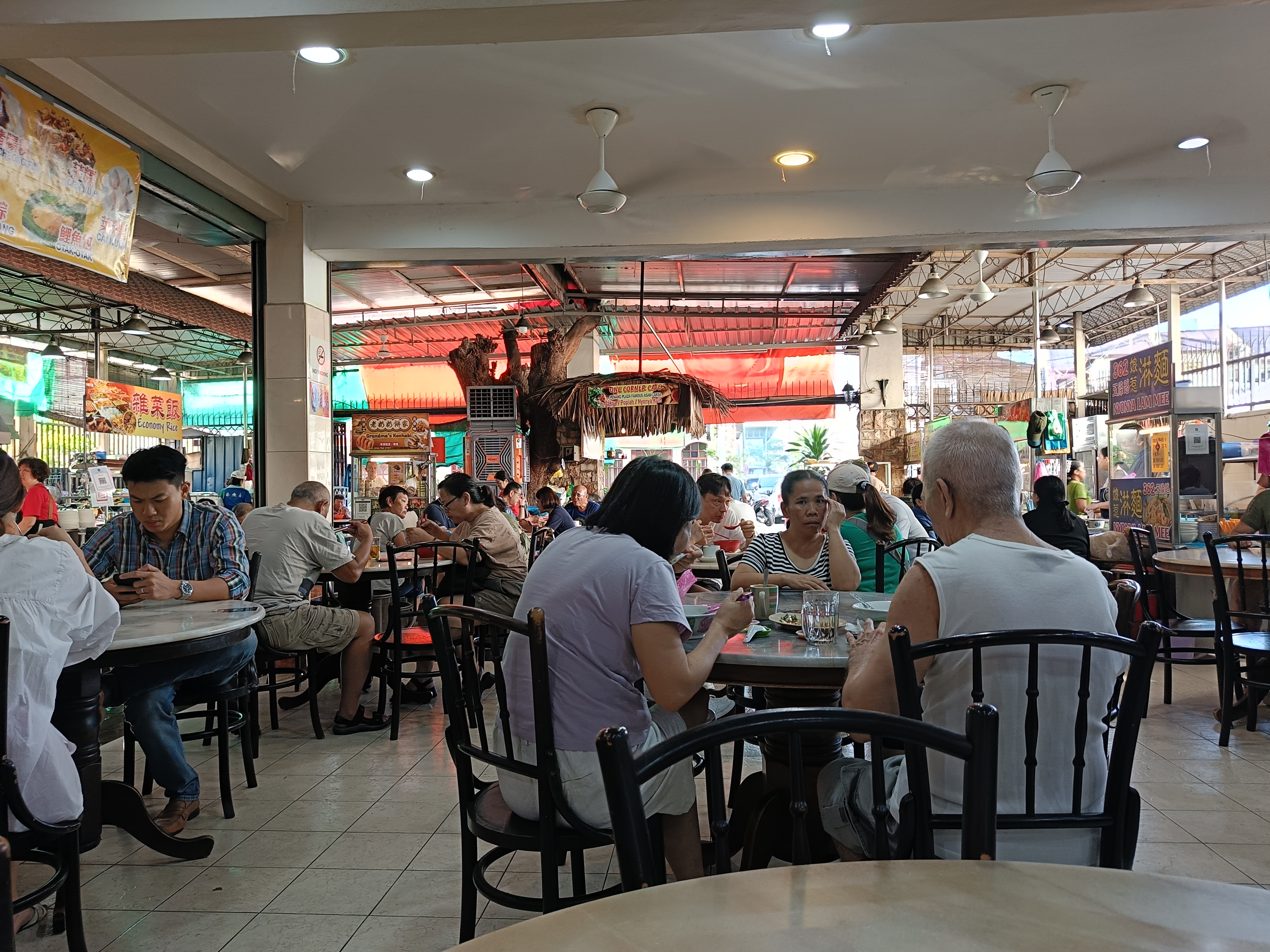
Just behind the plaza was One Corner Café, where I finally settled on a bowl of hokkien mee for breakfast. It wasn’t bad at all. Different stalls have their own way of preparing this hawker favourite, and here, I could really taste the full flavour of prawns in the broth. Quite satisfying.

Instead of retracing my steps along Anson Road, I took the long stretch of Burmah Road all the way to the Pangkor Road junction. Along the way, I paused in front of No. 229-B, where another of my old classmates, Chuan Keat, used to live during our schooldays. It brought back a wave of nostalgia—so many memories, now tucked away behind a gate that hadn't been there before. 

A little further on, I made a short stop at the corner to snap a few photos of the Victoria Memorial, unveiled in 1930 by Cecil Clementi, then Governor of the Straits Settlements. The statue still stands proudly on its pedestal, surrounded by four stone lions and their Union Jack shields. It’s part of the grounds of the Chinese Recreation Club (CRC). Victoria Green, where the CRC is located, was a public field gifted by the Chinese community in honour of Queen Victoria’s Golden Jubilee in 1887. The CRC itself was founded in 1892. Facilities were developed around the green over time, and the club became well known for cricket, tennis, badminton and more recently, community events. It remains one of the island’s most historic and respected social and sports clubs.

Turning left, I continued along Pangkor Road, then Perak Road, making a short detour into Khaw Sim Bee Road to look at the former Rediffusion building, until I reached the junction with Logan Road. And that’s where my four-kilometre-long morning walk ended, as I stepped back into the air-conditioned comfort of the LohGuanLye Specialist Centre.

ADDENDUM: I've also included some photos of MacAlister Road which I had taken the previous evening when I walked down in search of dinner.

My old classmate, Yeoh Oon Hup, now deceased, used to stay in one of these old bungalows. This particular one is now used as a nursing home

A second old classmate, Khoo Chuan Keat, also deceased, stayed here. The low stone walls that surrounded the houses along this stretch of road have all disappeared. In their place are metal gates that have destroyed the unique charm of the old houses 

From January to April 1963, this building in Perak Road served as the temporary premises of The Old Frees' Association while the Northam Road premises was being built

The old Rediffusion building which was acquired by the Penang Christian Centre after it had remained empty for quite a while

Behind this pillar stands the Buddhist Tzu Chi Dialysis Centre Penang. This is at the corner of Perak Road and Logan Road

The 218MacAlister building which houses the Tropicana and the Courtyard by Marriott

Soon-to-open 22 MacAlister Exsim which I suppose will be another hotel

This is the Ta Yuen Foh Thang (大圆佛堂), a temple run by vegetarian Mahayana nuns. It was established in 1883 which makes the temple 142 years old. I used to come here as a small boy, six or seven years old, brought along by my grandmother when she wanted to buy stuff. The place is filled with huge statues of Buddhist deities, with some arranged around a central dais in the main building. I used to tear around the gloomy prayer hall, completely unbothered by the stillness of the place and unfazed by the eyes of the statues looking down on me. Hardly anyone visited the temple back then, and I don’t think that’s changed much over the years—it still looks closed most of the time, quiet and undisturbed despite the presence of vehicles in the compound.


Saturday, 3 May 2025

Home-cooked authenticity

While in Bangkok last month, my fellow travellers and I sampled food from upscale Thai fare at the elegant Baan Khanitha on Sukhumvit 23 to the street stalls outside Platinum Fashion Mall. Some dishes were delicious, others decidedly lacklustre and no amount of chilli or spices could disguise their blandness. But the one place where we truly tasted authentic Thai cooking was at the Ruean Jaisai in Nakhon Ratchasima. This is a Buddhist meditation retreat roughly 200 kilometres from central Bangkok. Tourists don't normally visit there unless they go with a purpose. It’s nearly a four-hour journey to get there and another four to get back, but utterly worth the effort.

Because monks live at the retreat, each morning and midday devotees arrive to make dāna offerings of home-cooked food. By tradition, the monks eat only until lunchtime (at some temples it’s a bit later but never after 1 pm) and consume nothing substantial thereafter except permitted liquids and even then, there are rules to follow. So everything that is laid out will have been prepared fresh in people’s own kitchens. How much more authentic can the food get? When we visited Ruean Jaisai on 21 April 2025, we joined the lunch dāna and experienced the ultimate Thai-food moment. Simple yet sublime, every dish spoke of generosity, tradition and genuine home cooking. For that alone, I’m truly glad I was there.


Tuesday, 24 December 2024

Indian choice!

Food-wise, yesterday was one odd, crazy day—completely unplanned, utterly random, and I only realised the pattern while driving back from the island. Every single meal I had was Indian: breakfast, lunch and dinner!

It all started with breakfast at my regular Indian spot in Bukit Mertajam. I had headed to the Post Office early in the morning to use their Poslaju service and on my way back, I decided to grab some thosai and masala tea. My usual Chinese coffee shops were all closed—it was a Monday, after all—so the choice was easy.

A few hours later, I found myself heading to Penang Free School to pass something to the Headmaster. As usual, I lingered around to soak in the school's vibes. The place was unusually quiet thanks to the school holidays, but before I knew it, it was lunchtime. 

Since I was already in the area, it was an automatic decision to stop by The Garden restaurant for some Indian vegetarian banana leaf rice—just a stone's throw from the school.

And dinner? I ended up driving my friends from KL and Japan to Little India. Our wanderings led us to a newly opened restaurant where we treated ourselves to a sumptuous Indian meal that included some prawn masala, palak, mutton bone soup and briyani rice. 

It was only while driving home that it hit me: every single meal of the day had been Indian! Surprisingly, I didn’t miss my usual Chinese food at all.

Tuesday, 15 October 2024

Fine dining

We recently had the occasion to indulge in some fine dining experience, courtesy of an event organised by HSBC Global Private Banking at the Orinea Restaurant in Sunrise Gurney. It was a gathering of around 50 people. Apart from us, I believe most of the guests were clients of this private bank from Singapore. 

Naturally, the dinner was preceded by a mandatory talk—a forum discussion, actually—where a few lawyers and financial services professionals were invited to speak on succession and legacy planning. I was hoping to pick up something new, but unfortunately, the panel covered only the basics, leaving little to discover.

Now, about the fine dining. The cuisine was unmistakably French. Each course was exquisitely crafted and beautifully presented, but the portions were incredibly tiny. We left feeling as though we could have gone for a late-night supper, though at our age, we thought better of it. 

Alongside the meal, we were served an impressive selection of whiskys—four varieties in total, all excellent. Perhaps the only real takeaway from the evening was learning how to truly appreciate whisky: swirling the liquid in the glass, inhaling the vapours through the mouth and sipping the whisky slowly, rather than gulping it down. Although, we did notice a few people doing just that, throwing back their heads to down all that fine stuff in a jiffy! Poor sods, I thought, completely missing the point of the evening.

Note: I was checking up on this Riverstown Invergordon 30-year-old single grain Scotch Whisky online and saw this description of its aroma and taste:

Aroma: Spicy and rich with notes of vanilla, caramel, honey, hay, and notes of tobacco and oak.

Taste: Lots of spices; Pepper, ginger, allspice, cinnamon and sweet vanilla. You can also feel nuts, marzipan and sweet notes of oak.

Finish: Long and spicy with aftertaste of burnt sugar and nut notes.

I suppose there’s a lot of eloquence to describe the whisky when a bottle costs around RM1,100. Incidentally, the retailer mentioned it was the very last bottle of his stock—one that we had knocked back. Should we feel privileged or not?