This time, I ordered their Vietnamese Raw Beef and Beef Ball (Phở Tái Bò Viên) to try. But I cannot give a definite opinion about it because it is not often that I eat beef noodle soup. All I can say is, can-lah.
My wife and daughter decided to share an order of the Hanoian Style Fish with Tumeric & Dill with Vermicelli (Chả Cá Lã Vọng). Our verdict about this dish: slightly disappointing. Why? Because this restaurant could not replicate the real, original style from Hanoi. My whole family was in Hanoi for a family holiday in 2014 and we had truly experienced the authentic stuff at the Chả Cá Thăng Long fish restaurant there. We were so impressed with the food that we went back a second night to eat it again. But here at the An Viet restaurant? Nah....we won't order it again. It is a pale version of the original. There must be a reason why the original uses the snakehead and not any other variety of fish, isn't it? This version served at An Viet wasn't the snakehead fish, that I can definitely say, and it made a world of a difference to the taste and texture. Secondly, there was hardly any dill. We really missed the copious amount of dill that we had in Hanoi. And thirdly, I was surprised to see that this dish came with a slightly soupy base. But the most important difference was the type of fish meat.
Showing posts with label Vietnam. Show all posts
Friday, 16 September 2022
Pale version
I really miss Michael's quaint little Que Huong Toi restaurant along Jelutong Road in Penang. Before it closed in 2019, the restaurant served one of the best Vietnamese food on the island. Real, authentic Vietnamese food because in his kitchen were Vietnamese cooks. Every time I went there either on my own or with my wife, my choice of Vietnamese food would invariably be their Banh Xeo, a Vietnamese crepe stuffed with bean sprouts, minced pork and prawns, and eaten with leafy greens and loads of herbs such as mint and basil leaves. At the height of the restaurant's popularity, Michael opened two branches in downtown Church Street to cater for the office crowd and also at the Queensbay Mall. But suddenly, Michael vanished from the scene and his restaurants closed with him. Nobody knew what had happened but his restaurants' closure brought on my deep hunger for Vietnamese food in Penang. However, no other Vietnamese food outlet could, in my opinion, compare favorably with Que Huong Toi's. Michael, if you happen to read this, please do consider opening your restaurant again.Recently in Kuala Lumpur, my wife, daughter and I decided to have our dinner at the An Viet restaurant in The Gardens Mall. I was familiar with this place. Firstly, they have an outlet at the Gurney Plaza in Penang. Then, of course, I've eaten here in this very outlet in the past once or twice. My opinion of their food was so-so only. Nothing to shout about. But I ate there because I wanted some Vietnamese food to warm my belly.
Sunday, 20 January 2019
Danang, day four: Ba Na Hills
The fourth day of the old farts' stay in Da Nang proved dreary. The day started well enough but the weather turned dreary -- cold, wet and dreary -- when we left for the Ba Na Hills.
Now, the Ba Na Hills was about 45 minutes to one hour away from the One Opera Danang Hotel where we stayed. It was a long drive but time passed rather quickly before we found ourselves at the spacious parking area which had the potential to hold, maybe, 100 tour buses. It was tremendously huge. We were suitably impressed.
At the onset, I would want to say that the Ba Na Hills has been developed into a theme park. It comes complete with a cable car system -- more than one system, if you count the various lines -- and tourist attractions like a funicular train, a golden bridge supported by gigantic hands, other gigantic disembodied body parts, flower gardens, French villa, pagodas and temples, indoor amusement theme park, wax museum and, of course, several hotels and restaurants. There are no casinos on the Hills though, or otherwise one of its favourite attractions would surely be to bet on the fast-changing weather. Sunny, misty, wet, all constantly changing by the hour.
Meanwhile, my take on Ba Na Hills is that the Ba Na Hills is to Da Nang just like Penang Hill is to Penang. Both sites offer a cooler respite from the warmer climes of the lowlands. But I wouldn't want Penang Hill to suffer the same fate as the Ba Na Hills. It's fun to go up the Ba Na Hills for all these tourist attractions but to me, it loses its appeal after a while. I prefer the laid-back beauty of Penang Hill anytime. Okay, I've said my opinion.
Entering the building, we were to take a 20-minute cable car ride up into the mountains. We looked upwards and that was when we saw the first sign of ominous clouds forming. Clouds turning a hint of grey and then becoming darker. But we old farts from The Old Frees' Association were already committed to this trip.
Now, where the Ba Na Hills are concerned, you have to take a chance with the weather. It can be incredibly clear with blue skies and you can see around for miles. Or it can be damp, wet, dreary, cold and incredibly misty. We drew the short end of the straw. Wet and misty would be our experience.
Their cable car ride is supposedly the longest in the world. Imagine that. A South-east Asian country possessing the longest cable car ride in the whole wide world. And we were on it. Zooming up into the clouds. Mist all around us. Below us, the lush green tropical vegetation.
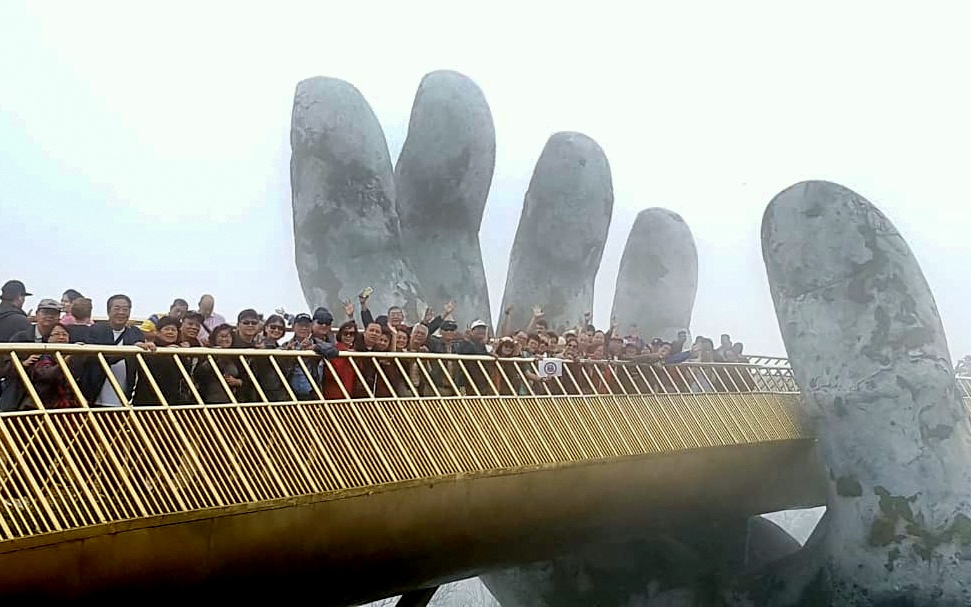
Soon, we arrived at the end of the line and we were quickly bundled by the guide to the Golden Bridge which consisted of a pair of hands seemingly holding up a 150-metre long pedestrian bridge. This attraction was only finished last year and it explained why it was one of the most popular places to visit at the Ba Na Hills. Despite the inclement weather, we all clambered onto the bridge for a very bleary group picture. But what else could we do but to make the most of this weather?
We were to remain there for about half an hour before taken to explore somewhere else. But two of my tour members got themselves lost. Okay, we acknowledged that it was not the fault of the tour guide that they got lost. They simply wandered off by themselves. And with there being 32 of us, each having a mind of our own, it was very difficult for the guide to herd us together.
Somehow, after about a 45-minute search, the two missing members were found. By then, it was too late to be shown more of the area. We had to take another cable car -- a shorter trip this time -- to go up the hill again. This was to the French village. By now, the weather had gotten worse. It was raining and the mist was thick. So thick, in fact, that all the buildings were shrouded in grey. Our group had either to don raincoats or open their umbrellas. My wife and I preferred to use our own umbrellas and so, with an umbrella in my left hand and camera in my right, hoping to be able to take some clear pictures which was impossible, we marched from the cable car station to the restaurant to take our lunch.
After lunch, there was little time to explore the place before the guide led us indoors somewhere to visit the wax museum. Along the way, we had to pass through an indoor theme park. All the attractions here were filled with people. We hurried through the place into the museum. Spent about half an hour there before we headed back to the cable car station for the trip back to the base station and thence, back to Da Nang.
| My first inkling that the Ba Na Hills was a theme park was when I saw this sign. Not once, but everywhere. You just can't avoid the name of this corporate entity. |
| I don't know what the stone carver was thinking of, but he made this stone monkey look like it was enjoying itself tremendously |
| Soaring into a misty world |
| One of the huge disembodied sculptures |
| And that's us on the Golden Bridge. There's another hand somewhere in the distance, which we couldn't see because of the mist. But it's there, all right! |
![]() |
| I could get Saw See to point her finger at the stone finger.... |
![]() |
| ....but despite showing her how to, she couldn't get my finger to touch the sculpture! |
![]() |
| Luckily, a friend happened to take this impromptu picture of me, which sort of compensated for all my frustrations |
![]() |
| If you look hard enough, you'll see me holding the OFA logo |
| A very welcome lunch, if only to get out from the cold and damp. Temperature outside was 16 Celsius |
| What's there to see when it was wet, wet, wet through and through? |
| Sun World? It was more of a Wet World! |
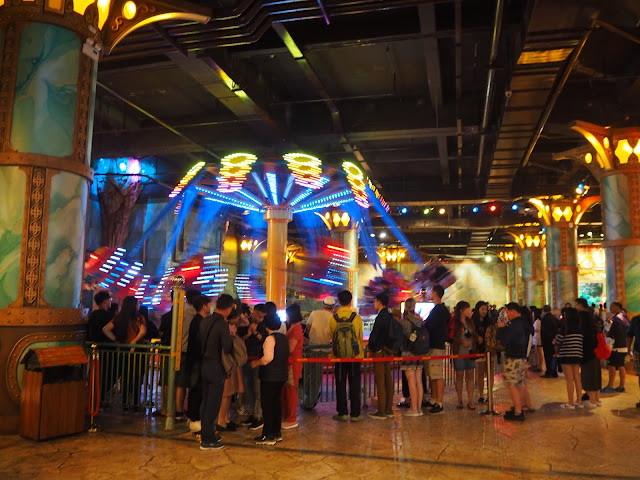
| The indoor theme park |
| Wax museum |
| Wordless scream. And I guess the reflection of my hand in the mouth added to the terror of the moment. |
| Fancy that, a heater fan |
| And here we go back down the hill |
Market
One last place for us to visit in Da Nang, and that was the market. Huge place but we could only spend about half an hour here. Many of us picked up tidbits of food to bring home to Penang.The next morning after breakfast, we checked out from the One Opera Danang Hotel for our flight home to Penang. An exhausting 96 hours in Vietnam. Despite some slight misadventures here and there, the vacation was well worth it, especially among the other old farts from The Old Frees' Association. Hope to do this again next time!
| I wonder what can be cooked with dried shrimps this size? |
Friday, 18 January 2019
The blue car
When I visited the Thien Mu Pagoda temple grounds in Hue last week as part of the Old Frees' Association tour group, I was confronted with a grim reminder of Vietnam's sad and violent days from the 1950s till the 1970s.
| Photo by Oon Chee Seng |
As someone with some interest in history, I learnt the significance of this old car to the Thien Mu Pagoda only after coming back home. Was there a religious connection between car and temple? Of course, there must have, but it had everything to do with politics too. Vietnamese politics, that is.
The car was used to carry an old senior Buddhist monk in 1963. The Buddhist monk was Thich Quang Duc. If you don't know who he is, please do a google search on his name. You'll be surprised, if not shocked, to learn what happened to him, and how it led ultimately to the overthrow of President Ngo Dinh Diem of South Vietnam five months later.
A religious suppression by Diem's government resulted in many anti-government protests taking place all over South Vietnam, but notably in the capital, Saigon. On 11 Jun 1963, Thich Quang Duc was driven in this blue car to his self-immolation spot in Saigon. Read about it in Wikipedia here, or otherwise learn what I had first written about him in this blog 12 years ago here. It was the first of a series of self-immolations by members of the Buddhist clergy, which brought the plight of Buddhists to the attention of the international community.
![]() |
| Historical photo by Malcolm Browne |
The 1960s was a time of great changes to almost all of us from The Old Frees' Association who were in this tour group. If you were growing up in the 1960s, chances are that you would not have missed knowing about the war in Vietnam. Even a superficial knowledge of a war far away had left a mark in my memory decades later. It might have left the same impression in your mind too.
Thus when we had the chance to visit the Thien Mu Pagoda, if we had been told about the history of this car properly, we would have appreciated its association with Vietnam's past. A hands-on history lesson lost.
Danang, day three: All day long in Hue
Thien Mu Pagoda
Our first stop was at the Perfume River jetty where we boarded a dragon boat for a river cruise upstream to the Chua Thien Mu. By now, we had understood that Chua was the Vietnamese word for Pagoda.| All 32 of us could fix inside one of these spacious boats. |
| The symbol of the Chua Thien Mu: a seven-storey pagoda on the grounds. |
Imperial Citadel
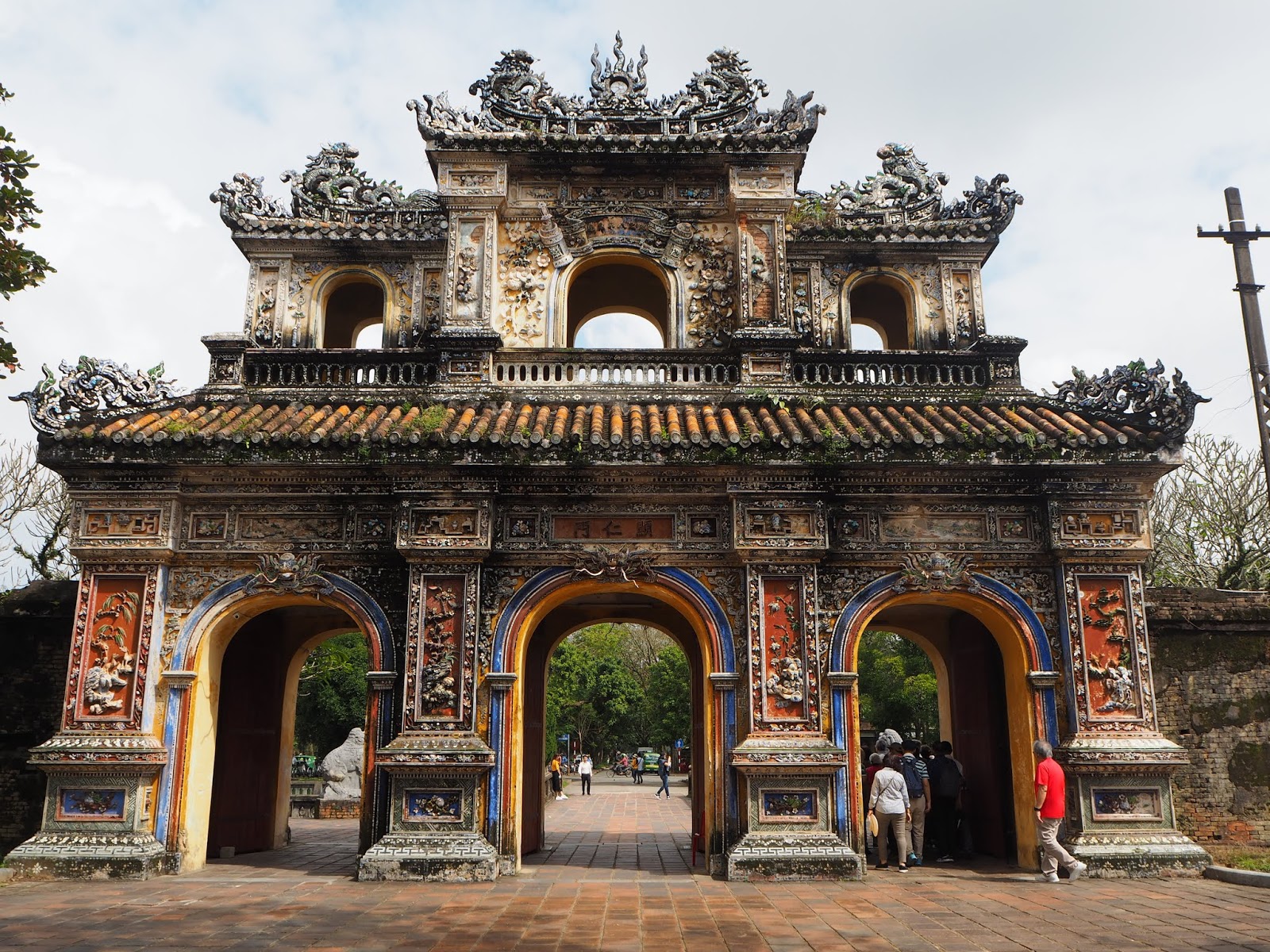
Leaving the Thien Mu Pagoda, we visited the Imperial Citadel next. This was once the seat of power for the Nguyen kings of Vietnam, with Hue as the capital. The Imperial Citadel is a sprawling complex of buildings, monuments, gates, landscaped gardens and the odd royal tombs.
According to a description in Wikipedia, the grounds of the Imperial Citadel are protected by fortified ramparts measuring two kilometres by two kilometres, and ringed by a moat. The water in the moat is routed from the Perfume River through a series of sluice gates. Inside the citadel is the Imperial City with a perimeter wall some 2.5 kilometres in length. And within the Imperial City is the Purple Forbidden City, which was modelled after the Forbidden City in Beijing. In the past, access to the innermost enclosure was restricted to the imperial family. The Imperial Citadel was made a UNESCO heritage site in 1993.
Because its grounds are some immense, it would have been impossible for us to walk from one attraction to another. In fact, even to get into the Citadel itself, we had to commission a special white electric car to take us in, and even then, we had to walk from a point near the citadel's flag tower to the imposing citadel gate. Once inside, another set of electric buggies awaited us to bring us around.
| The flag tower, which is almost impossible to miss. |
| The Citadel Gate |
| Once through the gate, it was feeding time for the carp |
| The Citadel's electric buggies driven by charming Vietnamese woman |
| Another view of the interior of the To Mieu Temple |
| And this is inside the Royal Theatre. |
| One more of those imposing gates and that's it: we're about to leave the Imperial Citadel. |
| Boarding the white electric cars to bring us back to the parking lot outside the Citadel. |
Royal tomb of Khai Dinh
Before we left Hue, there was one last place for the old farts to visit in the afternoon: the royal tomb of Khai Dinh, one of the last emperors of Vietnam. He proved to be very unpopular, having raised taxes on his people to build his tomb which was completed by his son after his death. The tomb is located on the outskirts of Hue and would require visitors to be healthy enough to climb the steep steps to reach Khai Dinh's final resting place. The inside of the tomb features elaborate glass and porcelain shard art while the ceiling is decorated with nine dragons. Despite the fine and bright architectural design, the place is actually quite morbid. By six o'clock, it becomes completely deserted.
Dragon bridge
By nightfall, we had reached Da Nang. The trip was uneventful with the tour guide telling us of the accident that had occurred at the Hai Van Pass. The return trip did not follow the same road that we took to Hue. Instead, the driver took us through the Hai Van Tunnel which at 6.28km is the longest tunnel in south-East Asia. The tunnel reduces the distance between Da Nang and Huế by 20 km (12 mi) and saves between 30 minutes and an hour on traveling times over the old Hải Vân Pass route.
Tired though we all were, the first thing that we did on reaching Da Nang was to stop at their Dragon Bridge. We had already noticed it on the first day of our arrival in Da Nang but here was the opportunity to see the bridge up close.
Subscribe to:
Posts (Atom)