Showing posts with label Tan Chin Nam. Show all posts

Monday, 24 July 2023

Big Dragon Project

This story has been late in writing. Originally, I wanted to write it in April after Ding Liren had won the world chess championship, making him the first-ever male player from China to become the world chess champion. Something had stopped me from writing then. Anyway, I've now decided to do something with Ding's historical win and what better way to begin than from the beginning? 

Have you heard of the Big Dragon Project? No? Well, it wasn't a complete secret to begin with. Some people in the chess circle knew about it but as it did not involve them directly, they just didn't care much for it. Not until Ding became the world chess champion. But I've seen it happen, from almost the start of it. 

After Ding's win, some foreign journalists became intrigued when they heard about a Big Dragon Project in China. Just about two to three weeks ago, I was contacted by a journalist asking for information, which I have given him. But I thought that I should also publicise it here on my blog for the greater good. So here goes! (I should mention that the version which I gave the journalist was mainly re-written. But this is my original version.)

Myself playing chess with Dato' Tan Chin Nam in 2014
In 1974, Tan Chin Nam was elected as the first president of the Malaysian Chess Federation. He was already a very successful businessman in his own right, a big-time property developer. However in chess, he was a complete newbie but one willing to immerse himself into a totally new world. 

Settling down into this new role, he got to know Dr Lim Kok Ann (Singapore) who in turn introduced him to Florencio Campomanes (Philippines) and other chess presidents from around the Asian region. As part of his scheme to revitalise chess in Malaysia, he agreed to organise the first Asian Team Chess Championship in Penang, Malaysia. It was also the 50th anniversary of the World Chess Federation and somehow, he invited FIDE to hold their FIDE Congress to Penang. So in December 1974, both the FIDE Congress and the first Asian Team Chess Championship were both held at the same time in Penang.

By Tan Chin Nam's assertion, the Big Dragon Project was hatched in December 1974 by Dr Lim Kok Ann, Florencio Campomanes and Yasuji Matsumoto (Japan) and him. He invited the Chinese Chess Association to send observers to the FIDE Congress Penang but instead, two officials from the Chinese Embassy in Kuala Lumpur turned up. On the sidelines of the FIDE Congress, the first meeting of Asian chess presidents took place. As a chessplayer representing Malaysia in that Asian Team chess championship, I remember seeing the Chinese officials arrive for meetings at the Merlin Hotel in Penang. (That old Merlin Hotel is now the City Bayview Hotel.)

The idea behind the Big Dragon Project was simple. An Asian country was selected as trailblazer to narrow the gap in chess technique and knowledge between Asia on one side and Soviet Union, Europe and North America on the other side. India could have been selected but the country sided with the Philippines, Indonesia and Singapore to give the opportunity to China with its bigger population and thus, potential.

On the coat tail of a successful Asian team championship in Penang, Tan Chin Nam convinced FIDE to accept the Chinese Chess Association as a member in 1975. I believe that more than anything else, China's entry into the world chess fraternity helped that country to open themselves up to the rest of the world in every aspect. It was even more significant than the American ping-pong diplomacy in 1971. A very grateful Chinese Chess Association subsequently invited the Malaysian Chess Federation to send an official delegation to visit their country in April 1978. Again, I was in the thick of it as a player.

So the Big Dragon Project was launched with China. It was all about creating a great Asian chess power by raising their level of play and then producing grandmasters. As far back as 1974 or 1975, the objective was to make China the destination for future world chess titles. The strategy would start with the Chinese women players. First, they challenged for the women's individual world title, and then for the women's Olympiad team title. The Chinese men would then follow in the same order in due course.

As a multi-millionaire, Tan Chin Nam was able to throw a lot of his own resources into the project. However, nothing came easy. For the Chinese women, for example, it took 13 years after China's men's team's debut appearance in the Bueno Aires Chess Olympiad in 1978. Who could ever forget international master Liu Wenzhe's demolition of grandmaster Jan Donner in a sparkling brilliancy when China met Holland at the Chess Olympiad?

He financed a united Asian chess team with two players from China and one each from India and the Philippines to play a match with Yugoslavia in 1984. In 1985 he paid for Chinese participants to play in a zonal championship. Next, sponsorship of the First Beijing Chess Open in 1988, followed by funding the Tan Chin Nam Cup for seven years beginning 1995. In 2002, the Tan Chin Nam International Open attracted 22 foreign grandmasters to China.

Also important was purchasing chess books, computers and research materials, as well as sponsoring two chess study trips to Europe for top Chinese players in 1996 amd 1997.

The first big breakthrough came in 1990 when Xie Jun qualified to challenge Maia Chiburdanidze, women's world champion from the Soviet Union since 1978. In October 1991, Xie Jun defeated Chiburdanidze in Manila and ended a 41-year monopoly by the Soviet Union and a 64-year reign by European champions. At that moment when it happened, I was in Genting Highlands for an Asian Cities Team Championship. We were elated and felt very happy for Asian chess. I initiated a congratulatory postcard for Xie Jun, signed by many players and officials in Genting.

The next breakthrough came at the 1998 World Chess Olympiad when the Chinese women's team captured the gold medal and affirmed themselves as the new dominant powers in women's chess. The progress of the Chinese male players has been slower due to the greater competition among male chess players, but the struggle was still there for everyone to see. It must have been some 20 years since The Big Dragon Project ended but nevertheless, China continues to progress on their own momentum. The pinnacle of their success came this year with their grandmaster, Ding Liren, becoming the first world chess champion from China. 

All these would not be possible without the financial resources from Tan Chin Nam. But before anyone started accusing him of favouring chess in China before promoting the interests of Malaysian chess, he had made it very clear that the Big Dragon Project was nothing about chauvinism. In his own words, he said that it was, and it remained, a helping hand on his part to "promote excellence and to hammer out multi-national intellectual friendships on the anvil of honest competition."

  #BigDragonProject #chesshistory #chinachess #chessdiplomacy

Friday, 18 March 2022

Grandmaster of property

Four years have passed by since Tan Chin Nam died. If he had lived, he would have been 96-years-old today, having been born on this date in 1926. However, he had died in 2018. 

Normally on the 21st of October every year, I would be spending the day celebrating the anniversary of my alma mater's founding in Penang but by a quirk of fate, I found myself in Kuala Lumpur in 2018 to attend the convocation of one of my nephews. And it was on that day in  Kuala Lumpur that word arrived in the late afternoon of the passing of the Malaysian Chess Federation's honorary life president. As I mentioned, it was a strange quirk of fate for me to be in KL which enabled me to pay my last respects to this grand old man of Malaysian chess.

Over the last one year of so, I have been digging through my collection of old newspaper cuttings to reproduce stories on Tan Chin Nam in this blog. A few months ago courtesy of Edwin Lam, I came across another feature story, this time bearing a deadline of 10 June 2006 in the Business Times newspaper in Singapore. Chess and horse-racing were only mentioned in passing as the main attention was on his business empire. Nevertheless, the feature was an interesting read and it complemented his memoirs, Never Say I Assume!, that came out in the same year.

Grandmaster of Property

TAN Chin Nam, whose name translates literally from the Chinese as Tan Develop South, may not be a household name in Singapore. But the seasoned Malaysian property developer was instrumental in two landmarks in Singapore - the Shangri-La Hotel on leafy Orange Grove Road and Parkway Parade in the east.

This was revealed in the 80-year=old businessman's recently published memoirs, entitled Never Say I Assume, which were written jointly with Mr Tan's friend Larry Parr.

The 293-page book provided a colourful sketch of Mr Tan's early years in pre-independence Malaysia, his stint as a rice trader and supplier to the British army, his 10-year tenure as a compradore for Bangkok Bank, his groundbreaking property projects in Malaysia and Singapore, his association with the first prime minister of Malaysia, and his passion for thoroughbreds and chess.

He has been widely credited as the man who built the first condominium in the Malaysian capital, through his former listed company Tan & Tan. The project is aptly called Desa Kudalari (which means running horse in Malay) as it is sited near the former turf club, which has since been transformed into the home of the 88-storey Petronas Twin Towers.

The tycoon, who was last year ranked by Malaysian Business magazine as 28th richest man in Malaysia with known assets in excess of RM500 million (S$216.41 million), has earned many other accolades along the way. They include "Grandmaster of Property", "Mr Low Cost" after he was the first developer of houses in Malaysia for a mere RM5,000 apiece; the maiden Property Man of the Year award for Malaysian developers in 1992; the only horse owner to have won the prestigious Melbourne Cup three times with two horses; and honorary life president of the Malaysian Chess Federation.

Despite his many achievements, the octogenarian appeared friendly and sincere during a recent interview at his suite at the Shangri-La in Singapore. He wore a short-sleeved shirt and declined to don a jacket for the photographer. He disclosed that he had turned down offers of free accommodation at the hotel that he helped develop in the 1970s. He had ready and easy answers to many questions during the interview.

Mr Tan has continued to keep a finger on the pulse of major corporate and political events on both sides of the Causeway. When asked about the state of bilateral ties between Malaysia and Singapore, Mr Tan readily gave his views. "From day one I find the chemistry of the two countries not workable," he lamented. He said the Singapore approach was too "black and white" while Malaysia adopted a "grey" stance. "You cannot say who is right and who is wrong," the diplomatic businessman said.

Mr Tan proposed the formation of a private company to help resolve all the problems on both sides of the narrow Johor strait - the sale of Malaysian water to Singapore, the stalled bridge project to replace the Causeway linking the two countries, the redevelopment of the Malaysian railway land in Singapore and other issues.

All the items in the list of outstanding bilateral problems could be injected into the private company. The items can then be classified as "assets" and "liabilities" to both countries.

The company can then be floated as a sizeable public company, he said. But there must be an element of goodwill. "I appeal to Singaporeans to follow Tunku's style. Instead of meetings, go to the golf club, socialise a little bit," he said, referring to his good friend - the late Tunku Abdul Rahman, who was the first premier of Malaysia.

The reference to the late premier didn't come as a surprise. His friendship with the late prime minister is well known and is chronicled in Mr Tan's memoirs.

In the autobiography, Mr Tan fondly called his friend "the George Washington of Malaysia" as the Tunku had helped Malaysia secure its independence from the British in 1957.

Mr Tan disclosed that he was invited to a black tie dinner with the late premier in 1959 after the Tunku saw Mr Tan "hacking away" at the Royal Selangor Golf Club - a rather posh establishment for the 33-year-old Mr Tan then. "The dinner went well. The Tunku and I shared a common interest in horses and the destiny of Malaysia," Mr Tan wrote.

Mr Tan said he never benefited financially from his long friendship with the Tunku, who died a relatively poor man although he was a prince. In fact, Mr Tan disclosed that he helped pay the Tunku's income tax of about $40,000. "The truth is that I owed the Tunku a favour that had nothing to do with his loyalty during the racial riots of 1969," Mr Tan said, without elaborating.

Friendship, sincerity and loyalty appears to be a consistent theme in Mr Tan's life and business dealings. This is reflected by his long association with businessmen such as "sugar king" Robert Kuok, who is still the richest Malaysian, the late property developer Ang Toon Chew of Petaling Garden, and Chin Sophonpanich, who founded Bangkok Bank.

Although Mr Kuok is well-known for his current control of the chain of Shangri-La hotels worldwide. Mr Tan's early involvement in the project in Singapore in 1969 is less well know.

Mr Tan fell in love with the 12-acre plot of land at Orange Grove almost instantaneously. "Robert Kuok wasn't involved (initially). We (Mr Tan and Mr Ang of Petaling Garden) came, we saw, we bought. It took about one minute to make our decision," Mr Tan said.

Mr Kuok entered the picture subsequently and they jointly developed the landmark hotel. "Robert Kuok is Robert Kuok. After some time, he became senior partner," Mr Tan laughed. He then explained: "Robert Kuok was better capitalised than us at that time as we were basically condominium builders."

Mr Tan was sketchy about details, merely saying his stake was diluted while Mr Kuok raised his stake in the hotel. Apart from cashing out to raise money for his other housing projects, Mr Tan realised that it was not possible for the two men to run the hotel. "There can only be one tiger on the hill," he quipped.

But success such as the development of the famed Shangri-La Hotel didn't come easy for Mr Tan, whose rubber-trader father lost his fortune following the crash of rubber price in the 1920s, turning to opium for solace.

Mr Tan and his late brother, Kim Yeow, founded Wah Seong - which is Chinese for "Chinese merchant" - in 1946 to trade in commodities including Burmese rice. The business sank when its shipments were grabbed by pirates. They revived Wah Seong to handle food shipments to the British prisons and hospitals in colonial Malaya. Work was hard and the profit margin slim, but Mr Tan relished the memory of delivering potatoes and taking breaks after work at Penang's esplanade.

Like many Chinese traders then, Mr Tan and his brother ventured into property development. Their first project was a row of five shophouses in Penang in 1948. They sold each one for 5,000 Straits dollars per shop.

Mr Tan undertook a grander project in 1959 together with the late Mr Ang. The project was Petaling Garden, which today forms part of Petaling Jaya - the first satellite town to support the development of the bustling Malaysian capital. But success got into his head. "In 1959 I figured there was nothing I could not do well," he wrote.

He became a compradore - a middleman between an enterprise and the Chinese community - for Bangkok Bank in 1959. Like many compradores, Mr Tan took a commission on loans and foreign exchange deals in return for guaranteeing all the transactions.

He recalled Bangkok Bank's late founder Chin Sophonpanich as telling him that he would be very good in the job within five years - although Mr Tan reckoned he needed only one year to be a successful compradore.

Mr Tan revealed that he made about one million Malaysian dollars as a compradore in the ensuing decade - but lost it overnight in 1969 when a loan for the same amount soured. "I was injured in terms of my personal wealth, reaching deeply into my pockets to repay the bank," he wrote.

Despite being crushed by the banking experience, Mr Tan is believed to have maintained close contact with the banking family until today, although Mr Chin died in 1988.

Fortunately for Mr Tan, he has had more hits than misses in life. One hit was the development of Parkway Parade in the 1970s in Singapore by Parkway Holdings, the listed vehicle of the Tan family on both sides of the Causeway.

But Parkway, which was run by his nephew Tony Tan Choon Keat, came under fire from minority shareholders in 1995 for its ill-timed Harbourview project in the US. The showdown at the annual general meeting lasted more than four hours, deemed by this newspaper as a record in local corporate history.

Mr Tan's team won the day. He cashed out of Parkway two years later after the share price appreciated by over 60 per cent. His memoirs said success in developing Parkway Parade gave him the confidence to undertake his biggest-ever project, known as Mid Valley City in Kuala Lumpur.

The plan to build the biggest mall in South-east Asia was daring on all counts, due to the retail glut in the late 1990s and the onset of the regional financial crisis.

Fortunately for Mr Tan and family, the bet turned out to be a winning one. Big turnouts can now be seen almost daily at the well-designed mall along the busy Federal Highway, which has more than 1.7 million square feet of net retail space - a lot bigger than Singapore's Suntec City which has a retail area of over one million sq ft.

Another success was the Tans' Australian vehicle Ipoh Ltd, named after the tin mining capital of Perak, whose portfolio included the grand Queen Victoria Building in Sydney.

The Tan family sold its controlling stake in Ipoh to the Government of Singapore Investment Corporation four years ago in a deal valuing the entire company at A$260 million (S$304.8 million).

"I trade and build things. Which are what I do best," Mr Tan declared.

Despite his tendency to trade assets like commodities, Mr Tan and family have kept Mid Valley in Kuala Lumpur for investment income. The asset generated RM171 million in revenue last year. Pre-tax profit from the property alone stood at RM92 million, according to the latest annual report of parent company IGB Corporation.

IGB is in the midst of adding a high-end appendage known as The Gardens which, when fully completed by 2008, will have a shopping centre with a net floor area of 800,000 sq ft, two office towers, and two five-star hotels in a garden environment. The Tan empire is now run mainly by Mr Tan's son Robert Tan Chung Meng and daughter Lei Cheng. [Editorial note: Robert Tan was the son of Tan Kim Yeow, not Tan Chin Nam, and was thus the latter's nephew.]

He has full faith in them. "The second generation can turn out to be an improvement of the old man," he quipped.

A rather modest statement for a man who has not only made it big in Malaysia but also in his southern ventures in Singapore and Australia. And he did it in style, guided by his strong principles, lessons from his early business failures and his many friends in the business and political arena.


Thursday, 15 July 2021

Talking with Tan

I'm still rearranging my personal chess archives, otherwise known as my storeroom. Happened to come across this November 1995 issue of Chess Life, published by the United States Chess Federation, which featured Tan Chin Nam on its cover. Probably a first for a Malaysian chess player, amateur or otherwise, to frontpage a foreign chess publication but then, with former Chess Life editor Larry Parr behind the story it was bound to happen one day, and this was it.

The magazine commented that while most of Tan's largesse was evidenced on the Pacific Rim, he "played a large part in securing sponsorship for the US Amateur Team playoff at the Harbor View Marina and Yacht Club in Baltimore in 1993."

A transcript of the interview that Parr had conducted follows below. By then, he had moved his residency to the SuCasa Hotel Apartments in Kuala Lumpur where he was employed to ghost write Dato' Tan's autobiography.

TALKING WITH TAN, by Larry Parr

IF DATO' TAN CHIN NAM is not the world's wealthiest businessman, he is probably its wealthiest chessman. An enthusiastic and dangerous amateur player, this 70-year-old mega-developer keeps a chessboard and men at the ready in his private office in Kuala Lumpur, Malaysia. Visitors are expected to play on the set with the man whom business newspapers dub the "property grandmaster" and chess journalists the "Maecenas of Malaysian chess."

But life was not always so prosperous.

Dropping out of school at age 13 and working as a street hawker and clerk, this financial giant avers that he "was once a poor man myself." Among his earlier business efforts was the famous Ipoh Gardens housing project which earned him the nickname of "Mr. Low Cost."

Although officially retired from Tan & Tan and IGB Corporation, the two major components of the Tan Group of companies, Dato' Tan is still, in the view of many business reporters, the man who calls the major shots. For example, this vigorous old Lion King divided power among his children between Tan & Tan and IGB, and then quoted the Chinese proverb, "You can't have two tigers on one hill."

As far as chess is concerned, Dato' Tan started out by playing the Chinese variant at a good club level, first becoming involved in Western chess about 1973 when a previous Malaysian federation got deregistered by the government. He proved important in establishing the current Malaysian Chess Federation.

But let Dato' Tan speak for himself about why he became enmeshed in Caissa's coils and about what he regards as his most important contributions:

Larry Parr: What attracts you to chess?

Dato' Tan Chin Nam: I'm fascinated by the game. I eat, talk and dream chess – though the dreams are sometimes nightmares. For example, how many FIDE officials will stand and watch a game for four hours with corns on their feet? I do.

Chess can be rewarding. I now think that I can become a better player. Chess teaches you never to say, "l should have won the game." That's like saying you shouldn't three putt. I'm stupid to make a mistake or not to anticipate a move by the opponent. There are no "should-haves" in chess. The failures are the result only of one's stupidity.

For youngsters, chess teaches discipline, patience, systematic analytical thinking, and the humility that only comes from getting beaten. In fact, I like to lose. If I win, then there is no more competition for me; any player that I beat is out of my book. To remain in my "club," you must beat me.

Parr: Speaking of "nightmares," what do you find most aggravating about being involved in chess?

Dato' Tan: That's easy to answer. Like doctors, chess players never say thank you and never say sorry. When I started organizing chess events, some of the local players rated at 2200 wanted appearance fees! ln a way the sheer nerve of these people made me feel happy even when it was also annoying.

Parr:  Malaysia has held a number of high profile international competitions, including the 1990 Karpov-Timman candidates' final. What about sponsoring the Kamsky-Karpov match for the FIDE "world championship?"

Dato' Tan: No. It would be hard for the Malaysian Chess Federation to do this when local players would be raging against any potential sponsor. Before we can host grand tournaments and matches, we need a home-grown grandmaster and some more IMs. The point behind the 12-tournament rating series is to create a large new pool of Malaysian players, several of whom might then become grandmasters.

Our best prospect right now is Mas Hafizulhilmi Agus Rahman, a 15-year-old Malay schoolboy who has just scored 50 percent in the qualifying Zonal for our region. It was a tremendous result for him and for our country. Eduard Gufeld thinks very highly of the boy.

Parr: By one estimate, you have donated about $2 million to chess. Why?

Dato' Tan: Some people are born stupid. Just think how I could have invested those funds! But I already answered this question earlier. It is because I like chess and wish to be involved, and I'm proud of some of the things that I've done.

Parr: What are your outstanding contributions to chess?

Dato' Tan: Chess people best know me for helping to finance and find a venue for the 1984 USSR vs. the World Match, but I've done other things that have had a greater long-term value.

What Kerry Packer did for cricket, I have tried to do for chess. Around 1986 I fought very hard to rate rapid chess, which has contributed significantly to chess development and media interest in Asia. I also initiated the Asian Presidents' Conference which is held every two years at Olympiads. Campomanes has made it a regular feature in order to keep up communications among all of the Asian federations. Another innovation was my starting the Asian Team Championship in 1974 and the Asian Cities Championship in 1979. Both of these competitions have helped the Asian federations to come together in cooperation.

Parr: One last question. Do you take authentic pleasure from playing a lovely game of chess from start to finish?

Dato' Tan: I think I would. But I have yet to play such a game and can't tell you for sure.

Note: I would have liked to change all the American English spellings into proper international English but then decided to leave them alone to reflect the original idiosyncratic flavour of the American culture.

Tuesday, 22 June 2021

Master in business and chess

While going through my old newspaper cuttings recently, I came across this old story which I've been keeping for almost 20 years. Eighteen year, to be more exact. It was a story by Thean Lee Cheng that had appeared in the weekly Bizweek pull-out section of The Star newspaper of 22-28 Feb 2003. Before I reproduce it in full below, let me add that the following week after the story has come out, Tan Chin Nam came out to Penang for a meeting. Sometimes, he would ask me to come out to the Cititel Penang to meet him in the morning, not to play chess although I would always have a set handy nearby but for news about the chess scene in Penang. He was always interested to hear what was happening here, how the Penang Chess Association was getting on. And I would fill him in with the news he desired to hear. On more than one occasion, I shared with him a breakfast of Penang chee cheong fun which he could never get the authentic stuff in Kuala Lumpur. He really appreciated that.

Master in business and chess

TAKE it from the master. Nothing happens by chance, not in the corporate world, not on the chessboard, not on the racing circuit and certainly not on the golf course. Not for Datuk Tan Chin Nam, the patriarch of the Tan family who controls IGB Corp Bhd.

He should know. He has been through all the booms and busts of an economic cycle, the rise of a company, the fall of another. Be it war or peace, he has been there.

Tan retired from the corporate world in the early 1990s and is no longer a director of any publicly listed company now. He, however, has substantial shareholdings in a couple of companies under the IGB group today. Gold IS Bhd and Wah Seong Corp Bhd being two of them.

"I retired at the age of 70. Nobody thought I would. I am now 77. Because to just make money, is that what life is all about? How much is enough? Will it ever be enough?

"A million was a lot of money before. Today, it is almost hay. It is not the RM200 million you make but whether you have the last RM100,000 when the bank calls for it. Businessmen learn this the hard way during every crisis."

No university taught him his business skills, no mentor. And forget the manuals.

Tan quit school at 16. "I passed standard seven and was supposed to go to Junior Cambridge," he recalls. World War II took care of that. But Tan is no less rich because of that. If anything, he may be the richer for it.

A mere lad, he went into the world of buying and selling. That was his first job. "On my first day of selling ayam (chickens), vegetables and fruits at the roadside, my former fellow students in Victoria Institution saw me, I was malu (embarrassed), humbled even though I was making an honest living.

"There were no shops. Everybody was a broker, everybody traded. I was determined just to survive. not live. I didn't have the luxury of living. The moment I owned Straits Dollars (SD) 1,000 I was happy."

That SD 1,000 came by luck. "Ninety per cent, it's pure luck," Tan says in his penthouse office suite at Menara Tan & Tan in Kuala Lumpur, his autobiographer Larry Parr present throughout the interview.

He bought a cash sweep, a form of empat ekor (numbers sweep) and won SD1,852.

"l used that as an investment tool to go into business and invested in a trading company called Wah Seong. That name is significant. Today, Wah Seong Corp Bhd is a company with big plans. It aims to transform itself from a medium-sized Malaysian industrial group into "a major Asian/global oil and gas service infrastructure group" by the year 2007. Tan is a major shareholder there.

The company specialises in the coating of pipes used in the oil and gas industry. It took over the listing status of Perdana Industri Holdings Bhd last July 2002. 

"My philosophy was simple. If I had Straits dollars 10,000, I was one in 10,000 in South-East Asia in the old days, that's roughly where I would be standing. My ambition was to have SD20,000, and SD200,000 was the grand finale. After that, I stopped counting. Likewise with horses. After I had a stable of 20 horses scattered here and there, I also stopped counting. It no longer mattered how many horses I had, but how many times I won."

Tan is the only Asian to have won the Melbourne Cup, one of the oldest and most prestigious races in the world. Indeed, he is the only horse owner to have won it three times.

The Melbourne Cup is in the same league as the English Derby, America's Kentucky Derby and the Dubai Cup.

Twice in 1974 and 1975. it was with Think Big, a horse he co-shared with Malaysia's first Prime Minister Tunku Abdul Rahman in 1975 for his second win and the third was in 1996 with Saintly.

The largest stake money he ever won was the 1996 Melbourne Cup - A$600,000. Tan has horses in Hong Kong, Australia, Singapore, Malaysia and elsewhere.

After about 20 minutes, Tan changes pace, moving from a game of speed to one of intellect.

Enough of horses! Let's play chess. Describing himself as a business man who is a chess player and not a chess player who happens to be a business man, Tan says he can play "eat and sleep" chess for days.

"You know why I enjoy it so much? It teaches discipline and it is a game that forces one to think. I have been promoting the game since 1974. There is a need in this country. Where do our young people spend their free time?

"Too many of them get involved in crime and drugs. In my time, we had the boy scouts. We caught spiders, played tops and marbles, had our fighting fish and swam in Dusun Tua.

"What do our young people do today? I saw the direction our youth were heading a long time ago and I am only sorry that the people in authority cannot see what I see."

Tan has been spending an average of RM100,000 annually since 1974 to promote the game. Beside the intellectual somersaults that the game accords him, Tan enjoys the friendship he has made over the years.

Comparing the manoeuvres on the chessboard with those in the business world, Tan says it is a wrong move (on the chessboard) versus a wrong word on the corporate field.

If you offend someone in a game of chess, the worst is that you are banned from playing. In the business world, it is different. So you have to be very careful with what you say."

In the chess world, when you are with a chess friend, money does not count. In the business world, one is a friend because it serves a business requirement.

Tan once described friendship like a piece of music. It transcends time, culture, class and race. "I valued friendships then, as I do today. With a true friend, one does not seek to ask for help when in need. Help is offered even before one asks. In life, there are very few friends of that calibre.

"Each of the friendships made contributed to my life in different ways. There cannot be one single one that..."

Tan pauses, turning back the pages of his mind. Lost friends but not lost friendships.

"The Tunku (Malaysia's first Prime Minister Tunku Abdul Rahman) is one of them. We shared more than just Think Big, the horse which won the Melbourne Cup twice and which the Tunku co-shared with me for the second Melbourne Cup win in 1975. He paid me RM30,000 for his share of the horse. He confided a lot in me, although he was 23 years older than I."

"My philosophy on friendship has not changed. Always make new friends but never forget the old. Not only because the more friends you have, the happier you are, but also because the fewer enemies you have.

"I like to consider some chess moves now."

Thursday, 1 November 2018

Realising objectives (part two)


On the 22nd afternoon, I accompanied my wife and sister-in-law to the Dewan Tunku Chanellor at the University of Malaya for the convocation ceremony of my nephew. Leaving them there, my next destination was the unlikely Xiao En Centre in Cheras.

Why the Xiao En Centre? Well, this was the unscheduled stop in my short visit to Kuala Lumpur. The previous evening, I received some text messages to inform me that Dato' Tan Chin Nam had passed away at the age of 92.

People who know me well would realise that Dato Tan was the main man behind the growth of chess in Malaysia. He was the first president of the Malaysian Chess Federation and for the past 15 years or so, had his company sponsor the Malaysia Chess Festival, possibly the largest chess and most popular event that the country had ever seen.

Some people would also know that I've known Dato Tan since 1974. With such a long history between the two of us, it became imperative that I should pay my last respects to him, especially since I was already in Kuala Lumpur.

So that was why I had to go to the Xiao En Centre with some urgency. I shall be writing a separate story on remembering Dato Tan later, a sort of tribute to him.

From the Xiao En Centre, I dropped off at the Pasar Seni MRT station and took a short walk to the Junk Book Store in Jalan Tun HS Lee. I had heard about this second-hand bookshop from Facebook and was curious to see for myself the range of old, second-hand books there. True enough, when I entered the building, there were rows upon rows of second-hand books, all wrapped up carefully in plastic sheets.

I went through the ground floor and then the proprietor told me that there were more books on the first floor. So up I went there. Took a slow perambulating walk round the passageway and then my attention was diverted to three boxes on the floor that held some 300 pieces of vinyl records. Immediately I sat down to go through the dusty pile of records and I pulled out several titles that interested me.

Then I asked whether they had any books that dealt with the history of old Penang. Maybe, he said, and then he asked his assistant (could be his wife) to open up the second floor for me to check on some titles there.

So up I went too to the second floor. Took a quick look around because the lady said they would be closing at five o'clock. then went downstairs again with the records to haggle with the prices. Felt spending RM150 on seven records was a fair price to pay!

On the way back to the MRT station, I came across the Soong Kee coffee shop. I had been here with a cousin some two or three years back, but it was at night, to eat the beef koay teow there. I was alone this time but it was as good a time as anytime to order a new bowl of the said beef koay teow to try again. Superb stuff. Very happy with THIS decision.

The next day on the 23rd, my daughter brought my wife and I to the Batu Malai Śrī Subramaniar Swamy Devasthanam (more popularly known as the Batu Caves Temple) in Batu Caves. Although we had visited the temple some three to four years back, I had felt that it was time to revisit it as so much had been written lately following a decision by the Temple Committee to give the whole place a new coat of paint. Yes, Batu Caves is now a riot of rich, bright colours. The main temple at the foothill has been gaily painted in multi-coloured hues, as also the 272 steps that led to the biggest of the limestone caves at Batu Caves.

Whether or not the Batu Caves temple will lose its national heritage status remains to be seen although I hope not! The colours themselves do not mean that the value of the temple has been devalued. It is the very nature of the Indians to celebrate colour in their everyday lives as well as in worship. For the Batu Caves Temple, much value and heritage are still attached to it as could be seen in the numbers of devotees present despite the day not being any religious occasion. The cave walls still have a history to tell. So I would suggest to the National Archives to leave the Batu Caves Temple well alone and let the Temple Committee do their job.


Tuesday, 30 October 2018

Remembering Tan Chin Nam


This story appeared in the Star2 section of The Star newspaper on 30 Oct 2018 (but not online). Below is the original unedited version with additional pictures taken of Dato Tan through the years. [UPDATE: The online version of this story has now appeared in The Star here.]
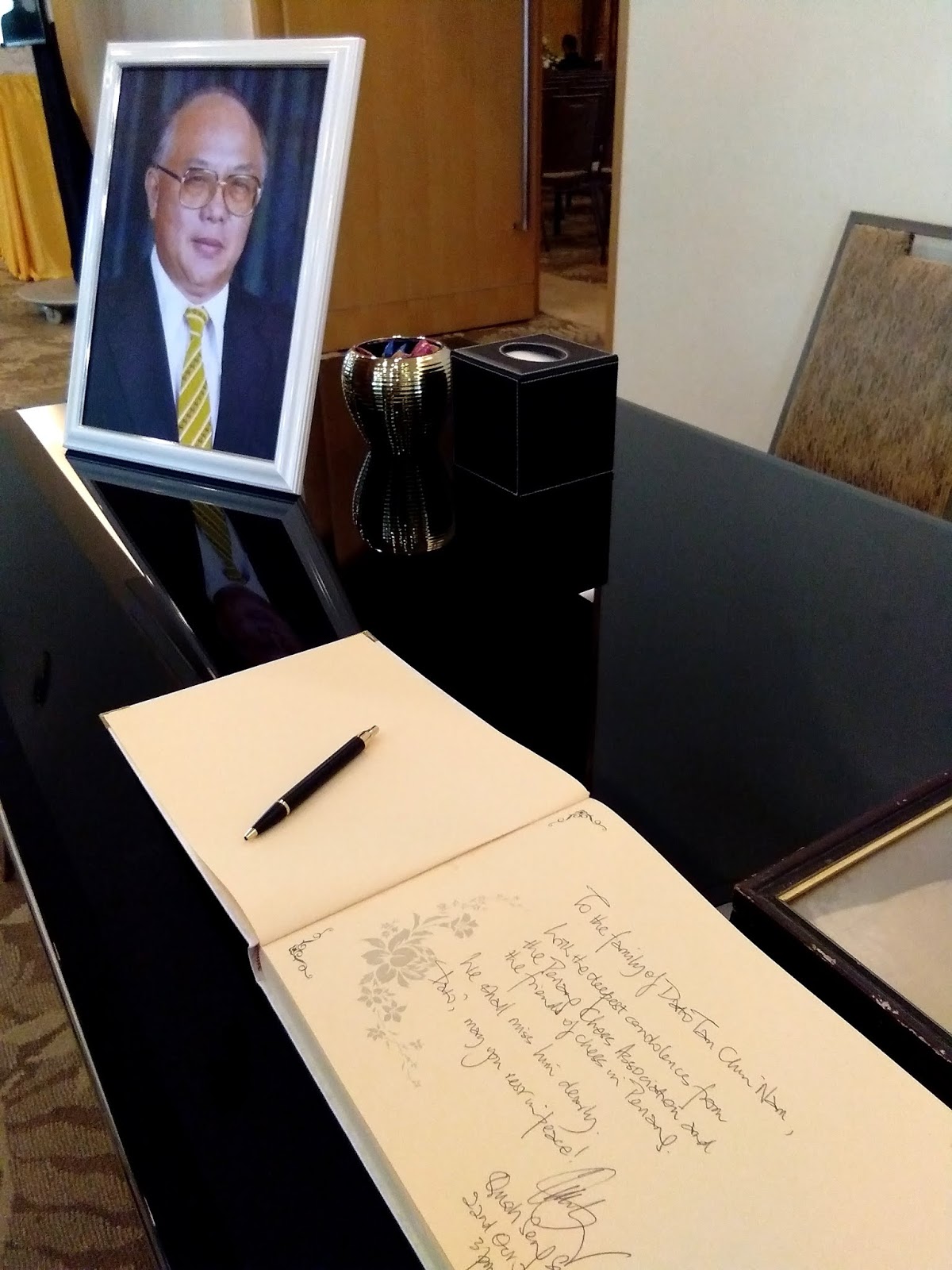
The text message came in at 6.14pm. Sent by See Swee Sie, President of the Penang Chess Association (PCA), it read: "It is with great sadness that I inform you, though you most probably already know.  Dato Tan has passed away." Barely five minutes later, my good friend in Kuala Lumpur, Hamid Majid, texted me: "It is with sadness, that I announce the passing away of Honorary Life President Dato Tan Chin Nam at 4:30 today, Sunday, 21 Oct 2018."

Photo credit: Khong Wai Cheong
I felt devastated. I had dreaded the day when he would pass away and with each passing year of the Malaysia Chess Festival, I became more certain that the moment would happen soon, if not later. After all, he was already 92 years old this year. Yet, when it happened on 21 Oct 2018 at 4.30pm, the news floored me.

I made a few telephone calls to Hamid and Swee Sie but there was not much of additional information from them. Hamid said the family was making final arrangements soon. Nothing more I could do but wait. That night even as I went for the Old Frees Association annual dinner in Kuala Lumpur, my thoughts were far away.

Caught smiling after winning the Melbourne Cup in 2008
I first met him in 1974. At that time, he was just plain Tan Chin Nam but already a well-respected property developer. Of course, being a mere 20-year-old at that time, I didn't know much of this man. Who was he, I had asked silently at that time, that wanted to start the new Malaysian Chess Federation to take over from the defunct Chess Association of Malaysia? Anyway, I was down in Kuala Lumpur with the then first PCA president, Fang Ewe Churh, to attend that inaugural meeting of the Federation, and got to know him.

It has been 44 years. That's a very long time. If ever I was in Kuala Lumpur for a stretch of several days, I would try to fit in a visit to him at his office or his former home at Desa Kudalari. Initially built to look over the Selangor Turf Club – horse racing was one of his other great passions in life – his condominium unit later commanded a grand view of the KLCC Twin Towers.

Once, he invited me to his home for "some games of chess" but before we even played a single game he excused himself first because he needed his afternoon nap. So there I was, enjoying the grand view from his balcony while he slept in his reclining chair in the living room.

While he was still able to travel around for corporate meetings in Penang in the 1990s and 2000s, I would meet him with my chess board. In between chess games, he would ask me about the progress of chess in Penang. He really took a very keen interest in the affairs of the association. If we needed any money for chess activities in Penang, we looked no further than his company on the island. He would ask me to go see his niece and present my proposal to her. And occasionally, I'd buy some local street food to share with him. Once I brought some Penang chee cheong fun which he attacked with gusto.

Photo credit: Khong Wai Cheong
Tan celebrated his 80th birthday in March 2006. It was a grand affair at the Renaissance Hotel in Kuala Lumpur. Each of his guests was presented with a copy of his memoirs, Never Say I Assume! They were all pre-signed copies as it would have been impossible for him to sign them all on the spot. He called me over. "Seng Sun, give me your book," he told me and I duly handed it over. Then in his shaky handwriting – he was already suffering from Parkinson's – he added the words, "Dear Seng Sun my good friend of 32 years."

In the last few years of his life, he had been sickly. About five years ago, he suffered a fall which restricted his movements. For several years, he gamely tried to continue walking but later gave it up and remained largely confined to a wheelchair. He had his good days and bad days, according to his personal secretary. When I visited him at his house last year, I was forewarned that he might not be awake. True enough, he never stirred from his bed the whole time I was there.

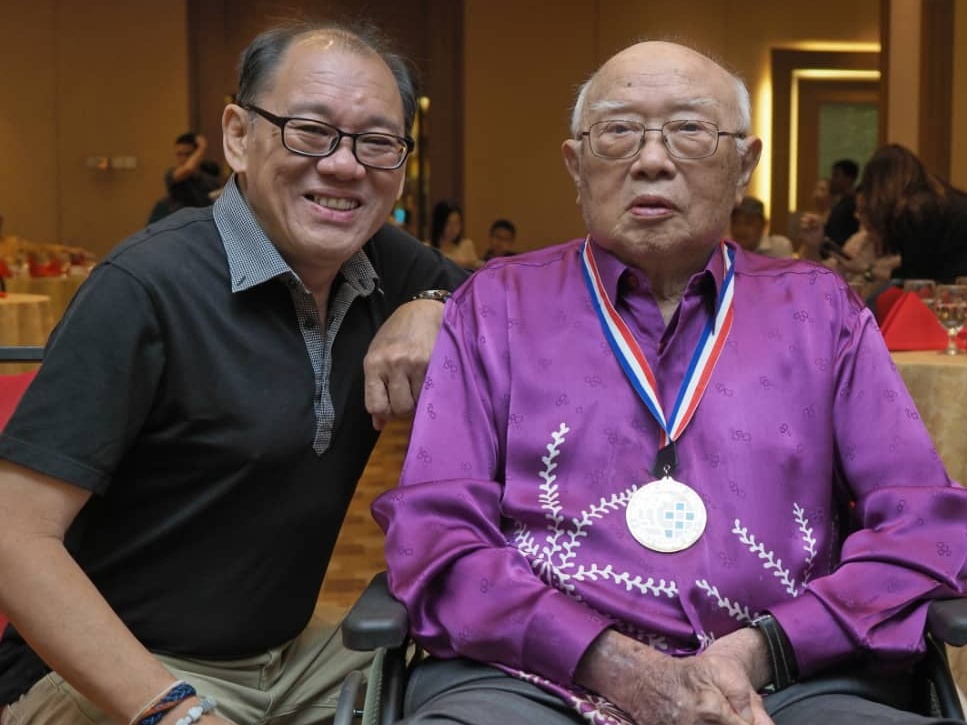
This year, I was lucky. Tan was lucid enough to turn up at the closing ceremony of the Malaysia Chess Festival. But I could see the fatigue in his eyes. Like always, everyone milled around him, everyone greeted him and he acknowledged them back with a stare, sometimes with a nod. But he never spoke. And that was the very last time I met him. Eight weeks later, Tan was gone from this earth.

On the morning of the 22nd of October, his obituary appeared in the newspapers. I told Swee Sie that I shall have to go to the funeral home to pay my last respects on Monday even though the obituary notice said that the wakes would be opened to the public on Tuesday and Wednesday.

So I turned up at the Xiao En Centre in Cheras on Monday afternoon. Of course, nobody was there yet. There were no guests, no family members, just two representatives from Xiao En. There were rows and rows of chairs and meanwhile, their staff was still preparing the ballroom. Tan's body was in the holding room, I was informed, while I talked to the Xiao En people. And then suddenly, one of them turned to me and made an incredible offer, "Come follow me. I can give you some private moments with Dato."

I duly followed her to the holding room and thus there I was, standing beside the Big House and looking down at the most serene Dato Tan Chin Nam, dressed in a light blue shirt with yellow tie and a dark jacket, and having his final rest. "Goodbye," I mouthed silently, "I'm going to miss you."


Saturday, 1 September 2018

Meeting old chess friends


One week after I had returned from playing in the Merdeka rapidchess team open tournament with my The Old Frees' Association teammates at the Cititel Midvalley, I found myself in Kuala Lumpur again. Same place too, the Cititel Midvalley.

Reason was to attend the closing ceremony of the Malaysia Chess Festival but mainly, also to meet with the grand patriarch of Malaysian chess, Tan Chin Nam, whom I had not talked with for at least two years. He would now be 92 years old, getting to be 93 in March next year.

While I had visited his home last year in an effort to meet him, he was not feeling well enough to see me. But I knew that he would be at the closing ceremony. He wouldn't miss it if he was able. And I couldn't afford to miss this opportunity. It was a chance I had to take.

So I flew to Kuala Lumpur on the morn of the 26th of August. And yes, he did turn up. The moment he entered the hall, the whole place was abuzz with excitement. Everybody wanted to fuss over him. Such an important man in Malaysian chess.


Other than Dato Tan, I met up with several other chess friends that I have known throughout the years. But if only I had taken the opportunity to take more pictures with them. Oh well, there is still next year, though.

 Carl Hessler from the United States. He used to call Penang the biggest Chinatown in the world outside of China.

Possibly my oldest foreign chess friend, Ignatius Leong from Singapore, whom I've known since the 1970s.
 
And of course, this is Hamid Majid, another old chess friend. Known him since the 1980s when he first started to be interested in chess organisation. Now, this is so much ingrained in him.

 See Swee Sie, the current President of the Penang Chess Association.  


The next morning, I bumped into another old friend at breakfast in the hotel. Khoo Boo Teik, one year my junior in school. Only a casual chess player, unfortunately. He now works in Tokyo, Japan.


Sunday, 11 September 2016

The OFA chess adventure


It took three months of planning before I managed to bring a team of four players from The Old Frees' Association down to Kuala Lumpur for the Malaysia Chess Festival. The tournament in question would be the ASTRO Merdeka rapid chess team open tournament. This annual event has been organised for ages and it pulls possibly the most sizable and diverse crowds in the country.

At first, I thought that each team could consist of five players but changing regulations meant that the organisers did not want any reserve player on the teams. As such, the players were required to play every round without rest. Could I stand the strain, I thought to myself. But never mind, here's a chance to see whether I would still have the determination to play nine rounds without faltering.

So we arrived in Kuala Lumpur by train on 9 Sep 2016, Chuah Heng Meng, Terry Ong, my wife and I arriving at KL Central and we found our way to the Cititel MidValley, the chess festival's venue. Colin Chong, being KL-based, joined us sson later.


For much of the two-day event, we experienced a roller coaster ride. The first round saw us pummel an inexperienced team by 4-0. Then we happened to be paired with a team of experienced players and that saw us receive a 0-4 drubbing. In the third round, we won by 3-1 but the fourth round saw us losing 0-4 to a team of female chessplayers from Indonedia. That, fortunately, was the last time that we lost by such a wide margin in the tournament.

We recovered in the fifth round with a narrow 2½-1½ win and followed up with a 3-1 win in the sixth round. A 1-3 loss occurred in the seventh round, a 2-2 draw in the eighth round and finally, a 1½-2½ loss in the ninth round saw us settle at 47th position in a field of 96 teams.

I guess we couldn't complain much about our results because when I brought the team down, I told them that our main aim was to enjoy ourselves playing in this event. We had no ambitions about winning a prize as we knew that the strong teams were all going to be more formidable than us.

Chuah used to be the bedrock of chess in his younger days but he is no longer the stubborn player we used to know. Colin continues to be plagued by time trouble and Terry's game was not solid enough. As for me, my competitive days are behind me too. Playing for fun is all we have left. But we are glad to have come to KL. The Merdeka event has enabled us chess players to meet and renew our acquaintances all over again. We are, after all, one big chess family. Gens una sumus.

The Penang Chess Association vice-president, Tan Eng Seong, caught three-quarters of our team in a jovial mood in the hotel's lobby at the end of the first day.

This was before the fourth round got underway. Note our opponents: all lady players from Indonesia. We couldn't stop them from annihilating us.

However, the drubbing did not affect our mood at all. Here we are, still looking rather cheerful (or at least, Terry and I are.)

I can't quite remember who we were playing against, but we were playing on Board 13, which was as high as we could climb.

The report would not be complete without a picture taken with the grand old man of Malaysian chess, Tan Chin Nam, who is now 90 years old. He has been in a wheelchair for some years already and had a health scare in December 2013 when we were all so concerned about him.


Saturday, 4 October 2014

Chess is about people playing


I know that this year's Malaysian Chess Festival is all over already but I simply must post a few pictures that I took - and also taken by one other photographer - during the few days that I was there as a guest of the organisers.

I know that this picture isn't clear but it encapsulates the grey hairs and the white hairs fighting it out in the KLK Lee Loy Seng seniors open tournament.

It was really a big crowd at the festival's main events: the Arthur Tan memorial international open in the foreground, the Bukit Kiara Properties chess challenge and the seniors tournament in the background.

And a few days earlier, the Swensen's rapid age-group open tournament got underway. (Picture by Khong Wai Cheong)
A rather candid picture of Tan Chin Nam at the chess board. No, he wasn't playing in the seniors tournament; he was just visiting to see everything for himself. But he is truly the man behind the festival.

Year in and year out, the man behind the Malaysian Chess Festival, Hamid Majid. That's him in the centre. (Picture by Khong Wai Cheong)

The chief arbiter's table.

Players and spectators milling round to watch a crucial game.

Rows and rows of players at the blitz tournament.

The photographers photographed.

Prize-winners

One of the VERY few photographs where Tan Chin Nam is caught smiling! On my left is Ng Kay Yip, a director of JobStreet.com whom I did not get to meet at all during my eight years in the company. Fancy getting to know him at this festival! (Picture by Khong Wai Cheong)

Hah! A very crucial game during the ninth round of the Malaysian Chess Festival. Too bad it wasn't played in any of those three main events. Naturally, I was winning against the Grand Old Man of Malaysian Chess but I dragged on the game till the endgame where, to my chagrin, suddenly I saw his unimpeded passed pawn march two squares at a time down the board. I allowed him to promote his pawn and then called out a draw. Must note that he wasn't really cheating. At his age - 90 next year - I've got to give him a little bit of leeway with his eyesight. (Picture by Khong Wai Cheong)

I mustn't forget a geek and his computer toys :-)


Thursday, 11 September 2014

Chess reunion


I'm looking forward to travelling down to Kuala Lumpur next week to see the Malaysia Chess Festival 2014 for myself. No, I'm not in any way associated with the running of the show or even as a player. But as a long-time supporter of the annual Festival - I've been contributing stories for their souvenir programmes for a very long time - I have an open invitation to be there every year.

For a long while, I had thought that this year's Festival would have been cancelled. I clearly remember that at last year's event, the octogenarian Dato' Tan Chin Nam, who is the man behind the Festival for umpteen years already, had indicated that the 2013 edition, coinciding with the 10th Arthur Tan memorial Malaysia open chess tournament, would be the last that his business empire, IGB Berhad, would be sponsoring.

Apparently, Tan had a change of heart because just about a week ago, the main organiser called to invite me to KL and at the same time, asked me for a story for this year's Festival. "Or else the souvenir programme would be rather bare," he admitted.

"It is all rather last minute, isn't it so?" I had grumbled to him, but he said that the Festival had actually been announced by email as early as June this year. Oops, I must have missed his email in my inbox then.

Anyhow, I've already sent my story to him, just in time for print, and told him that I'd be there as always to drop into the tournament hall on the fifth level of the Cititel at the MidValley megamall.

Actually, the Malaysian Chess Festival is much more than just the Arthur Tan memorial Malaysia open. This year's event starts off with the 34th astro rapid chess tournament on 12-13 Sept 2014. Then there's the fifth Swensen's age-group chess tournament on 14 Sept 2014. Only then do we get to the 11th Arthur Tan memorial Malaysia open, the fifth KLK Tan Sri Lee Loy Seng international seniors open chess tournament and the ninth Malaysia chess challenge on 15-21 Sept 2014. And sandwiched in between the rounds of these three events will be the first Bukit Kiara rapid chess individual tournament on 18 Oct 2014.

So I'll be staying in KL next week from Thursday week till the end of the Festival. I'm raring to find out how happy can I continue to be while in the presence of my long-standing chess mates. I'm saying this because with each passing year, I am finding myself to be more and more irrelevant because the Internet had overtaken the traditional methods of chess reporting. News gets around faster at the speed of electrons than the printed word ever can.

Besides cavorting with my old chess mates, I also hope to use my time in KL to check up on some music stores, especially those that are still offering vinyl record sales to their customers. There is a bigger rejuvenation of record sales in the Klang Valley than in my hometown, Penang, and I would want to see how it is like there. And finally, I hope to catch up with several people that I've lost touch with for a very long time. It's really time for a reunion of sorts...


Wednesday, 13 March 2013

Close call in Malaysian Chess Federation elections


Although I have been out of the circulation among the local chess fraternity for quite some time now, it doesn't mean that I am completely out of touch with the chess developments in the country. On the contrary, I still have a passionate interest in whatever that's going on at the national level. There are friends that keep me up-to-date whenever I want to know something.

For instance, I do know that after a lapse of countless years, the Malaysian Chess Federation has finally decided to call for an annual general meeting together with an election of new office bearers. The first call for an AGM was supposed to be in January but it was postponed two months, ostensibly to buy more time to get their three-year Statements of Accounts ready.

Definitely, it raised several eyebrows, including mine, because the first thought that came to me was why the MCF couldn't get their one-year, two-years, three-years  accounts right. I would have thought that as a society, it was imperative to account for all public moneys received. Wouldn't the authorities have come down hard on societies that fail to submit their annual Statements of Accounts or even their Annual Reports?

But never mind their inefficiency in this matter. The important point was, the MCF was going to have their annual general meeting last Sunday, on 10 March 2013. Finally. And there would be an election for new office bearers.

In all my years of association with chess in this country, I can hardly remember a time when there was ever a serious contest or even a half-hearted attempt for the president's position. Not for the post of President of the Malaysian Chess Federation (and by the way, certainly not for the post in the Penang Chess Association either.)

So it raised my eyebrows again when I learnt that for the first time, there would be a contest between the incumbent president, Ramli Ngah Talib, and a challenger named Zuhri. Over the past two years, there had been a growing groundswell of discontent over Ramli's management team and people were telling me that it was possible that unless one of the contestants stepped aside, it would be exciting come the AGM day.

Like I mentioned earlier, I can't remember a time when we had contests for the president's post. In 1974, Tan Chin Nam was the unanimous choice as the founding president. Then in the 80s, a person named Lajim took over briefly when Tan decided to call it a day. Lajim was replaced by a cabinet minister, Sabbaruddin Chik, who held the post well into the 90s. I recall that Sabbaruddin always said if anyone wanted to take over, he would give way willingly. Anyway, no one wanted to sit on that chair.

Through time, the politician also decided to call time on the MCF and his deputy, Rosli, took over briefly. When Rosli relinquished the post soon afterwards and nobody new could be found, Tan came back as a caretaker president until Ramli was persuaded to take over as the president in 2005, 2006 or thereabouts.

So through this long period from 1974 until 2013, we haven't had a decent contest for the president's post. Not until this year. Beneath the ground, I heard there were some considerable campaigning going on with both parties successfully convincing the delegates - comprising the various state chess associations - to align themselves with either of the candidates. But don't ask me who they supported because I don't know.

All I know is that on Sunday, both sides came well prepared for the annual general meeting. However, there was a long and heated discussion on the eligibility of the sitting council members to vote. Turned out that this was still allowed for in the new laws of the Malaysian Chess Federation. Nobody had deemed it fit to review this privilege when the MCF had to re-register itself under the Commissioner of Sports, no longer under the Registrar of Societies.

So it became a most delicate annual general meeting on Sunday. With the sitting council members allowed to vote as individuals too, there were a total of 40 eligible votes.

Voting was done by secret ballot. When the results were announced, everyone in the room was surprised that both Ramli and Zuhri had each amassed 20 votes. A tie. I was informed that there was consternation all around. Nobody had expected this to happen. Both sides had gone into the secret balloting with lots of confidence. And now this had to happen. Deadlock.

Another round of discussion arose on the next course of action. Come back another day? Not a good decision because most of the delegates were from outstation. Eventually, the delegates decided on a re-vote. However by then, one or more groups of delegates must have left because there were 37 people left when the second round of voting was called.

At the end of this second round, matters clarified quickly when Ramli was returned as the MCF president with 21 votes compared with 16 for Zuhri. For the people at the AGM, this had been a momentous occasion for them. For all of us who had been following the drama from afar, this has also been an historical moment for chess in the country. Now that everything's been settled, I can only hope that the factions in the Malaysian Chess Federation will close ranks and move forward. In spite of whatever flaws, chess must still be one family. Gens Una Sumus.


Monday, 27 August 2012

Observations at Malaysia Chess Festival 2012

It is no excuse but the truth. I've been finding myself more difficult to log into the Internet in the evenings ever since my wife started competing with me for the use of the home personal computer. What about the mornings and afternoon? Well, the real excuse is that I'm suffering from a lack of inertia.


Anyway, I was spending several days in Kuala Lumpur last week without my ipad2 or the heavier and bulkier Macbook or the netbook. I only had my mobile with me and I felt that it would be sufficient for me to survive a few days away from Penang. No heavy-scale surfing but just enough connectivity to allow me to check my emails occasionally.

So what was I doing in KL? In particular, at the Cititel Midvalley. Anyone knowing me would know that I would invariably be at the Malaysia Chess Festival. I went there with half a mind to play in the tournament but at the last minute, I decided against it.


The format this year had changed from a long time control to rapidchess games, and I was dead set against short time controls. I play chess to enjoy myself, not to suffer at the chess board, and I consider 25-minute games as pure masochistic. The rush of the adrenalin in the last 10 minutes of a chess game is not to my liking and the pressure has become too much for me. Why should I torture myself unnecessarily? I started realising this more than 15 years ago and that is why I've fought so shy of quick time control games in Penang and now in Kuala Lumpur.

The change in format was primarily due to one man: Dato' Tan Chin Nam through whose big generosity that the Malaysia Chess Festival has now completed its ninth edition. But for the first eight editions, all games were played at long time controls which allowed the tournament results to be submitted to the World Chess Federation for rating.

But this year, he decided that the Malaysia Chess Festival needed to be enlivened up and he insisted that the organisers turn the three signature events - the Arthur Tan IGB Malaysia open, the Lee Loy Seng seniors open and the Ambank chess challenge - into rapidchess events. Privately, I had told the organisers that this shouldn't be done but I guess their hands were tied. So word went out that the Malaysia Chess Festival would be different this year.

Disquiet from the international chess community came when the organisers received a message from China that said they would not send any player to the Festival. Since eight years ago, the Chinese had been fervent supporters of the Malaysia Chess Festival and their close ties with Tan actually went back to 1974. People may not realise it but one of the reasons that China is a chess powerhouse today is because of Tan and his Dragon project in the Seventies and Eighties.

Back to this message, the Chinese mentioned that they had been participating in the Malaysia Chess Festivals of previous years not because of the prize monies. If they wanted money, they already had lots of tournaments in China that now offer significant cash prizes. They told Tan that they came to play because of the title opportunities. Because rapidchess games cannot be registered with the World Chess Federation for title norms and qualifications, they decided not to take part this year. If ever there was a rude awakening for Tan, this must be it.

Faced with this dilemma, it was time for some damage control. It was too late to revert this Festival back to the traditional long time control. So what did the organisers do? They decided to stick with the rapidchess format but they combined all the three signature events into one big tournament. This was a master-stroke that saved the Festival.


I should mention that throughout the Festival, Tan was still trying to justify the change to rapidchess games. Before the first pawn was even pushed, he sought feedback from the participants whether the Malaysia Chess Festival should remain a rapidchess event or change back to its original long format. From among the 180-plus participants, only about 12 players were in favour of rapidchess.

During the course of the tournament, he asked me to show him to some of the Filipino players - they were grandmasters and international masters - as he wanted to know their preferred format, and they all told him that they wanted rapidchess events. Of course they would say that. It did not surprise me. These Filipino players were basically mercenaries. Unlike the Chinese who valued titles and norms above everything else, the Filipinos were only interested to win cold, hard cash. That was all they wanted and if they could win cash prizes in the shortest time possible, so much the better. So why spend five or six days over long time-control games when they could win the same amount of money in three days over short time-control games? See their logic?

Emboldened by the Filipinos' response, Tan again asked the participants for a fresh feedback at the closing ceremony. At first he asked for people who supported the short time control. Only a handful of players wanted that. I didn't bother to see whether or not they belonged to the Filipinos. Then he asked about long time control and the hall was filled immediately with raised hands. Not satisfied, he groped at the last straw and asked whether people would prefer one-hour games. Nobody raised their hands. So I guess that finally, the message sank in that long time-control games are what chess players want when they come down to Kuala Lumpur in August every year. Next year at its 10th edition, the Malaysia Chess Festival should be back to long time-control games and reclaim its stature as a premier chess tournament in this part of the world.


Chess aside, I must say that it was really good to meet up with all those chess fellas again: so many friends from among the chess players and the chess organisers. But of course, when I look at the faces of the younger local chess participants, I have come to realise that we are generations apart and the younger set do not know me at all. My definition of a chess generation is about six to seven years, the time it would take a player to progress through his secondary schooldays. I would not be wrong to risk saying that there were at least six generations - possibly even more when the youngest players were about 10 years old and the oldest players were well in their eighties - of chess players in the tournament hall. But no matter the age difference, chess still remains a game for everyone.