Showing posts with label Singapore. Show all posts

Friday, 20 December 2024

Food and friends

My recent trip to Singapore wasn’t entirely about chess—those moments were reserved for the late afternoons and evenings. So, what did I do during the mornings and mid-afternoons? For one thing, it was all about the food.

On two mornings in Geylang, I set out to explore the area in search of Bak Chor Mee, a Singaporean street food I find utterly irresistible. Every time I’m in the Little Red Dot, indulging in this dish becomes a priority. While I’m happy with any variety, the traditional style remains my favourite. Over two days, I managed to find two stalls—one at the Sims Vista Market and Food Centre, which was a bit farther from my hotel, and the other at a nearby coffee shop. My tastebuds decided: the stall at Sims Vista was definitely the better of the two.

On my last morning in Singapore, I opted for breakfast at a 24-hour roti prata restaurant just minutes from the hotel. Their thosai masala was delicious—a perfect way to wrap up my morning culinary adventures in Geylang.

Of course, my food explorations weren’t limited to the mornings. On one of the nights, I introduced one of my travelling chessmates to a popular beef hor fun restaurant in Geylang. It’s a place I’ve visited many times before, but it was his first time there, and the experience didn’t disappoint.

Another objective of my trip was to reconnect with friends and relatives. Unfortunately, I couldn’t meet my younger relatives—our schedules simply didn’t align. They were busy working and making money during the mornings while I was free, and when they were available in the evenings, I was tied up at the World Chess Championship matches in Sentosa. One was so consumed by religious fervour that giving me some time of day might have required divine intervention! 
That left my old classmates to call on, reliable people who, like me, were either retired or working less intensively nowadays. On Saturday, I met up with Nai Kwang and his wife, Eve, for lunch, and on Sunday, I caught up with Teik Kooi and his wife, Cynthia.

Teik Kooi and I go back a long way. He's my oldest school friend, we having known each other since kindergarten days in Seang Tek Road. And then during our Westlands Primary schooldays, learnt that we could be distantly related to one another as we shared some common relatives (who were then living in Hutton Lane and New Lane) while visiting these relatives during Chinese New Year. We discovered our common interest in chess during our Secondary schooldays at Penang Free School and naturally here in Singapore, we had much to discuss about the match between Ding Liren and Gukesh Dommaraju. He was initially doubtful about the quality of the games but I encouraged him to attend the games, pointing out that such a high-level chess event in Singapore, where he’s now a citizen, could be a once-in-a-lifetime opportunity. I’m not sure if he took my advice, but after I returned home to Penang, we continued exchanging notes about the games via social media.

With Nai Kwang, our time together was very much less about chess—his awareness about the game was limited to what he could read in the local newspapers about the chess match—and more about exploration. A passionate walker, he took me meandering through the streets of Little India. I wasn't complaining; in fact, I looked forward to it as I got a unique glimpse into Singapore’s daily life. We made a detour to the Sakya Muni Buddha Gaya temple, which I shall write about on another occasion. 

Our long walk ended at Muthu’s Curry, a very popular and well-patronised South Indian restaurant, where we enjoyed a fiery feast of fish head curry, lamb shank and naan bread. Lunch with Teik Kooi, on the other hand, was a completely different experience. He introduced me to the Sunday buffet at the Fullerton Hotel, the building once housing the Singapore Post Office. The sumptuous spread featured an array of delicacies, with seafood being the undeniable highlight.


Monday, 7 October 2024

From fragrance to budget

Fragrance in 2018
Life has a funny way of repeating itself. Way back in November 2018, my wife and I went on a short break to Singapore, and I decided to book us into one of the Fragrance Hotels—Sunflower, in Geylang. Now, even mentioning the name Geylang might ring a few alarm bells and raise several red flags of all sizes for some, but I thought, “How bad could it be?” Plus, we were on a budget. So, there we were at 10 Lorong 10. Of course, as soon as we checked in, my wife had opinions, lots of opinions. The bed was acceptable—clean sheets, which was crucial—but the shower’s hot water wasn’t great, and to top it off, the floor was a bit sticky. Behind the bed was filthy, like it hadn’t seen a broom in months. Oh, and the phone didn’t work. I swore right then: never again.

Budget in 2021
That, as I mentioned earlier, happened in November 2018. Fast forward to today, and I’m heading back to Singapore, this time with a couple of chess mates, to watch the World Chess Championship match between China's defending champion, Ding Liren, and India's official challenger, Gukesh Dommaraju. I left it to one of my mates to handle the travel and hotel arrangements. Guess where we’re staying? He booked ourselves into one of the Ibis Budget hotels in Singapore, name of Ametrine. I thought, “Great! I’ve stayed at Ibis Styles in KL and Hong Kong before, and while I know Ibis Budget is, well, budget, it’s still got the Ibis name, okay?”

Being me, I wanted to know exactly where this hotel was, so I pulled up Google Maps, zoomed in on Streetview, and—wait a minute—something about this road looked way too familiar. Especially the buildings. I double-checked and had a good laugh when I realised: Ibis Budget Ametrine is at Lorong 10, Geylang. Yes, the very same road as that memorable Fragrance Hotel. And the building's number along the road? Confirmed number 10. Yup, the very same address: 10 Lorong 10.

Turns out, yes and no. After some digging, I found out that Accor bought up the Fragrance chain not long after my stay and rebranded them as Ibis Budget. They even tore down the old four-storey Sunflower building and replaced it with a brand-new six-storey structure on the very same spot, reopening in 2021. So, here I am, about to step back onto the same road with fresh hope that this time, my Geylang stay won’t let me down... Keeping my fingers crossed! 

PS. Not travelling with the wife this time. It's fully a chess-infused trip. Besides which, she says my activities in Singapore are too boring for her!


Thursday, 16 March 2023

Hits and misses

We never had our bak chor mee in Singapore. That was my initial plan when we went down to Singapore in February but like all plans go, it was subjected to change once we got there. Neither did we get our chilli crab there. What happened was that a few days before my gang of brothers and sisters-in-law in Penang were due to fly south to Singapore to visit my brother-in-law there, we received word that an aunt there had invited all of us to lunch on the second day of our stay. But with no further details, our plans became awry.

It was an invitation that was impossible to decline. Everyone had to accept. After all, this was the family of my father-in-law's youngest brother in Singapore. We had plans to visit them but they had better plans for us. Anyway, it would be a fabulous opportunity for my wife and her brother and sister to meet up with their Singapore cousins. It wasn't like they were staying in Penang and we could pop around the corner to visit them. So in accommodating them, that put a clanger in all our feasting plans. But we still had our makan moments....

This was our first meal in Singapore at a Chinese coffee shop in Ghim Moh. Belachan chicken wings. One of many dishes ordered by our sister-in-law there. I must say that the wings - and other dishes- tasted delicious. Maybe it was because we were famished. Very famished.

We were in Chinatown. We wanted to see the last of their Chinese New Year street lights there but we saw very little. Frustrated, we walked around and landed at this shop in Tiong Bahru that sold chicken rice. It's supposed to be well-known, this Tiong Bahru Hainanese chicken rice. Even claimed to have a bib gourmand award from the Michelin fellas. In my opinion, their reputation is a little over-rated.

Although the portion was generous enough and there was an endless flow of soup if one is so inclined to drink and drink it, I found the chicken meat to be a bit too dry to the extent that it had lost its succulence. So I can't claim to be impressed with this coffee shop despite their reputation. There must be better chicken rice stalls or shops elsewhere!

Oops, walking aimlessly around Chinatown after our dinner, we suddenly found ourselves entering the Maxwell food court. We were supposed to have this place in our itinerary on the following day and yet, here it was right in front of us. So we went in to look around. I showed them the Tien Tien chicken rice outlet which was in the midst of clearing up after the day's business. Anyway, we wouldn't be able to eat any more chicken rice for the day. We bumped into this stall and my wife and my nephew had the experience of deep frying the mini hum chim peng themselves. Five pieces for one Singapore dollar. We ordered 10 pieces to take away.

This I liked, the satay centre at the Gardens-by-the-Bay. Its uniqueness was that it sold pork belly satay. Everyone of us thought that it was heavenly. This is not something that we would see at satay stalls in Penang: pork satay, yes, pig intestine satay, yes, but pork belly satay, no. 

On the second day of our stay, we had breakfast at the Ghim Moh market's food court. A very traditional food court. I turned my attention to their chwee koay. I had it before and it tasted very good. But in this visit, it tasted kinda bland. Not as delicious as before, unfortunately. Oh yes, a word of caution for anyone from Penang searching for good popiah here. Don't bother. Unlike the Penang version, the version we are all so very familiar with, the Singapore popiah is all dry. Definitely not to our liking! I'd give it a BIG miss.

Two pictures of chicken rice in one story. But this one's from a stall at Food Loft in Geylang. stall by the name of Teik Kee which serves roast pork, char siew, roast duck etc. I opted for their chicken rice since it looked so irresistible and I did not regret it. In my opinion, one of the better sources for chicken rice in Singapore. My brother-in-law chose their roast pork and char siew rice and did not regret it either. 

For breakfast on the third day, I was rather apprehensive of the choices at the Ghim Moh market food court and opted for a simple roti telor. But then I saw that the same stall was offering mini roti chanai too. So I ordered a plate too. This mini roti chanai was nothing different from an ordinary one. It's just that the hawker had sliced up the flipped dough into five parts and made mini pieces out of each of the parts.

Quick lunch at the Changi airport before heading home. I ordered the prawn paste ramen from Woke Ramen. Can't say that I enjoyed the bowl. Maybe it was because I was too anxious about making sure that we did not miss the flight. While everyone else were taking their sweet time to finish their food, I kept looking at my watch. Would we make it to the gate? Luckily my mother-in-law was on a wheelchair which I could push ahead while the others caught up with us. Anyhow, we did make it to the gate before it closed.

Tuesday, 7 March 2023

LYF One-North


During my recent visit to Singapore, my group of travellers stayed at the very hip LYF One-North Hotel which was about a 15-minute walk to my brother-in-law's place in Ghim Moh. Located right next door to the One-North MRT station, thus making it very convenient for hotel guests. The place looked decent enough when I made the booking for three rooms and indeed, when we checked into the hotel, it surprised me and brought out our smiles. First impressions: nice lounge area, very polite and helpful staff to assist with our check-in, amenities included a swimming pool, an amphitheatre, a fitness room, laundromat, barbeque area and a well-equipped kitchen for anyone wanting to cook. 

Overall, a nice, clean environment. As I understand it, the hotel caters to a growing community of 400 companies, 800 start-ups and 50,000 professionals such as technopreneurs, creatives and self-starters. It is a vibrant cluster that hosts prominent research and knowledge-based organisations, startups as well as business schools. 

But as I said elsewhere in this blog, my group consisted of in-laws here on a short holiday stay. I only happened to bump into LYF One-North because it was recommended by my brother-in-law in Singapore. The studio rooms were rather small but that was no issue with us as we were out of the hotel for most of the time. We found them functional: comfortable bed, nice showerheads, wash basin outside the toilet and ample points to recharge our mobiles, even beside the bed. But there was no refrigerator in the room. Have to use the shared refrigerator on each floor and for this, there's a need to trust your food or belongings with the other guests well...people that you do not know at all.

I noticed that the rooms lacked complimentary drinking bottles and I did mention this in the feedback form. The reply from the hotel was, "To share, lyf is a co-living brand designed and managed by millennials for millennials, the millennial minded and the next gen travelers. It signifies a new way of living and collaborating as a community, connecting guests with fellow travellers and change-makers. While we do not provide complimentary beverages, as a co-living service residence, we have a social kitchen within the property which our guests are encouraged to use during their stay. The social kitchen is available 24/7 for the convenience of our guests coupled with vending machines that display an array of beverages and snacks. In addition, our lyf residents enjoy exclusive discounted rates at reputable food and beverage establishments within the one-north vicinity and our lyf Guards are always on hand at our Say Hi! counter to render any assistance to our guests as needed." 

So I get it....a hotel for millennials and run by millennials. I'm not one, unfortunately, the time has passed me by. Values have changed with the changing times. No wonder I noticed several millennials with laptops doing their work in the hotel's co-working lounge. The lobby has become a mobile workplace and replaced their cubicles in offices. 

Would I stay here again? I think so. The main drawcard would be the proximity to the MRT station. Practically a case of hopping-on, hopping-off after a long day of walking our feet off.


Wednesday, 1 March 2023

Cutting it very close


It has been 10 days since I returned from a very short holiday in Singapore. How short was it, you may ask. Well, is a three-days, two-nights stay considered short enough? In my opinion, yes, because there are lots of things to do in Singapore. Of course, many people will dispute me saying this but all I can say to them is that you've got to make your own time interesting. If not, then your holiday will be boring.

Anyway, what happened is that my brother-in-law and his wife and kid, my sister-in-law and her husband, and my wife and I flew down to Singapore with my mother-in-law after months of persuading her to go visit her eldest son there. To my mother-in-law, two nights to anywhere outside Penang would be considered very long for her already. Ideally, she would prefer to fly into Singapore in the morning and return by night time. She is that homely a person. And the danger with her is that she was liable to change her mind at the last minute. We told her no way could she back out from the trip because the flight tickets have been bought and the hotel rooms booked. So finally, the extended family vacation for the eight of us became a reality. 

We went on Friday and came back on Sunday. There were anxious moments for my wife and I before the two flights. On the day of our departure, we were supposed to pick up my brother-in-law and family from their house in Bandar Tasek Mutiara at 6.30am. But horrors! Something went awry with the alarm clock and my wife woke me up ay 6.25am. We're late, we're late, she told me frantically. Her mobile alarm did not go off and for some strange reason, my own mobile phone went into a reset mode. Whatever sleep vanished from our eyes. We phoned her brother and told him to drive separately to the airport. We would join them there. Luckily, we had fully packed our bags the night before, It was only a matter of us washing up and loading up the luggage into the car. We did all that within 20 minutes. We left the house and hoped that there would be no traffic congestion on the Penang Bridge or the roads around the Bayan Lepas Free Trade Zone. There were none.

The other anxious moment was our return on Sunday. We cut it too close going to Changi airport. Our flight was at 2.55pm and I hadn't even printed our boarding passes. But I finally managed to get it down by 1.15pm. Then it was a rush for lunch which we managed to complete by two o'clock. I was a nervous wreck and had no appetite to complete my meal, but the rest of my group was oblivious to it. Afterwards, we had to rush to the boarding gate. I asked my mother-in-law to sit in a wheelchair and we followed my brother-in-law in search of the gate with the rest in tow behind us. As luck would have it, the gate had to be he farthest away. Except for five more persons lingering there, there were no more passengers. I heaved a big sigh of relief when everyone of us boarded.


Wednesday, 8 December 2021

80th anniversary (1): Japanese invasion

Today marks the 80th anniversary of a very significant event in Malaysia's history. At 00:30 (that is, 30 minutes past midnight) on the eighth of December 1941, Japan launched their offensive on the Malayan peninsula. This was the beginning of almost four full years of hellish dark days of the Japanese Occupation from December 1941 till their surrender in September 1945.

Despite my misgivings about Wikipedia, I must say that when it comes to describing the events of the Second World War, there is a lot of detailed information. From Wikipedia, therefore, I shall quote extensively to describe the fateful day when the Japanese landed in Kelantan. Earlier, they had sailed from southern Indo-China and their fleet of warships dropped anchor 3km from the coast. 

The ships were carrying approximately 5,200 troops of the Takumi Detachment (Major-General Takumi Hiroshi, aboard Awazisan Maru). Most of these troops were veterans of the war in China. (Wikipedia)

The invasion began with a bombardment at around 00:30 local time in Malaya on 08 December. (The Japanese carrier planes flying toward Pearl Harbour were still about 50 minutes away; the attack on Pearl Harbour started at 07:48 local time in Hawai'i on 07 December.) The loading of landing craft began almost as soon as the transports dropped anchor. Rough seas and strong winds hampered the operation and a number of smaller craft capsized. Several Japanese soldiers drowned. Despite these difficulties, by 00:45 the first wave of landing craft was heading for the beach in four lines. (Wikipedia)

The Dogra Regiment immediately opened fire on the invasion force with artillery and machine guns. The first and second waves of Japanese soldiers were pinned down by the intense fire from the Dogra's pillboxes and trenches but after vicious hand-to-hand fighting a breach was made in the defences on the south bank of the Pengkalan Chepa river estuary. On the northern bank the Japanese were pinned down on an island where dawn found them trapped in the open. Allied aircraft began attacking the invasion fleet and the soldiers trapped on the island. Japanese casualties in the first and second waves were heavy. The Japanese managed to get off the beach only after the two pill box positions and supporting trenches were destroyed. Despite their heavy resistance, the Dogras were forced to retreat to their defences. Reinforcements were brought forward to support the Dogras. At 10:30, the British forces attempted to retake the lost beaches. The fighting was heavy with both sides suffering more casualties. Some progress was made but the British forces were unable to close the breach. In the afternoon, a second attack went in but failed again to close the breach. (Wikipedia)

The Japanese claimed that the landings at Kota Bharu were some of the most violent of the whole Malayan Campaign. It was estimated that they suffered an estimated 300 killed and 500 wounded. (Wikipedia)

By comparison, the Japanese met with little resistance when they landed at Patani and Singora (now Songkhla) during the early hours of 08 December. The Thai garrison immediately occupied positions alongside the roads leading down to Malaya, but were brushed aside into positions which the main Japanese advance could ignore. The Thais suffered only a total of 57 casualties in Patani and Singora. The fighting ceased at noon when orders for an armistice was received from Bangkok. (Wikipedia) This lent credence to the oft-repeated story that Japan had secret discussions with the Thai Prime Minister, Plaek Phibunsongkhram, to allow the Japanese military free passage through Thailand. 

Phibun also granted Japan permission to use Thailand as a base of operations to invade neighbouring Malaya. Within hours after the armistice came into effect, squadrons of Japanese aircraft had flown into Songkla airfield from Indochina, allowing them to carry out air raids on strategic bases in Malaya and Singapore from a shorter distance. (Wikipedia) The Japanese troops that landed in southern Thailand were the ones that bicycled down the west coast of Malaya towards Singapore and in the process, overran the air defences in Penang, but more of that in a later story.

Together with this amphibious assault on Kelantan and the bombing raids on Pearl Harbour in Hawai'i, 17 Japanese bomber aircraft also carried out dawn air raids on Singapore at 04:00 on the same day. I wrote in my book, Ten Thousand Prosperities: the Story of Ban Hin Lee Bank, that although the targets were military airfields, the naval base and Keppel Harbour, some wayward bombs landed on Raffles Place and elsewhere in the city. One bomb hit a street opposite the Ban Hin Lee Bank branch in Singapore and many surrounding buildings were reduced to rubble. The bank building was, however, completely untouched. That the Japanese aircraft had breached British defence lines shook public confidence. Rumours swirled and people started hoarding food and moving out to the countryside.

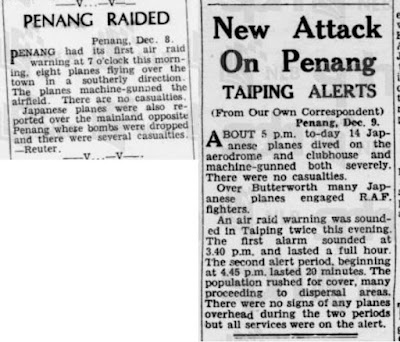
Apart from the landings on Malaya's east coast, 08 December 1941 was also noted as the day that Japanese enemy aircraft had flown over Penang island and mainland for the first time.  The Malayan Tribune reported that the island had its air raid warning at seven o'clock in the morning when eight planes flew over George Town in a southerly direction. Reuters reported that there were no casualties except on the mainland where bombs were dropped. The Singapore Free Press and Mercantile Advertiser said that 14 Japanese planes dived on the aerodrome and clubhouse in Penang at about 5pm on 09 December and machine-gunned both severely. Again, there were no casualties on the island. Over at Butterworth, many Japanese planes had engaged RAF fighters.


TO BE CONTINUED....


Sunday, 26 September 2021

A scouting conundrum

When you search on the Internet, the same one-line information of "an experimental Boy Scouts troop formed by the YMCA Penang in 1908" is repeated ad nauseum as if there isn't any new information to add about the Scout movement's beginnings. Even the official Scouts Association of Malaysia doesn't say more. This is simply some data that has been accepted by the Scouting community in Malaysia as an historical fact without need to question or researched further, full stop. Isn't anyone inquisitive enough to try and find out more?

The formation of this experimental Boy Scouts troop didn't happen by accident. In February of 1908, Robert Baden-Powell had called on all boys to enrol themselves as Peace Scouts, a fascinating organisation with secret signs and war songs. (1) 

The Revd George Frederick Pykett (b. 1864, d. 1932), who was already the principal of the Anglo-Chinese School, would have played a huge role in getting this experimental troop together at the Young Men's Christian Association (YMCA) in Penang, which he had set up in 1905. So it came to pass that Scouting became an activity of the YMCA Penang and it complemented their St John Ambulance First Aid classes. At that time, the YMCA operated from premises in Logan Road which was reputedly vast enough to hold a football field (2). Where in Logan Road was this premises though? I don't know exactly although I've been told that it was close enough to the field at Westlands School when this latter school came into existence in 1935.

Little is known about the early activities of the experimental troop but there is this picture (see below) which showed a group of Boys Scouts at the YMCA in Logan Road. At the back of the picture was an attestation by Goh Guan Ho (b. 1891, d. 1969) before a Justice of the Peace in 1966 that the picture was taken in July 1908. 

Goh Guan Ho was born in Singapore. (3) It is known that he had his early education at the Anglo-Chinese School in Singapore in 1904 where he won a General Progress prize in Standard VII (4) but by 1907, his family had relocated to Penang. While studying at the Anglo-Chinese School in Penang, he had won the first prize in the Penang Chamber of Commerce examination in 1907. That same year, he passed the First Aid examinations held by the St John Ambulance Corps and had then joined the Penang Chinese Volunteer Corps. In 1908 when this Boy Scouts picture was taken, Goh Guan Ho was the Head Boy of the Anglo-Chinese School in Penang. (5) Later in his life, he was President of the Penang Bar Committee and Advisor of the YMCA among many other positions he held publicly. He began his political career in 1954 and was elected to the Municipal Council on an Alliance ticket. Three years later when George Town was granted city status by Queen Elizabeth II, he became the first Mayor. However in  1959, he was defeated by the Socialist Front candidate, Tan Phock Kin, in the Federal election. Goh died in November 1969, three years after making his attestation regarding the Boy Scouts picture. (6) You may wonder why I ramble at length about him. Why not? He was the central character in this story; he was also a respected personality in Penang. Besides, there's a road that's named after him: Goh Guan Ho Road is very near to Rifle Range. 

But let's get back to the two images at the end of this story. There's a controversy whether the information on its reverse side is accurate or not. While Goh Guan Ho said that it was taken on the YMCA ground in Logan Road in July 1908. a Scout historian in Singapore by the name of Wan Meng Hao was disputing this.

When this picture first appeared on a blog story by Yeoh Suan Choo in July 2018, she was contacted by Wan Meng Hao two years later who claimed that the "scouting photos were taken in Singapore, not Penang. Sorry but the certifications by the JP in 1966 are wrong. Mr Goh was residing at that time in Singapore, not Penang." 

Wan Meng Hao also made reference to his book, Scouting in Singapore 1910-2000, which he had co-authored with Kevin YL Tan. The book was published by The Singapore Scout Association in 2002. It's an excellent book, by the way. On Page 13 of his book, he had also used this picture by Goh Guan Ho and captioned it as "Possibly the earliest picture of Scouts in Singapore. According to Goh Guan Ho (extreme right), this picture was taken sometime in 1909 at Fort Canning. Goh left Singapore in 1916 to study law and later moved to Penang."

Well, who was right? Goh Guan Ho as mentioned in the book or Goh Guan Ho as written behind the picture? Which Goh Guan Ho is to be believed?

I can't say much about the conflicting statements but I was thinking aloud to my friends yesterday that if this location should be Fort Canning, would it also possibly show up in present-day pictures of the Fort Canning Park? After all, if the Singapore government is very concerned about heritage conservation, they would have tried to conserve all the buildings in the Fort Canning Park today, not tear them down. Somewhere, shouldn't there be a brick building that may look similar to the one in the centre of the picture?  

So I decided to visit the Tripadvisor website. I know that on this website, visitors love to contribute pictures of their travel destinations. I located the link to the Fort Canning Park and found 1,883 pictures there. I must say that I did click through all the pictures but found no picture of buildings remotely close to the arches shown in the picture. I know this is not even sleuthing around Fort Canning personally but this is the best that I can do for the moment. Perhaps Wan Meng Hao can identify the building. It would be very helpful all around. 

Anyway, Yeoh Suan Choo had backed away from pursuing this matter further with a reply saying that she was no authority on Scouting, was not a researcher and so had to leave it to Wan Meng Hao to check out the story.

Well, I have been intrigued by these pictures for three years now - despite not being a Scout myself - and new evidence have been uncovered, thanks to the National Archives of Singapore which had placed some early copies of the Straits Echo newspaper online for people to read. That was why I was writing at length about Goh Guan Ho. In 1908, Goh Guan Ho was no longer residing in Singapore. How could he be, when he was already transferred to the Anglo-Chinese School in Penang to continue with his schooling? Furthermore, he was now the Head Boy, a respected post that placed him apart from the "rest of the boys." That's him standing on the far right in the picture. Next to him was E Roberts who was later to become the assistant general secretary of the Straits Settlements in 1910. 

Goh Guan Ho had also identified the person on the far left as George Pykett. It's a red herring as far as I am concerned. People tend to think that the George Pykett here referred to the Principal of the Anglo-Chinese School. Far from it. This George Pykett was his contemporary, one of two sons of Revd George F Pykett, the other being Dick Pykett who was also in the picture but not identified. Why do I say this? First, seeing how he had addressed the more senior E Roberts with a Mister salutation, Goh Guan Ho wouldn't be so brazen to refer to his old school headmaster simply as George Pykett. He would have added a Reverend to the name. Second, it was known that Revd George F Pykett was not in Penang from March (7) till November 1908. (8) He was on a long furlough leave to the United Kingdom and the United States. And thirdly, I had stared and stared at the picture and concluded that the fellow looked too young to be the 44-year-old Revd Pykett at that time. (Okay, that last part was a bit subjective but it was good enough for me.)  

So let me strongly suggest here on my blog that the picture was indeed of the Logan Road premises of the YMCA Penang in July 1908. The people identified by Goh Guan Ho were all part of a larger group of Penangites - except for E Roberts, Bertie Pedley, Caunter and the two Pykett siblings - and all 28 of them couldn't possibly have travelled together to Singapore just to have this picture taken. It was such a large and extraordinary group of uniformed people that the newspapers of the day in Singapore would surely have caught whiff of their arrival and wrote something about them, but there was none I could find. No, I believe Goh Guan Ho's attestation before the Justice of the Peace to be the definitive word. Unless other evidence surfaces, the Scouting movement in this part of the world would appear to have started in Penang, albeit on an experimental basis, and then spread to other parts of the peninsula, including Singapore, within the next two years. 

--------------------

NOTE: I don't normally mention the sources of my information in my blog stories but somehow, I feel it is pertinent in this case should anyone want to verify them. They are all from the National Archives of Singapore's e-newspaper section. 

(1) Straits Echo, 10 February 1908
(2) Straits Echo, 3 July 1907
(3) Biographical Dictionary of the Chinese in Malaysia, published by Institute of Advanced Studies, University of Malaya
(4) The Straits Times, 23 December 1904
(5) Straits Echo, 28 February 1908
(6) Berita Harian, 18 November 1969
(7) Straits Echo, 24 February 1908
(8) Straits Echo, 27 November 1908


Sunday, 16 May 2021

State Chinese (Penang) Association

Jack Ong had been my colleague in Ban Hin Lee Bank way back in the late 1990s. That was before the bank was swallowed up by Southern Bank at the start of the present millennium. Although so many years had passed by since the initial consolidation of the banking industry, we had on occasions bumped into one another. We generally kept in touch through social media but once in while, face-to-face until the pandemic brought all such latter activities to a near standstill.

Last night, I received a message from him urging me to look at a video he had produced in conjunction with the centenary celebrations of the State Chinese (Penang) Association. The intention to set up this association was voiced in 1920 and it was first mooted as the Penang branch of the Straits Chinese British Association of Singapore in November of that year. 

But in January 1921, the association in Penang declared itself to be independent of their Singapore counterparts. "It is stated on the best authority," reported the Malaya Tribune in their copy of 5 January 1921, "that it has now been definitely laid down that the Straits Chinese British Association is not....to be described or regarded as a branch of the Straits Chinese British Association of Singapore, but as a sister-association affiliated with that in Singapore, enjoying exactly the same status and rights, and in no way dependent upon Singapore." Blah, blah, blah, as can be ascertained from the first illustration on the right. (Note: This was originally a Straits Echo story, as can be seen from the "S.E." initials at the end of the news item.)

The Straits Chinese British Association (SCBA) was very influential politically and had a powerful voice in society. Its membership was made up of well-known members of the Chinese community in Penang. The first president was a prominent businessman, Lim Eu Toh, one of those rare breeds who had studied in both Penang Free School and St Xavier's Institution, and thus was eligible to join both The Old Frees' Association and Old Xavierians' Association when the two Old Boys associations were established. If I'm not mistaken, he could be a member of Penang Free School's management committee but that would need further investigation.

The Singapore Free Press and Mercantile Advertiser, in its copy of 26 June 1930, printed a story about an SCBA committee meeting. One item caught my eye: the association had decided to make representations to the Director of Education on the "subject of constant changes in the personnel of the senior staff of the Penang Free School." That the SCBA would interest itself in the affairs of the Free School was very interesting but understandably, it could be nothing unusual if the majority of the committee members were the Penang babas who had studied in this premier school.

This issue definitely alluded to the frequent movements of the school's headmasters. Ever since Ralph Henry Pinhorn retired as the headmaster in 1925, there had been no less than four persons appointed to this important role by the time this SCBA meeting was held: William Hamilton from 1925, David Swaine from 1927 and Leslie Arnold briefly in early 1929 until replaced by DW McLeod later in that year. Understandably, this was because the colonial British government had taken control over Penang Free School in January 1920. Pinhorn stood tall among his peers and was regarded as untouchable but once he was gone, the appointment of headmasters was left to the mercy of the British civil servants in control of Education. And there were many Directors of Education and Acting Directors of Education that came and went away.

Despite the SCBA's representations in 1930, the rapid transfers of Penang Free School's headmasters continued unabated until 1934. McLeod lasted as headmaster until 1931. Edgar Stowell crossed over from Bukit Mertajam High School temporarily for a few months in 1931, and then he was replaced by MR Holgate later in the year. J Bain came along in 1933 and finally, Arnold returned this time as a long-term headmaster in 1934 until the onset of the Japanese Occupation when the British community quietly evacuated to Singapore in the still of the night and left Penang as an open town. I won't elaborate more as this story about the headmasters' musical chairs was already detailed on Pages 132 and 133 of my book, Let the Aisles Proclaim.

On 14 January 1964, the SCBA formally changed its name to State Chinese (Penang) Association (SCPA) and threw its membership open to all Malaysian citizens of Chinese origin.

Meanwhile, back to my original intention of writing this story, which was to bring attention to this message from Jack Ong. In order to promote the SCPA centenary last year, the association had held an international colloquium earlier in 2021 with various online talks organised on the Penang baba nyonya community and culture. This first video has now been posted to YouTube. It is very informative and a way forward to lure every baba and nyonya with origins in Penang back to their roots. However, if you were to subscribe to their YouTube channel, there are more videos of similar nature to watch.


Wednesday, 11 March 2020

A Haw Par nude


The Haw Par Villa could possibly be one of the earliest theme parks in Singapore. I haven't been there for a very long time. The last occasion I was there, I was with my brother-in-law, and we had a whale of a time there, making all sorts of ridiculous poses.

Today, I saw this picture of one of the exhibits at the Haw Par Villa. It showed a scene from Journey to the West, where Sha Wujing, the third disciple of the Tripitaka monk, had been overcome by the female spider demon. All these demons were always plotting to capture the monk because they believed that his flesh would give immortality to those that consumed him.

I was staring at the image and suddenly, it dawned on me that in my possession were a number of black-and-white pictures that my father had taken in the 1950s or 1960s. And one of them depicted this very same scene of Sha Wujing and the spider demon.

But there was one difference. One marked difference. The spider demon in the colour image, although scantily clad, was actually wearing almost nothing originally. I wonder when was it that the owners of the Haw Par Villa dressed up their exhibits. Anyway, here are the two pictures.

This image was downloaded from the Wikimedia Commons and attributed to Seng Kang.


Sunday, 8 March 2020

Flu fighter


Today is the eighth of March 2020. It has been 17 years since the death of Dr Lim Kok Ann, the former Secretary-General of the World Chess Federation. Right now, the world is undergoing great strain from the pandemic known as Covid-19 which previously was known as the Wuhan coronavirus. I am bringing up Lim Kok Ann's name on the anniversary of his passing so that more people will be aware of his other life's work as a research scientist in Singapore.

In 1957 Singapore and the Malayan peninsula were hit by the A2 strain of the Asian Flu. This virus was thought to have emerged from the province of Kweichow or Guizhou (è²´å·ž) in China. First reported in February 1957, this virus spread to Yunnan province and moved rapidly through China. Up to 500,000 Chinese people were infected. In March 1957, Mongolia and Hong Kong were hit, followed by Singapore in April. All of Asia was infected by mid-May. The influenza strain was subsequently called A2 by virologists. [1]

In a front page story in The Sunday Times of 05 April 1957 [2], the newspaper reported that hundreds of Singapore people had been hit by an influenza epidemic believed to have been spread by ships from Hong Kong. "The epidemic is widespread," said the newspaper, adding, "On Pulau Brani, 30 cases were reported in one kampong inhabited by workers of the Marine Department (population 200)." Many other cases were subsequently reported in other parts of the island.

Some other excerpts from the newspaper:
Virologists of the University of Malaya have isolated the virus in some cases at Pulau Brani. Specimens will be sent to the World Health Organisation influenza centre in Britain, which takes strains from all parts of the world, to trace how the epidemic is travelling.
The Professor of Bacteriology, Prof. J.H. Hale, yesterday described it as "true influenza." It was impossible to give figures, as it was not a notifiable disease, he said. He said the Medical Department could think of no special measures to check its spread.
"Let it burn out. We can do nothing about it," he said. The wearing of sterilised masks would not be of any help, he said. "I don't want to give false hopes to anyone by asking them to wear them," he added.
Prof. Hale said that members of his staff had gone to Pulau Brani earlier in the week to get specimens of the virus. They had later heard that there were many cases in other areas. They had sent cables to the World Health Organisation in Geneva and London saying that they had isolated the virus. He said Dr. Lim Kok Ann was working on the specimens.
The disease has struck several Asian countries recently. A report from Japan in January said that 200,000 people were affected. In March came a report that an influenza epidemic was raging in Peking, causing hospitals and clinics to be crowded and schools to suspend classes.
Then in April a record outbreak of influenza gave Hong Kong doctors one of the busiest spells they could remember. Earlier this month reports from Taipei described hospitals as "crowded" as the epidemic spread in Formosa.
For a very brief time, Dr Lim Kok Ann was sort of a chess mentor to me. I first met him in 1974 when I was playing in the Malaysian team at the first Asian team chess championship in Penang, and he was the chief arbiter for the event. I had just suffered a bad loss in one of my games and I must have looked rather down and frustrated. He took me aside and gave me some words of advice. Chess, he said, was not about playing tactics randomly. You must have a strategy when playing the game. Strategy, after all, is the sum of all the tactics you put together. The last time I met him was in Singapore, maybe two or three years before his death on 08 March 2003. Already elderly and frail, he kept mostly to himself during that annual Malaysia-Singapore chess match. But he still wanted to play for the Singapore side, such was his passion for the game.

Born in 1920, Lim Kok Ann was the grandson of the Singapore pioneer, Dr Lim Boon Keng. His father was Walter Lim Kho Leng who was the first manager of Ban Hin Lee Bank Ltd in Penang when the bank opened for business in September 1935. Apart from being well-known in international chess circles, Lim Kok Ann had a long and successful career as a research scientist. Stella Kon, his daughter and author of Emily of Emerald Hill, said that as a young lecturer in Singapore, he conducted the world's first clinical trials of the new Sabin polio vaccine for the World Health Organisation in 1949. As a result of these trials in Singapore, polio was almost eliminated throughout the world. [3]

His other contribution to medical science was in isolating the A2 strain of the Asian Flu in 1957. How it happened was that he was invited by a friend to visit Pulau Bukom to see some patients suspected of having got influenza from a flu outbreak in Hong Kong. It was very likely the patients in Pulau Bukom, where Shell Oil Company had a large installation and where some port workers lived, had caught influenza from passengers off ships they had visited. [See Note 1 below] [4]

"I went over to Pulau Bukom with the Public Health doctor and found typical cases of influenza - the patients had fever, running noses, red eyes, some cough - and were miserable," he wrote in his unpublished auto-biography which his children had since released as a blog, Gong Gong Says, in 2006. He took throat swabs and blood specimens and returned to the laboratory where he innoculated some eight-day-old and some 14 day-old chick embryos with extracts of the throat swabs to which a mixture of penicillin and streptomycin had been added.

To cut a long story short, the laboratory tests made him suspect that he might have isolated an influenza virus. As he could not be sure initially, he prepared sealed glass ampoules of the chick embryo abstract and sealed ampoules of the patient’s serum, and packed them off to various influenza centres in London, Washington and Melbourne for further tests. The Walter & Eliza Hall Institute for Medical Research in Melbourne was the first to respond and subsequent tests proved that his virus isolate which, although belonged to the Influenza A virus group, was sufficiently different from other Influenza A strains.

His auto-biography continued: "On Monday morning the Singapore Straits Times reported my coup with front page headlines: Brilliant Singapore scientist discovers new influenza virus. In following write-ups they called me Flu Fighter. I did not think that they knew my Grand Uncle by marriage, Dr.Wu Lien-Teh, had published his memoirs under the title Plague Fighter. [See Notes 2, 3 and 4 below]

He then concluded in a rather resigned tone: "The aftermath of my discovery of the new Influenza virus, subsequently named Influenza A2 virus was something of an anti-climax. The main aim of the world-wide WHO Influenza Observer network was the early detection of new influenza virus variants. The A2 virus was present in Hong Kong at least two weeks before it came to Singapore where the virus was isolated about a week after cases had been recognised. It then took a further week before the virus was identified as a new type. WHO’s interest in new influenza variants was not purely academic; WHO had hoped that early detection and isolation of new influenza variants could lead to better control measures because vaccines could be prepared against the virus and populations elsewhere protected against the new virus before it arrives.

"This was a vain hope. It took about a month for vaccines to be made against the virus isolates sent to England and to the United States. First the virus had to be adapted for growth in large quantities, then tests for safety and efficacy would have to be made before the vaccine was actually used. By the time the health authorities had a vaccine ready, the new influenza had arrived on their shores and in most cases, second epidemic waves had already begun.

"Modern transportation enables large numbers of infected people, some not even showing signs of illness to be landed among susceptible populations well within 30 days, the minimum lead time for isolating a new virus and preparing a vaccine from it. Flu Fighter was an empty label; I fingered the enemy, but nothing I did affected its progress round the world."

NOTES
[Note 1: His unpublished auto-biography said Pulau Bukom but The Sunday Times newspaper of Singapore, dated 05 May 1957, had instead mentioned Pulau Brani.]
[Note 2: Maybe time had fogged his memory again, but The Straits Times of 24 May 1957 gave, as a sub-heading on the front page, "High Praise for Colony Doctor"] [5]
[Note 3: Wu Lien-Teh's first wife, Ruth Wong Shu-Chiung, was the sister of Lim Boon Keng's wife, Margaret Wong Tuan Keng, which meant that Wu Lien-Teh and Lim Boon Keng had a tang mooi relationship.]
[Note 4: Wu Lien-Teh was a giant icon in his time. He is best remembered as the medical doctor from Penang that fought and beat the plague in China in 1911. My stories on Wu Lien-Teh can be accessed here.]

SOURCES
[1] Paleomicrobiology: Past Human Infections, p206. Editors: Didier Raoult, Michel Drancourt. Publishers: Springer-Verlag Berlin Heidelberg, 2008. ISBN: 978-540-75854-9.
[2] Flu strikes Singapore. The Sunday Times (Singapore), 05 May 1957
[3] The Inspiring Achievements of Lim Kok Ann, by Stella Kon, imbedded in Junior Tay's story called Remembering Prof Lim Kok Ann. Published in the blog known as IM Kevin Goh's Chess Site, 19 January 2013
[4] Flu Fighter. Lim Kok Ann. Published in the auto-biographical blog known as Gong Gong Says, 07 December 2008
[5] Scientists say the flu bug is new type. The Straits Times (Singapore), 24 May 1957. 


Wednesday, 21 November 2018

Singapore's kampong revisited


After waxing exuberance over my visit to Pulau Ubin last March, I promised my wife that I'd bring her to the island when we next visit Singapore. On the 10th of this month, that was where we went as we wound up our short trip there.

With the help of my old friends of course! Jeff Yeo and his lovely Evelyn. According to Jeff, each of us must've taken about 22,000 steps during the four hours on the island. That was about 15 kilometres. Nevertheless, that wasn't even covering the whole place.


Despite it being a Saturday, we felt that the crowds were just not there. There were more people on the island last March. Our first destination would be the Puaka Hill in the middle of the island.


Along the way to Puaka Hill, we came across this sign at the side of a path leading to a small temple called the Fo Shan Ting Da Bo Gong Temple. However, there is a bigger temple with the same name just a short distance away from the Pulau Ubin ferry terminal. I am told that the locals distinguish the two as the country temple and the town temple. Below is the altar of the Tua Pek Kong deity at the country temple.


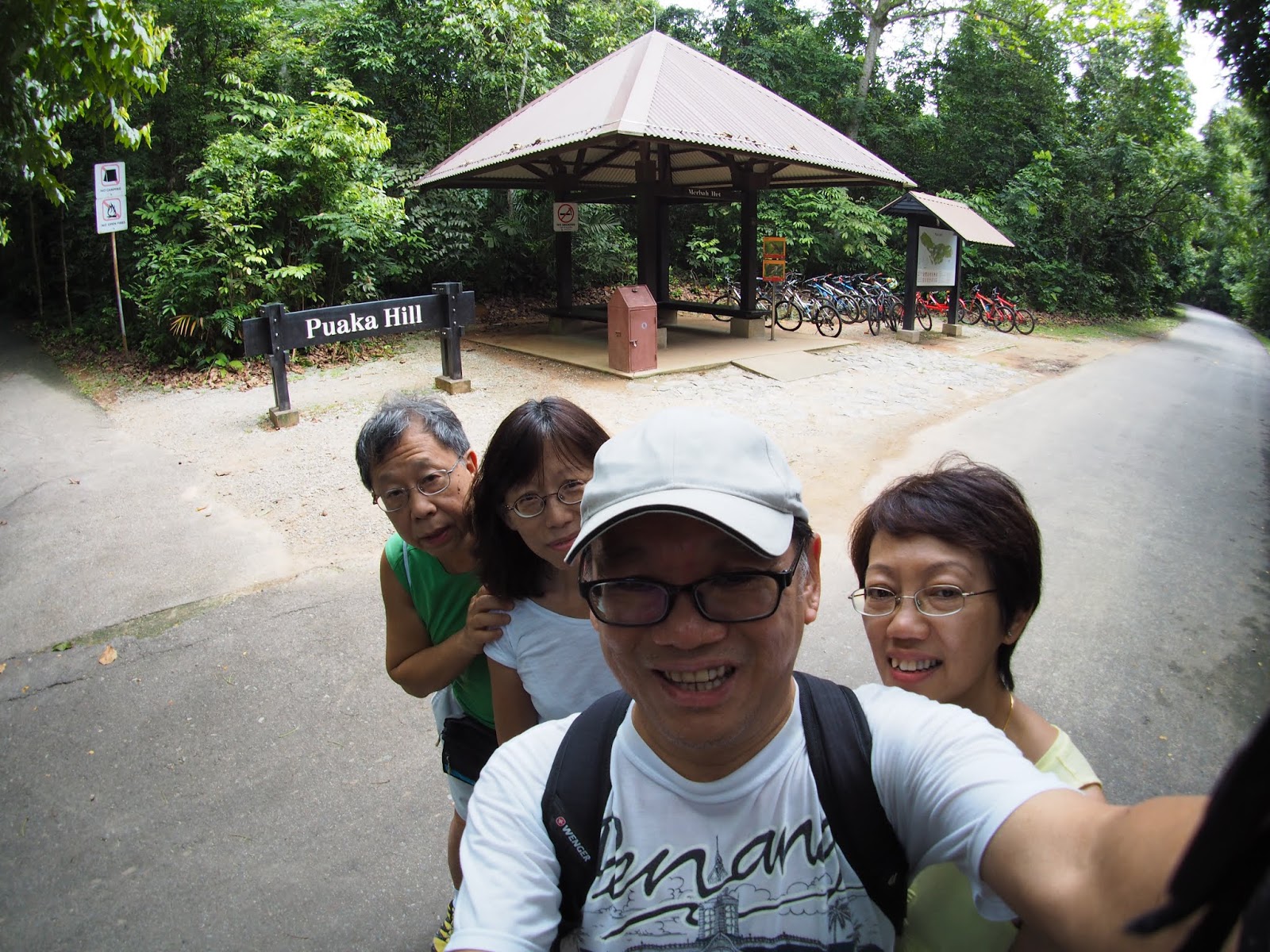
 And so, finally, we reached the junction to Puaka Hill. We turned off the main road and for the next five to 10 minutes, walked along a gradual track to the top. 


Breath-taking view from Puaka Hill


Gorgeous  blue sky at the Chek Jawa Wetlands' boardwalk 


 The visitor centre at the Chek Jawa Wetlands


Picturesque scene while walking back to the jetty