Monday, 31 January 2022

Sighting the last Ox moon

The thin crescent waning moon on 31 January 2022

Over the past four days, we've been waking up at around six o'clock on account of the approaching Chinese New Year. Main reason is because of the need to do the marketing early. There are so many things to buy from the wet market in Kampong Baru: fruits and fresh foodstuff. All the preparations required for the reunion dinner as well as the preparations for the midnight worship to welcome in the New Year! 

Moreover, another reason why we spaced out our purchases at the market this year was to try and avoid the traditional large crowds on the last two days before the festival. But we know that it would be largely impossible because there are some stuff which needs to be bought on the last day itself. Like, for example, the huat koay which, if left overnight, would turn harder and chewier. Not something to my liking.

Although we are in the Tropics, just a few degrees north of the equator, the sun rises pretty later at about 7.35am at this time of the year. Thus, it was still dark when we left the house for our pre-Chinese New Year marketing. 

The same moon higher up in the sky on 30 January 2022
If there's ever a good time to watch the waning moon, it would be now. In fact, the last four days have been a joy for me. As the waning moon rises in the eastern sky each morning, it grows thinner and rises lower as the days progress. Yesterday morning, I could still see a bright, 7.5 percent illuminated moon low in the sky at about 6.30am. The day before, a 14.9 percent illuminated moon higher up in the sky at much the same time too.

Today, however, was a challenge. Because it was already the eve of Chinese New Year, I knew that the moon would rise even later and it would be very low in the sky. In order to see it, I might have to wait till a bit later but if I waited too long, the sky would have brightened and it would be next to impossible to see it. Moreover, on the eve of Chinese New Year, the moon would become a tiny sliver with its illumination only at 2.4 percent. Hard put to notice it at all!

So after hurriedly doing my marketing this morning, I settled it at a vantage point to watch the dark but brightening sky. For about five minutes I couldn't see anything at all. Then just as I was about to give up - isn't this always the case? - I noticed a slight discolour between two coconut trees in the dark but dawning sky. Could that be the moon? The more I strained to look at it, the more I was convinced that this was indeed the elusive last sight of the waning moon before Chinese New Year! After my camera caught hold of the moon, it disappeared from the now brighter sky.


Thursday, 27 January 2022

Ancestral prayers

Chinese New Year comes in five days' time. For my family, the prelude to Chinese New Year does not begin with the grand send off of the Kitchen God on the 24th day of the 12th lunar month simply because we do not have this deity's altar in the house. 

Instead, we kick off our preparations with a simple vegetarian offering to the memory of my grandparents, parents and aunt. We always keep our offerings very simple: only assorted fruits and tidbits are offered; no meat-based food are permitted despite our baba-nyonya background. Thus, there's no cooking at all. This has been our practice for the past half century or so, and I'm simply following tradition. At the end of the worship, there's no burning of gold or silver paper money either. 

But we still practice divination by throwing two old coins to "ask" whether the departed have arrived at my household to enjoy the offered fruits and tidbits to them, or whether they have finished "blessing" them. It's all a matter of chance because the coins will turn up either heads or tails, but sometimes I think there is some unseen force controlling the coins. 

I'll tell you why: there have been two occasions in the past when I simply couldn't get a confirmation of their "presence" despite throwing the coins a dozen times in succession. It was either both heads or both tails. Then I realised that I hadn't requested the invisible door spirits to let them into the house. A quick appeal to the door spirits and bingo! The coins turned positive at the next toss: a head and a tail showed up immediately! Sometimes, you just have to believe in the unexplainable.

So what comes next after this? For my family, there's this putting up of a red cloth banner with auspicious words over the main doorway. It symbolises that the family is ready to greet in the new year. All around the neighbourhood and indeed, in almost every Chinese household in the country, this red cloth banner will be hung up between now and New Year's Eve.

PS. I came across this picture and a four-line pantun (and its translation) in The Peranakan Community of Western Australia on facebook today. It was about the worship to send off the Kitchen God to the Jade Emperor where he would then make his annual report on the household.

Somewhere among the offerings would be the tnee koay (甜粿); the stickier the better so that the jaws of the Kitchen God would be stuck shut and the deity wouldn't be able to spread any unsavoury report. Another version is that the tnee koay will allow the deity to report only sweet things to the Jade Emperor and thus spare that household from any bad consequences. Either way, the pantun is worthy of reproduction here:

Pagi, pagi berseh berseri, 
Dalam dapor sembah diberi, 
Tarikh Datok balik ke-tinggi, 
Pulang ke-romah ari Cheh See!   

(Translation)

From earliest morning everything looks resplendent, 
The family gathers in the kitchen offering their obeisance, 
Today, marks the date the Deity returns for his annual report, 
He returns back home on the 4th day of the New Year!


Saturday, 22 January 2022

Thich Nhat Hanh

Only last month, I was writing an entry in this blog about Thich Nhat Hanh, a Buddhist monk from Vietnam. I did not say much about him except to mention his age and the concern about his health - I didn't even know whether he was still living or not - but I reproduced a story from one of his books titled A Pebble for Your Pocket (ISBN 1-888375-05-1) which was published 21 years ago. It was a story that left a deep impression on me. Deep enough for me to have wanted to share it.

I was rocked this morning when news filtered out on facebook, and then on whatsapp, that this remarkable monk had died at the age of 95. He was an influential and revered activist monk. During the 1960s, he refused to side with North or South Vietnam and worked tirelessly to speak out against the Vietnam War. 

"I saw communists and anti-communists killing and destroying each other because each side believed they had a monopoly on the truth," he once wrote. When he left Vietnam for the United States to meet Martin Luther King, the South Vietnam government banned him from returning, thus sending him into a 40-year exile.

Thich eventually settled in France where he opened the Plum Village meditation centre to promote mindfulness to the West. He was the author of about 100 books on Buddhism and mindfulness. In 2014, he suffered a stroke which left him unable to talk. Expressing a desire to return to his native village, the Vietnamese government allowed him to return. Thus, from 2018 till his final days this month, he has been looked after by the monks in the Tu Hieu Temple in Hue.  

In order to appreciate Thich Nhat Hanh further, here is one of his last public interviews, conducted by no less a personality than Oprah Winfrey. A year after this interview, he was stricken by a stroke. This was a very powerful interview or teaching, in my opinion. 

Saturday, 15 January 2022

An autobiography titled "𝑳𝒐𝒈"

I never got to ask David Hwang Hong Shi why he named his pictorial autobiography as Log but I was offered an answer by his wife, Molly Ooi. 

In his younger days, David had been a very active Scouter and he was a King's Scout from his schooldays at St George's Institution in Taiping. His interest in Scouting had continued throughout his working life, first as a Scout Master at Westlands (Primary) School in the 1950s and which carried through to Penang Free School in the 1960s and early 1970s, later at Westlands Secondary School until his retirement from government service, and finally at the International School of Uplands. The Scout movement will remember that they had to keep a log book of their activities and this was the reason why David's autobiography was simply called Log. 

The book chronicled his life's work from his schooldays till his final retirement as General Manager of Penang Club and then the founding of the Taman Sri Nibong Residents' Association. Log is privately produced and there is not more than 50 copies in print. I consider myself lucky to have received a copy. 

Actually, I visited the couple yesterday afternoon to collect it and we spent time reminiscing on the past: not that our careers crossed paths but he was already a school master at Penang Free School when I entered Form One in 1966. True to his outdoorsy lifestyle, he was a Physical Exercise teacher at the school. Fast forward later to 2012 when Molly and I were co-editors of FIDELIS, the coffee table book of The Old Frees' Association, David was always in the background to give advice on certain matters when required. That was when I got to know him well.

Wednesday, 12 January 2022

Sarcopenia

Here are two interesting articles on the dangers of Sarcopenia which came to me via Whatsapp. 

Sarcopenia is a condition affecting older persons. As we age, we begin losing muscle mass and strength which if unchecked, will eventually lead to the inability to move by ourselves and have to use wheelchairs.

The alarming point is that my schoolmates and I are soon to reach 70 years of age in two to three years, and yet many are unaware of this creeping condition in our lives.

Admittedly, I was unaware of it until recently. For years now, I have been puzzled over my own gradual weight loss. Eight years ago, I used to weigh almost 80 kg but now, I'm happy enough to tilt the scales at 69 kg. I see my upper arm muscles gradually decreasing in bulk. The deltoid muscles have lost mass. It had to take some comments from my barber before I started to realise about this deteriorating health condition. Thus, it is time that we take some control over this area of our physical well-being.

So to convince anyone that sarcopenia is a real condition, here is the first of two stories, and it comes courtesy of someone in Taiping.

𝑺ᴏᴍᴇ IMPORTANT 𝑨ᴅᴠɪᴄᴇ ᴏɴ 𝑯ᴇᴀʟᴛʜ ꜰᴏʀ 𝑺ᴇɴɪᴏʀ𝒔!😱🙏

Today I want to share a condition that many seniors suffer from. It may appear trivial but can result in dangerous consequences. It may start with only a drop in appetite and then  walking becomes progressively weaker. The body feels less enthusiastic and less energetic. This is the beginning of the disease of most elderly people suffer from - namely muscle wasting and weakness.

As you may be aware... the leading cause of death for many elderly people at the age of 65 and above is not a strange disease. The main cause of parental death starts with slips and falls - either in the room, bathroom/toilet or going up/down the stairs.

This is related to the weakening of the muscles experienced by the elderly... so that they are prone to poorer balance and falls.

All of us will slowly and not so consciously experience a physical decline with significant changes to the body over the next 10 years  A simple example is we start to eat less and become less agile in our movements.

Please note that by the age of 50 we have already started to experience 1-2% muscle weakness with up to 30% muscle loss by the age of 60 and up to 50% by the age of 80 years old.

This situation can only be prevented by two main things namely a sensible diet and exercise (physical activity). These two things you should still do as much as possible no matter how old you are.

Keep eating enough... even though your teeth aren't as strong as they used to be... and you don't have much appetite either... keep eating. 

Try not to just eat vegetables. You should also eat eggs and meat regularly because it builds muscle together with daily exercise. For this reason, I have vegetarian friends who have started to eat meat again. 

Whatever the type of sport, no matter how light the sport is, whether you want to jog, cycle or just take a leisurely walk. Try to continue to have sports activities as often as possible.

And lastly don't forget to get enough sunlight for Vitamin D and hygiene reasons (eg kill bacteria or reduce/remove odours). Older people really need Vitamin D to prevent bone loss and muscle weakness.

However, don't just rely on the sun and buy a Vitamin D supplement especially if you are not the outdoor type. The skin of older people may have difficulty in absorbing and creating Vitamin D from the sun alone.

Let's share care & live well ❤️

And here is the second story from the other side of the world. I have made changes to some spellings in order to de-Americanise the story and make it more understandable to non-American eyes. Also, I converted some weights and measurements to the universal metric system.

What’s the worst health problem that can happen to you? I’m sure many readers would say cancer, stroke or Alzheimer’s Disease. I agree these are all frightful diseases. But there’s another one that occurs gradually as we age. It’s called sarcopenia (the loss of muscle mass), and this creeping frailty forces many elderly into nursing homes because their muscles are so weak they can no longer get off the toilet.

A recent report from Tufts University in Boston says sarcopenia robs people of their independence and often leads to the risk of falls resulting in serious injury. Visit any nursing home and you’ll see multiple examples of sarcopenia.

Studies show that sarcopenia begins around age 45 and increases at the rate of one percent a year. That means that by age 65, sedentary people have lost half of their muscle mass. And you cannot lose muscle mass without losing muscle strength. Women are at greater risk than men as they start out in life with one-third less muscle mass than men. Moreover, since they live longer there’s longer duration of muscle loss.

So what can you do at an early age to prevent ending your life in a wheelchair? As the elderly age they tend to shy away from strenuous tasks that cause discomfort. This sets the stage for sarcopenia.

First, don’t neglect sufficient protein. Dr. Paul Jacques, director of Tufts nutritional programme, says, “It’s estimated that 20 percent of people between the ages of 51 to 70 have inadequate protein intake.” But the Tufts report also states that most North Americans get plenty of protein, but they obtain it the wrong way. Cheeseburgers and fried chicken provide protein, but they also provide too much saturated fat and calories. Researchers stress another important point. You should not only get adequate protein at dinner, but also at other meals.

So what’s the appropriate protein math to prevent sarcopenia? The proposed average is 40 to 70 gm a day depending on body weight (0.8g of protein per kilogram). So a 50 kg woman would require 40 gm and a 80 kg man 64gm. In addition, the amount depends on daily activity.

What about exercise? It’s been known for decades that weight lifting and working on resistance machines increases muscle mass and strength in young people. But when this approach was tried on older people their muscles did not get larger.

The reason for these poor results was the initial fear that to push older people too hard is unwise. I say “amen” to that, because I’ve seen cases of snapped tendons due to the loading of excessive weights. But there is a positive side if weightlifting is done with caution and not pushed to the limit. When researchers used increasing weights for those between 60 to 72 years it doubled their strength in 12 weeks of training. Some frail 90-year-olds tossed their canes away in 8 weeks of graduated exercise.

There are other benefits to preserving muscle mass. During an illness the body withdraws protein from muscles to aid in the healing process and produces antibodies to fight infection. When sarcopenia is present, there’s less ammunition to fight illness. Dr. William Evans, at the University of Arkansas, cites a study in Finland in which men in their late 60s who had lifted weights for years, had muscle mass similar to non-athletes in their 20s. Joggers however, are not protected from sarcopenia as the stress produced by this sport can’t compete with lifting weights.

The message is here is that to maintain muscle mass you require an adequate dietary intake of protein along with exercise, preferably using weights. This is not news I like to hear. I’ve enjoyed sports, but not lifting weights. But reluctantly I keep a pair of weights close to my computer and intermittently use them. I also enjoy replenishing my protein with a six-ounce steak (63 gm) and baked potato with skin (5 gm). And to ease my anxiety that I may be protein deficient I enjoy 5 ounces of red wine (0.3 gm of protein).

And finally, I shall urge everyone not to miss an educational and informative session which Diabetic Malaysia has arranged for this Sunday at 2pm. Consultant Geriatrician Dr Ong Ing Wei from University of Malaya shall give a talk on Sarcopenia on the Zoom platform. Use this link and login information below to attend: 

https://us02web.zoom.us/j/89608230939?pwd=M3haSlZOUWdRanM1SEVNTXNHck05dz09

Meeting ID: 896 0823 0939

Passcode: 323121

Sunday, 9 January 2022

Omicron

Rather disturbing, isn't it, when people can sneak out of the country when they are unvaccinated but that was what happened when a group of Malaysians returning from their pilgrimage to Saudi Arabia were tested positive for the Omicron variant of the Covid-19 virus upon their return. Although the authorities have promised an investigation into this matter, there is this deep concern that these people have already started spreading the virus to the community via their family members and friends. 

We don't know the true extent of the infections as this Omicron variant is reported to be milder than the previous Delta or Indian variant. Being mild mean a greater chance that infected people may mistake their symptoms for the common cold or influenza. 

Plus, I view the daily official numbers released by the Health Ministry with some scepticism. Everyone suspects that the numbers are under-reported, and they may be right! At the very least, friends tell me that we should double the official figures and even then, it may still be inaccurate. Anyhow, if the situation remains unchecked, there is a possibility of a full-blown viral attack by March. (Friends in Australia also doubt their own numbers, saying that they are multiplying their numbers by five or 10 times.) 

Meanwhile, the Prime Minister's Department has released a list of hotels in Kuala Lumpur, Selangor and Negri Sembilan for the purpose of quarantining the infected returnees. Thank goodness for this list. There's some comfort here that healthy visitors to KL and the two states can avoid booking themselves into these quarantine hotels. I can never be assured enough that their sanitisation process will be thorough to satisfy me! 


Wednesday, 5 January 2022

Water, wigs and wisdom

One of my latest acquisitions: the third volume of Marcus Langdon's research into Penang's history when the island was elevated as the fourth Presidency of British India from 1805 till 1830, with Malacca and Singapore considered as its dependencies.

The third volume comprises six chapters which the author had termed as books with each dealing with different aspects of the island's past. 

Book One covers the aqueduct system which delivered water from the dams and reservoirs to the town. Book Two researches the public jetty which provided the early transportation of goods and people from the island to the trading vessels and the mainland. Book Three deals with the history of the early newspapers. Book Four talks about the the first hospital in Penang. Book Five describes how the present legal system of the country had started from Penang. And Book Six touches on how the Penang jail was established.


Saturday, 1 January 2022

65th anniversary

There is no dispute that George Town was declared a city by Queen Elizabeth II on 01 January 1957. A totally apolitical declaration, based on an application of the then Municipal Council of the town in 1956, and granted the city status solely on merit.


First waning moon of 2022

My first camera images for the new year: a 4.9 percent illuminated waning moon with a faint but noticeable earth glow and only two days away from the last new moon before the Chinese New Year on 01 February 2022. It so happened that I was already awake at six o'clock - a rarity! - and thus decided to step outdoors for a breath of cool fresh morning air. So there I was, wandering around the neighbourhood, and I saw the moon low in the sky. Tomorrow at about the same time even if the weather is clear, it should be barely above the horizon, even thinner and practically impossible to see.  


Thursday, 30 December 2021

Eating an orange

Thich Nhat Hanh is a Zen Buddhist monk from Vietnam. This story is taken from his book, A Pebble for Your Pocket (ISBN 1-888375-05-1), published 20 years ago. 

Since 2014 there have been some concerns about his health but no latest word is available. If he is still around, he should be in his 90s.

Here is one of several meaningful gems from his book. Be in the present. The past is gone; the future is yet to come.

When you look deeply at an orange, you realise that an orange - or any fruit - is nothing less than a miracle. Try it. Take an orange and hold it in your palm. Breathe in and out slowly, and look at it as if you were seeing it for the first time. 

When you look at it deeply, you will be able to see many wonderful things - the sun shining and the rain falling on the orange tree, the orange blossoms, the tiny fruit appearing on the branch, the colour of the fruit changing from green to yellow, and then the full-grown orange. Now slowly begin to peel it. Smell the wonderful scent of the orange peel. Break off a section of the orange and put it into your mouth. Taste its wonderful juice.

The orange tree has taken three, four or six months to make such an orange for you. It is a miracle. Now the orange is ready and it says, "I am here for you." But if you are not present, you will not hear it. When you are not looking at the orange in the present moment, then the orange is not present either.

Being fully present while eating an orange, an ice cream cone, or any other food is a delightful experience.

Wednesday, 29 December 2021

Shorter wait for treatment

Spent yesterday morning at the eye clinic of the Penang general hospital. Was there for my regular eye check-up which comes round approximately every six months.

Ever since the pandemic hit the country in March last year, there is a noticeably thinner crowd of people at the out-patient clinics. Formerly, the place would be packed with people and it would be very difficult to squeeze into the waiting area, let alone find a place to sit. What used to be people milling around the entrance, well, I haven't seen this lately. Patient control seems more efficient now. There are stricter checks at the point of entry. People whose appointments were at a later time were not allowed into the clinics to register themselves earlier. 

I've been told that the less pressing cases have been diverted to the district government clinics for treatment and thus the more urgent ones are seen at the GH. In this respect, I don't know whether to consider myself lucky or not! Maybe I should, because our eyes are very important. But then holistically, all parts of our body are important, not only our eyes. 

Anyway, despite social distancing at the hospital, there are now ample places to sit and wait. What also used to be a long, long wait for treatment has improved remarkably. I was in and out of the hospital - and it included waiting time to collect my medication - within two hours! (Before the pandemic, if my appointment had been scheduled for 9am, I would invariably leave the hospital only after 3pm: a six-hour wait for consultation!)

This consultation period could have been shorter but I had to wait for my eyes to be properly dilated, and this took up about 40 minutes! Four times I had to have their eye drops because each time the nurse commented that my eyes weren't dilated enough. This caused me some problems eventually because my eyes became overly sensitive to the glare of the midday sun. It wouldn't have been so bad if I received only one one or two eye drops, but I had four! 

Luckily, like always, my wife had driven me to the hospital because this matter of my eye dilation had occurred before. Extra careful now. She has been driving me to the hospital and back. And luckily for once, I had the presence of mind to bring along my dark shades. What would I have done without them yesterday!

Sunday, 26 December 2021

Li Chun (立春), 2022

When I was writing about the Tang Chek festival a few days ago, my mind was on what comes next. What Chinese festival would we would be celebrating next? According to the calendar, the Chinese New Year holiday will fall on 01 February 2022 to coincide with the new moon.

While my family shall also celebrate the occasion - and I am looking forward to my son and daughter returning to the family home in Bukit Mertajam - to us, the actual date of the Chinese New Year according to the lunisolar calendar will be on 04 February 2022.

At 4.52am (2052 UTC) on this date, the sun is calculated to have crossed the 315° longitudinal line in the sky. This important event heralds the annual Li Chun (立春) or the Coming of Spring. In the olden days when I was still staying in Seang Tek Road, my grandparents - all Baba Nyonyas in Penang - would more commonly say Jip Chun instead of Li Chun. 

It is all cultural, by the way, nothing religious about Jip Chun at all. The sun crosses the imaginary longitudinal line in the sky. The day comes and the day goes. The only traditions that I shall attach to this day are to fill up the rice bucket to the brim and then stick a new piece of red paper with the character Chun (春) on it to signify continuous abundance for the forthcoming year. 

That's all the symbolism I shall attach to the moment. And because the exact time of Jip Chun is in the early pre-dawn hours, at 4.52am, I shall wait for a more appropriate time to accomplish this task. After that? Well, it is still Chinese New Year after all. What DO you do during Chinese New Year, anyway?

By the way, I've been writing diligently about Jip Chun in this blog since Year 2007 and you can still read them here:

Li Chun. 2021
Li Chun, 2020
Li Chun, 2019
Li Chun, 2018
Li Chun, 2017
Li Chun, 2016
Li Chun, 2015
Li Chun, 2014
Li Chun, 2013
Li Chun, 2012
Li Chun, 2011
Li Chun, 2010
Li Chun, 2009
Li Chun, 2008
Li Chun, 2007


Tuesday, 21 December 2021

Tang Chek 2021

It's the Winter Solstice. Do have some koay ee to celebrate Tang Chek today!


Monday, 20 December 2021

The flooding of Kuala Lumpur

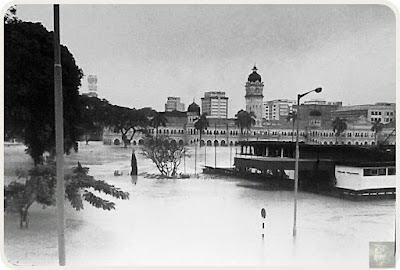
At the end of 1970, I sat for the Malaysian Certificate of Education (MCE) public examination. After that, of course, it was about three months of doing little as my friends and I waited for the results. Come to think of it, I can't remember what I did in those three months apart from the little adventure I'm relating below. 

Anyway, one of my cousins, also in Form Five but in a different school, asked whether I would like to join him on a short holiday trip to Kuala Lumpur. Immediately I had said yes to him because for the first time I could travel on my own outside my family.

Boy, if only I had known then the adventure we would get into! Soon after the new year began, we made our way down to KL by train. It was an uneventful journey but it had been raining heavily. When we arrived at the Kuala Lumpur station in the morning, we were met by my cousin's eldest brother. "Quick, follow me, we must get out of here," he ushered us out from the station.

The reason soon became clear. It had rained heavily and parts of the city were impassable to traffic. But somehow, we managed to make our way to the Selangor Mansion where he was staying. From the window of his flat, we realised that we had arrived in a flooded Kuala Lumpur. As far as our eyes could see, there was yellow, muddy water where the streets should have been. We took refuge in his flat for a day, I think, before we could leave and make our way to Petaling Jaya.

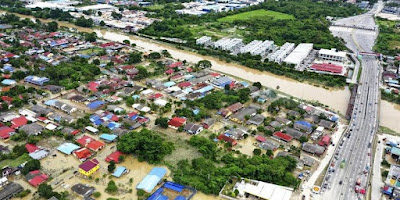
Fast forward 50 years to 2021 and a few days ago, torrential rain at the weekend in the central region of the peninsula left brought flood waters to Kuala Lumpur, Shah Alam and Klang. History repeating itself? Yes, although it could have been largely avoided, in my opinion, if the government had given more attention to drainage amidst the country's development. Oh well.....


Another Penang-born Singaporean, of course!

Reality check for the politicians and little napoleons. When you start meddling in the lives of the local population, it is time for them to seek greener pastures elsewhere. So, congratulations to Penang-born Singaporean badminton player Loh Kean Yew for attaining a success which remains an elusive dream for many here in Malaysia. 


December moon 2021

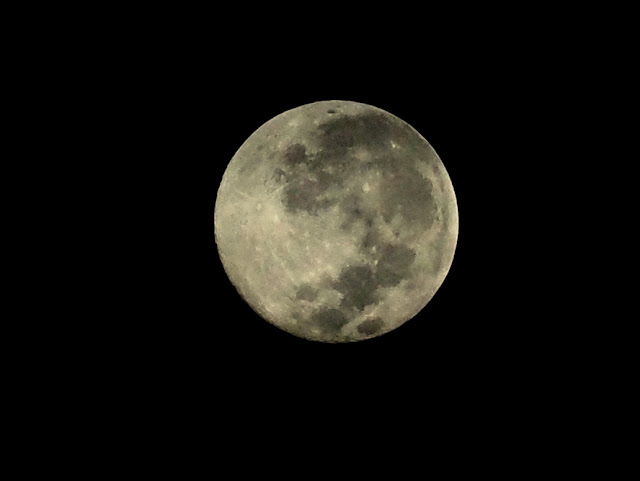
I was awakened this morning just before 5.30am. Despite the drawn curtains, the bedroom was unusually brighter than normal, unlike previous nights. It was moonlight trying to stream its way into the room and lighting up the curtains! That could mean only two things. One, it has to be the full moon. And two, the sky was clear after several days of light rain and thick cloud cover. Sure enough, there was a bright orb of light hanging low in the sky. My mind was alert enough to make me jump out of bed and seek out my camera to record the moment.

The moon was 99.5% illuminated. It was already waning but still full enough. According to astronomy websites, the exact full moon occurred yesterday at 11.26am local time, which meant that a full 18 hours had passed before I took the pictures. But the sky last night, like many previous nights, was thick with clouds because of the low-pressure depression and accompanying rain that had swept over the peninsula during the weekend. So no moon to be seen then.

1/1000s, f5.6, ISO 2000

Moon halo
1/30s, f5.6, ISO 2000


Sunday, 19 December 2021

80th anniversary (5): From the Japanese perspective

At four o'clock in the afternoon on this date 80 years ago (19 December 1941), the first Japanese troops landed on Penang island. This was a result of Penang surrendering after nine days of continuous bombardment by Japanese enemy aircraft and the quiet evacuation of the British military garrison and European civilians. With the island now totally defenceless, it fell upon the local civilians to fly the white flag to signify Penang's surrender to the Japanese military. In today's 80th anniversary story, the last of my five-part commemoration of the sad occasion, I shall reproduce two stories from The Syonan Shinbum newspaper. 

Meanwhile, Singapore fell to the Japanese military on 15 February 1942. Five days later, The Straits Times was commandeered to resume publication under a new Japanese name. At first it was called The Shonan Times but in the course of the next few months, this was replaced by other names, viz The Syonan Times. The Syonan Sinbun and finally, The Syonan Shinbum. Regardless of the name, the newspaper was still the official propaganda organ of the Japanese Administration in Singapore until their surrender to the Allied Forces there on 12 September 1945. (In Penang, the Japanese had surrendered 10 days earlier on 02 September 1945.)

To mark the first anniversary of the Japanese invasion, The Syonan Shinbum of 08 December Showa 17 (昭和 17 年) (Showa 17 is 1942), carried a full page of stories that glorified the Japanese achievement. They were propaganda but there was still useful information to glean from them.

Domei in the stories referred to the Japanese Empire's Domei News Agency. It was dismantled after the Allies defeated Japan at the end of the Second World War. Part of this news agency is today Kyodo News. 

In my previous story (the link to Part 4 appears at the end of this story), I had mentioned how the Union Jack was lowered from Fort Cornwallis and a white flag had replaced it as a sign of surrender. I had also related how a local radio station had broadcast a message of surrender to the Japanese. In the first story below, we learn of a third attempt at informing the Japanese through three men who had rowed across the Channel and made their way to the Japanese headquarters in Kuala Muda.

Penang Saved From Needless Bombing (Domei)

HOW THREE MEN, two released Japanese internees and a Eurasian jockey, rowed in a sampan to Kedah to inform the Japanese Army of Penang's surrender, in one of the most interesting stories of the entire Malayan campaign.

When the British garrison marched out of Penang on the night of Dec 16, the general belief was that hostilities, as far as the island was concerned, were over. But when Japanese bombers continued their raids, attention was drawn to the fact that the Union Jack was still flying over Fort Cornwallis, and the people realised that the British had evacuated without declaring Penang an open town.

Leaders of the various communities held a hurriedly convened meeting and it was decided to broadcast a message to the Japanese troops that Penang had surrendered. The Prai power station, source of the island's electricity supply, having been dynamited by the British forces a day before they evacuated, arrangements were made to tap the current generated by an emergency plant at the local hospital.

With this current, the Penang Broadcasting Station, operated by local radio technicians, again started functioning. At short intervals, the message of surrender was read out, and in between gramophone records were played as in a regular radio programme. In addition, two newspapermen volunteered to lower the Union Jack at Fort Cornwallis and and hoist the white flag in its place. Amid the drone of raiding planes, this was carried out.

The most effective measure to inform the advancing Japanese troops of Penang's capitulation, was a decision to send a delegation to the mainland and contact the Japanese personally, Two Japanese internees, released when the British garrison evacuated, and a Eurasian, I. Allan, a jockey by profession, left in a sampan on the morning of Dec 17 and after 10 hours of strenuous rowing in a choppy sea crossed the channel and reached Kuala Muda in Kedah.

From there, the three men without any rest left for Sungei Patani, Headquarters of the Japanese Forces. They contacted them the following day at noon, and gave them an account of how Penang had surrendered and that Japanese nationals were trying to restore order. This saved Penang from further bombing.

At 6pm on the evening of Dec 19, Japanese troops landed.

During the Japanese Occupation, all clocks were moved forward by two hours to synchronise with the official time in Japan. Thus, the 4pm mentioned in my previous post (Part 4) appeared in the newspaper story above as 6pm. They both referred to the same time. Also, the Eurasian jockey's full name was Ivan Allan.

The second story is also from the same issue of The Syonan Shinbum which gloated over the surrender of Penang. The part of the story of the story that interested me was the aerial dogfights over the mainland. In The Sara Saga, Saravanamuttu said that he was the local representative that submitted the report to Reuter's office in Singapore. He wrote: "As Reuter's correspondent in North Malaya, after careful investigation and interviewing one of the British pilots, who had baled out, at the Penang General Hospital, I reported that four British planes were brought down while all the enemy planes got away safely. However, the official communique interchanged the words 'British' and 'enemy' and this shook my confidence in official communiques after that."

Surrender of Penang A Story of 'Shameful Cowardice' (By a Domei Staff Writer)

PENANG is not by any means the most strategic point in Malaya and no great battle was waged to bring about its fall, yet the story of the surrender of this island may well occupy an important place when the history of the Greater East Asia War comes to be written.

It is a story of shameful cowardice, of how high British officials deserted their posts at the first sign of danger, and how the European civilians were evacuated in the dead of night, leaving the local population in chaos.

Perhaps more than in any other place in Malaya, the manner of the fall of Penang showed up the hollowness of British propaganda and exposed the truth that the British do not care if all Asiatics die as long as not a single Briton is imperilled.

When war broke out early in the morning of Dec 8, few in Penang were aware of it until special newspaper editions carried the report of the landing on Kota Bahru, the raid on Singapore and the historic attack on Pearl Harbour. The sensation, as was only to be expected, was tremendous but beyond the policemen posted outside Japanese business premises and residents, there were no visible signs of a "war atmosphere."

Long years of British propaganda extolling Malaya's strength had lulled the population, especially the European section of it, into such a state of comatose complacency that they still refused to believe that the war could be brought to Penang.

Within a week that fond illusion was shattered as Japanese bombers smashed shipping, and harbour and aerodrome facilities, crushing resistance with no great difficulty. Not more fatal to British prestige than the defeat in  arms were the incredible war communiques issued by British Military Headquarters in Singapore and the even more incredible conduct of British officials.

Everyone saw for himself the dogfights over the mainland in which the defenders invariably came off worst: next day they read in the papers that Japanese planes had been shot down! What they did not know was that the local representative of Reuter's news agency had sent a cable to his head office in Singapore reporting the loss of four British planes and that his report had been issued as a communique by Headquarters with the word "Japanese" substituted.

As the air raids continued, the Chinese, the Indians, the Malays and the Eurasians panicked but none in such a fashion as the British officials. The Resident Councillor moved his office from the waterfront to his house four miles away from the town, and the Chief Police Officer deserted his post, later, shamed into some semblance of manhood by the terrible disorder in the town, re-establishing his headquarters in a building in the residential area. In short, the two men who should have tried to maintain order and seen to the continued operation of vital public services were conspicuous by their absence. The other British officials were no better.

And while looting proceeded unchecked in the business centres of the town and the officials were in hiding, the people of Penang continued to read exhortations by Sir Shenton Thomas, telling them to keep their chins up, and declaring that "every inch of the country will be defended."

Last act of the British tragedy in Penang was enacted on the night of Dec 16, when the garrison evacuated and the white population snacked out on their heels, with no thought for the chaos they had left behind.

Here it may be mentioned that in sharp contrast, this callous attitude, the Japanese military attempted to restore order in Penang even before they occupied it. In their daily flights over the island, the planes dropped thousands of pamphlets, warning looters to cease their plundering immediately. When the Japanese occupation troops set foot on Penang on Dec 19, they took effective measures to check the criminal elements and, what was equally important, arrange for sale of rice to the people.

The measure of co-operation that the people of Penang have been and are giving to the Japanese Administration tells more eloquently than mere words the feelings of gratitude towards the men who came as conquerors and have remained as friends.

<< PREVIOUS (PART 4)
<< PREVIOUS (PART 3)
<< PREVIOUS (PART 2)
<< PREVIOUS (PART 1)

Thursday, 16 December 2021

80th anniversary (4): White flag

Eighty years ago, the Japanese military invaded Malaya and bombed Penang. This is the fourth instalment of my five-part stories to commemorate this sad occasion. It is quite safe to say that many families in Penang, if not all, were affected by the atrocities. I know that mine were displaced. On my maternal side, my grandparents fled to the hills, the chau huan that I had mentioned in Part 2. My paternal grandparents probably did the same too and they never really recovered after the Occupation was over. My father continued with his education at Penang Free School after the War but because of the pressing economic circumstances, he had to quit within the year to find work and support the family (at that time comprising his parents and a sister.) Such sacrifices were not uncommon as the local population tried everything to rebuild.

So far, we know that by 16 December 1941, the British had completed their evacuation from Penang: over four successive nights, they quietly removed their civilians and military garrison by train or ship down to Port Swettenham and eventually, Singapore. 

Few people knew what happened on the island in the days between that evacuation process and the arrival of the Japanese. Six years later in 1947, not too long after the Japanese Occupation days were over, The Straits Times carried an account of those three days which was written by Oh Kee Tiang, a member of the "D" (Chinese) Company of the Penang and Province Wellesley Volunteer Corps who was there to help restore order in a town where law and order had ceased to exist.

Here is his story which appeared in that newspaper on 17 December 1947. I have changed almost nothing in his story:

PANDEMONIUM, chaos and lawlessness were rampant when Penang, for the first time in her history, became an open town six years ago today, on Dec 17, 1941. It was an experience few who went through it will ever forget.

In the little village of Ayer Itam, nestling at the foot of Penang Hill, 80 member of "D" (Chinese) Company of the 3rd Battalion, Straits Settlements Volunteer Force (Penang and Province Wellesley Volunteer Corps), under the command of Lieut Lim Koon Teck (now Crown Counsel, Singapore) formed a special volunteer police force to give security to 80,000 evacuees during those hectic days.

Assisted by members of the Medical Auxiliary Service, including a few doctors, Air Raid Wardens under Group Warden Khor Ewe Kin (recently commended by the Governor of the Malayan Union) and local Defence Corps, they patrolled the village and outlying areas throughout the day and night, keeping a strict vigil against looting and pillaging.

The decision of this gallant band of volunteer workers who accepted the task of restoring order out of chaos when the whole population was running riot without a government, was the result of a conference by members of the Chinese Company with Lieut Lim Koon Teck at the semi-deployment camp, Telok Bahang, on the morning of Dec 17.

Before the evacuation of the European members of the Battalion, "D" (Chinese) Coy, was fallen in at the camp at about 2pm on Dec 16.

Officer Commanding the Company, Capt Pooley, then gave the last order of the day. The Battalion was moving over to the mainland to do "rear guard" action down to Singapore. But the Commanding Officer, Lt-Col EA de Buriatte, had secured the option for the Company to stay back if they wished, no provisions having been made by the authorities to look after the dependents of volunteers.

"If you come with us, you may win greater glory. But there is no dishonour in staying back," were the words of Capt Pooley. One officer from "D" (Chinese) Coy went down to Singapore with the Battalion. He was Lieut Lim Chiam Ghee who has been missing ever since.

The rest of the Company, under the command of Lieut Lim Koon Teck, were instructed to act as a military police force for the maintenance of law and order. They were told to report to the Chief Police Office at the new racecourse, Batu Gantong, the next morning in "full fighting order."

That night Lieut Lim Koon Teck and a platoon of men patrolled the town in a lorry.

"At 8am, I left Telok Bahang Camp with 25 men in one available lorry to report to the CPO at New Racecourse as instructed," wrote Lieut Lim on Dec 17, 1941. "When we arrived at the racecourse camp, no one was to be found. We went to the Indian Association and the new Police Headquarters to look for him, but in vain."

The town was deserted save for looters. Bombs were still falling. Lieut Lim left the men and returned to Telok Bahang where the remainder of the Company were still awaiting orders.

He told the men that the CPO could not be found.

A conference was held in the dining shed and a unanimous decision to go to Ayer Itam, as this area contained the largest part of the population of Penang, was reached.

At 11.30am that day, 25 men under Lieut Lim occupied the Ayer Itam Police Station. The rest of the men went along in whatever transport was available.

Ayer Itam village was in chaos. Every house right up to the interior of Paya Terubong was filled with evacuees. The Dispersal Camp at Thean Teik Estate had more refugees than it could shelter. There was no law or order. All public services were disrupted. Shops were closed and barricaded for fear of looters. Rifle shots were heard at night. The streets were strewn with refuse that had not been swept.

Armed patrols were soon organised. With arm bands bearing the letters "C.P.", they went around the village and outlying areas continuously throughout the 24 hours of the day and night, keeping a strict vigil for looters.

Discarded arms at the Chinese Recreation Club were collected. Armed guards were placed at the water reservoir at Ayer Itam, the petrol dump at Jelutong and the rice godowns at Kampong Bharu, to prevent them from being looted.

Field kitchens were established where kanji was distributed to the destitute and homeless.

Mr Lim Cheng Ean, a prominent local Chinese lawyer, joined the force as adviser. He was in charge of rice-rationing (sold at 45 cents a gantang) and price control, particularly of foodstuffs.

With the return of confidence shops re-opened. Vegetable gardeners brought their produce to sell. Street stalls mushroomed overnight and lined both sides of the road.

Road cleaners returned to work. Sanitation and anti-malarial work were resumed.

In the meantime a public meeting of residents of Penang was called at the Francis Light School and the outcome of that meeting was the appointment of a Committee, named the Penang Service Committee, to take charge of the town and organise the various essential services.

Headed by Mr M Saravanamuttu, editor of the Straits Echo, the Committee included seven doctors and two Europeans.

The Committee got in touch with Lieut Lim at Ayer Itam and an agreement was reached to co-operate to maintain peace in Penang.

Bombing was still going on and the Committee hoisted the White Flag at the hospital and the Residency to indicate that Penang was now an open town. The Union Jack at the Flagstaff was hauled down and the White Flag hoisted in its place.

Mr AS Willwebber was put in charge of the Volunteers Police Force in the town area, comprising ex-volunteers, air raid wardens, LDC, etc.

A sub-committee was appointed to take measures to safeguard the health of the town, and resume town cleaning and nightsoil removal.

A post office was opened at the Chinese Convent School, Dato Kramat Road, for delivery of letters to those who called there between 10am and noon daily.

An express delivery service for telegrams within Penang was also opened, and a daily hand printed bulletin was issued by the Committee.

Rice-distribution centres were established at Pulau Tikus toddy shop, Jelutong toddy shop, Balik Pulau and Tanjong Bungah. Those who could afford to pay were entitled to purchase one gantang of rice at 45 cents. Cooked rice was given to those who could not pay for their rice.

With the help of the emergency electric plant at the General Hospital, the Penang Wireless Society transmitter was put in operation and from 9am to noon on Dec 19, the following appeal was put on the air at regular frequent intervals:

This is Penang calling on ZHJ on 49.3 metres. This is Penang calling the Japanese Headquarters in Malaya. Penang is an open town. There are no armed forces nor any defence whatever in Penang. The British have evacuated Penang. Please stop bombing Penang. Please reply on the 38 megacycle band by telephony or morse.

No reply was received. But at 10am that day, pamphlets asking the public to keep order were dropped by Jap planes. In the meantime, interned Japs who had been released from the prison utilised Dato Kramat ground to write a message in Japanese with white textiles for Japanese airmen to see.

At 4pm that same day, the first Japanese troops landed in Penang.

Regarding the Union Jack at the Flagstaff, Saravanamuttu in his book, The Sara Saga, had more to say about this first-hand experience:

The Committee insisted that the Union Jack at the top of the flagstaff at Fort Cornwallis should be hauled down. I told the Committee that that should be the task of the Japanese when they occupied the island but the Committee to a man insisted that it constituted a danger and that it was the cause of the continued bombing. They assumed that it was my duty as Chairman of the Committee to do it but when I called for volunteers to accompany me, not one came forward! So I got one of my staff, a sub-editor by the name of RS Gopal, to keep me company as I drove through the bombed area to the Fort. It was an eerie experience with dead bodies strewn about on the streets and buildings blazing on all sides. When we got to the Fort, we found that the Union Jack had been sewn on to the rope of the flagstaff and could not be hauled down. So poor Gopal had to climb the rope ladder to the top and cut the flag free from the rope. 

<< PREVIOUS (PART 3)
<< PREVIOUS (PART 2)
<< PREVIOUS (PART 1)

TO BE CONTINUED....