Tuesday, 13 June 2017

Sitiawan sunset


This used to be called the Monkey Garden but since there were no monkeys to be seen, the archway proclaiming it has been dismantled quite some time ago. What's left now is a simple cement boardwalk that weaves out about 100 metres into the sea. In the late evenings, the mangrove trees cast very forlorn shadows on the surroundings.

We walked here, just a stone's throw from the Tua Pek Kong temple in Sitiawan, and were in time to view a fiery sunset at about seven o'clock. Question: are the mangrove trees lining both sides of the boardwalk here dead or alive? In my opinion, they looked more dead than alive. The ones beyond were much healthier, though.


Monday, 12 June 2017

Sitiawan: The Tua Pek Kong temple


We were lucky to have caught the 4.15pm ferry from Pangkor as we landed back at the Lumut ferry terminal just before five o'clock. With still some hours to go before evening, we decided to visit the Tua Pek Kong temple complex to the south of Sitiawan town, a journey of about half an hour.

Instead of guiding us through the main road, my GPS took us down the narrow roads of Kampong China - supposedly a shorter route - before we finally ended up near the Pasir Panjang coast. Initially, the winding journey made me doubt the reliability of the GPS but eventually, I heaved a sigh of relief when the unmistakable silhouette of a pagoda loomed large in the distance. That must be the temple up ahead, I told my passengers.

Turning the corner into the temple's car park, the grand scene before us practically took our breaths away. Yes, I had seen a picture of the giant statues that stood outside the temple but I never expected that in real life, the whole place was so immensely huge. "Wahh....so big, ah!" exclaimed my friend.

We wandered off in different directions. The centre piece was the Tua Pek Kong deity, sitting serenely and staring off into the distance, which in this case, was the Straits of Malacca, flanked on both sides by other statues, prominent among them were Kuan Yin on the left and Ma Chor Poh on the right.  Interestingly, one of the statues depicted a tiger and I was told that this statue represented the White Tiger of the West or the Hor Yah which is worshiped during the Chinese New Year festivities in Chinese temples all over the country.

The Journey to the West by the Buddhist monk, Hsuan Tsang, and his three guardian disciples - Monkey, Pig and Sandy - depicted in stone


There were more surprises to come when we entered the temple complex grounds. More gigantic statues everywhere, depicting most, if not all, popular areas of Taoist worship. Among them, four statues depicting the guardians of the four corners of the world, Maitreya or the Laughing Buddha of the Future, the Ksitigarbha bodhisattva who teaches or instructs all beings in the six realms between the death of Gautama Buddha and the rise of Maitreya, and the Hock Lok Siew trio or the three stars of Prosperity, Status and Longevity.


A huge fountain in the foreground with nine dragons aiming their jets of water towards a central round ball. 

To the left of the grounds rose a newly completed seven-tier pagoda, the first three levels of which were filled with hundreds of small statuettes of Tua Pek Kong, Kuan Yin and Gautama Buddha. Devotees could have their names placed below an image with a donation of RM2,000. We climbed up to the top tier of the pagoda - a total of 134 steps -  and found preparation work still in progress. We looked out the windows. Airy. And the scenery from the top tiers, looking out to the sea and the mangrove swamp in the distance, was fabulous.

Don't ask why the statue has its eyes closed with a red sash. Most probably, the time hadn't arrived for it to be properly activated. There were several statues with similar red sashes across their eyes.

Climbing down, we then went into the old, traditional Tua Pek Kong temple building. This temple is not recent. It has existed for at least some 100 years already. It used to be very ordinary and modest, but some devotees must have struck it rich and made ample donations that had allowed the temple to expand into this complexity.


Behind the temple was yet another vast area worth exploring. A fish pond filled with countless numbers of carp. A statue of Jiang Ziya (姜子牙) sat prominently at one end of the pond with a hookless fishing rod in his hands. For the connection between Jiang Ziya and the origins of the Quah (Ke) (柯) surname, read it here. At the other end of the pond were statues representing the eight immortals (八仙) waiting to cross the sea. And somewhere in the middle of the pond, two cheeky statues of boys peeing an endless stream of water into the pool.


Moving on, we came across a long, colourful dragon hallway of about 100 metres. One enters through the mouth of this mythical beast and exits at the tail. But what's inside the long corridor? Scenes depicting the Halls of Hell where sinners meet with their retribution. Each Hall is ruled by a Judge (presumably the Yama Kings) who hands down the punishments of gruesome tortures. Very educational, if one hasn't seen Hell itself but if you have been to the old Haw Par Villa in Singapore, well, they are pretty much similar.


And finally, our last bit of exploration was to climb an ascending corridor along the perimeter wall of the temple grounds. Here, a long row of stone statues lined the walkway. I did not bother to count the number of statues; the significance of them fails me but each of these life-sized statues featured scholars, government officials, army generals, pugilists and other characters in various poses.


Sunday, 11 June 2017

Sitiawan: Pangkor revisited


It must have been easily 10 years since we last visited Pangkor. It's a small island with locals staying on the east coast and tourists on the west coast. What a unique divide! There have been progress on the island, of course, but the place is still very laid back. Not that we were complaining; indeed, we enjoyed the brief hours that we spent there. First stop after we rented a car - RM50 for the four hours on the island - was to visit the Dutch fort. However, we overshot the place and ended up at Teluk Gedung at the south-east end of Pangkor. Before we turned back, we took the opportunity to gawk at a new structure which was to be opened on the following day. I'm sure this floating mosque will become the island's newest tourist attraction.


From Teluk Gedung, we then backtracked along the same narrow road and ended at the ruins of a Dutch fort which we had missed earlier. Of course, the fort has long been abandoned but we were quite surprised at how small it was. According to wikipedia, the ruins are remnants of a Dutch outpost to control trade in the Malay peninsula. The fort was built in 1670 for storage and protection of tin supplies from the Perak Sultanate. It was destroyed in 1690 by the Malays who were discontented with the methods the Dutch used to obtain the ore. The fort was rebuilt in 1743 and a force of 60 Dutch soldiers was placed to guard it until 1748, when the force was disbanded and the fort abandoned. Since its reconstruction in 1973, it has been gazetted as an ancient monument and historical site. (Story continues after the pictures.)


We then travelled up the west coast of Pangkor to visit the other main tourist attraction, the Lin Je Kong (靈慈宮) temple, at the north-east of the island, passing through the touristy beach section. As this was practically during the heat of the mid-day sun and the Puasa season, the beaches were completely deserted.

The temple can be reached via a small lane from the main road. A small bay would be reached at the end of the lane. When we arrived, we saw a few families enjoying a swim in the bay. A glad respite from the afternoon heat, no doubt.

The main deity in this temple is Kuan Yin or the Goddess of Mercy. One can either choose to climb the outdoor staircase to the temple or walk along the waterfront, with waves lapping up the sea wall, passing by colourful statues of a frog, stork, turtle and a particularly dressed-up mouse, before climbing a second staircase. Both staircases would lead to the temple which would give the visitor a breath-taking view of the bay.

Finally, after the inevitable visit to the shopping district which was a stone's throw from the jetty, it was time to catch the ferry back to Lumut. We arrived back on the mainland at about five o'clock. All in, about six hours in Pangkor.


Saturday, 10 June 2017

Sitiawan: Fine beach but jaded rooms


The Swiss Garden Beach Resort in Damai Laut, about 30 kilometers from Sitiawan in Perak, is supposedly a four-star hotel but unfortunately, we felt that the rooms were rather jaded and tired. The hotel could do with a refurbishment to bring back its glory.

When we entered our room, we found it rather impractical to keep the curtains pulled open because the room was practically next to the road, meaning that we would be within sight of people from the outside.

But by pulling the curtains shut, the room was dim even with all the room lights switched on. The wall paint was blistering and the furniture had obviously seen much better days. Yes, a refurbishment would certainly be in order to put the hotel right again.

And the bathroom. Apart from the absence of towels in the room upon our checking in, I would comment that no decent hotel should be seen with bath tubs anymore. The norm is a standing shower zone. While less water usage is an obvious advantage to the management, shower stands are actually more user friendly for the older guests. No need to climb in and out of the bath tubs. Dread to think what would happen if they were to slip and fall.

There is one other incident that should be well worth mentioning. Maybe it was an honest mistake but what if it was not? When we arrived at the hotel, I unloaded all our bags onto a trolley which the hotel bell boy then pushed to the side of the lobby together with the trolleys of other hotel guests. Fair enough, I had thought to myself. But some time after our check-in had been processed, I suddenly realised that our trolley had gone missing. Seemed that one of the bell boys had moved our trolley by mistake. We had to wait a while for it to be returned, with our belongings intact. If we had valuables in our bags, this incident would have been a cause for concern.

After checking into our room, we went exploring the grounds. First stop was the inappropriately named Samsara Spa. I know that it is exotic to call the Spa that name but if only the hotel had checked its meaning first. Samsara is a Sanskrit and Pali word that refers to the endless cycle of rebirth, mundane existence and dying. Samsara is considered to be dukkha, a state of dissatisfaction and pain, perpetuated by desire and ignorance, and the resulting karma. Samsara is nothing glamorous.

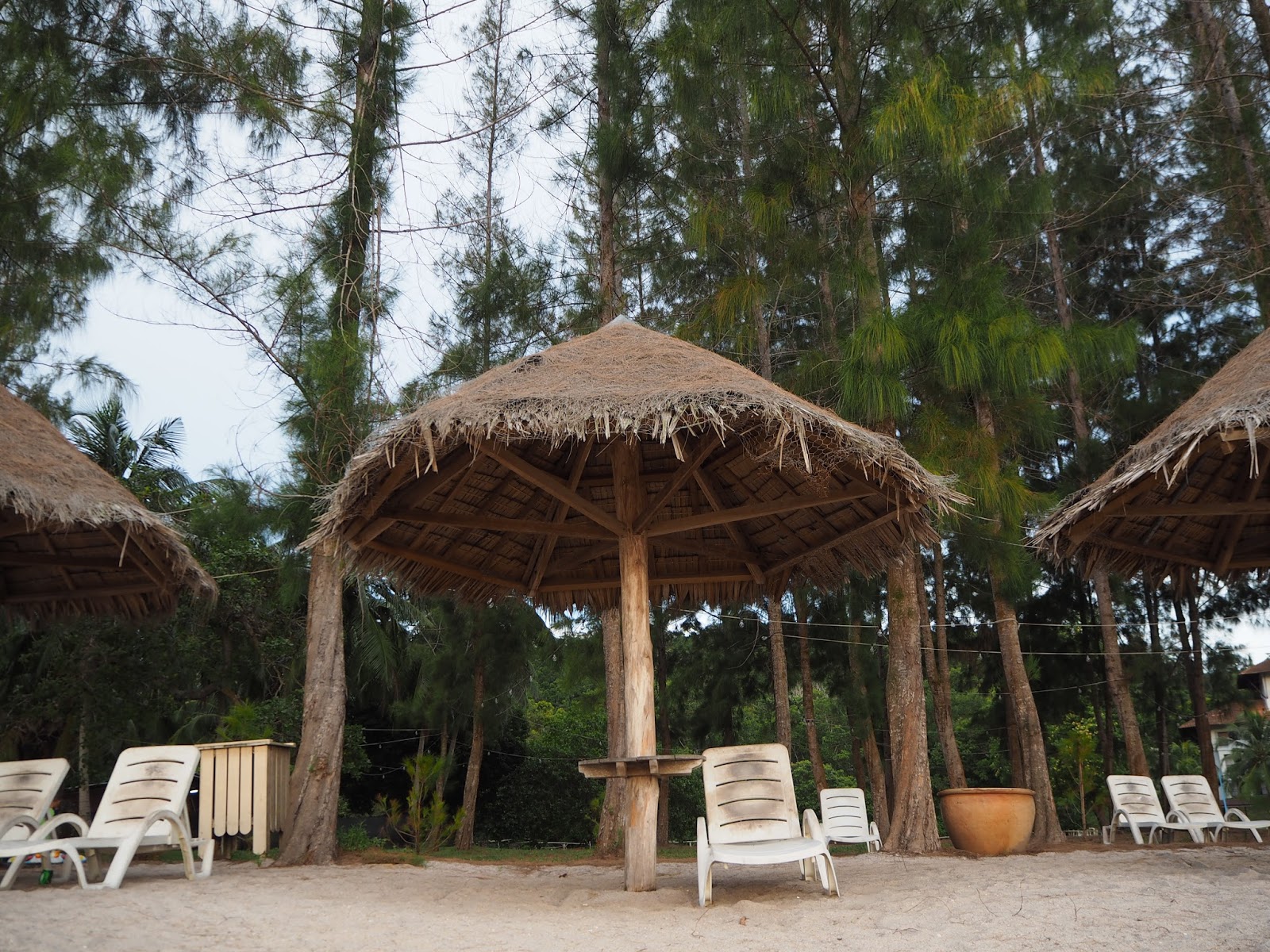
Then we turned our attention to their fitness centre that doubled up as a games room. Here, at least, we were quite satisfied with the facilities: a gymnasium, a sauna room and a jacuzzi. We promised to avail ourselves of these facilities in the morning of our final day at the hotel. Eventually, we found ourselves at the excellent private beach and spent some time wandering around until it was time for dinner. But too bad there wasn't any spectacular sunset that evening.

UPDATE: Comments and reviews are a-plenty on the tripadvisor website by people who have stayed at the Swiss Garden previously. Generally, the comments were made about the poor condition of the rooms. People aren't happy, and they are saying so. I wasn't alone in noticing that the hotel needs a refurbishment. But if one were to read the comments closer, it would appear that the hotel's management are avoiding to respond on the condition of the rooms but rather, they kept harping on the forthcoming improvements of their swimming pool later this year. Really, I don't know what should be more important: to provide a comfortable stay for their guests or a nice swimming pool for those guests who like a swim.