Showing posts with label PFS Bicentenary. Show all posts

Wednesday, 4 September 2024

Penang Free School: The war years

I've always been fascinated by what happened to Penang Free School during the Second World War. Unfortunately, I couldn't uncover much beyond what I had included in my 2016 book, Let the Aisles Proclaim. So, it's always exciting when a new narrative surfaces about the war years, especially when I'm able to connect it to Penang Free School. 

Recently, I was alerted by a friend, Roy Chai from The Old Frees' Association, to a story by Muskaan Ahmed in The Times of India, which I believe is a valuable addition to the limited knowledge we have about that dark period. The exclusive story, called The spy next door, can be read directly from The Times of India news portal (click here to read) but here is my own summary.

In 1942, during the Quit India movement, Penang Free School became an unexpected centre for covert training in a mission to overthrow British rule in India. When the Japanese occupied Malaya from December 1941, their military established an administrative base at the Free School by repurposing it from its original educational function to a strategic training ground for espionage. The Japanese saw the British presence in India as a threat to their ambitions in South-east Asia and sought to undermine it by converting disillusioned Indian soldiers in their cause. These soldiers were recruited into the Indian National Army (INA) by the founder, Mohan Singh, who persuaded them to join forces with the Japanese against the British.

Penang Free School played a pivotal role in this strategy. It was a training centre for the cadets who were prepared for guerrilla warfare and subversive activities. These cadets were trained in a range of espionage techniques, including deciphering coded messages, writing with invisible ink, identifying British aircraft and evading surveillance. The Japanese also provided training in reconnaissance missions, operating in hostile territories and propaganda to spread anti-British sentiment. Thus, the school became a vital base of operations for those seeking to weaken British influence in the region.

The Indian disillusionment with British colonial rule could be traced back to the First World War. Britain had promised dominion status for India in exchange for its support, prompting Indian leaders to encourage thousands of soldiers (jawans) to join the British forces. However, when Britain failed to honour its promise, many of these soldiers felt betrayed. Seeking new avenues to fight for Indian independence, they found themselves recruited for training at Penang Free School.

One such recruit was TP Kumaran Nair who had served with the Malabar Special Force, a British police unit established to suppress uprisings in India. Dissatisfied with British orders to disperse a group of women rallying for India’s freedom in Madras, Nair refused to comply and left for Singapore. There, he met KP Kesava Menon, a prominent activist who had led the Vaikom Satyagraha in 1924. Menon persuaded Nair to join the spy school where later, Nair became an instructor, passing on his paramilitary skills to the 34 cadets at the Free School.

The cadets, including 18-year-old Ramu Thevar from Ramanathapuram who was the youngest among them, were trained rigorously. According to Vijay Balan, Nair's grandnephew and author of Swaraj Spy, they were taught to navigate rubber boats to shorelines after submarine missions, handle firearms and endure the physical challenges of guerrilla warfare. The Japanese also trained them to cross British checkpoints on foot, using real-life scenarios to test their ability to evade detection. Out of the 34 cadets, only two, including Nair, managed to pass these tests successfully.

The training at Penang Free School also involved uncovering worker grievances in British-run factories in India and organising strikes to disrupt British economic interests and sow discontent. However, the mission faced significant setbacks. In 1942, Japanese Colonel Hideo Iwakuro deployed the cadets across India without consulting the INA, leading to operational failure. The Japanese had underestimated the complexity of India’s linguistic diversity: South Indian cadets were sent to the North and vice versa, which resulted in communication breakdowns. A double agent exposed the plan to the British, leading to the capture of all the cadets and a collapse in trust between the Japanese and their Indian allies.

Following this failure, the spy school at Penang Free School closed in 1942. Many of the cadets were arrested and executed under the Enemy Agent Act of 1943. Among them were Nair and young Ramu, who were hanged in 1944. Their sacrifice remained largely unrecognised until a recent commemoration event in Malaysia which was organised by the Death Railway Interest Group. This group had raised awareness of the contributions of these cadets who were buried in unmarked graves.

Penang Free School's transformation into a centre for espionage training highlights its unique role in the fight for Indian independence. While its cadets’ mission ultimately failed, the school remains a significant yet overlooked chapter in the complex history of wartime alliances in South-east Asia. The story of these cadets reflects both the global dimensions of India’s independence struggle and the little-known contributions of a colonial-era school in Penang to that cause.


Saturday, 31 August 2024

Dr Ong Chong Keng

This 31st of August marks the 67th anniversary of the birth of our nation—well, technically, half the nation, as only the peninsula achieved its independence from the British in 1957. Full independence for Malaysia would come slightly over six years later. Nevertheless, the 31st of August will mark the 67th anniversary of the formation of the Federation of Malaya. I’d like to regress a further 10 years to 31 August 1948, exactly 10 years before Malaya’s Independence, when a most dastardly act of terrorism erupted on Penang Island.

In my 2016 book on Penang Free School, Let the Aisles Proclaim, I dedicated about three pages to discuss this event. Similarly, in my 2023 book on The Old Frees’ Association, Centenary, I repeated much of the same information to a slightly different audience. I wish to share the story again, not in print, but here on my blog, to reach a wider audience who may not have access to my books. In my writings, I described the event as "a murder most foul," and indeed it was.

The most shocking news to emerge in 1948 was the cold-blooded murder of Dr Ong Chong Keng at the hands of an unknown assailant on the night of 31st August. The news rocked the Federation and was carried on the front pages of the newspapers: 

Dr. Ong Chong Keng, a Federal Executive and Legislative Councillor, was murdered by an unknown gunman in a squatter area three miles from the centre of Penang. Police offered a reward of $5,000 for information leading to the arrest of the murderer. A Chinese youth was detained. 

Dr. Ong had long been opposed to Communism and had not hesitated to state his views in the Federal Council. He was found dead with bullet wounds in his head at 7am in a lane in a squatter area at Trusan Road, a turning off Perak Road. He had been called out to a case and left his house on a motorcycle. Police were not prepared to state whether the call was real or a fake to get Dr Ong away from his house. He apparently left his motorcycle at Trusan Road and took one of the many footpaths in the kampong. He was found sprawled face downwards with his medical bag close by. 

An official police statement said that at 9pm a young Chinese youth, aged about 22, went to Dr Ong’s dispensary and told the manager that there was a sick man in Jelutong. The manager contacted Dr Ong, who went on his motorcycle to Jelutong with the young Chinese on the pillion. When Dr Ong had not returned by 11.30pm, the manager went out to look for him but could find no trace of him. He reported the matter to the police, who instructed patrols to make a search for him. Early the next morning, a Chinese man on his way to work saw a crowd of children gathered around a body. A police party identified the body as that of Dr Ong Chong Keng. 

At the time of his death, Dr Ong was also the President of The Old Frees’ Association. The Free School paid tribute to his memory by flying its flag at half-mast and was well represented by the Scouts at the funeral several days later. In an immediate Government response to the murder, the Commissioner-General, Malcolm MacDonald, said in appreciation, “Dr Ong Chong Keng was a man of rare distinction. He was more than a leader of the Chinese community. He was a leader of the peoples of Malaya. To the service of this country, he dedicated a brilliant array of gifts. He had the courageous heart of a soldier, the cultured mind of a scholar and the noble vision of a statesman. He was a memorable Malayan Patriot.” In a remarkable gesture, MacDonald himself attended Ong’s funeral. 

A public appreciation was also offered by Harold Cheeseman: “Ong Chong Keng, known to me always as OCK, first came under my notice as a precocious child in Standard II. I watched and indeed stimulated his progress through the school until I had him as a pupil for some years in the top classes. He was not a hard worker. There was no need for him to work hard, for he had exceptional ability. He took a full part, however, in the various school activities and societies. He was a keen scout, later a keen cadet officer, and in after years an enthusiastic volunteer officer. He made his first excursions into debate in the school debating society, and his articles, becoming more and more polished as the years passed, were a feature of the school magazine for many years. From early youth, he was an omnivorous reader, and in recent years there was nothing in which he had greater pride than his library. 

"Some pupils pass from the master’s ken after school days are over. Not so with Ong Chong Keng. He maintained regular contact with me throughout his career at the University of Hong Kong and in later years. After the liberation, he never visited Kuala Lumpur without calling on me or writing to express regret if he had been unable to do so. I think, therefore, that I may claim to have known him well. He was an able and forceful speaker. He was ambitious, but it was not merely personal ambition; it was also ambition to be a leader of his people and to work for them. He was proud of being Chinese, but as he used to say to me again and again, he was proud most of all of being a Malayan Chinese. 

"His service was not confined to his community. It was to the country. This was exemplified in many ways. He was a past president of the Penang Rotary Club, and he was an official in, and often the driving force of, many organisations that exist to render service. This true and able son of Malaya has been foully and prematurely cut down in the fullness of his powers, just when life seemed to be opening out for him in great promise. His life was not lived in vain. His service must be an inspiration to all who seek to work for the good of this country.” 

Police investigations later disclosed that Dr Ong was believed murdered as the result of a conspiracy between the Malayan Communist Party and the Ang Bin Hoay secret society. However, the man that pulled the trigger was never captured. At the inquest in November, an automatic pistol found on the dead body of a Kedah bandit was believed to have been the weapon that killed Dr Ong. A police witness testified that he found the pistol on a hilltop, attached to the body of the bandit, who was believed killed in an engagement with the police and military. One of the five bullets in the pistol’s magazine was sent for testing, and the Senior Chemist concluded he was strongly of the opinion that the bullet matched the one which killed the former Federal Councillor. 

In December, the Coroner returned a verdict of “murder by a person or persons unknown” but added that there was good reason to believe that the perpetrator of the crime had outlived his victim for a few weeks and “expired miserably in a place remote from civilisation at the hands of his fellow murderers, his body lying there to rot as would the body of a dead beast of prey.” 

The body of Dr Ong was brought to the Toi Shan Convalescent Home on Hutton Lane, where it remained until the fifth of September. After the traditional Chinese funeral rites were completed, a procession of 5,000 relatives and friends followed the hearse on its hour-long journey around George Town. Leading the procession was an armed police escort, accompanied by the Municipal Band, its drums draped in black cloth, playing funeral selections. Following a parade of scrolls and Chinese musical troupes was the hearse, carried by Ong clansmen and escorted by police armed with rifles and Sten guns. Mourners walked beside and behind the hearse, with a contingent of Boy Scouts from local schools bringing up the rear, followed by several thousand friends and relatives. Curious crowds estimated at 50,000 lined the streets, while armed police patrolled the town. Special constables on motorcycles and in loudspeaker vans directed the traffic. The procession dispersed at Macalister Road, after which the hearse proceeded to Mount Erskine for the burial.


Saturday, 6 July 2024

The name's 𝗣𝗲𝗻𝗮𝗻𝗴 𝗙𝗿𝗲𝗲 𝗦𝗰𝗵𝗼𝗼𝗹

The founding of Penang Free School is a fascinating story, driven by Robert Sparke Hutchings in 1816. Hutchings, the Chaplain of the Anglican Church on the Prince of Wales' Island, was deeply committed to education and he recognised the dire lack of opportunities for the local population on the island. He felt compelled to act on this gap.

On 6 January 1816, during a Council meeting under the governorship of William Petrie, Hutchings proposed establishing the Native School of Prince of Wales' Island. His vision was to create a school "open to all children regardless of class or race," ensuring that even those who couldn’t afford the nominal fees would be supported by the institution. This proposal was about more than just education; it was about inclusivity and equal opportunity.

Initially, the school operated from rented premises in Love Lane. However, it soon relocated to its own buildings on a plot of land alongside the compound of the Anglican Church in Farquhar Street. Hutchings threw himself into this new role with enthusiasm, balancing his church duties with his passion for education.

The Prince of Wales Island Gazette on 17 February 1816 captured Hutchings’ sentiment perfectly: “It is an uncontroverted truth that the happiness of society results from the good conduct of the majority, and this good conduct results from early habits, or education. It is impossible that the rising generation should acquire good habits and inclinations if they are left in idleness – uncultivated ground must at least remain barren, or what is worse, produce noxious weeds.”

Hutchings' proposals were well-received, and the Governor in Council appointed a committee to implement them. This committee, chaired by Hutchings and including notable public figures such as Robert Ibbetson, Capt John Monckton Coombs, Capt John MacInnes, James Carnegy, David Brown and Richard Caunter, presented a detailed report on 13 January 1816 in which they proposed establishing two schools, one for boys and one for girls.

This marked the beginning of the Prince of Wales' Island Free School, named after the island itself and reflecting its colonial heritage. The school's name underscored its mission: to provide free education to all children, regardless of their background. This institution not only provided education but also embodied the spirit of inclusivity and equal opportunity for all children on the island.

I cannot find any confirmed sources that could tell me when the name of Prince of Wales' Island was changed to Pinang or Penang. The name change could have been gradual, but by 1867, the name Penang had started to gain permanent use and traction even in government documents, thus superseding the name Prince of Wales' Island, which was frankly quite a mouthful. Accordingly, the school's name was shortened to simply Penang Free School to reflect the changing times.

After the Independence of Malaya in 1957 and the formation of Malaysia in 1963, efforts were made to convert all English names into Bahasa Malaysia. Thus, Penang Free School suddenly became called Sekolah Menengah Kebangsaan Penang Free or SMK Penang Free. Of course for many of the Old Boys of the school, this was completely unacceptable. Horrors, it was like a big part of the school culture and tradition been chopped off and discarded. Unofficially, they continued to called it Penang Free School, despite the official documents.

In the 2010s, and possibly even earlier, a campaign was initiated by the Old Frees to petition the Ministry of Education to revert the school's name to its original form. By no means was this a precedent because in 2009, Victoria Institution in Kuala Lumpur had its ugly sounding name of SMK Victoria reverted to its original. The Bicentenary celebrations in 2016 provided a good platform for this effort, and the Raja of Perlis, Tuanku Syed Sirajuddin Jamallulail, was fully supportive. During the Bicentenary dinner on 21 October 2016, he proclaimed, "I would like to announce that the school will retain its name. The school will not be called SMK Penang Free but will be called as Penang Free School until the end of time." 

It is never too late to reproduce this old Bernama story from 2016 in case people forgets about this momentous decision.

Penang Free School to keep its name

Bernama
Published:  Oct 22, 2016 9:02 AM
Updated: 9:24 AM

Penang Free School will retain its name as this has been approved by the Education Ministry.

The announcement was made by the Raja of Perlis, Tuanku Syed Sirajuddin Syed Putra Jamalullail, who is also an Old Frees Association member, in his speech during the bicentenary dinner of the school in George Town last night.

"I would like to announce that the school will retain its name. The school will not be called SMK Penang Free but will be called as Penang Free School until the end of time," Tuanku Syed Sirajuddin said in his speech.

Penang Free School, the oldest English medium school in Malaysia and South-East Asia, celebrated its 200-year anniversary yesterday and more than 3,000 alumni and former teachers gathered at the school field for their grand gala dinner. 

The gathering had gained the National Book of Records as the largest alumni gathering in the country, with 3,130 registered attendees.

The bicentenary celebration was planned by its Bicentenary Committee chairperson, Abdul Rafique Abdul Karim, since 2011 and alumni from across the globe had come back to the school for the celebration.

In conjunction with the celebration, a stamp line with the image of the school, together with a time capsule that is to be opened in 50 years' time, has been launched.

Meanwhile, the 200-year-old school is also waiting to get the approval from the National Heritage Department on its heritage status.

- Bernama

#PenangFreeSchool #SchoolHistory #EducationHeritage #Penang #MalaysianHistory #HeritageSchool #OldFrees #SchoolBicentennial 

Thursday, 16 September 2021

Goh Hooi Beng

The administrator of The Old Frees' Association facebook page reported today the passing of Goh Hooi Beng, former Headmaster of Penang Free School from 1988 to 1993. He was the seventh Malaysian and the last non-bumiputra to serve as the Headmaster of the school.

Mr. Goh Hooi Beng, a distinguished scholar himself in a year and class of unusual scholastic talent, and became the Head Master of his alma mater, died today at the age of 77 from malignant lymphoma at UMMC. A brilliant student among a star studded constellation of very bright students, he earned a Colombo Plan scholarship to study in Tasmania. He served the education department well and retired in PJ where he was active in church activities. Always a serious and quiet man, he was much respected among his many friends. May he rest in peace. 

The only times I met him were at the PFS Bicentenary dinner and two days later when he turned up at the OFA to buy a copy of Let the Aisles Proclaim. We had a private chat after that. May he rest in peace.


Tuesday, 18 May 2021

Definitely NOT a mission school

I received a short message from Anwar Fazal yesterday. "Was PFS started as a mission school?" he asked. And he sent me an accompanying story from a recent Aliran newsletter with the title Mission schools contributed immensely to Malaysia’s education system. Buried within the story was a paragraph that read: "One of the earliest mission schools in Malaya was the Penang Free School, established in 1816, by Rev Robert Hutchings of the Anglican Church." 

After some discussions with Anwar Fazal, I decided to write a response to the Aliran story with the intention of clearing the air about the original - and present - status of Penang Free School. My stand is that Penang Free School was never envisioned as a mission school in the eyes of the founder, Robert Sparke Hutchings. He was a clergyman from the Anglican Church, that was true, but there was as far as his clerical duties went. He never proposed the Prince of Wales' Island Free School to be part of the Anglican Church movement. In fact, he was not even on the island when the school opened in a Love Lane house on 21 Oct 1816.

My letter to Aliran appears below, addressed to their President, Anil Netto. My request is simple enough: either make the correction in their story to reflect the true status of Penang Free School as a public school or remove it entirely. I don't want people to make use of the Aliran story to perpetuate a wrong view of the school. Let's see how they respond.

[UPDATE: Before I proceed to my letter, let me insert this update to say that I got through to Anil himself today (21 May 2021). We spoke of many things but at the end of which the conversation turned back to their mission school story. He agreed to amend their story and I'm glad to say that the picture of the school gate and all references to Penang Free School have been removed. Thank you, Anil.]

Dear Anil Netto,

SS Quah here. I am glad to learn that you are now the President of Aliran. Congratulations! The reason for this email is to refer you to an Aliran story "Mission schools contributed immensely to Malaysia's education system," written by Mr Benedict Lopez and dated 15 May 2021.

When Penang Free School celebrated its Bicentenary in 2016, I was commissioned to research and write a book on the history of the school. This, I managed to complete in 30 months and the book, "Let the Aisles Proclaim," was subsequently launched by the Raja of Perlis on 21st October 2016.  

In the sixth paragraph of the Aliran story, the writer claimed that "one of the earliest mission schools in Malaya was the Penang Free School, established in 1816, by Rev Robert Hutchings of the Anglican Church."

Unless Mr Lopez has concrete proof that Penang Free School was a mission school, I would like to present you with some facts to show why his viewpoint is flawed. But first, some background information.

Hutchings arrived in the Prince of Wales' Island in 1814 and took it upon himself to propose at a Council meeting on 6th Jan 1816 to set up a Native School which would be "open to all children regardless of class or race." In response, Governor William Petrie appointed a committee consisting of Hutchings as chairman and proposer, Robert Ibbetson, Capt John Monckton Coombs, Capt John MacInnes, James Carnegy, David Brown and Richard Caunter. The committee's detailed report was subsequently incorporated into the document known as the Original Plan of the Establishment of Prince of Wales' Island Free School. (Please see the attachment which is reproduced from Let the Aisles Proclaim.)
    • It is important to note that Point #3 of the Original Plan mentioned the first object of the school would include implanting in the children "the early habits of Industry, Order and Good Conduct."
    • Point #7 said the children may be "instructed in reading and writing English, and in the common rules of Arithmetic."
    • Point #8 further said that at a proper age, the children may be "instructed in useful Employments as Carpenters, Smiths, Shoe-makers, Taylors, Book-Binders, &c"
    • But more importantly, Point #9 stressed that "great care be taken that the prejudices of Parents averse to the Christian Religion be not by any means violated."
It is quite clear from these four Points alone that Penang Free School was never meant to be a mission school. Indeed, at the school's first annual meeting on 22nd Oct 1817, Capt Coombs presented a report on behalf of the School Committee - comprising  the six abovenamed gentlemen - that described the Free School as a "Public School." (Penang: The Fourth Presidency of India, 1805-1830, Volume 2, pp 232-38, Marcus Langdon)

I can go on with more evidence but I wish to end by saying that right from the Free School's establishment in 1816, the headmasters had either been men of commerce, military men or (British or Malaysian) civil servants. No man of the cloth has ever been appointed to this important position in the school.

Anil, if you find my argument compelling enough, I hope you will take the effort to either correct the story by Mr Lopez or remove it entirely. I hope you can understand my reservation that if other people start quoting Aliran as a reference point, it may create more misinformation about the correct history of Penang Free School. 

By the way, if Aliran wants to purchase a copy of Let the Aisles Proclaim, the book is available from Areca Books, Gerakbudaya (in Beach Street) or the Penang House of Music.

Warm regards
SS Quah
Penang, Malaysia

P.S. This email is carbon-copied to Dato' Seri Anwar Fazal who first brought Mr Lopez's story to my attention and Mr Andrew Lim who is the President of The Old Frees' Association to keep them in the loop. Thank you.


Sunday, 6 October 2019

A copy for Methodist Boys School


I know that it's better late than never but finally, I got to meet up with a fellow Old Free, Lau Chong Beng, yesterday morning to present the Methodist Boys School with a copy of Let the Aisles Proclaim. Chong Beng has been the headmaster at this school since 2015.


Saturday, 5 October 2019

Video history of Penang Free School


I have moved this story to a separate page of its own on this blog as I feel it is important enough to stand on its own merit. To access the story, please click here.


Sunday, 21 July 2019

The Spirit of the Bicentenary lives on


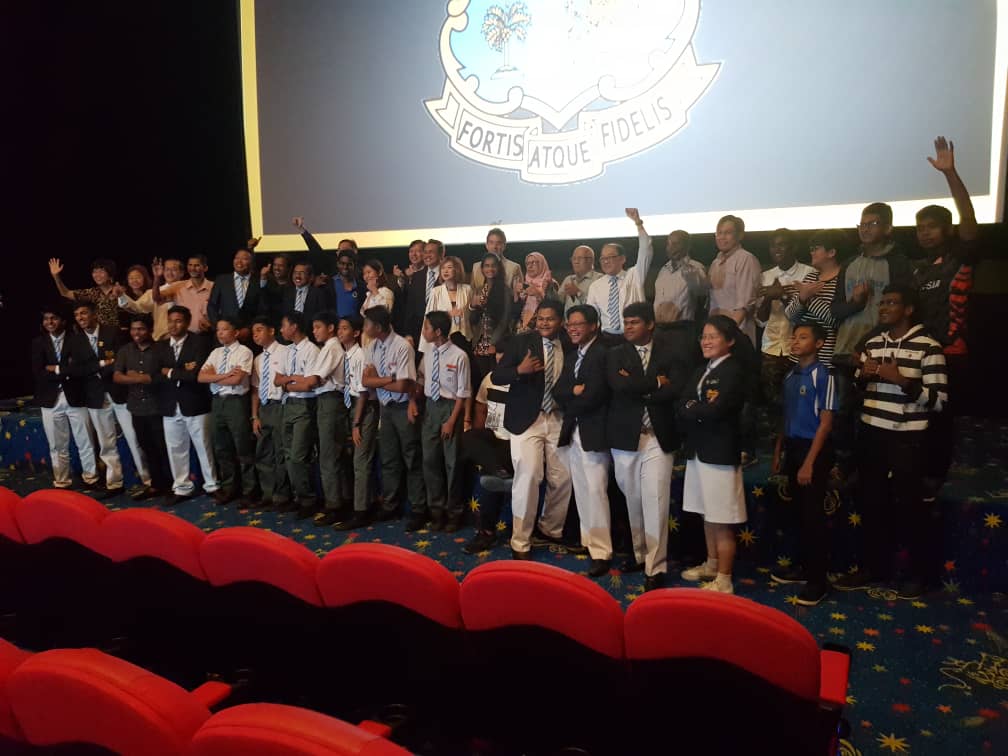
The Spirit of the Bicentenary lives on in those of us who attended the charity premiere of The School that Built a Nation at the GSC Queensbay Mall this morning at 11 o'clock. Not a full house, however, which must have been quite a disappointment for the co-organisers, The Old Frees' Association and the Yayasan Penang Free School. But for those of us who turned up for the screening, it was the Bicentenary all over again, although three years down the road.

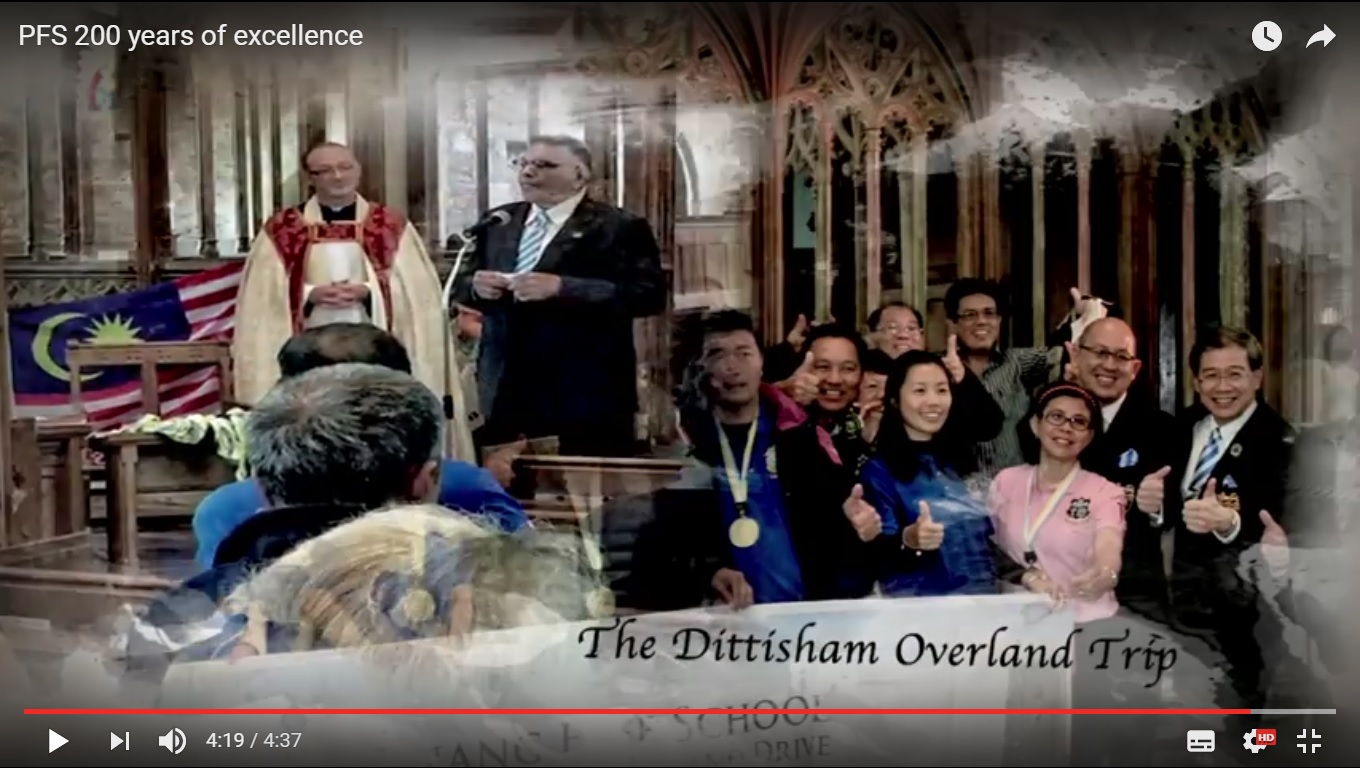
The documentary film brought back many vivid memories for my wife and I because we were there in Dittisham in Sept 2016 to await the arrival of the convoy of 4WDs that had began a 15,000km overland journey from Penang three months earlier. Therefore, seeing images of the St George's Church in Dittisham as well as the stained glass windows bearing the name of Robert Sparke Hutchings really brought lumps to my throat. And to hear Helen Woodman interviewed brought back even more memories.

The documentary moved along at quite an even pace. Nary a dull moment. The interviews with Tan Boon Lin, Anwar Fazal and Marcus Langdon were absorbing, as also the interviews with John Hughes, the Saw brothers and others, which had been expertly crafted into the documentary to tell a very compelling story of Penang Free School. Tan talked about his experience while a pupil during the war years, Anwar spoke of his spectacles and more importantly, gave a brief background on Wu Lien-Teh, and Langdon spoke of his connection to the Free School through George Porter who was the third head teacher of the school.

To those who had not seen this film for whatever personal reason, I can only wish that they had seen it. I think it was a missed opportunity. They would have enjoyed it immensely. Really!

But like I told some people, this film is not wholly about Penang Free School nor is it wholly about Robert Sparke Hutchings and his vision. No, this film is more than that. To me, this film documents the history of education not only of Penang but of the country. And how education had spearheaded the country's march towards Independence and beyond. This should be a film for everyone to see, not only the Old Frees and the present Frees.

I'm surrounded by the School Prefects. Hope it's not detention class in their minds!

Sitting practically in the front row.

Mahyidin Mustakim giving his "brief" opening remarks before the start of the screening. He's wearing two hats as the President of the Old Frees Association Kuala Lumpur & Selangor and the President of the Yayasan Penang Free School.
The audience of Old Frees, teachers, present Frees and invited guests.
After the show. A group picture of most of us who were present.


The spirit of the Bicentenary


Saturday, 6 July 2019

A critic's opinion


My old schoolmate, Kee Thuan Chye, was invited to the charity screening of The School that Built a Nation, the documentary film on Penang Free School last Monday. He wrote an opinion piece in facebook recently. I think it is worthy of reproduction here, and I hope he doesn't mind at all 😊
I was invited to the premiere screening of the documentary on the Penang Free School, pompously and, I think, erroneously entitled 'The School that Built a Nation', last Monday at GSC in One Utama. {The school did not build Malaysia even though it brought out graduates who contributed to the development of the nation.)
The invitation came from Loo Shun Ming, the director and editor who did a commendable job of putting the one-hour docu together. It was delightful meeting her for the first time.
It was also delightful meeting some of the Old Frees who attended the screening, especially my good old friend Sukhindarpal Singh and his brother Harinder; the legendary Anwar Fazal, who has an inspiring story to tell in his interview in the docu; Ahmad Said; Jagmohan Judge, who is actually a lawyer despite his name!; and Lim U-Jin.
Meeting U-Jin was particularly heartening because he told me he was so inspired by my giving my children Malay, Indian and Chinese names that he gave his own children names from other races too. His daughter, for example, has Sunitra as her middle name, similar to that of my daughter, Soraya Sunitra. I'm so glad to see this acknowledgement of Malaysian inclusivity.
It was also a wonderful surprise to see former PFS headmaster Tan Boon Lin there. He is now 90, and he has much to say in his interview in the docu. When I entered PFS in Form One in 1966, he was the headmaster then. It's amazing to see him still going strong.
I also met my old classmate Abu Huraira, former group executive director of Utusan Malaysia Mohd Nasir Ali, and Cheah Wee Leong, a former banker who is now an investment banking trainer.
The screening was preceded by the singing of the school anthem. And after the show, during the taking of a group photo, the anthem was sung again.
A show of alma mater spirit, I suppose, but I couldn't help wondering how many of the Old Frees present -- professionals, corporate figures, businesspeople, politicos, beneficiaries of the system, etc, among them -- live up to the line in the song that says, "Free School for the BRAVE and for the TRUE".
How many among them are real Frees, with courage and integrity and independence of spirit?
There will be another screening of the film on July 21, this time in Penang at GSC in Queensbay Mall at 10am.
But within his own circle of old school pals, he gave us a better insight into his experience watching the film:
The docu was not bad. But the part about the school building in Farquhar (Fucker) Street was overlooked. I also thought there could have been something said about the Tunku and his saving the school premises in Fucker St from being demolished. The visuals could have been more varied and imaginative. Too much repetition of the handwriting visual. There were some interesting revelations but other interesting ones were omitted. The script is written by a Mat Salleh named Alan Braddock. Not a suitable choice, in my opinion. It needed a local, better-informed perspective. The docu's core theme is the celebration of Hutchings' vision. Which is fine, but it needed to be more solidly fleshed out. I also don't see how the docu could have been titled The School that Built a Nation when it doesn't even touch on Tunku Abdul Rahman. Only carried a quote from him at the end. The only luminary featured was Wu Lien Teh. There were irrelevancies too, like Boon Lin talking about his wartime experiences and Anwar Fazal about his breaking the state's middle-distance records in athletics. The docu needed a local to write it and an Old Free to direct and edit it. The narrator, Nick Atkinson, is also a Brit.

Monday, 24 June 2019

Penang screening (latest)


I'm really looking forward to attend the screening of this 50-minute documentary film in Penang. 

With a title like The School That Built A Nation, it has built up a lot of anticipation in me.

As can be seen from this image, The Old Frees' Association in Penang has also released the details for this charity screening, which will be at the Golden Screen Cinema at Queensbay Mall on 21 July 2019 at 10 o'clock in the morning.

Tickets are available from the Free School office as well as from The Old Frees' Association. They are priced at RM100 each and the proceeds will be channelled to the PFS Foundation Fund. I do hope that the Old Frees and non-Old Free well-wishers will seize the opportunity to go and watch the documentary. Please do not let any personal hang-ups prevent you from re-living and appreciating your good old schooldays.

The Penang Governor will be present and from what I know from people in the OFA management committee, the Chief Minister has also been invited. Hope he will give some face and attend.

Here is the teaser trailer for anyone who haven't seen it.


Note: The School That Built A Nation was commissioned by the Old Frees' Association Kuala Lumpur & Selangor as their contribution towards Penang Free School's Bicentenary in 2016, chronicling the history of Free School right up till the Bicentenary celebrations. This documentary completes the contributions by the three PFS alumni associations in Malaysia and Singapore. In 2012, The Old Frees' Association had produced the book, Fidelis, while The Old Frees' Association Singapore came out with Live Free in 2016.


Thursday, 6 June 2019

The school that built a nation


Coming to a cinema near you in Kuala Lumpur and Penang, the screening of this documentary film, The School that Built A Nation, which commemorates the Bicentenary celebrations of Penang Free School in October 2016. 

The documentary in Kuala Lumpur on 1 July 2019 will be graced by the presence of the Raja of Perlis, Tuanku Syed Sirajuddin Jamalullail who, like his father Tuanku Syed Putra Jamalullail, is an Old Boy of the School.

The tickets - priced at RM1,000 and RM100 - are already on sale and the monies collected will go to the Old Frees' Association Kuala Lumpur & Selangor's scholarship and association funds.

"This is a good opportunity to reconnect with school mates and to reminisce with old friends as well as to support the scholarship and association funds. Do get in touch with Melvyn, Adi or any of the committee members for your tickets!"

The date for the Penang screening has yet to be announced but it is also expected to be in July. An announcement by The Old Frees' Association is forthcoming.

The School that Built A Nation was commissioned by the OFA KLS to mark the Free School's 200th anniversary in 2016. The production team had even travelled to London and Dittisham. The latter was the birth place of the founder, Robert Sparke Hutchings. In London, the team met up with John Hughes, the son of the School's last British headmaster, JMB Hughes. John Hughes himself was born in Penang.

Here is the teaser trailer for anyone who haven't seen it.


Saturday, 3 June 2017

Let the Aisles Proclaim


There was a book launch  today on the role of William Farquhar in the founding and development of Singapore and I took the opportunity to present a copy of my book, Let the Aisles Proclaim, to historian and author Marcus Langdon who had been so much help to me in my early days of writing the book. He had been such an inspiration to me. (And what better place than to use the Penang Institute as the backdrop?)


Friday, 16 December 2016

The Westlands boys


When one mentions the Westlands boys, it can only mean the boys that passed through Westlands Primary School and NOT Westlands Secondary School. The Westlands Primary School was originally called Westlands School and in my book, Let the Aisles Proclaim, I had written in the notes:
The Straits Times of 30th September 1930 had reported that “In Penang a new English boys’ school at Perak Road, the Francis Light School, accommodating 500 boys was opened in January.” The earliest reference to Westlands School was in the 31st July 1934 edition of The Straits Times when Mohamed Rouse spoke in the Legislative Council of “the new Westlands School in Penang is to be opened shortly.” On 25th May 1937, the same newspaper wrote of “the Westlands School Boy Scout Troop (Third Penang) repeated their 1934 victory in a competition for junior troops for the Victoria Shield on the Empire Day sports and rally.” The three feeder schools – Hutchings School, Francis Light School and Westlands School – in turn received their intake of boys from the Wellesley Primary School. The New Straits Times of 30th May 1990 quoted a former Wellesley Primary School teacher as saying that the school started in 1929, but the school was known earlier as the Hillview Government School (Singapore Free Press and Mercantile Advertiser, 9th December 1930). The Singapore Free Press and Mercantile Advertiser of 7th October 1924 had reported that “In Penang the temporary Hillview School has been opened.”  The Straits Times of 8th December 1928 referred to “the Free School, Hutchings School and Hillview School at the present time corresponded to the upper, middle and preparatory schools of an English public school.”
When we had our pre- and post-bicentenary reunions of the Sesqui boys in Penang, we made it a point to gather round for a group picture only those old school mates who were also from Westlands School from 1960 to 1965. Our Headmaster then was K Balram and our school hall was named Cheeseman Hall. Sadly, the Westlands School in Victoria Green Road was converted into the Westlands Sports Training Centre several decades ago. Here are the two pictures.

This one was photographed at the pre-bicentenary reunion on 20 October 2016. The ones in the picture are Ling Heong, Chye Chye, Teik Wah, myself, Oon Hup, Seng Oo, Kar Keat and Kah Kheng.

This picture was taken at the school. More people turned up and consequently, more old Westlands School friends surfaced. From left, Kah Kheng, Chye Chye, Sugumaran, Siang Jin, Oon Hup, Ewe Leong, Subramaniam, Hean Guan and Teik Kooi. From right, Ling Heong, myself, Seng Oo, Teik Wah, Mokzani and Kumaraveloo. I can't recall the other two in the photograph.


Thursday, 15 December 2016

The bicentenary reunions


Finally, I remember that we had some fabulous reunions of the Sesqui boys, pre- and post-bicentenary celebrations. The first of three was on 20 October 2016, held at Kim Guan's condominium unit at Gurney Drive. Quite a lot of us turned up and many drank themselves under the table. I turned up for what was supposed to be a short hello-goodbye but it eventually became a long-drawn hour's stay. Thinking back, how could I ever think about getting away with only a short 20-minute stay at that party? No way!

Okay, I shall do my best to identify all the old farts in this picture. That's Derek hidden behind Chin Chuan, followed by Chye Chye, Swee Poh, Teik Wah, Choi Choon, myself, Ling Heong, Nai Kwang, Oon Hup, Andrew, Benny, Kah Theang, Kim Bock, to be confirmed, Soon Chye, Hee Lye, Chim Jin, Sanan, Seng Oo, Thuan Chye, Thiruchelvam, Michael (up). Kheng Hock (down), Kah Kheng, Hean Guan and Kim Guan.

The second reunion was held at the school canteen on 22 October 2016 morning where we were treated to a nasi kandar lunch cooked by Mohd Noor. He was too busy looking after the food that he failed to join us in any of the group photographs. I had to arrive late for this reunion, having been caught up in a traffic jam coming out from Bukit Mertajam, and missed the singing of the School Rally. Still, I was among the first to receive a commemorative T-shirt.

As this group of old farts was even larger than the previous one, I will not attempt to identify everyone in the picture. But we had the presence of Johnny Ooi, our old History teacher and hockey coach. That's him sitting in the picture, the odd one out.

As if two reunions were not enough, we celebrated again over dinner on 22 October 2016 at the E&O Hotel in Farquhar Street, George Town. Another round of merry-making and meeting yet other old faces that could not make it to the morning affair at the school.

No point trying to identify the old farts here too but I love all of you, whoever you are!


Friday, 18 November 2016

Happiness tinged with some sadness


I'm writing this either late at night of the 17th of November or the early hours of the 18th, depending on how fast I can finish this post.

I've just returned from the 93rd annual dinner of The Old Frees' Association on the island. This was supposed to be a happy occasion because finally, the Bicentenary Committee has acknowledged my role in this year's Bicentenary celebrations: the time that I had spent on Let the Aisles Begin and my many other activities, all in the name of the Bicentenary.

I have to admit that I was surprised to be called onto the stage. Never expected it. But here at the St Giles Wembley's ballroom, I went up to receive an appreciation gift from the Bicentenary Committee chairman, Abdul Rafique. I suppose it sort of partially compensated for being overlooked during the official launch of the book by the Raja of Perlis on 21 Oct 2016. Can you imagine an author not invited for the launch of his own book?

Me and my school pals: Huan Chiang, Swee Poh, Michael, Kok Hin, yours truly, Andrew, Kim Guan, Oon Hup, Chye Chye, Kah Theang and Teik Wah.

Anyway, this was supposed to be a happy occasion - and it was a happy occasion until I received a whatsapp message from a friend to inform me that Soo Ewe Jin, an executive editor at The Star Publication had passed away earlier in the day.

This news had a very sobering effect on me because even though I knew that he was battling cancer, I had on occasions exchanged messages with him through facebook. Our latest exchanges were on the 8th of this month but I never realised that they could be our last.

Ewe Jin was, of course, an Old Free some five or six years my junior in school. Unfortunately, I never had the occasion to meet him face to face, either at school or when he was working in the mass media.

I had wanted to see him last year on one of my rare trips to the Klang Valley but a traffic snarl on the North-South Expressway meant that I arrived late in Kuala Lumpur and meeting up with him was postponed. We never did manage to arrange another date. My loss and anyway, it's too late for that. So all I can say right now is that my thoughts are with his wife and two sons.

Below was his last message to me. Guess I won't be receiving any more from the late Soo Ewe Jin. Rest in peace, my friend.


Thursday, 17 November 2016

PFS 200 years video


This video below was first shown at the Bicentenary Dinner of Penang Free School.

Much, if not all, of the information in the video was based on the draft manuscript of my book, Let the Aisles Proclaim, which I had released to Mahyidin Mustakim who is the president of both the Old Frees Association Kuala Lumpur & Selangor and the Penang Free School Foundation.

P.S. Today being the 17th of November, my wife and I shall be celebrating the 93rd anniversary of The Old Frees' Association at the OFA Annual Dinner in George Town. Other than my own school mates, the Sesquicentenary boys, I hope to meet up with lots more Old Frees friends of various ages. See you there!


Monday, 24 October 2016

Bicentenary celebrations


Yes, I enjoyed myself tremendously during the Bicentenary. Right from very early in the morning at the Protestant Cemetary in Northam Road to the School Speech Day and ending with the big reunion dinner on the school field in the evening. All these activities gave me a sense of pride of being an Old Boy of Penang Free School. A feeling which I haven't felt before.

I call myself one of the original Sesquicentenary boys because my friends and I entered the Free School in Form One in 1966, the year that Penang Free School celebrated its 150th anniversary, but to be truthful, at that time the significance of the event meant little to us. We were far too young to appreciate it. I was merely reaching 12 years old on 21 October 1966, just about two weeks short of my 13th birthday. Moreover, we were in the afternoon school session and most of the preparations for the Sesquicentenary did not involve us. But we were still glad for the carnival-like atmosphere during the week-long celebrations in 1966.

This year, it was different. Now 61 years old, going on 62, I appreciated fully the Bicentenary. This was an event of a lifetime. My lifetime. So, at the Bicentenary Speech Day at the Pinhorn Hall in the morning, I sat in the front row and watched the arrival of the guests - led by the Raja of Perlis who was an Old Boy of the School and the Penang Governor who was not an Old Boy but who always attended Speech Day because this is a Free School tradition that the Head of State would attend - then the playing of the National Anthem and the School Rally by the School Band, followed by the various speeches and prize presentations, before the Speech Day assembly adjourned for the launch of the commemorative stamps and first day covers, the time capsule and the planting of trees.

In the evening, joining in the revelry on the school field, mingling with other Old Frees from the different batches and catching up with old friends, some of whom I've not seen for almost 50 years, and some of whom I've not known despite studying in the same batch! Nevertheless, there was much fun and joy. At many tables, wine and liquor flowed freely. Nobody, absolutely nobody, could have prevented us Old Boys at the RM1,500 tables from enjoying ourselves with drinking, cheering and shouting at the top of our voices. Then there were the inevitable speeches but the highlight among them was the Raja of Perlis' speech in which he said the name of the school would be known officially as Penang Free School, our original name, and not some other sekolah menengah kebangsaan name. That brought on the biggest cheer of all.

My book on the School's history, Let the Aisles Proclaim, was then launched by the Raja of Perlis and soon afterwards, an impressive four-minute long fireworks display took place. Seeing the fireworks erupt directly above us was beyond words to describe. Pretty soon, it was time to say our goodbyes to the people in the field. But although the Bicentenary celebrations were now officially over, the real reunion of old school friends were just beginning. Over the course of the next few days, there would be a lot of catching up to do with old pals from outstation and overseas. Thanks to the School's Bicentenary for the occasion, the excuse, the purpose, the reason to bring us together again.

SPEECH DAY PICTURES


BICENTENARY DINNER PICTURES