Showing posts with label environment. Show all posts

Tuesday, 1 July 2025

New electricity tariff looms

Looks like we’re heading towards changes in our electricity bills starting today. I’ve been following this for some weeks now, and from July onwards, electricity tariffs in Peninsular Malaysia will be adjusted monthly instead of every six months. That’s the big shift announced by the Energy Commission (Suruhanjaya Tenaga).

The idea is to make our bills reflect fuel and generation costs more accurately and in real time. The base tariff, which stays fixed for a few years, has now been set at 45.4 sen per kilowatt-hour (kWh), up from 39.95 sen. This is part of what's called Regulatory Period 4 (RP4), which runs until the end of 2027.

On top of that, there’ll be monthly adjustments to the final tariff depending on fuel prices. If fuel costs go up, the tariff can also go up, but by no more than three sen per kWh each month. Anything beyond that will need Cabinet approval. So it’s not entirely free-floating, but still a lot more responsive than before.

Also, our electricity bills are going to look a bit different. The current five-tiered domestic tariff structure is being replaced with a more itemised one. Usage will now be broken down into energy, capacity, network and retail charges. It’s meant to be more transparent, though I suspect most people won't be bothered with the details unless something looks unusually high.

There’s a small bonus for those who don’t use much electricity. Households using 1,000 kWh or less a month will qualify for a monthly rebate under the Energy Efficiency Incentive (EEI) which is reflected on the bill. And for small businesses like shops or offices using below 200 kWh a month, there's a similar rebate too. It’s to encourage everyone to be a little more energy-conscious.

The Time-of-Use (TOU) scheme is also being expanded. Entire weekends now count as off-peak hours, plus a long window from 10pm to 2pm on weekdays. If we can shift our high-usage appliances or machines to those periods, we might save a bit more.

While domestic users may not feel the pinch straight away, businesses might. Under the new structure, users are now grouped by voltage levels (low, medium, and high) with heavier users paying more across the board. Manufacturers and service providers who rely heavily on machinery or air-conditioning may face tighter margins due to both the base rate hike and monthly volatility.

This is where companies may want to rethink their electricity use. For some, installing solar panels might be viable but that’s not always an option, especially for those renting space or operating in multi-tenant buildings. Still, there are other energy-saving solutions out there.

The good news is that exploring these alternatives doesn’t just help cut electricity bills. It also supports ESG (Environmental, Social and Governance) commitments. More companies are being asked to show progress on sustainability. Improving energy efficiency is one of the simplest, most measurable things that can be done. Whether reporting to the board, regulators or just doing the right thing,  it all counts.

Anyway, electricity bills are going to look a bit different soon. It might take some adjusting. But for those who can adapt and take energy seriously, it could turn out to be a real opportunity in disguise.


Saturday, 5 April 2025

Second life


It's been about six years since the tecoma tree outside the house last bloomed this profusely. In recent years, with only a scattering of flowers each time, I'd begun to wonder if the tree was getting old and losing its ability to put on a real show. The last bloom was just about three weeks ago—short and underwhelming. I think I spent no more than a week sweeping the porch and the road. And then, out of the blue, the tree exploded into bloom again—this time with a vengeance! It's like it suddenly remembered what it was capable of. So yes, it’s sweeping time again... but I'm not complaining.

Random update: When I first moved into this neighbourhood back in December 2004, there were quite a number of tecoma trees along the road, all planted by the developer. But over the years, they were chopped down one by one. The tree outside my house is, unfortunately, the last one standing. I’ve resisted calls to cut it down too—because apart from the flowers, it gives me a lot of shade in the afternoons. My house faces west, so the afternoon sun can be quite a nuisance at times. For the minor inconvenience of having to sweep the porch maybe once or twice a year, the tree gives me cool shade, and for that, I’m very thankful. As long as I’m able, the tree stays.

Wednesday, 2 April 2025

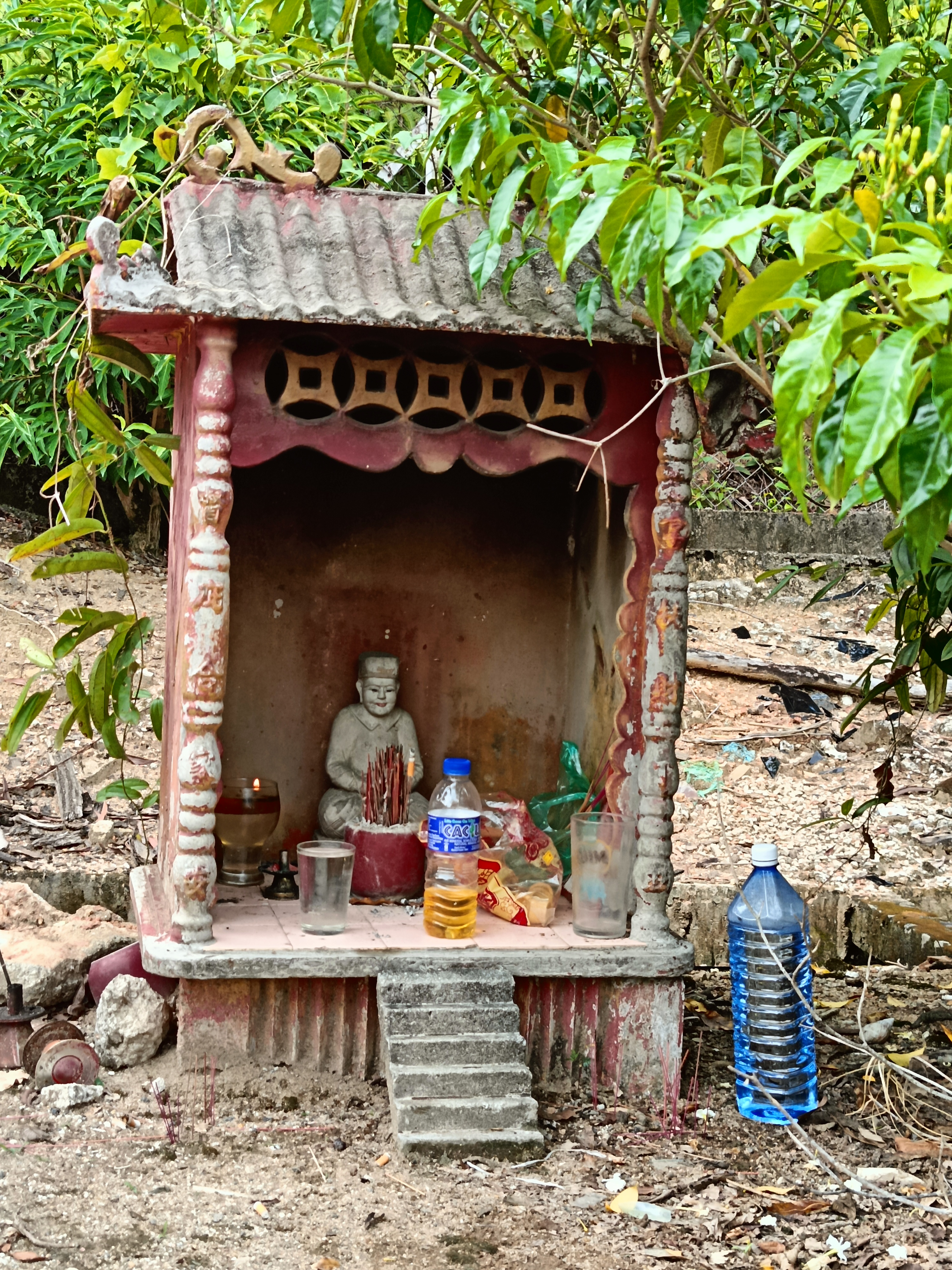
Guardian spirits of the land

The story two days ago about our Datuk Kong experience at the Nandaka Vihara got me thinking—how did the Datuk Kong tradition even get started in this part of the world? These Datuk Kong shrines are almost everywhere in Malaysia, from small towns to bustling cities. Possibly in Singapore, Indonesia and southern Thailand too. But where did this guardian spirit come from?

Before I go any further, I should mention that this peculiar local guardian spirit is sometimes called Natok Kong, or even Latok Kong. Why? Because in the old days, Chinese settlers had trouble pronouncing certain Malay words, and Natok Kong or Latok Kong just stuck.

These shrines aren’t grand temples like the ones dedicated to well-known Chinese deities. They’re usually small, tucked into corners, by the roadside, nestled beneath trees or standing quietly outside homes and businesses, some private and some public—especially in areas with large Chinese communities. But even with their modest appearances, they hold immense significance for those who worship there.

The Datuk Kong isn’t just one deity; it’s a general term for guardian spirits believed to watch over specific places. Some say each Datuk Kong was once a real person—an early settler, a respected village elder or a local leader who shaped the land’s history. Others believe these spirits are tied to nature, acting as protectors of the land, trees and hills. Whatever the origins, one thing’s clear: their presence is deeply woven into the lives of the people who revere them.

What makes the worship of Datuk Kong fascinating is how it blends Chinese folk traditions with Malay spiritual beliefs. The name itself—Datuk, a Malay honorific—already hints at this fusion. As Chinese immigrants settled in the Nanyang, they encountered local traditions and incorporated certain elements into their own practices. And so, the Datuk Kong became a figure straddling different worlds and cultures, and embodying Taoism and indigenous animistic beliefs all at once.

No two Datuk Kong shrines are exactly alike. Some are just humble altars with a single Datuk Kong statue or figurine and incense burners, while others are more elaborate, featuring multiple and different Datuk Kong statues together, red lanterns, banners and plaques inscribed with prayers or auspicious words. Occasionally, there's no statue at all. Instead, I've seen earth mounds, termite mounds, boulders draped in yellow cloth. even red wooden plaques with gold-painted Chinese characters, to represent the deity—emblems of the Datuk Kong’s presence in nature. Offerings vary too—flowers, fruits, tea and even traditional Malay delicacies like sireh and pulut (glutinous rice) are common. But one rule is almost always observed: no pork. Since many Datuk Kong spirits are believed to have Islamic roots, worshippers take great care to keep offerings halal. If anything, this small but significant detail reflects the harmonious blending of cultures that defines Malaysia’s spiritual landscape.

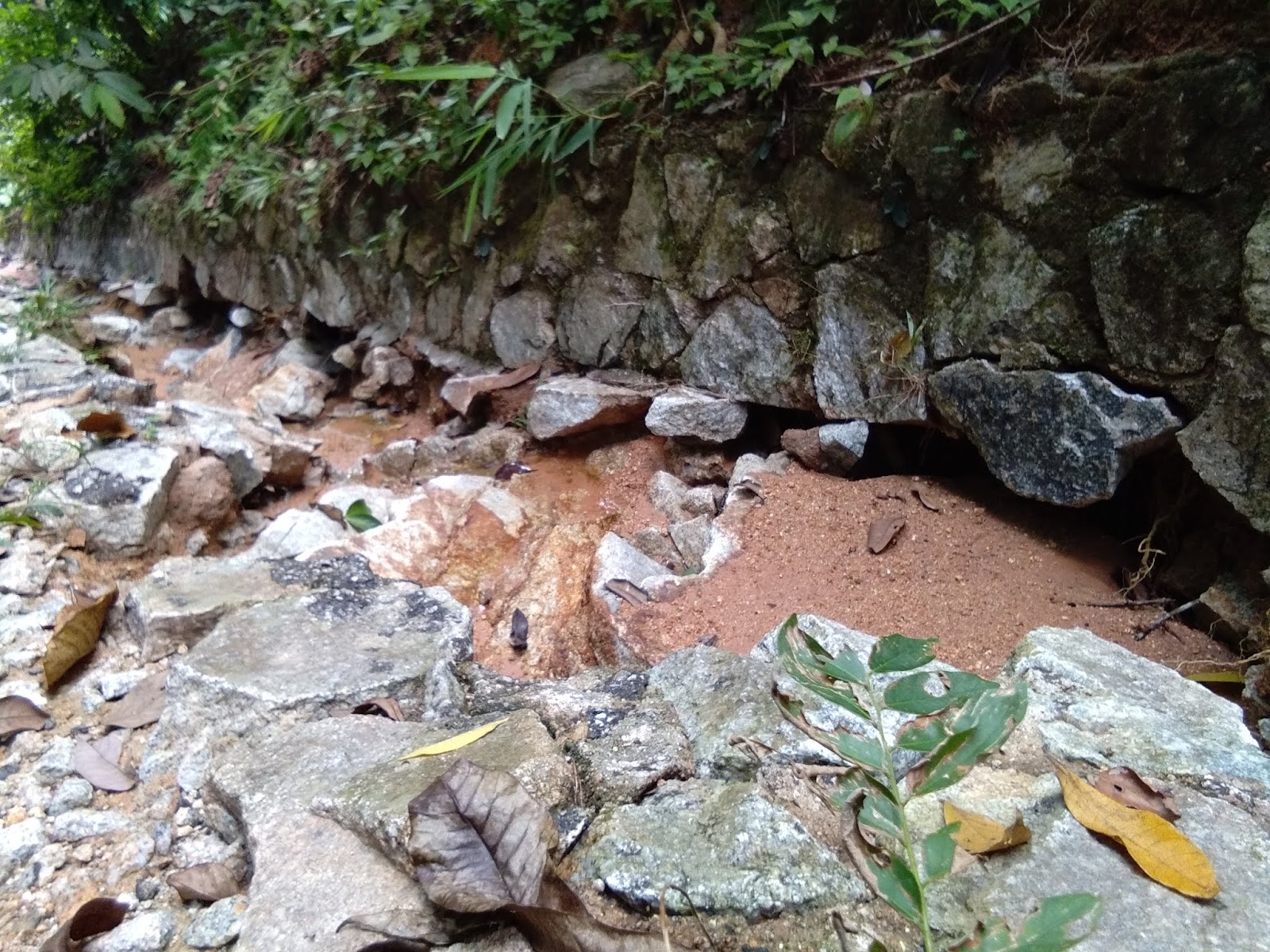
Sometimes, though, the Datuk Kong doesn’t even have a physical shrine, but they are there all the same. When we step into parks, forests or mountains, we just know the spirits are there. It’s an unspoken understanding—we respect their presence, and in return, we hope they don’t disturb us. Some people even carry joss sticks, ready to offer a quiet prayer to appease them and ask for forgiveness for any unintentional transgressions, just in case. And I say this from personal observation—I’ve seen friends bring joss sticks to Kedah Peak when we visited in the 1970s, long before it was developed into the Jerai Hill Resort like it is today.
For those who pray at these shrines, Datuk Kong isn’t just a guardian of the land—he’s a protector, a giver of wisdom, someone to turn to in times of need. A shopkeeper might light incense and ask for prosperity in business. A traveller might pause to seek safe passage. A family might offer prayers for good health and peace at home. Whether these requests are granted is, of course, a matter of faith. But ask any believer, and they’ll tell you—Datuk Kong watches over them, in quiet but steadfast presence.

And despite the ever-changing world around them—where old villages give way to skyscrapers and traditions constantly evolve—these small shrines remain. They’re a silent but enduring reminder of the past, a testament to a community that continues to find comfort in its spiritual roots. It’s an unspoken understanding, one that bridges cultures, connects generations and, in its own quiet way, keeps the spirit of Datuk Kong alive.

Note: I wrote about unintentional transgressions above. But what about the intentional ones—the kind that affect innocent parties? Just last month, I heard a story about someone—an artist, apparently—who thought it’d be cool to paste a picture of a well-known local art celebrity over the face of a Datuk Kong statue. He brushed it off as nothing more than artistic expression, just a bit of creative flair. No harm intended.

But whether he meant any harm or not, something strange happened soon after. The person whose face was used in this so-called "art piece" started experiencing some unexplained health issues. Nothing life-threatening, but troubling enough that it couldn’t be ignored. It got to the point where his family felt compelled to seek forgiveness. And once they did, the health problems reportedly eased.

Sceptics might scoff and call it pure coincidence. And maybe it was. But if there’s one takeaway from stories like this, it’s that local spiritual cultures—whether you personally believe in them or not—are not to be taken lightly. Some things, some traditions, have a way of demanding attention and respect. Best not to tempt fate.

Note: These pictures of roadside Datuk Kong shrines were taken during my walks around the neighbourhood. Maybe I should revisit these shrines to get updated pictures of these statues.


Friday, 21 February 2025

ESG workshop

Last Wednesday, my wife and I attended a half-day workshop on the Simplified ESG Disclosure Guide (SEDG), presented by a consulting group. It was part of a larger event, the ASEAN Finance and Central Bank Deputies Meeting. We were almost denied entry as our names weren’t on the attendee list, but after some confusion, the matter was resolved, and we joined a group of about 30 people, mostly from SMEs. Unfortunately, we missed the first hour due to unexpected traffic congestion, but the workshop was simple enough for us to pick up the missing information as we went along. Luckily, there were still three more hours to go.

The workshop turned out to be pretty interesting. ESG gets talked about a lot, and while I could throw around terms like Scope 1 and Scope 2, their definitions never really sank in. But after today, I finally have a proper understanding of what’s required. What I did know before was that ESG is more than just a buzzword—the Securities Commission and Bursa Malaysia place great emphasis on it, and public-listed companies are already required to disclose sustainability-related information in their annual reports. Many of them will have to step up their ESG compliance even more in the coming years.

For SMEs, though, things are a little different. They’re not yet legally required to follow the same ESG disclosure frameworks as public-listed companies, but that doesn’t mean they can ignore it. Big corporations, especially multinationals, are increasingly insisting that their suppliers align with ESG principles. It’s just a matter of time before ESG compliance becomes a must-have for SMEs wanting to do business with them.

Anyway, back to ESG. The E part of ESG—Environmental—is what most of us are generally familiar with. The first thing that comes to mind is energy consumption—the electricity we use to power our offices, businesses, homes, etc. Everyone knows the first step is replacing traditional lighting with LED fittings. But there’s much more to it than just cutting down on electricity bills. ESG also looks at emissions reduction, waste management, water conservation and responsible sourcing of materials. That’s where Scope 1, Scope 2 and Scope 3 emissions come in.

  • Scope 1 covers direct emissions from a company’s own operations, like fuel burned in company vehicles or factory machinery.
  • Scope 2 covers indirect emissions from purchased electricity or energy used by the company.
  • Scope 3 is the tricky one—it includes emissions from a company’s entire value chain, meaning suppliers, customers and even the end use of a product. This is often the biggest part of a company’s carbon footprint, but also the hardest to track and reduce.

The S in ESG stands for Social, and this covers things like human rights, labour standards, employee management, occupational health and safety, as well as diversity and equity. It’s about how companies treat their staff, their suppliers and even their customers. Are workers paid fairly? Do they have a safe working environment? Are businesses actively promoting diversity and inclusion? These are all part of ESG’s social component.

And finally, G stands for Governance, which is all about how businesses conduct themselves. I always knew that submitting proper audited financial reports was important, but I didn’t realise that governance also includes things like leadership transparency and ethical business practices. Companies need to disclose information on their board of directors and senior management, including diversity, independence and conflicts of interest. Then there are things like having a proper code of conduct, anti-corruption policies and whistle-blowing mechanisms—all of which fall under Governance.

The workshop really drilled home the importance of ESG, especially for the SME representatives there. But I can already see the challenges ahead for SMEs trying to implement these guidelines. Tracking emissions, especially Scope 3, won’t be easy. Neither will restructuring policies to ensure full compliance. Still, there’s no escaping it. Eventually, the big industry players will demand ESG compliance before doing business with anyone, and companies that don’t adapt might find themselves left behind.


Sunday, 16 June 2024

Rise of ESG as buzzword in Malaysia

This essay on Environmental, Social and Governance (ESG) adoption in Malaysia is going to be pretty heavy for me as I write about it for the first time in my life. Do bear with me a bit as I put my thoughts down in writing, okay? 

Environmental, Social and Governance (ESG) criteria have been around for a while globally, but they've really picked up steam in Malaysia over the past decade. I began to become fascinated with it quite recently. To understand how ESG became the latest buzzword here, let's take a look at the journey, from regulatory changes to the shifting mindset of companies and the public.

In the beginning, which was in the pre-2010 years, ESG in Malaysia was mostly lumped together with Corporate Social Responsibility (CSR). Big multi-national companies operating in Malaysia started to blend in some environmental and social concerns into their business strategies, influenced by global standards. Frameworks like the United Nations' Sustainable Development Goals (SDGs) and the Paris Agreement started shaping how businesses thought about sustainability, and this set the stage for what would later become known as ESG.

The 2010s were when things started to shift. More and more Malaysian companies began to move from traditional CSR towards a more structured ESG approach. Regulatory bodies like Bursa Malaysia and the Securities Commission Malaysia began pushing for sustainability in their guidelines. A big moment arrived in 2014 with the launch of the FTSE4Good Bursa Malaysia Index, which showcased companies that had strong ESG practices, This nudged others to follow suit.

By the late 2010s, ESG was no longer just a niche topic but had gone mainstream. Companies began to see the benefits of strong ESG practices, both for their bottom line and their reputation. Investors also started paying more attention to ESG metrics, driven by a global shift towards sustainable investing. This put pressure on companies to be more transparent and accountable.

Many Malaysian companies started aligning their sustainability reports with international standards like the Global Reporting Initiative (GRI) and the Task Force on Climate-related Financial Disclosures (TCFD). This not only boosted their credibility but also helped them compete on a global level.

As we moved into the 2020s, the Malaysian government doubled down on its commitment to sustainability with policies and strategic initiatives. The 12th Malaysia Plan (2021-2025) emphasised sustainable development, and this showed that the government was serious about ESG.

Public awareness of ESG issues also skyrocketed. High-profile concerns about the environment and social issues, from climate change to labour rights, were all over the news. This forced businesses to address these issues more pro-actively. Major companies, especially in finance, palm oil and manufacturing, started embedding ESG deeply into their operations. 

These were several factors driving the rise of ESG in Malaysia:

    1. Regulatory: Stricter sustainability reporting requirements from Bursa Malaysia.
    2. Investor Interest: A growing number of investors preferring companies with strong ESG practices.
    3. Global Trends: The influence of global sustainability movements.
    4. Corporate Leadership: Leading companies in Malaysia setting examples by adopting and advocating for ESG.
    5. Public Concern: Increasing awareness and concern about environmental and social issues among the public.

Wrapping up, I would say that the journey of ESG from a niche idea to a mainstream practice in Malaysia showed how regulations, corporate actions and public awareness came together to create real change. By the early 2020s, ESG was firmly planted in the business world here, and this fashionable buzzword is pushing to shape a more sustainable and responsible future.


Saturday, 15 June 2024

Nandaka at dusk

A photograph capturing the four stupas at Nandaka Vihara, encircling the Bodhi tree within the compound, though only two are distinctly visible. These stupas are newly constructed and currently awaiting only the final finishing touches. The image, taken by the Chief Abbot, Bhante Dhammasubho, at dusk yesterday, showcases the Bodhi tree set against a dramatic, darkening fiery sky.


Friday, 23 February 2024

Revisiting BM hill

Second day of Chinese New Year. Sunday, the 11th of February. We heard that the Bukit Mertajam forest park in Cherok Tokun had finally reopened after a two-year closure for repairs and rejuvenation. 

My daughter, back from Kuala Lumpur, was eager to explore the hill trails but my wife was unable to join us, So it was just me with my daughter as we set off along the trail beside the stream that ran through the park. Though the tarmac road had been improved significantly, the hill trail we took was basically untouched. A huge tree that had fallen across the trail more than two or three years ago was still uncleared and we had to clamber across the trunk. Because hikers were still finding ways to get into the forest park despite its temporary closure, the earthen and stone trail was still very much in use by them and thus, nature had not had time to reclaim it. 

At one point, I decided to veer off the normal path and took my daughter to find the park's biggest tree. Her first visit here. This is reputedly the biggest known tree in Penang, whether on the mainland or island. 

Eventually, we emerged from the trail to rejoin the tarmac road. I was surprised by the work done by the Public Works Department to improve the condition of the road and also the steep slopes beside it. But there was still one problematic part that was covered by torn blue sheets of plastic. I wonder what the Department is going to do next. They can't simply leave the job unfinished. It would be quite an eyesore. 

Oh, by the way, because we had rejoined the tarmac road at a bend where the metal ladder stood, we did not even reach the old Wawasan 2020 viewpoint. It would be interesting to see what has happened to this place. It shall be left to another trip, and perhaps I may even climb higher next time to the clearing where the tea house is.


Sunday, 21 June 2020

No need for alarm


In case people are getting excited or alarmed over a message from Joey Yap that has been making its rounds in social media yesterday and today, let me say that solar eclipses are nothing out of the ordinary. Solar and lunar eclipses are natural phenomena that happens several times in a year. But we do not notice them much because the eclipses are not visible in every part of the world and if they do, the eclipses are not total but only partial, which leave a lot of people disappointed if they tried to look at them.

Interestingly, Joey Yap wrote two messages in his facebook. He's the world's foremost expert on metaphysics; so everything he says is related to his knowledge of the subject. The first was that "It's very rare for an Annular Solar Eclipse to happen on the SUMMER SOLSTICE day! Annular means there is a FIRE RING around the Moon. The areas most affected by this eclipse are Congo, Central African Republic, Ethiopia, Pakistan, India, Xiamen China. The rest of the world above and below these countries, are only partially affected." And his second message said, "June 21 is an annual solar eclipse, which means at a certain angle you can see a Ring of Fire . In most tradition of metaphysics (western or eastern), solar eclipses are not a good omen. There are reasons of course. However, this June’s eclipse is not the worst (as compared to the one coming in December). I will explain fully on my voice message in telegram. Different countries will have different timings and different animal signs may be immune and or be affected if exposed."

To his second message, I had responded with a "Malaysia is not particularly affected by this solar eclipse. Only about 10% of the sun will be covered by the moon and in the context of the sun being the most dominant object in the sky, there's practically no difference in brightness over Malaysia. In the higher latitudes such as Myanmar or northern Vietnam, there may be a more significant difference. But the path of totality will pass over Taiwan and a large swath of central China." (Joey Yap gave my comment a thumbs up.)

What I wrote was true from a non-metaphysics point of view. There is nothing to be alarmed about. We won't even notice the partial eclipse. But a person living closer to the path of totality will experience a more surreal dip in temperature as well as the intensity of the sunlight. Those within the path of totality will see the ring of fire as the moon's elliptical orbit presently takes it further away from the earth and thus visually a wee bit smaller than its average size in the sky, will not completely cover the sun. There will be a narrow band of light surrounding the moon.

And the path of totality? It can be seen here from this diagram which I've obtained from the timeanddate website. The path of totality is a very narrow corridor starting from somewhere around the Caroline Islands in the Pacific Ocean and cutting a swath across Taiwan, central China, northern India, central Pakistan, across the southern part of the Saudi Arabian peninsula and into central Africa where it ends in northern Congo-Brazzaville. Apart from this narrow corridor, it will be a partial eclipse for everybody else. The Americas, New Zealand and much of Europe and Australia are not affected at all. So I repeat, no need for anyone to get so alarmed over nothing. It's just a regular celestial occurrence.

P.S. The last time that Malaysians witnessed a solar eclipse was last year, in November. People, especially the local astronomers, were flocking to Tanjong Piai at the southern tip of the peninsula where totality was experienced. Elsewhere in Peninsular Malaysia, it was only a partial eclipse. So you see, solar eclipses are not so rare after all. But as Joey Yap said, for it to coincide with the Summer Solstice, well, that makes it rare enough. The Summer Solstice in the northern hemisphere is the day when the sun, making  its apparent journey northwards, touches the imaginary latitudinal line known as the Tropic of Cancer and then reverses its path southwards towards the Tropic of Capricorn in the southern hemisphere six months later. Stonehenge in England is a popular spot to watch the rising or setting sun on this Solstice day although I don't know how the Covid-19 pandemic will affect those summer revellers travelling there this time.


Tuesday, 24 March 2020

Sand storm


The current order to control the movement of people around the country as the government attempts to break the spread of the coronavirus means that I have the time to catch up a bit on my stories. Here's one. It was meant to be written at the end of last month. My friend, Siang Jin, was in town and on a Friday morning, the 21st of February, we had assembled at the school to discuss our preparations for the student leadership workshop for the fourth and fifth formers.

We finished early and decided to go to the Ocean Green Restaurant in town for lunch. I hadn't been there for quite a while. The food was good, as always. But this was not what i want to talk about. After we had parted company at the end of the meal, I walked to the beach front to take in the sights and trying out some features on my camera. Funny, I've had this Olympus E-PL7 for several years already but I've very seldom played around with these features.

So there I was, moving about the beach, snapping merrily away on my camera and taking a good look at the faraway Gurney Drive when I was puzzled to see some haziness covering up the view along the coast line. I only took one or two snapshots before my attention was diverted elsewhere, but imagine my surprise when I learnt later that Gurney Drive had been affected by a very rare sand storm. The Malay Mail newspaper had reported the phenomenon here.


Saturday, 16 March 2019

MPSP: a dereliction of duty?


My complaint today to the Province Wellesley Municipal Council or Majlis Perbandaran Seberang Perai (MPSP) over an uncollected garbage bag: 

I stay in Lorong Jernih 4. The MPSP garbage truck comes round every Tuesday, Thursday and Saturday to collect rubbish from the houses here.
I had left a garbage bag beside my rubbish bin outside the house on Wednesday night. 
On Thursday, I noticed that the garbage truck had emptied my rubbish bin but left the garbage bag uncollected.
Today on Saturday, I noticed again that the garbage bag has not been collected. 
I want to ask the MPSP why had your garbage collectors not doing their job properly. In the first place, I never see your men come round to sweep the road of rubbish or fallen leaves and flowers. Now, I have to buy the garbage bags myself, sweep clean the area outside my house and tie up the garbage bag neatly for your men to collect. 
As a rate payer, I want to know why is there this dereliction of duty? 

Friday, 21 September 2018

Passadhi at Penang Hill


Green House. The first thing that comes to the mind of people nowadays are the two hawker centres or coffee shops in Burmah Road that adopt this name. But I'm not referring to them. The original Green House, would you believe it, was located up Penang Hill.

Or to be more exact, halfway up Penang Hill, accessible by the Penang Hill Railway.

Of course, in the old days when the funicular railway was split into two tracks, the Middle Station was a mandatory stop when passengers were required to change from one train to the other. One train would ply between the Lower Station and the Middle Station, while the other train plied between the Middle Station and the Upper Station.

Nowadays, the trains seldom stop at the Middle Station anymore because there is no need for them to stop. Since 2011, it's one continuous track from top to bottom. Only those trains that leave the Lower or Upper stations on the hour will stop here for residents to get on or off.

So there I was waiting with my wife - and two friends, Heng Swee and Alice - at the Lower Station on the 10th of this month. We were met by a couple, Ian and Bin, who were going to lead us to the Green House. We took the train up till the Middle Station, got off there and walked for about 200 metres along a track before reaching a long flight of steps to climb up to the old property.

"There used to be a suspension bridge linking the station to the bungalow," Ian explained to me, "but through decades of neglect, the bridge has collapsed and disappeared."

The 80-plus years-old Green House used to be the hillside holiday retreat of Ong Keng Seng (b 1898, d 1963) to get away from the hustle and bustle of the town. Ong was a well-known Penang trader and businessman. He started the Tai Tong & Co which later became Saw Seng Kew & Co, and was the chairman of the Kwong Wah Yit Poh newspaper. He was involved in the Kuomintang during the pre-war period and helped found a number of Penang organisations such as the Rubber Trade Association, Li Tek Seah, Philomatic Society and Lam Wah Ee Hospital. He was a promiment member of the Ong clan community. In education, he presided over the school boards of Chung Ling High School and Penang Chinese Girls' High School, and was involved in the boards of many other Chinese schools in Penang.

When he died in 1963, Green House was among his estate that was left to his many sons and daughters. Through the decades, however, few took interest in the upkeep of this bungalow and it fell into deep neglect and was later abandoned to the elements. When we visited the place earlier this month, we saw the depth of its neglect. Termites had attacked the property in several places and the balconies were in danger of collapse. Totally unsafe for anyone to tread on. A fall would mean tumbling down 20, 30 feet down the slopes.

Green House actually consisted of two main timber bungalow buildings, an upper bungalow and a lower bungalow, sitting on a quarter acre piece of land. The upper building had been rehabilitated somehow but not the lower one. But at least, the partitions in the lower bungalow had been torn down to leave the four walls standing. On the interior of all four walls, we read graffiti that had been left by holidaymakers, principally students, who had camped there overnight in the 1980s.

Here was where Ian and Bin come into the picture. Bin is one of the grand-daughters of Ong Keng Seng and she learnt that unless something was done to Green House, there was a danger that the state government could ultimately confiscate the property. So she set into motion a plan to ask her relatives, those sharing the title deed to Green House, to donate the place and turn it into a Buddhist meditation centre. And this was how the Passadhi Buddhist Meditation Society came into being about two years ago.

Admittedly, the partial rehabilitation of Green House has been long and arduous. Above the upper bungalow, the heavy rains of last November 2017 caused a minor landslip that brought the earth crashing down. Workers were employed to clear the soil and the slope then reinforced with waterproofing and concrete. Subsequently, a new kitchen was built. There are also four new kuti huts for visiting Buddhist monks of all denominations, and presently there is a resident Mahayana monk, Venerable Xin Shen, staying in one of them.

In the immediate future, there are plans to place a 40-inch Buddha statue in an open space beside the upper building. Having been up there to Passadhi, I see that the space commands a breath-taking vista of George Town and the cape below; the view extending all the way south to include the Penang Bridge and across the Channel to Province Wellesley.

There are other challenges ahead, especially in raising funds for the rehabilitation of the rest of the dilapidated property and in welcoming enough monks to stay here. But there is also the challenge of attracting visitors and devotees to Passadhi because apart from hiking up Penang Hill for the very fit, the only practical access to the place is by the train service and the fares are not cheap in the long run. Moreover, there are usually long queues of tourists for the trains during weekends and the holidays, which may turn away genuine visitors to Passadhi. These are challenges indeed but both Ian and Bin are pragmatic about them: "We'll overcome them with determination and optimism." That's the spirit.


Sunday, 17 June 2018

Bukit Mertajam hill damaged


We decided to go up the Bukit Mertajam hill in Cherok Tokun a few days ago. Driving in, we had to stop before the main gate into the forest park because it was closed to all vehicular traffic. We asked the guard why and he replied saying that the road leading up to the summit had been destroyed due to the heavy rain about two weeks ago. That must have been the thunderstorm we experienced on the night of 28 May. Several roads in the town had been inundated with flood waters then. We didn't realise that it had affected the hill too.

But can we go in, we asked the guard hopefully. Okay, lah, you can go it, he replied. If he did not let us in through the gate, he was sure that we would have tried to sneak in somewhere else. Might as well let us through. So, thankfully, we walked in and he closed the gate shut again after us.

As we walked towards the second car park, we could see the extensive damage. Rushing water could be very unforgiving as it destroys everything in its path. In this instance, the water had brought down the earth and soil from further up the hill and the mixture of water and debris had further eroded the road surface and embankments.

I would suppose it is going to take the Forestry Department months before all the damage could be repaired and the park opened to the general public again.


Wednesday, 8 February 2017

BM Hill, revisited


By my estimate, it must have been about six months since I last stepped foot on the hiking trail that ran beside the stream at the Bukit Mertajam recreation park in Cherok Tokun. I had the opportunity to do so this morning and by a good coincidence, I had decided to bring along my camera. So here are a few pictures that I took along the way: and no, I did not go to the hill's summit or even till the tea house. I exited the hill track at the metal steps and made my way down by the tarmac road.


Wednesday, 16 July 2014

Penang Hill's elevated walkway


I read in the papers today that the new Penang Hill elevated walkway has finally been declared open officially by the Chief Minister, Lim Guan Eng. Built at a cost of around RM1.5 million, the walkway connects the upper station of the funicular rail station to the refurbished food court. It took about 10 months for the project to finish but it seemed like two years to me!

When I was up at Penang Hill last month with a friend, we were commenting that this elevated walkway was preventing us from walking directly to the Tuanku Yahya Petra Road which was where we wanted to go as we wanted to look out to the city of George Town below. Instead, we were forced to take a long detour along the walkway to the open space outside the Penang Hill complex, and then double back along the road towards the upper station.

We did reach that vantage point eventually but along the way, we had to pause to take in many of the old and new attractions on the hill. But such is the lure of Penang Hill that I never get tired of looking at the same old attractions.

This is the lower station of the funicular rail service with its simple huge signboard proclaiming the year that the train service was launched. 

I remember that after the tracks were replaced and realigned in 2011 with funds from the Barisan Nasional federal government, they had openly claimed credit for the Penang Hill upgrade by erecting a signboard that proclaimed the project as "A National Front Ministry of Tourism Malaysian Government Project for the People of Penang" knowing fully well that the state was governed by the Pakatan Rakyat political party. I don't know when it was taken down; I hadn't really noticed it on my many trips up the hill. Only this time, I couldn't miss the red signboard that replaced it. Red sure has a way of attracting attention.

Ever since the four old red-and-white coaches were changed in that same year with two spanking new blue coaches, the trips to the upper station have become a breeze. While the old coaches were pulled by DC (direct current) motors, the new coaches are pulled by motors running on AC (alternate current). As a result, the 30-minute trips have now been shortened to a mere five minutes. That's how fast a one-way trip up or down the Penang Hill has become. Some people have commented that the faster trip has made the journey up the hill less meaningful as everything is a blur and it is more difficult to enjoy the slowly cooling atmosphere. Maybe so, but I do like the new coaches. They are much more comfortable and a thrill to ride, especially when the old middle station speeds by.

This is the new elevated walkway, about a month before its official opening but already in use by visitors to the top of the hill.

A sign of new attractions to come at the hill station: an audio tour of Penang Hill. When I visited, only these signs were visible as the audio equipment had not been installed yet.

Don't just simply look left as one walks along the elevated walkway. Remember to look on the right-hand side too or else one will miss the sight of old train pulley wheels. These were used when the old coaches were still in service. the new blue coaches are now running on new pulley wheels.

Soon enough, the Penang Hill Complex loomed before me. This complex houses the food court (which is called the Cliff Cafe) and the Owl Museum. I didn't visit the museum and I do remember some comments from people that have done so that it is not worth the while to go in as there are no owls there but only owl-themed handicraft. But I'd like to keep an open mind on this. Perhaps one day, I'll go in and see for myself whether the museum is worth spending some money on. 

But I did go into the food court. I just had to try the ais kachang there. People seems to be enjoying this treat there, and I wasn't disappointed. Big bowl of shaved ice, generous amount of toppings, large dollop of creamy ice cream.

Emerging from the Cliff Cafe food court into the open. This is a recreational space that used to have a playground. It's now like an amphitheatre for functions and activities. 

One of the original wooden coaches is still on display at one side of the open space. Another one can be seen at the Penang Museum in downtown Farquhar Street, George Town.

Another iconic attraction at Penang Hill....the old Penang Hill police station. I think the staff here are leading a very slow and pleasant life. What can go wrong here up on the hill that will require their intervention? 

Need to know your bearings? This signpost will set anybody in the right direction.

These electrical buggies will bring visitors along the Tuanku Yahya Petra road.

I visited the rooftop of the Cliff Cafe, seeing that quite a number of visitors to Penang Hill were doing so as well. This observation deck gives one a breath-taking view of the south-eastern part of the island but unfortunately on the day I was there, the haze was thick and obliterated my view.

Once at the observation deck, there is no missing this big LOVE signage. Yes, this is Penang's version of the love lock concept found elsewhere around the world.

This is a section of the padlocks found on the 80-foot stretch of fencing on the LOVE deck. Fancy yourself padlocking up your declaration of love and then throwing the key away permanently? Then do it here.

Other attractions at Penang Hill include the nature walks, the wide varieties of flora, the mosque and Indian temple, the Bellevue Hotel and the various colonial bungalows. It's well worth it for anyone to spend time - a whole day, maybe - at this old hill station, Malaysia's oldest hill station.