Friday, 18 January 2019

Danang, day three: All day long in Hue


The previous day, we old farts had checked into the Eldora Hotel in Hue at about 6.30pm. However, there was very little time to enjoy the hotel's facilities because by 8.15am on Day Three, we had checked out and were on our way to explore Hue and then head back to Da Nang.


Thien Mu Pagoda
Our first stop was at the Perfume River jetty where we boarded a dragon boat for a river cruise upstream to the Chua Thien Mu. By now, we had understood that Chua was the Vietnamese word for Pagoda.

In my opinion, the Chua Thien Mu wasn't a particularly impressive attraction although the gardens were very well maintained and landscaped with lots of bonsai plants. There also weren't that many people around on the day of our visit. However, the place represented what Hue was all about: it is Hue's most historical temple, built in 1601.


All 32 of us could fix inside one of these spacious boats.  

The symbol of the Chua Thien Mu: a seven-storey pagoda on the grounds.


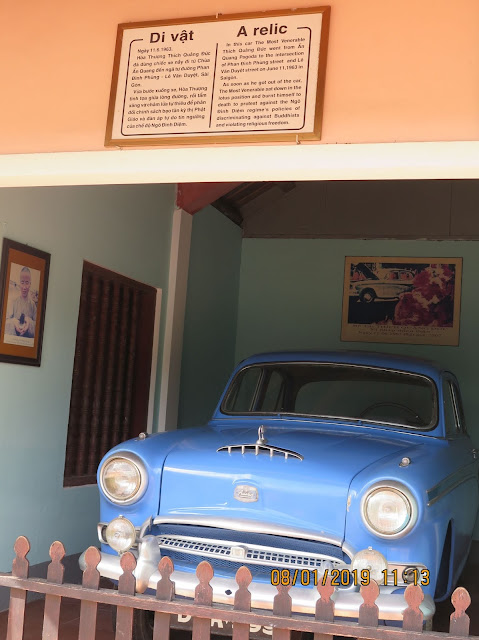
"A relic: In this car The Most Venerable Thich Quang Duc went from An Quang Pagoda to the intersection of Phan Dinh Phung street and Le Van Duyet street on June 11, 1963 in Saigon. As soon as he got out of the car, The Most Venerable sat down in the lotus position and burnt himself to death to protest against the Ngo Dinh Diem regime's policies of discriminating against Buddhists and violating religious freedom." Photo by Oon Chee Seng

Imperial Citadel
Leaving the Thien Mu Pagoda, we visited the Imperial Citadel next. This was once the seat of power for the Nguyen kings of Vietnam, with Hue as the capital. The Imperial Citadel is a sprawling complex of buildings, monuments, gates, landscaped gardens and the odd royal tombs. 

According to a description in Wikipedia, the grounds of the Imperial Citadel are protected by fortified ramparts measuring two kilometres by two kilometres, and ringed by a moat. The water in the moat is routed from the Perfume River through a series of sluice gates. Inside the citadel is the Imperial City with a perimeter wall some 2.5 kilometres in length. And within the Imperial City is the Purple Forbidden City, which was modelled after the Forbidden City in Beijing. In the past, access to the innermost enclosure was restricted to the imperial family. The Imperial Citadel was made a UNESCO heritage site in 1993.

Because its grounds are some immense, it would have been impossible for us to walk from one attraction to another. In fact, even to get into the Citadel itself, we had to commission a special white electric car to take us in, and even then, we had to walk from a point near the citadel's flag tower to the imposing citadel gate. Once inside, another set of electric buggies awaited us to bring us around.  

The flag tower, which is almost impossible to miss.

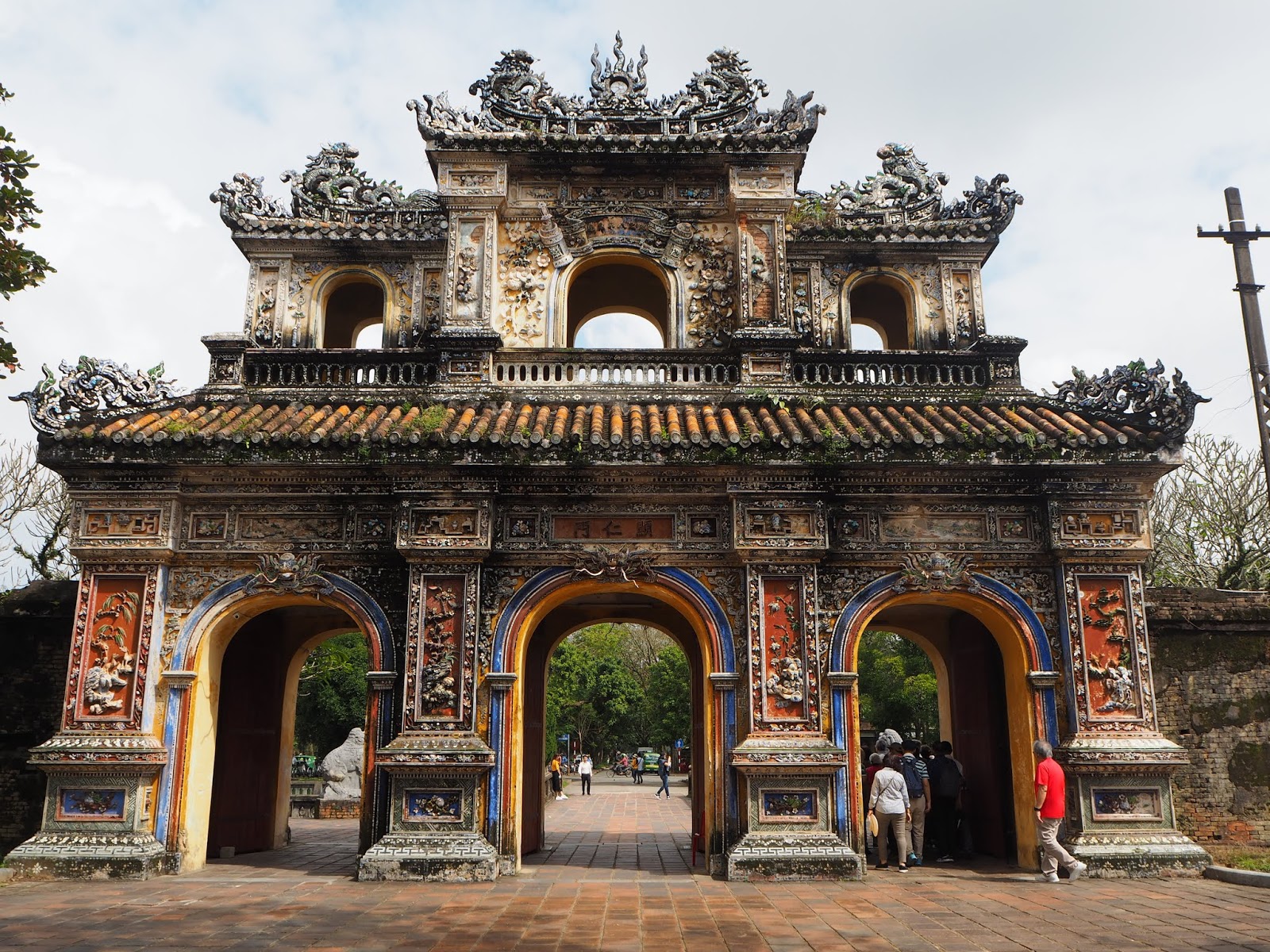
The Citadel Gate

Once through the gate, it was feeding time for the carp


The Citadel's electric buggies driven by charming Vietnamese woman

Inside the To Mieu Temple. A plaque erected outside the temple said: "Constructed between 1821-1822 the To Mieu Temple was dedicated to the Nguyen emperors. During French Occupation  1884-1954,  only seven emperors were honoured: Gia Long, Minh Mang, Thieu Tri, Tu Duc, Kien Phuc, Dong Khanh and Khai Dinh. Emperors Ham Nghi, Thanh Thai and Duy Tan, who were known to be patriotic, were added in 1959. The To Mieu Temple was restored during 1997-1998."
Another view of the interior of the To Mieu Temple

And this is inside the Royal Theatre.

One more of those imposing gates and that's it: we're about to leave the Imperial Citadel.


Boarding the white electric cars to bring us back to the parking lot outside the Citadel.

Royal tomb of Khai Dinh
Before we left Hue, there was one last place for the old farts to visit in the afternoon: the royal tomb of Khai Dinh, one of the last emperors of Vietnam. He proved to be very unpopular, having raised taxes on his people to build his tomb which was completed by his son after his death. The tomb is located on the outskirts of Hue and would require visitors to be healthy enough to climb the steep steps to reach Khai Dinh's final resting place. The inside of the tomb features elaborate glass and porcelain shard art while the ceiling is decorated with nine dragons. Despite the fine and bright architectural design, the place is actually quite morbid. By six o'clock, it becomes completely deserted.


Dragon bridge
By nightfall, we had reached Da Nang. The trip was uneventful with the tour guide telling us of the accident that had occurred at the Hai Van Pass. The return trip did not follow the same road that we took to Hue. Instead, the driver took us through the Hai Van Tunnel which at 6.28km is the longest tunnel in south-East Asia. The tunnel reduces the distance between Da Nang and Huế by 20 km (12 mi) and saves between 30 minutes and an hour on traveling times over the old Hải Vân Pass route.

Tired though we all were, the first thing that we did on reaching Da Nang was to stop at their Dragon Bridge. We had already noticed it on the first day of our arrival in Da Nang but here was the opportunity to see the bridge up close. 


Thursday, 17 January 2019

Danang, day two: Onward to Hue


The drive from Hoi An to Hue was the longest we took by bus. Covering a distance of about 160 kilometres, it took about seven hours instead of the expected four hours. Along the way, we made three stops in our itinerary. No, wait. We made FOUR stops which included an unscheduled stop by a beach to watch fishermen bring in their catch to sell to their middlemen. So these four stops together with the long drive through the Hai Van Pass took up the whole of the seven-hour trip.

Chua Linh Ung
Our first stop was at the Chua Linh Ung in Danang itself. It is a sprawling complex. There is a main pagoda building but it tends to be ignored because every tourist will ultimately find the 67-metre high white statue of Kuan Yin, just a stone's throw away, to be more fascinating. And all of us, the old farts from The Old Frees' Association, are just like any other tourist. We gravitated there too, trying to find the vantage point to photograph the statue. At the base of the statue is a worship hall. Curious, my wife and I tried to find the flight of stairs that would allow us to climb up all 17 floors of the statue. Unfortunately, we found the entrance roped off. What a pity.


At every place we stopped, we would all make a beeline to the toilets. At the Chua Linh Ung, instead of a proper restroom for the men, we had to do our business along a long, narrow corridor. Using the urinals would be an experience by itself.   

This is the entrance into the Chua Linh Ung itself. Up a flight of granite steps....

....and you'll find yourself in a spacious stone garden filled with bonsai plants and statues of the 18 arahants lining the perimeter. At the back is the main worship building, which we just viewed from afar, such was our haste to go see the Kuan Yin statue. 


Breath-taking view of the 67-metre high statue of Kuan Yin which looks over the city of Da Nang. This is indeed the meeting place of heaven and earth.

The worship hall below the Kuan Yin statue.
A face-on view of the worship hall. The centre statue is that of Sakyamuni Buddha, flanked on the right by Kuan Yin and on the left by Sam Cheong (Tripitaka)

Emerging from the worship hall, we decided to take a clockwise walk around the Kuan Yin statue. 


The building isn't tilted. My camera was, though.

Saying goodbye to the Chua Linh Ung.
Thong Bao beach
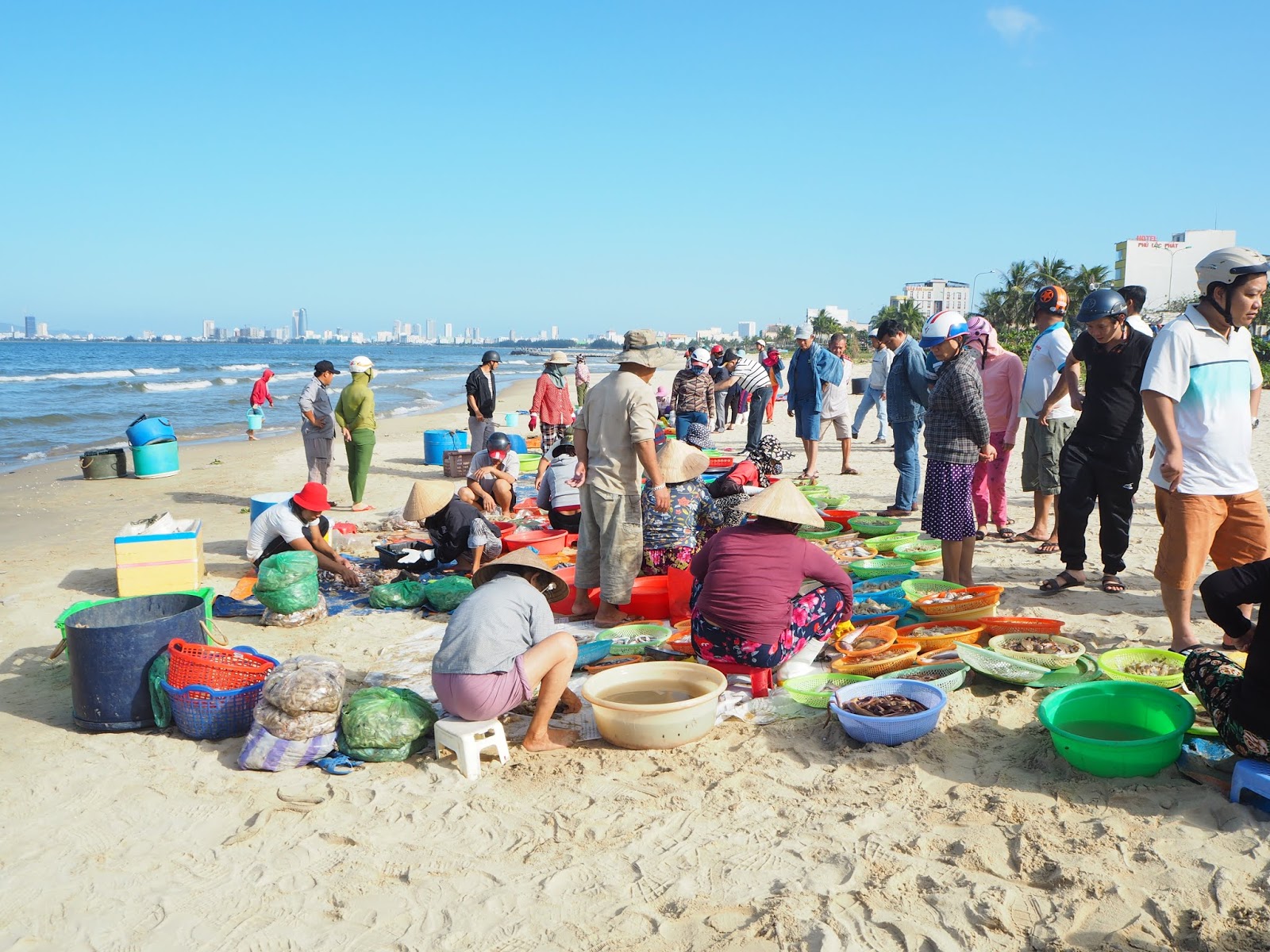
The unscheduled stop. While speeding towards Hue, the driver spied a group of people on the Thong Bao Beach and stopped the bus for us to wander down to them. These people were fishermen and they were selling their day's catch to the locals. We joined in to watch them sort out their catch. There was a wide variety of fresh seafood.


Here's a closer look at the fish, mantis prawns, shrimps, crabs....

A fisherman bringing his catch to the shore with his associates standing by to upload them. Photo by Leong Khoon Wah

Photo by Leong Khoon Wah

The fishing boats are in the background but just note the waves coming in.


Hai Van Gate
So our journey continued. The bus made its way gingerly up the Hai Van Pass north of Da Nang. This is a winding road that hugs the Annamite Range for some 21 kilometres and traverses a mountain spur that juts out into the sea. As we were seated on the left side of the bus, we missed out a lot on the scenery looking seawards. Instead, all we saw, for much of the whole 21 kilometres, was the side of the mountain.

But there were some consolation. Occasionally, we'd see small shrines by the roadside: shrines put up by grieving people to mark the spots where fatal accidents had occurred in the past. Once, we also caught a glimpse of some elaborate praying ceremony on the mountain slope. Yes, the mountain pass was a dangerous road. In fact, the day after, our tour guide informed us that another fatal accident had occurred.

The Hai Van Pass is a two-lane highway with one lane going in either direction. Except for one place along the highway, called the Hai Van Gate, there is no-where else that vehicles can stop. At this rest area, one can climb up the Gate where a fort once stood. It is now abandoned and in ruins. In 2017, archaeologists unearthed the foundations of two 1826-built gates which had been damaged during the war (1946-1975).  Before and after the Hai Van Gate is reached, there are two dangerous hairpin bends apart from the sudden curves and blind corners.


Thua Thien-Hue is the name of a province in Vietnam.

Here we go, climbing up the abandoned fort

Could this be a pillbox, a look-out tower?


This is the rest area at the Hai Van Gate. Traders have set up all sorts of small businesses for the tour buses that stop here. 


Coffee at The Lagoon
After all those visits to the Chua Linh Ung and the abandoned fort at the Hai Van Gate, it was time for some real Vietnamese coffee. Our final stop was at the aptly-named Cafeteria The Lagoon, a rest place that looked over the peaceful Vung An Cu lagoon. It seemed like a popular rest area to me: popular with newlyweds wanting to take their wedding pictures against the backdrop of the lagoon and the Annamite Range in the background. Even as we were alighting from the bus, we could spy a couple posing on a sand spit in the faraway distance. Busybodies that we were, some of the old farts even went across the spit to watch the photography session. But many of us chose to remain in the cafeteria with our coffee and fresh coconut water.


Photo by Tony Beh