Sunday, 25 January 2015

Ao Nang food adventure


The last two weeks have been pretty busy for me and my wife. First, it was a last-minute trip to Seremban and Malacca, and then there was this short holiday in Ao Nang, Thailand that we had planned for since September last year.

Having just returned yesterday, there's no time for me to write anything about our holiday yet but here, at least, is a collage of the variety of food that we sampled in the streets and restaurants in Ao Nang. It is well and good to be carried away and enthuse about Thai food but mind you, not all were up to my expectations.


Tuesday, 20 January 2015

Nyonya cakes, peranakan kueh-mueh


It took me a while to hunt down Baba Charlie's nyonya cake shop. Firstly, I couldn't locate it properly on Google Maps. Secondly, when I keyed the co-ordinates into my GPS, it led me round and round and round. It was only after a painstaking search of Tengkera Road on the GPS that I finally managed to see the cake shop as a point of interest.

But once you know where to look, locating the shop became very easy. The only possible big danger was to scrape the side of the car on the road kerb when negotiating into the narrow lane. Apart from that, once in the lane, you must realise that further in, the lane would become impossibly narrow for a car to pass through and it was necessary to park it in the open space nearby and walk to the shop.

Baba Charlie's nyonya cake shop is actually housed in a small wooden hut. Inside, Baba Charlie's family and staff were busily making nyonya cakes. All sorts of traditional nyonya cakes. And the cooked cakes were all on display in an adjoining room, waiting for buyers who came in droves when my wife and I were there.


My first impression was that there weren't much difference between the nyonya cakes in Penang from those available in Malacca. There are a great deal of similarities but of course, there are nyonya cakes that are unique to Malacca only. Or made in a slightly different way.

One of the unique nyonya cakes is the kueh bongkong. I've never come across this in Penang before. We bought a packet to try and we found it simple yet delicious. Maybe a tad too sweet for our tastebuds as well, but hey, practically all nyonya cakes would actually require you to have a sweet tooth!

I don't normally find tapai (fermented glutinous rice) sold by the nyonya community in Penang, only by the Malays, and so, I was very happy to see this delicacy available at Baba Charlie's. We bought six packets, brought them back to the hotel, and happily enjoyed them all the way to Kuala Lumpur.

We couldn't possibly buy a piece of everything in the shop and so, we had to be very selective of the cakes that we bought. One of them was a nyonya popiah. I had noticed that in a corner of the kitchen, a lady was making the popiah skin in several frying pans. That was so unlike the way the popiah skins are made in Penang. The Penang version can be paper thin and it is an art in itself to making the skin. In Malacca, the popiah skin tend to be thicker.

My second impression was that Malacca nyonya cakes tend to use a lot of the clitoria flower. The locals call it bunga telang but its actual scientific name is clitoria ternatea. The clitoria is blue and it is a natural colouring agent for many of the nyonya cakes in Malacca.

Almost all the nyonya cakes I saw in Baba Charlie's shop had a tinge of blue in it. Elsewhere, I know that the clitoria blue is also used as a whitening agent when washing white-coloured clothes. Lam chneh was how my mother called it.

And my final impression was the quality control at Baba Charlie's nyonya cake shop. While we were there, all the packets of ondek-ondek were suddenly swept away from the counter. Even the packets that had been bought by their customers were asked back from them. I asked them why, and Baba Charlie's son said that the batch had been rejected. Somehow, there was not enough gula melaka inside the ondek-ondek. It wouldn't be sweet enough, he said, and customers had complained in the past when the nyonya cakes lacked enough sweetness.


Monday, 19 January 2015

Durian chendol, not!


Fact: Much of Jonker Street is dead during weekdays. Fact: much of Jonker Street is a tourist trap with exorbitant prices.

There is nothing like a gullible tourist to part with this money. Foremost among these tourist traps is a small shop called Bibik House. When my wife and I walked past the shopfront during our recent trip to Malacca, our eyes latched onto a sign touting durian chendol.

Many of my friends would know that usually, I cannot resist the calling of a durian. "Smell me, eat me, taste me," the durian would call out to me and I, like a zombie, would throw caution to the wind and buy the fruit.

Only this time, there was no fruit. But there was the word durian displayed prominently on signboards outside and inside the shop. So with high expectations, we ordered a bowl of chendol and I asked the lady at the counter to include durian in it.

The first sign of danger was that she opened a plastic container and scooped up some miserable portion of frozen durian flesh - I do hope it was durian flesh and not durian ice-cream - and placed it in the bowl of chendol. Then she pushed the bowl to me and said, "RM6." I dutifully paid up, brought it to my wife and we tucked into the bowl.

Let me say that the chendol was nothing like what we expected. Hardly any taste of durian at all. Just a sickly sweetness from an overly liberal dash of gula melaka. Great disappointment, to say the very least. And to pay RM6 for it was a great injustice to our pockets.

At any time, let me just say categorically that the two Penang Road chendol stalls in Penang are miles ahead of this Bibik House when it comes to serving quality chendol, without durian. Elsewhere along Jonker Street, other stalls were selling chendol at RM3.50 to RM4 per bowl. Of course, they were without durian pulp but hey, what a world of a difference in the price.


Sunday, 18 January 2015

Sun sets over Malacca


Malacca wasn't in my original schedule. After our visit to Seremban, my initial plan was to travel to Kuala Lumpur and stay there for a night. But my wife had different ideas. Since Seremban is so close to Malacca, she suggested, why don't we go there instead?

Frankly, this was a spiffingly good idea. Immediately, I booked ourselves into the Hotel Puri, which is one of Malacca's better-known boutique hotels. And immediately after that, I had second thoughts whether a single two-day, one-night stay in Malacca was enough. Without any further hesitation, I booked for a second night's stay there.

Let me say that it wasn't a bad decision to stay three days in this old former Portuguese/Dutch/British colony. It gave us more leeway to do whatever we wanted to do. And I did tell my wife, let's try to make this a food trip. But when we arrived in Malacca, we were wondering whether we should go all out on a makan spree. We've already had crabs in Seremban the day before and we were mindful of our cholesterol level going out of control at our age.

But visiting the Portuguese settlement in Malacca had always been in our plans and we know that there are restaurant there, and a very popular item on the menu are the crabs cooked in whatever way we wanted. How to avoid crabs when this crustacean keeps popping up everywhere in menus? In the end we succumbed to temptation and we did order one large crab cooked with salted egg (double danger for cholesterol: crab and salted duck egg).

Apart from the food at the Portuguese settlement - or more accurately, Portuguese Square - we had a little bonus in watching a very glorious sunset. Here is a series of pictures I took, all within five minutes, between 7.10p.m. and 7.15p.m. Pretty dramatic, don't you think so?


Saturday, 17 January 2015

Chasing after food in Seremban


Luckily I had someone to show me around Seremban when my wife and I visited the place earlier this week. And nothing is more important, actually, than to go on a food trail with someone who is familiar with the place. Ask me to go there on my own and I will probably end up eating the worst of the worst food, but a foodie guide changes all perspective on filling the stomach properly!

Take for example, the night we were there. We were taken to the Sin Yit Sing Restaurant which, I am told, served one of the best soup noodles and marmite crabs around. Here is the interior of the shop. Very typically a Chinese restaurant. What's important is the food and its quality. Nothing else would matter.


And this is one of their signature dishes: a soup noodle with chunks of fried fish head cooked in a broth containing ginger and pepper. Boy, was it spicy! I almost choked at one point when the spices flared up in my throat.


Here's how it looked like when scooped into your own personal bowl.


Another of the restaurant's signature dishes, which is marmite crab. There were other flavours but we decided on their most popular one. We ordered two crabs.


And finally, there was this fried pork knuckles done in the Filipino style. The skin was crispy enough but I would say that the frying was overdone and the meat turned out tougher than expected. Total damage to the pockets was around RM160.


Who haven't tasted Seremban siew pau before? We were told that when the original Seremban siew pau maker passed away, his business was continued by the son. However, he had two daughters too who opened their own separate siew pau outlets. We visited one of the sisters' shop in Temiang, called Kedai Siew Pau Asia. But the shop's more commonly known as the Siew Pau Master.


When we arrived, many of the pastries had just been removed from the oven. Wafts of fragrant aroma filled the air. As usual, my wife was thrilled to see so many pastries in the shop.


We bought one siew pau each for tea, and then headed to the Seremban central market in search of their famous hakka mee. There are several places serving hakka mee but we were told that this stall in the market's hawker centre was just about as original as we can get. It sells only in the morning. Interestingly, the hawker's brother has his own stall elsewhere that opens from the afternoon. They cater to different crowds of people.


Markets are very vibrant places. Usually very colourful too. The Seremban central market wasn't any different from large markets elsewhere in the country.


And here it is, the Tow Kee Hakka Mee outlet in the hawker centre. Curiously, we did not see droves of people lining up to order. I think to the locals, this was just one of several hawkers operating here. And nothing much to excite tourists too, which is good, because too much fame can cause food quality to deteriorate fast.


Finally, the hakka mee came. At first glance, it looked like Singapore bak cho mee, but I preferred this version for its simplicity and authenticity. It may not look attractive but the taste was delicious.


For lunch, we went to the Silver Dragon Restaurant somewhere in Seremban2. This is supposedly one of the biggest Chinese restaurant in Seremban with a seating capacity of 2,000 people. We had arrived early and were the first patrons. The place was empty but because of the size of the hall, I could well imagine how busy it would be when filled with people. We selected from the set menu and had fried prawns, vegetables and steamed tilapia.


Friday, 16 January 2015

Old friend Kumar


There I was, deciding to have a bowl of hokkien mee at a coffee shop in Pulau Tikus - you know, the one at the corner of Burmah Road and Bangkok Lane - and sitting down at any empty table when my ears picked up the end of a conversation at a table next to mine. Not that I was eavesdropping or anything like that, but when the person was speaking loud enough into a mobile it would be almost impossible not to overhear the conversation.

Anyway, it was the end of his conversation and his last few words into his mobile were "old frees association." If you are, like me, a member of The Old Frees' Association, would you not turn your head? That was what I did and what did I see? Three Indians having a mee goreng breakfast. I looked at the Indian guy in the middle, the one who had just ended his conversation. He looked at me. We sort of recognised one another.

"Kumaraveloo," I called out to him. "Seng Sun," he called out to me. Well, well, well, here was someone that I hadn't met in something like 42 years. Old friends, indeed. We were classmates at the Penang Free School but we had known one another even longer: since primary schooldays at Westlands School.

And fancy meeting him in a coffee shop in Penang when all the time, I knew him to be living in Kuala Lumpur. He is a freelance film director and was in town to search for locations for his next project. He had to run for an appointment but we agreed to meet up at the OFA later for some drinks. That's how this picture came about...


Overnight trip to Seremban


This week has been pretty busy and interesting. On Sunday, my wife and I took a long, leisurely drive down to Seremban and after an overnight there, we drove to Malacca for a two-night's stay. From Malacca, we proceeded back to Penang but not before breaking our journey in Kuala Lumpur for one night. All in, we were away from home for five days.

Why Seremban, people may ask. Well, why not? I haven't been back to Seremban since the mid-1990s when I was in the Seremban outskirts of Ampangan to set up an automated teller machine at the Ban Hin Lee Bank branch there. I don't know what has become of the branch, much less to know the fate of that ATM.  Didn't bother to find out.

Anyway, while in Seremban, we had a most interesting time meeting up with a few people. The Sivanesan family heard we would be in town and invited us to their home. And that's how we were introduced to their two talented children, Subramanian and Nithyalakshmi.


Both Subra and Nithya had been playing in the national junior chess championship in Kota Kinabalu last December and had returned home as the respective champions in the boys' and girls' events. It is quite unprecedented in Malaysian chess that a brother and sister had won the individual national junior championships in the same year and at the same time. I was pretty impressed when they trotted out the gleaming trophies and placed them before me.

Subra is 17 years old this year, going to Form Five, and his sister is younger than him by two years. The boy started playing chess 10 years ago and his sister began playing soon afterwards.

Later, we went to the Seremban2 city park, developed by IJMLand, and walked around its man-made lake.

Lots of people there on a Sunday late afternoon: a bunch of them were exercising but mostly, people were either strolling everywhere or watching other people watching them.

We crossed the bridge and looked down into the water. Was surprised that hundreds of hungry carp and catfish - a few measuring maybe four feet long - waiting for people to feed them. And when they threw bread into the water, the fish swarmed round to gobble down the food.


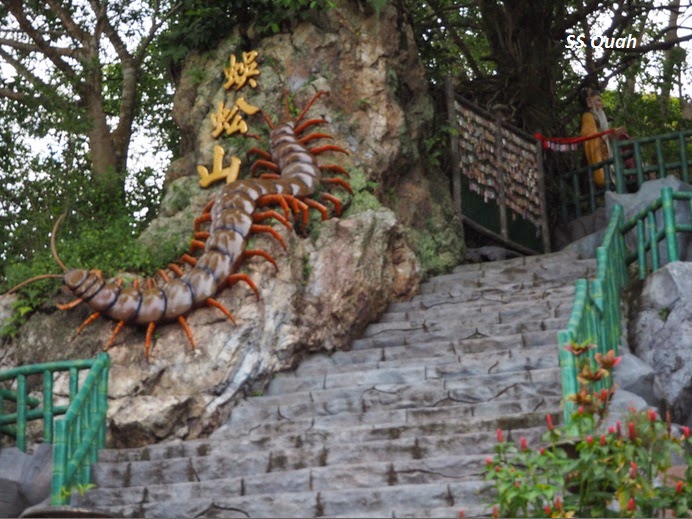
The next morning, my wife and I visited the Then Sze Koon temple on Centipede Hill in the Temiang area of the old Seremban town.

Possibly, a huge centipede had taken up residence in the hill a long time ago and that's how this creature lent its name to the place. Anyhow, we didn't see any live centipede there.

We spent quite some time there exploring the temple grounds and basically gawking at the life-sized statues of Chinese mythology figures.

After a hearty breakfast at the old Seremban market, we visited the IJMLand office in Seremban2 to meet with a few folks. They have a CSR project under development right now but I'm in no position to say anything else at the present moment. But trust me, this project is chess-related (ahha, now you know why I was in Seremban!) and it's going to be interesting.

The meeting over, we drove to their hill park for a breath-taking 360-degree view of the whole Seremban2 development. If you are unfit, it may take a little bit of effort to climb up to the highest point in the park but it would be quite worthwhile to look down below on the resident houses that dotted the foothills. The houses here were all beautifully designed and pretty impressive. Needless to say, so were their selling prices as IJMLand had targeted the development here for the high-end market.


I should also add that the hill park complemented the city park. One was on flatland with a picturesque lake as its central feature, the other was on a hill with an excellent good view of the whole Seremban2 township. Just climb on any of the six small pavillions there and you can see miles and miles of rolling country.

The hill park has no lake but it had something else: a realistic enough dinosaur park as an attraction. Small but educational, and it brought out the kid in me. When I was very much younger, dinosaurs had interested me a lot and I do remember visiting libraries to pour over their reference books on these long extinct creatures. I should also add that when Jurassic Park came out, I had made a beeline to watch the film in the local cinema.


Saturday, 3 January 2015

The Bellevue hotel up at Penang Hill


Um, so where was I on New Year's Eve? Oh yes, I was up at Penang Hill with my wife. This had been a trip that we had been looking at for quite a few years already but we never really had the chance to have an overnight stay there over a new year because the only hotel there, the Bellevue Hotel, was always fully booked whenever we inquired.

Possibly this was because we had asked the hotel's reception too close to the end of the year when other people had already made their bookings long ago. The Bellevue is only a small hotel with only 12 rooms and like everywhere else, reservations are always on a first-come basis.

This time, I had made my inquiries quite a while ago, possibly about six months back. I was mildly surprised that the hotel did not bother to ask for a booking fee in order to keep the room for us but seeing how the place is always full at the end of the year, I suppose the hotel is not afraid of any guest not turning up.

The Bellevue is actually an aged bungalow that had been converted into a hotel. The present building is about a hundred years old but the operations here started maybe 60 years or so ago.

The hotel had undergone considerable renovation about 18 months ago and the room we were allocated was modern, clean and very decently furnished. The beds and pillows were very firm and a joy to lie down and sleep. The whole hotel has no air-conditioning as the day-time is rather mild while the temperature at night could plunge to the low 20s. There is a stand fan, though. The bathroom was spacious but what we found missing were basic amenities like soap and bath gel. We inquired at the reception and was told proudly that the Bellevue was a detergent-free establishment. They boast of this water system where guests can bath, wash and clean effectively without using soap, shampoo or toothpaste. Moreover, the waste water discharged from the rooms are recycled and reused for watering the gardens.

I was told that the original building and its grounds - not more than 100 metres from the Penang Hill Railway's upper station - was once the residence of either a William or Thomas Halyburton who was the first (and possibly part-time) Sheriff of the Prince of Wales Island (Pulo Pinang). It dated back to the early 18th Century under the British East India Company, and the site was named Halliburton’s Hill.


The main attraction of the hotel is undoubtedly the terrace at the back of the building. It houses a modest restaurant (see note below) and guests can either choose to dine in the indoor section or the outdoor section.

My personal preference is to go outdoor where one can wander around the garden and look down at the breath-taking view of the city of George Town from the promontory till Ayer Itam. From left to right, the scene stretches from Tanjong Tokong to Glugor, where the two Penang bridges can be seen linking up the island and the mainland. The mainland is right across the stretch of water known as the Channel and on a clear day, even the faraway Kedah Peak can be seen. Of course, right ahead of us on the mainland is the Bukit Mertajam hill.

There used to be a snake coiled among the upper vines on the terrace of the outdoor dining area but on this trip, it wasn't there anymore. I asked the hotel staff what had happened to it and I got a sad reply.

About a year ago, the hotel was visited by some officials from the State Wildlife Department (Jabatan Perhilitan). Not only was the snake confiscated, the hotel was fined for keeping it. The slimy creature had been such a constant feature of the hotel in the past and to know that it is not there anymore was quite a letdown.

Still within the grounds of the hotel and looking down towards the city is an amphitheatre with a small geodesic dome. Have I mentioned before that the owner of the Bellevue was a good friend of Buckminster Fuller who popularised the construction of the geodesic dome in the later half of the 20th Century?

At the front of the grounds is a small Aviary and Garden, free for hotel guests to enter. There is a private collection of native and exotic birds - some of which were originally rescued from the illegal wildlife trade - including Pheasants (Argus, Peafowl, Crested Fireback), Parrots (Cockatoo, Eclectus, Macaw) and Pigeons (Nicobar, Crown, Pied Imperial). The botanical collection include rare and endangered Malaysian plants.

Okay, I was mentioning earlier about their modest restaurant. Let me say now that this hotel as a whole has a charming Old World character. When we checked into the Bellevue, we were informed by one of their staff that we could order coffee or tea there while enjoying the sights of the city below. However, he did warn us that the service could be slow. That, I already knew from one of my schoolmates who, not so long ago, was working for the owner of the Bellevue. During his two or three years at the company, he had tried to change the attitude of the staff there but it turned out to be an impossible task. My friend has since resigned.

But what I didn't expect was that slow was an understatement. After we had left our belongings in the room, we did got to the terrace, hoping to order some tea. We were there for about a half hour but nobody came to take orders. Oh well, we really didn't require the tea. We wanted more to wander around the garden than anytime else.

The next morning, we went back to the restaurant for breakfast. Our room package included breakfast, see, an English breakfast, actually, of coffee, bread, butter and jam, and complete with sausage and egg. We were told that the kitchen staff would come in only after 8.30 a.m. Unusually late for a hotel kitchen to start operating, but never mind again.

We sat down at our table at 8.40 a.m. and indicated to the restaurant staff that he could begin serving us breakfast. At nine o'clock, our jug of hot coffee arrived with a glass of orange juice. More waiting followed. Our coffee was getting cold. And then at 9.21 a.m., the rest of our breakfast arrived. Bread, sausage, eggs. All this while, we were one of only three parties at the restaurant. "Do you want more hot coffee?" the restaurant staff asked us politely. "Erm, no, thank you," I answered, "we are done, and we really want to go explore the Aviary now." And we beat a hasty retreat from the restaurant....

Yup, this Bellevue hotel has a character, all right!


Thursday, 1 January 2015

Firing in the new year


New year fireworks at Straits Quay in Tanjong Tokong, as viewed from the Bellevue Hotel up at Penang Hill.