Tuesday, 18 February 2014

The changing face of Mengkuang Dam


ALL IN THE NAME OF PROGRESS :-(

(May 2010)

(October 2012)

(May 2013)

(February 2014)
(Above photo by Tang Long Kin)

Compare all this progressive destruction with these pre-2008 pictures of the Mengkuang Dam. (Click above link to view)

Monday, 17 February 2014

The two Penang bridges


For a very long time, I have known that the Hotel Equatorial in Bukit Jambul, Penang, provides a very nice view of the south-eastern part of the island. When I was still working at JobStreet.com, the lower ground floor corridor of the hotel had always provided me with a brief escape from the job stress. But ever since I retired from this company more than four years ago, I haven't had many opportunities to return to this place. However, I always remember seeing the sprawling Bukit Jambul golf course below me whenever I walk along the corridor. In the far distance would be the Penang Bridge.

Just very recently, I had the occasion to visit this hotel again. Re-took in the view. But then, I realised suddenly that on my right, just after the Jerejak island, I could see the second Penang Bridge too. This actually makes the hotel very uniquely placed among all the hotels in the state. It has a good vantage point. In one fell swoop of the view, anyone could - on a clear day, of course - see both the first and second bridge linkages to the mainland.

The picture below will show you what I mean but unfortunately, the two bridges are simply too small to be noticed clearly. But just to let you know that they are there. P.S. If you cannot see the picture well in this story, just click on it and the picture will pop out.


Sunday, 16 February 2014

Snow moon


I wasn't particularly interested in taking a photograph of the first full moon of the Chinese New Year but then, it was shining brightly into my bedroom this morning at about seven o'clock. The western astronomers call it the Snow Moon or the Hunger Moon. Reason unknown to me! (Note: Mode handheld, Camera Fujifilm F500EXR, Shutter 1/40, Aperture f16, ISO 200, Image cropped)


Saturday, 15 February 2014

More on our particular Quah (柯) surname in Penang


Last November, I had written about the origins of our particular branch of the Quah (柯) surname in Penang. Yesterday at our annual Chap Goh Meh worship session, I was reminded that one of our Quah brethren, Chin Eng, had once researched and produced a short piece on the history of the Swee Cheok Tong Quah Kongsi (瑞鵲堂柯公司). This document was never circulated outside of the Kongsi's committee and before anyone else forgets about it again, it is fitting that I should reproduce it here (my own comments are in parentheses):
The Quah Kongsi has its origins from Hock Kian Seng (福建省), Chuan Chew Hoo (泉州府), Tang Uahn Kuan (同安縣), Chap Phaik Tor (十八都), Cheh Sian Li (積善裡), Leong Boon Poh (龍文保), Chan Tao Kak (田頭角), Tia Boay (鼎尾), Ow Quah Sia (後柯社).

Quah Lau Seong, the son of our clan leader Quah Soo Tee, from the village of origin in China, Ow Quah Sia, initiated an organisation called Hye Inn Tong (海印堂) and worshipped the deity, Poh Seng Tai Tay (積生大帝). Later on, clansmen from Ow Quah (後柯) and Goh Joo Quah (五裕柯) together donated money to buy real estate called Hye Inn Garden (海印園). The Swee Cheok Tong Quah Kongsi was established in the year 1805 by clansmen from Ow Quah and Goh Joo Quah.
(NOTE: There is a small anomaly here because the Kongsi's Rules and Regulations mentioned 1846 as the year of establishment of the Swee Cheok Tong during the reign of Emperor Toh Kong [Tao-kuang or Daoguang (道光帝)] in China. According to historical records, he reigned from 1820 to 1850.)
(UPDATE: The same Rules and Regulations of the Kongsi mentioned the Pia Gor year in the reign of Emperor Toh Kong. For a long while, I was puzzled by the term Pia Gor but I've just come to realise that my esteemed Kongsi predecessors in the Straits Settlements that had first drafted our Rules and Regulations in the last century could have referred to the Celestial Stem and Earth Branch of the traditional 60-year cyclical Chinese calendar [see the wikipedia entry for sexagenary cycle]. If so, then Pia Gor was their Hokkien way of writing Bing Wu [丙午] which would then place the year squarely as 1846.)
When our forebears came to the Nanyang to earn a living in the early part of the 19th Century, they brought along Poh Seng Tai Tay to worship in Penang and celebrated the deity's birthday on the 15th day of the third moon of the Chinese calendar. They bought properties in Penang and set up the Swee Cheok Tong Seh Quah Kongsi (檳城瑞鵲堂柯公司) here with the following objectives:
  1. To stimulate a feeling of sympathy and relationship among the clansmen of Quah and interest in the welfare of the Kongsi;
  2. To promote social interaction and to give an opportunity to all Quah clansmen to meet and discuss all points of interest relating to business transactions, etc;
  3. To promote the interest and welfare of the younger generation of Quah clansmen;
  4. To assist one another in a wedding or funeral among Quah clansmen as the case may be; and
  5. To promote the worship of Poh Seng Tai Tay that originated from Hye Inn Tong Temple, Tia Boay, Ow-Quah Sia, Hokkien, China, and worship memorial tablets (Sinchu) of Quah clansmen.
The Quah clansmen followed a cyclical series of 12 generation names: Chew (照), Choo (珠), Lai (來), Hoo (富), Seng (盛), Kee (奇), Chor (祖), Boo (武), Yu (於), Ban (萬), Soo (思), Lean (聯)
(NOTE 2: Definitely, these generation middle names have fallen into disuse within our Quah clansmen. As far as I know, none of my present Quah brethren has followed this naming convention for decades. It has stopped even with my own lineage, and my great-grandfather could have been the last of his kind to sport a generation name.)  


(UPDATE 2: Finally, this picture is of the plaque that is affixed above the main altar in our Swee Cheok Tong Kongsi House in Penang. While it proclaims Hye Inn Tong as the name of our private temple, similar to the original Hye Inn Tong in the Hock Kian Seng, it also signifies that the Hye Inn Tong was the original name of our Kongsi in Penang but because subsequently, we also accepted members from the Tong Su side of the same Ow-Quah clansmen, the enlarged Kongsi embraced the wider name of Swee Cheok Tong in 1941. The year inscribed on the plaque (15th year of the Republic of China, proclaimed on 1 January 1912) would refer to 1927.

(About 10 years ago, I was told by a Kongsi elder, now deceased, that some of the trustees and members were from outstation, living or working around Taiping and Bagan Serai, which were mainly populated by the Hokkien community, and they requested the Kongsi to spread its wings to northern Perak and establish the Hye Inn Tong of Taiping which was essentially a branch of the Penang Kongsi.)


Friday, 14 February 2014

Chap goh meh at Quah Kongsi


The Quah Kongsi had the first of this year's worship sessions this morning, on the 15th day of the first lunar month of the Year of the Horse, which is Chap Goh Meh. Normally, this would be the first occasion that the Quah clansmen would get to meet one another in the New Year after the last worship session at Tung Chik (winter solstice) in the previous year. We do the worship sessions five times in a year and as the president of the Kongsi, I will always make it a point to attend.

Other than meeting the usual committee members and trustees, there was this little surprise of bumping into new visitors that come visit the Kongsi House occasionally. They had come to pray to the Kongsi's resident deity, Tai Tay Eah, and also to the memorial tablets in the inner hall.


Thursday, 13 February 2014

The Dr Wu Lien-Teh Commemorative Symposium


There are about four weeks to go before the start of the Dr Wu Lien-Teh commemorative symposium in Penang. 

Although this three-day event should interest medical doctors (there will be a one-day international symposium, organised by the Penang Medical College, on Global Health Challenges: Infectious Diseases in the New Millennium, the activities on the other days should be of common interest to anyone who admires the work done by this Penang doctor at a time when plague was such a worldwide health scourge. 

As I have already written a lot about Dr Wu Lien-Teh in my blog, I won't be repeating his achievements here except to point you to this link.  But about the symposium itself, here is some of the information extracted from the Dr Wu Lien-Teh Society homepage:


THE DR WU LIEN-TEH COMMEMORATIVE SYMPOSIUM
George Town, Penang, Malaysia
Saturday 8th March 2014 to Monday 10th March 2014

Persatuan Dr Wu Lien-Teh, Pulau Pinang
The Dr Wu Lien-Teh Society, Penang
槟城伍连德学会
(Registration No: NSID 032-27122012)

For more information, write to:
Secretary-General, The Dr Wu Lien-Teh Society, Penang
Email: wulientehsociety@gmail.com

Click here to download the Symposium_Participation_form 

Tentative Programme

Saturday (8th March)
Guest Arrivals
7.00pm: Welcoming Dinner by The Dr Wu Lien-Teh Society and Dr Wu Lien-Teh family reunion

Sunday (9th March)
9.00am to 1.00pm: Tour-The Dr Wu Lien-Teh Historic Trail
2:00 pm: Unveiling of the Dr Wu Lien-Teh bronze bust and memorial
3.30pm to 5.00pm: The Inaugural Dr Wu Lien-Teh Lecture by Professor Dr Anthony Capon, Director of the Institute of Global Health, United Nations University (UNU-IIGH), Malaysia
7.30pm: Official State Government of Penang Dinner (by invitation)

Monday (10th March)
8.30am to 2.00pm: International Symposium on Global Health Challenges-Infectious Diseases in the New Millennium. (Penang Medical College)

Speakers include the following:
  • Professor Richard Loh Li-Cher, Penang Medical College
  • Professor Ooi Eng Eong, Deputy Director, Emerging Infectious Deceases Programme, Duke-National University of Singapore, Graduate School/Medical School, Singapore
  • Dr Stan Fenwick, RESPOND, USAID Project, Bangkok, Thailand
  • Dr Alex Ooi, Hon Secretary of the Dr Wu Lien-Teh Society

Arrival of guests and registration     8.30am – 9.00am
Welcome address by President of PMC     9.00am – 9.15am
Opening speech and officiating of the inaugural WLT symposium by the representative of the Minister of Health     9.15am – 9.30am
Dr Alex KH Ooi – The Legacy of WLT     9.30am – 9.45am
Tea break     9.45am – 10.15am
Prof Stan Fenwick – a Short History of Animal-Associated Epidemics Zoonoses and human disease 10.15am – 11.30am
Prof Richard Loh – Tuberculosis- Still a scourge of mankind     11.30am – 12.15pm
Professor Ooi Eng Eong - Dengue prevention and the elusive sustainable solution     12.15pm – 1.00pm
Close of symposium     1.00pm - 1.10pm
Lunch     1.10pm – 2.00pm

FOR FURTHER INFORMATION. PLEASE CONTACT THE FOLLOWING:

FOR OVERALL EVENT
  • Mr Foo Yu Keong, Penang Global Tourism (Phone:  +6012-455 0074  Fax: +604-264 3455 Email: yukeong@penangglobaltourism.com)
  • Mr Clement Liang, Penang Heritage Trust (Phone: +6016-417 5258/ +604-264 2631  Fax: +604-262 8421 Email: clement@pht.org.my)

FOR INAUGURAL LECTURE

  • Ms Ong Siou Wuon, Penang Institute (Phone: +6012-733 4845/ +604-228 3306  Fax: +604-226 7042 Email: siouwoon.ong@penanginstitute.org)

FOR MONDAY 10th MARCH SYMPOSIUM
  • Prof Dr Rashid Khim, Head of Department of Public Health, Penang Medical College (Phone:  +604-226 3459  Fax: +604-228 4285 Email: rashid@gmc.edu.my)

FOR GENERAL SOCIETY MATTERS
  • Dato’ Anwar Fazal, President, The Dr Wu Lien-Teh Society (Phone:  +604-229 0497  Fax: +604-657 2655 Email: anwar.fazal@yahoo.com)
  • Dr Alex Ooi, Secretary General, The Dr Wu Lien-Teh Society (Phone: +65-96285011/ +65-67388331  Fax: +65-67348896 Email: dralexooi@gmail.com)

REGISTRATION
Please scan and send your completed application form and banking slip and to wulientehsociety@gmail.com. The closing date for registration is 28 February 2014

REGISTRATION FEES
A registration fee is payable as below and it will cover the Heritage Tour, the Welcome Dinner, Inaugural Lecture, Bust Unveiling Ceremony and International Symposium (including lunch).

  • International participants: RM250 (including meals and transfers between venues but no airport transfers)
  • Penang participants: RM150

All payments should be made as follows:
  • Enclose a cheque/cash/electronic receipt made to “The Dr Wu Lien-Teh Society, Penang”
  • Those who wish to pay electronically can pay to CIMB Bank A/C No: 0715-0006509-058. Swiftcode: CIBBMYKL (for overseas banking transfer)
  • Please send postal payments to the following address: Secretary-General, The Dr Wu Lien-Teh Society Penang, c/o Penang Heritage Trust, 26 Lebuh Gereja, 10200 George Town, Penang, Malaysia.

PARTICIPATING ORGANISATIONS

Please email wulientehsociety@gmail.com to obtain further information on participation.


Wednesday, 12 February 2014

Fire them, don't hire them


For quite some time now, I've had the #BetterPenang app installed on my iPad2. This is an application that's also available to Android users, and what it does is that it opens an avenue to make complaints, suggestions and ideas to both the Penang Island Municipal Council (MPPP) and the Province Wellesley Municipal Council (MPSP). The app was developed by volunteers but has the support from both the local councils.

Until about eight, nine or 10 days ago, I've never used it to lodge any complaint with the local councils. That changed about a week before the Chinese New Year holidays when I noticed that the drain along my road was chockful of brown leaves and there was even empty drink cans that had been discarded by irresponsible visitors to the neighbourhood.

When a week passed by without any sign of anyone coming to clear the drain, my wife asked me to make a complaint to the MPSP. And that was how I decided to give the #BetterPenang app a second look.

My complaint was posted to #BetterPenang right after the Chinese New Year but several days passed without any action taken. Thereupon, I made a second complaint as a follow-up to the first one.

I was wondering as to the effectiveness of this app when on the seventh of February, I noticed two workers from MPSP walking along the length of the road and digging into the drain. So now I know that the local councils actually do respond to the feedback through this app.

But I was curious. Why did the council respond so late to my complaint and indeed, after only two complaints were made? I went up to one of them to ask, but of course, after thanking him first. "Thanks a lot, bro, for clearing the rubbish from the drain. How often do you all do this kind of thing?" An innocent but loaded question.

"Actually," he said, "this isn't my job at all. I'm here as a back-up only. Somebody had complained and because the contractor had not responded, my boss at the MPSP asked us to look into it as quickly as possible."

Which again begged another question: if this job has indeed been sub-contracted out to a contractor and he is not doing his job, what is the MPSP doing about it? It is not only a matter of clearing the drains which I know, definitely, have not been cleared for a very long time but also a matter of sweeping the road where I stay on a regular basis. I know for sure that I hardly ever notice any sweeper along Lorong Jernih 4. A once-a-week sweep of the roads is not enough. Should be done daily, not weekly. And the MPSP should demand that their contracted workers all do their jobs properly. If not, sack them, terminate the contract, whatever. Give this job to some other companies that are hungrier.


Tuesday, 11 February 2014

CNY2014 Day 3: Kuan Im Temple


This was more than just a normal day at the Kong Hock Keong (Kuan Im Temple) in Pitt Street, George Town. This was the third day of this year's Chinese New Year in Penang. 

However, it was rather strange that for the first time in my memory, devotees were not allowed to bring their joss sticks into the temple. All prayers had to be done outside.

There are both good and bad points about this new practice. The good, of course, is that the cleanliness of the interior is very much improved -- no smoky incense inside a confined space to burn your eyes, no risk of being poked with someone's burning joss stick because he did not hold them above his head -- but the bad must be the horrible makeshift shed right in front of the main door. It is totally out of place with the heritage value of the 200-years-old temple which was established in 1800.


The vagabonds, tramps, beggars, homeless people -- call them what you want -- are almost permanent squatters at the temple during the day and more would turn up during the Chinese festive periods such as the Chinese New Year. They'd be here to await the generosity of some devotees who would distribute angpow or foodstuff. Surprisingly, they would form an orderly queue whenever necessary and so, they are not totally without reason. Between such hand-outs, they would hang out on both sides of the main door, as can be seen from the picture above. You'd also notice the two signs on the gate which warn devotees against bringing their joss sticks inside. 


So what are the devotees to do? Pray in the courtyard outside the temple. You want to kneel down while you pray? There are two rows of dusty wooden platforms for that purpose. If the authorities can bring in foreign artisans to repair, renovate and spruce up the temple, why can't they build a reasonably traditional Chinese pavillion instead of the makeshift metal shed? The whole structure is such an eyesore. There's a long altar table set up with their five aluminium urns. I am rather sad that for a temple that is so steeped with history, the temple authorities - meaning the temple trustees - had not even bothered to source for some traditional-looking altar table or urns.  An in the meantime too, the temple authorities would rather prefer the devotees to be exposed to the elements while they pray.


Back to the issue of the temple authorities and their resident vagabonds. If the authorities can be so strict with the devotees' practices, why can't they impose simple regulations on the vagabonds as well? I am sure the vagabonds are not without self-respect that they cannot be told to observe cleanliness in the temple's compound. It was quite obvious to me that these empty angpow packets had been discarded by them. What does it take for the temple authorities to ask these people not to litter?


See what I mean? The inner and outer halls of the temple are clean and bright, but the main courtyard is in such a big mess. What an uneven use of priorities.


At least, the small joss stick stalls beside Stewart Lane had been left alone when the Kong Hock Keong underwent repairs and renovation work last year. These stalls have been here for decades and I hope they will continue operating here for yet some time to come.


Monday, 10 February 2014

Venus in February 2014, part two


Two more photos of Venus, but this time in today's morning sky. The planet looks so much brighter than last weekend's. 


Sunday, 9 February 2014

Team work


Where I am concerned, the Chinese New Year celebrations are over. It ends for me today with the return of my son to the island. His studies continue and the new semester starts tomorrow. But with him around the house for the past two weeks or so, and with my daughter also at home from Kuala Lumpur for a week's break, it was really the best Chinese New Year present that my wife and I could ever had from them.

We were all together as a team from the moment that my daughter had arrived home. We all pitched in together to get things done around the house and also out of the house. Picture this:

On Chinese New Year's eve, the children helped their mother with the cooking. But in the morning, I helped them wash and clean the two cars. Then when it came to scrubbing the porch floor, they volunteered to do it by themselves. They went down on their knees to clean each and every inch of the porch.

There was a mini-crisis in the late afternoon when a picture frame came crashing down and the glass pane smashed to pieces. The children went about to look for the glass pieces and swept the whole of the living room thoroughly to remove them. I followed up with mopping the whole of the house.

We all did our fair share of cooking. My son contributed his skills to cook spaghetti with my wife on two days while my daughter helped me with my hokkien char. She also chipped in to assist with the preparation of the Chef Dad's chicken pie. My wife's pie filling was fantabulous!!

We didn't do much visiting this year. We didn't visit any relatives at all. In fact, the only external activities we planned together were to see the Robocop movie at the Sunway Carnival Mall, and visits to the Nandaka Vihara at the foothills of the Bukit Mertajam hill on the second day of the New Year, and to the Triple Wisdom Gem Temple in Pangkor Road and the Kuan Im Temple in Pitt Street on the third day.

Apart from that, since we were already out on the island, we decided to enjoy ourselves at the George Town Chinese New Year heritage celebration.

I should also mention that on the second day of the New Year, we took the opportunity to clear out all the clothes from their deceased grand-aunt's cupboard. They participated and had a lot of fun remembering their grand-aunt. All the good memories of their grand-aunt's love for them, all from just folding up her old clothes. I shall be taking these clothes to an Old Folks' Home later.

This about summed up our activities as a complete family. It was priceless....


Saturday, 8 February 2014

Chiao pai divination


All public Chinese temples will have at least two or three of them. Private Chinese temples, for example, those belonging to the clan associations, will normally have at least one too. I'm referring to those wooden chiao pai pieces that are used to interpret what deities say.

The chiao pai pieces always come in pairs, and are usually painted red although through time and usage, the colour may have worn off to expose the wood beneath the paint. One side is flat and the other is rounded, and when you fit both pieces together on their flat side, you get an oval.

Using them is simplicity itself. After a worshipper makes a request from a deity and needs an answer, the chiao pai pieces are clasped together with both hands and then allowed to fall to the ground. How the pieces end up will determine the deity's decision.

If the flat surfaces turn up together, or if the rounded surfaces turn up together too, it means that the deity's answer is not favourable to you. The combination you want is to have one flat side and one rounded side turn up on the floor. That would mean that the deity has said "yes" to whatever you prayed for.

Of course, you may recognise this process as simply the outcome of probability, the same as when two coins are thrown together. Given that there are only two sides to a piece of the chiao pai, it is a 50 percent chance that a flat-rounded combination will happen or not happen. But let me tell you, this Chinese divination method has more to it than meets the eye.

Away from the temples, a similar method of determining decisions is also employed when we Chinese pray to our ancestors. Most times, it is at the graveyards or cemeteries but sometimes, it is at home too. But instead of the wooden chiao pai blocks, two coins are used. A head and a tail combination appearing would mean the ancestors acquiescing to your questions.

And here's the interesting part. About four or five days before the Chinese New Year, it is my family's tradition to remember my grandparents and parents by praying to them at home. We would set up a table in front of the main door, lay out the fruits and a temporary urn for the joss sticks, and in the morning invite the ancestors' spirits to partake in this vegetarian offering. In order to determine whether they had arrived or whether they had finished eating, we would throw the two coins into the air and see the outcome.

Where this year was concerned, the job fell onto me to ask my grandparents, parents and aunt whether they had arrived. I threw the coins. They fell down with both tails up. I waited a while and threw the coins again. This time, both heads fell up. Undaunted, I tried a third time. Two heads again.

Now, what are the chances of that happening? Three throws and no head-tail combination? So I told my wife to try. Perhaps the ancestors were waiting for her to ask. She threw the coins into the air and they came down .... two tails. Weird. Four times out of four with no luck.

Then I remembered. I asked her whether she had prayed to the Door Spirits earlier? I know that I did not. All I had prayed to was to the Earth God to say that I wished to invite my ancestors' spirits home. She quickly lit some joss sticks and told the Door Spirits that we needed the ancestors to come in. The moment she did just that, I threw the coins and they came down head and tail. Finally. Just like that!

Sometimes, even if you don't want to believe it, you have to. You may feel sceptical over the whole practice but there are still things that cannot be fingered properly.

Oh, by the way, when it came to asking the ancestors subsequently whether they had finished enjoying the fruits which we had placed before them, I didn't get any problem at all. Head-tail or tail-head, no problem at all.


Friday, 7 February 2014

Venus in February 2014


I told my wife that I would like to go out for a walk around the neighbourhood again this morning. Still relatively dark outside but the air was wonderfully cool and crisp. Birds were chirping away all around me, as well as the screams of the cicadas filling the air.

I rounded the corner and was greeted by a tiny bright spot of light in the still-dark sky. Venus, the morning star. Brighter than any object in the sky. And yet, unblinking. Luckily, I had the presence of mind to whip out my mobile phone and try to take a picture. My only apprehension was whether the camera's resolution was fine enough not to make a muck out of my effort. Luckily, the shot came out well. Better than my expectation.


About a minute later, I rounded another corner. Noticed that the spot of light was still lingering up there. But by now, the sky was getting a bit brighter. Nevertheless, can't miss this second photo opportunity and so, here goes...


Took me about five more minutes before I could walk back to my original position: the place where I took the first picture. I looked upwards to the same direction of the sky but by now, Venus had disappeared. Completely obliterated in the brightening sky.What's left is tomorrow morning....


Thursday, 6 February 2014

Penang nyonya lam mee


This morning when I was walking around the neighbourhood, enjoying the crisp cool air, a small pang of nostalgia overcame me. 

Today would be the seventh day of the Chinese New Year and by tradition, my family members would gather to celebrate the birthday of the human race with a plate of Penang's Nyonya Lam Mee. Unfortunately, my aunt was no longer around to do the cooking.

I decided to cut short my walk and go to the market instead. My resolve was to try and reproduce her Nyonya Lam Mee, so that we could sit down and continue with this tradition for the evening's meal, with or without my aunt.

But my problem was, I was practically a newbie when it comes to cooking with hardly five dishes that I can claim to have cooked. Nyonya Lam Mee was definitely not one of them. So, not knowing where or how to start or begin, I had to turn to the Internet for recipes. Luckily, there were loads of them. I just tried to follow one and improvise.

If I may say so myself, I believe that I may have surpassed myself with my version of the Nyonya Lam Mee. My wife and son liked it very much. I'm sure that if my daughter had not gone back to Kuala Lumpur yesterday, she would have loved it too.  But I've already promised to cook it for her when she's back in Penang next.

So what did I buy from the market? First, about RM8 worth of medium-sized prawns from the fishmonger. But don't ask me how much they weighed. Then two strips of pork ribs from the butcher. This, I know came up to 550 grammes. Next, a stalk of Chai Sim vegetables and a big bag of bean sprouts. Finally, I didn't forget to pick up a bag of the all-important yellow noodles. What is Nyonya Lam Mee without the yellow Hokkien noodles, right?? The other ingredients, I already have at home.

Preparation took quite a while. I took quite a while to remove the shells from the prawns and then de-vein them. I think that was one of the slowest part of the whole process. Doing that, as well as nipping off the roots from each and every bean sprout. According to my wife, my aunt usually went one step further by breaking off the top of the bean sprouts too, but that's going a wee too far in my books. Getting the shallots ready for the frying pan was also quite time consuming but not as frustratingly long. Apart from that, I had to clean and chop the Chai Sim into smaller pieces.

To prepare the soup stock, I blanched the pork ribs for about a minute or two in a pot of boiling water, then I cooked the prawns in the same pot for about three minutes or four, before returning the pork ribs into the pot and let everything boil slowly for about 40 minutes. In the meantime, I had fried the shallots and then made a thin egg omelet which I then rolled up and cut into very thin slices.

Come closer to dinner time, I brought another bowl of water to the boil and then blanched three portions of the yellow noodles for about one minute. Removed the noodles from the pot and then laid them down on a big plate. I covered the noodles with the Chai Sim and bean sprouts, and then threw the huge chunks of pork ribs (my son called them macho chunks), prawns and sliced egg on the vegetables. Finally, I poured all the soup stock into the big plate and voila! Dinner is ready. All that remained to be brought out was the sambal belachan from the refrigerator, and my meal would be complete.


Tuesday, 4 February 2014

Standing an egg upright


I didn't quite expect it to happen but it did! There is this story going around that eggs would be able to stand upright on the day of Li Chun (立春), the fourth of February, which, according to Chinese astrology, signifies the beginning of Spring. My scepticism got the better of me and I went down to the kitchen and try it out for myself. Well, believe it or not, this was what happened....


BM midnight fire


I was at the Kampong Baharu market this morning. Needed to have my cup of coffee. No place to sit alone, so I went to share a table with two other senior citizens. They were busily talking. And very excitedly too.

It seemed that in the early hours of the morning, a big fire had broken out in the middle of the Bukit Mertajam old town centre. I didn't join in the conversation much but I got to know that the fire was serious enough. "Where was the fire," I asked one of them. "The market place," he told me. "You mean the one opposite the Tua Pek Kong temple?" I asked again. He nodded.

 (This picture from facebook of Ng Choong Huah)

According to him, the whole of the old wet market along Jalan Pasar has been razed. He had gone to look at it himself. The roads were totally impassable. The fire brigade was still on standby. They weren't sure how the blaze had started but the suspicion was that it could have been a short-circuit from the GSL supermarket which was housed on the upper floor of a double-storey building. The big problem was that the wet market behind it had extended into the ground floor.

(This picture from facebook of Jonah William Scully)

This GSL supermarket has been around for a very long time, perhaps like some 40 years ago. I remember that it used to be called BM Supermarket, the very first department store to be opened in this town. Used to be very crowded then, especially during the run-up to the festive seasons, but not in recent years when big shopping malls have eclipsed its usefulness. I think that I might have last climbed its front steps in early 2000.   

The supermarket in its pre-fire days. (This picture from facebook of Tang Hooi Theng)


Saturday, 25 January 2014

Marching towards the Bicentenary


My schoolmates and I were among the last of the lucky batches of new student intakes when we entered the Penang Free School in January of 1966.

Although meeting up with old friends from my Westlands primary school days was probably topmost in my mind, there were also new friendships to forge with other Form One pupils that had entered Free School from the Wellesley, Francis Light and Hutchings primary schools. Probably Pykett as well.

We always knew that the Penang Free School was then the premier secondary school in the country and there was a huge tradition behind it. We had a big responsibility before us. Big shoes to fill. All the expectations. We knew we had to study hard and play hard too.
But until months later, there was nothing to prepare us for the fact that the Free School had a very long, illustrious history and it was going to celebrate its 150th anniversary in October. However, the Form One classes being in the afternoon, I don't remember much about the excitement building up.

But yes, I came to realise the significance of the anniversary soon enough when old Captain Tan Boon Soon, then the afternoon supervisor, brought forth a new word to roll around our tongues: Sesquicentenary, a word meaning 150th anniversary. And we - my schoolmates and I - would be part of an historical celebration.

Back then we couldn't envision as much but 50 years down the road from the Sesquicentenary, we would get to celebrate the school's Bicentenary too.

So do you understand why I say we were among the luckiest batches of new students in 1966? If we had joined the school one year later - and it was a great possibility if I had not been in an express class in Standard Two at Westlands School - I would probably enter the Free School in 1967 and missed the Sesquicentenary celebrations altogether.

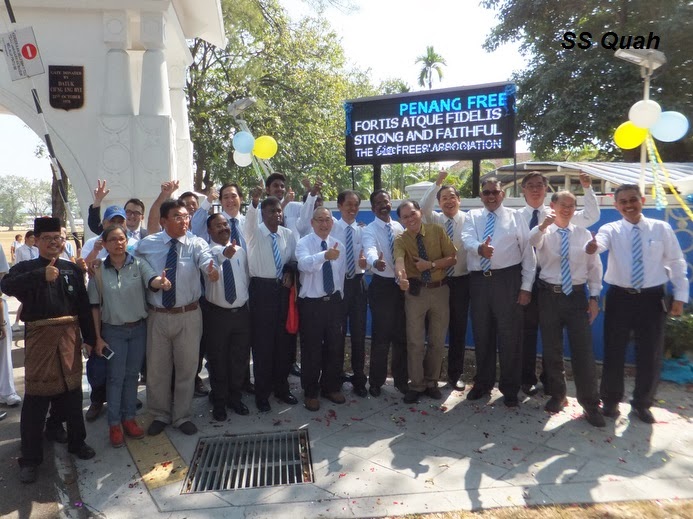
Well, the 25th of January 2014 marked exactly the 1,000th day before our alma mater, the Penang Free School, would celebrate this very occasion - the Bicentenary - on 21 October 2016. Friends and other fellow Old Frees around the globe, are you ready for this Big Day?

To mark this remarkable occasion, a digital countdown counter was unveiled by the Bicentenary Committee chairman Abdul Rafique bin Abdul Karim. Anyone visiting the school today surely will not miss this prominent signage on the right wall beside the main entrance.

Apart from representatives from the school's Board of Governors, PFS Foundation, Parents-Teachers Association, headmaster, prefects and a few students, other guests that turned up for this special unveiling included members of The Old Frees' Association and representatives from both the Old Frees' Association Kuala Lumpur and Selangor and The Old Frees' Association Singapore.

It was very assuring to see that there was still a lot of pride in our being associated with this school, borne out by the boisterous singing of the School Rally outside the school gate. It was all rather spontaneous and I am sure that we had startled passing motorists who would have wondered what was happening.


Passionate support for an education institution that's even older than the state of Singapore itself.


Wednesday, 22 January 2014

Old and new friends


My wife and I had a marvelous time catching up with some old and new friends at a small dinner at The Old Frees' Association Restaurant last night.

Alan Phang had just arrived in Penang from Singapore, where he had been on transit from Christchurch. He was a former committee member of the Penang Chess Association in the mid-1990s but had uprooted his family from the country to migrate to New Zealand. Somehow, he was one of the few chess fellas that I had kept in touch with successfuly. When we went to the South Island for a short holiday in 2010, he spent a day to show us around the earthquake-stricken Christchurch.

How are the redevelopment efforts coming along in the city, I asked him last night. Bad and slow, he said. That part of Christchurch which he had taken us to has disappeared too. The area's been filled with cranes and construction material as the city authorities are taking the opportunity to tear up the whole of the devastated area and rebuilding the central buisness district. Effectively, their heritage is lost forever. Very sad....

Alan arrived for dinner with his former colleague at Hewlett-Packard, Leong Wooi Kit, who came with his wife. This was the first time we met in person, although we had been corresponding by email some time ago when he wanted some tips on visiting Christchurch for a golfing holiday.

My last guests at dinner were Yeap Leong Teik and Anna. Leong Teik and I both go back a long way to our teenaged years as classmates in the Penang Free School. He's now a true-blue Singaporean citizen but he is keeping his Penang roots very firm. As such, he returns here quite regularly. We managed to catch up over old times last night.


Joey Yap's Penang seminar


My wife and I attended the Joey Yap seminar on fengshui and astrology at the Hotel Equatorial in Bukit Jambul, Penang on Sunday. I would estimate a sell-out crowd of at least 2,000 people.

Apart from Yap's sessions, the counters selling his books and fengshui courses were enjoying fantastically booming business! In particular, I found many people milling around his range of new works on the Qi Men Dun Jia (奇門遁甲) (Mystical Doors) and some even buying the whole set of books on the subject!

Prior to attending this seminar, we had already promised one another not to buy another of his books because we simply don't have time to read them! And yet, I guess the temptation was too much for her as she came away stealthily with a book and a software. As I don't have the time to install the software yet, I don't know what it is all about....


Finally, I managed to get Joey Yap to sign on my well-thumbed copy of the 10,000-Year Calendar book. I had meant to get this signed by him several years back but always, it had slipped my mind. Not this year, though. I made it a point to keep the book in the car so that I could slip into my backpack on the day of the event.

We then lined up quickly to have our picture taken after the book was signed. But one of his staff was even quicker and managed to catch us off-guard as we waited for this chap to use our camera.